Publication: Kew Bull. 28: 437 1973 publ. 1974
Description
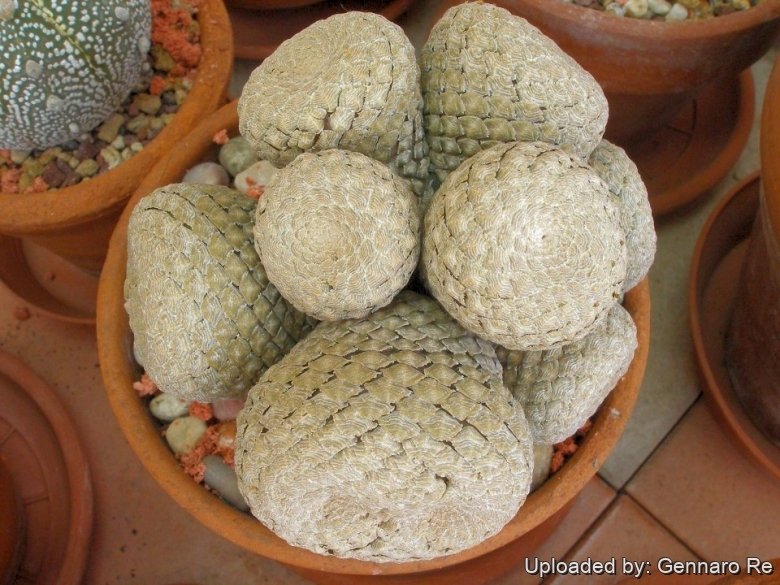
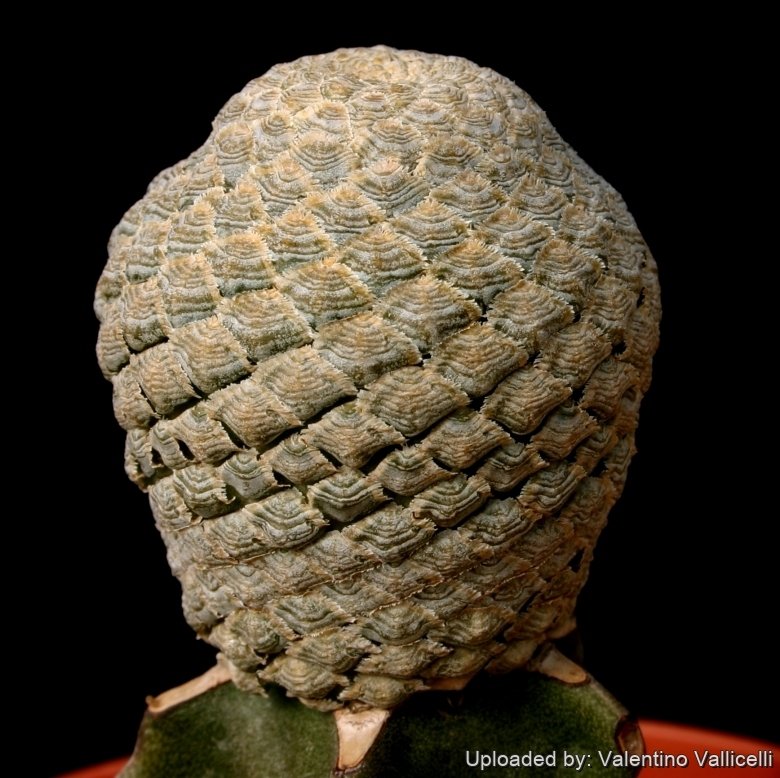
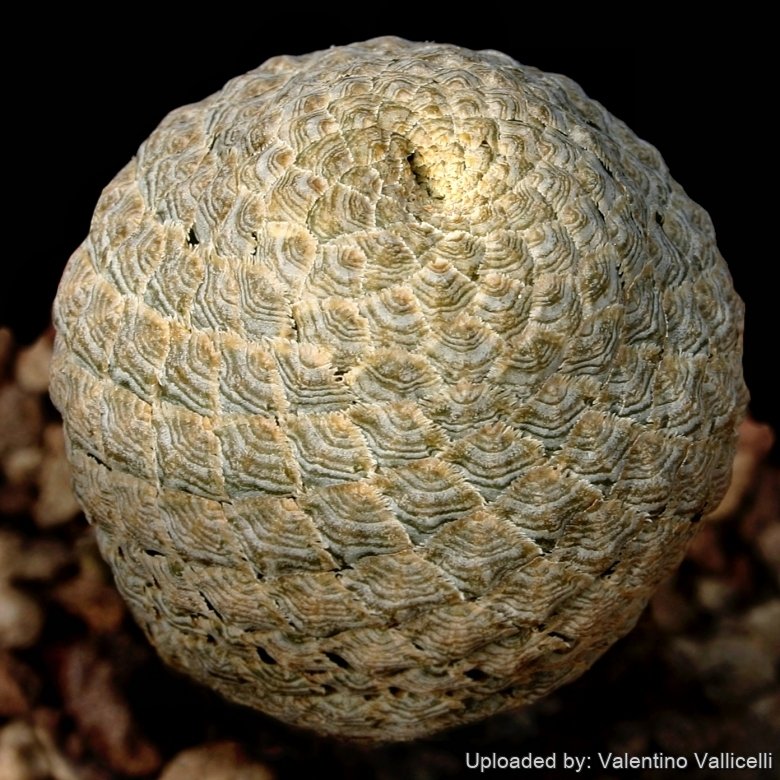
Euphorbia piscidermis (a.k.a. Fish Skin Euphorbia) is an attractive dwarf succulent Euphorbia covered with characteristic “fish-scales” that looks something like a small golf ball, no one would suspect it of being a Euphorbia when it is not in flower. E. piscidermis has a very unique look and is amongst the most desirable of all collectors’ plants.
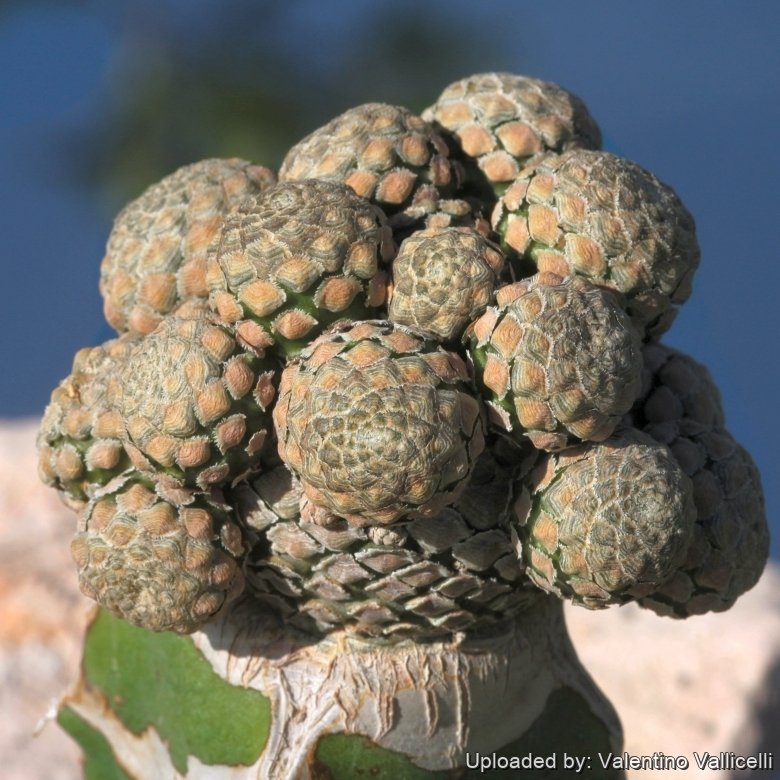
Habit: Usually unbranched it can eventually slowly branch dichotomously when very old. Multiple branches may also been produced when the apex is damaged.
Roors: Fibrous.
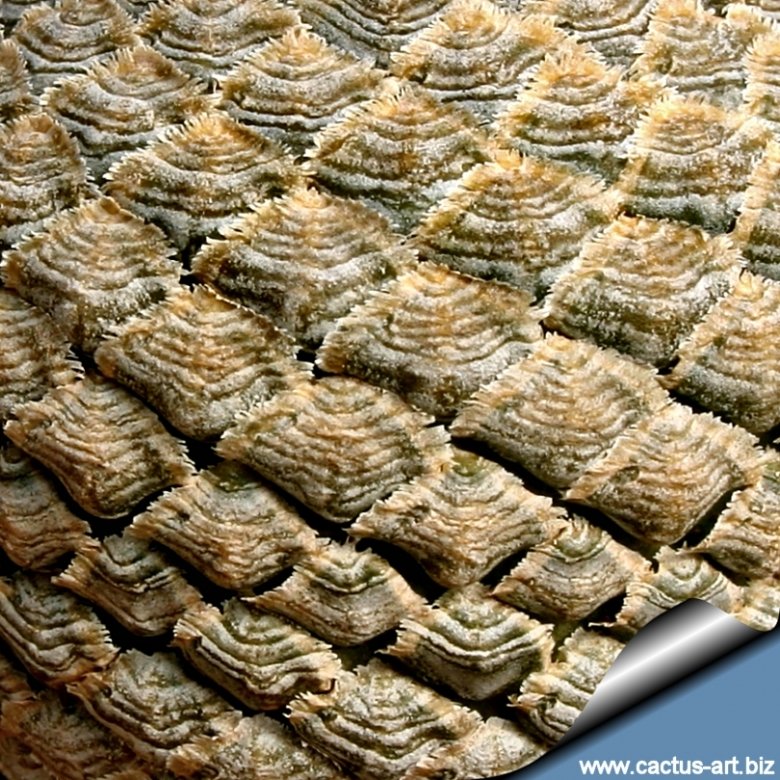
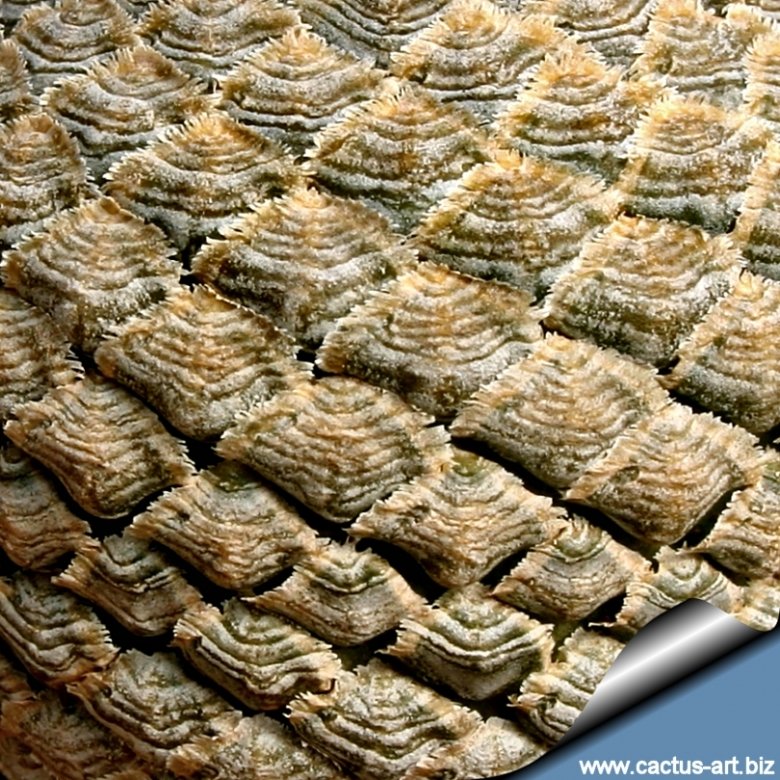
Stem: Subglobose, up to 12 cm tall, 7 cm in diameter, closely covered by imbricate (spirally arranged) paste-white fish-scale like appendages that are truncate tubercles with the upper margins produced upwards and fringed. This “scales” in about 13 overlapping spiral series.
Leaves: Obsolete.
Spines: Not present.
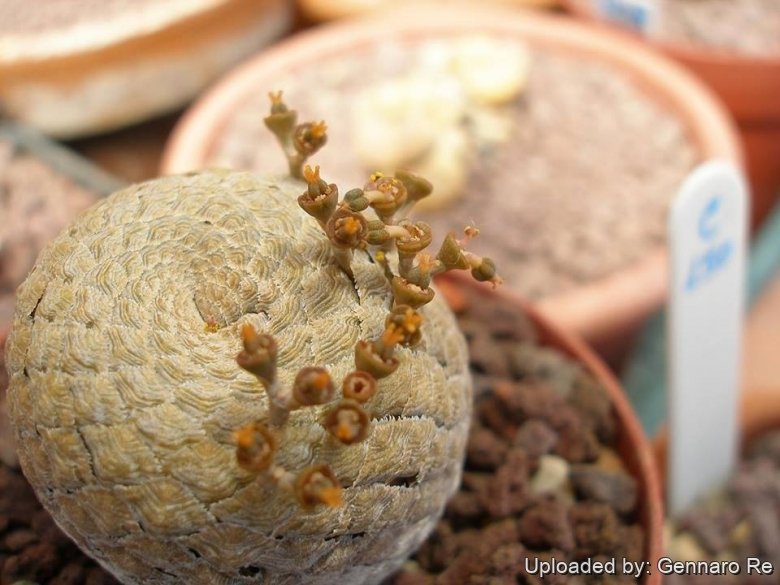
Inflorescence: Solitary cymes produced in a ring near the stem top, solitary, simple, peduncles to 1 cm.
Flowers: Cyathia 2-3 mm in diameter, nectar glands 4-5 on the central male Cythium, oblong, just touching.
Fruits: Obtusely lobed, 2,6 mm broad, exserted with peduncle recurved;.
Seeds: Ovoid, rugose.
Origin and Habitat
It is native to Ethiopia (Ogaden, Harerge Prov.)
Altitude: 1000-1050 metres above sea level.
Ecology: Grows in a very open deciduous bushland with main cover of low shrublets belonging to the Acanthaceae and Labiatae on stony limestone ridges. The plant is restricted to two very local patches.
Cultivation and Propagation
The “Fish Skin Euphorbia” is a difficult species to grow on its own roots and is usually grafted for convenience on Euphorbia canariensis, Euphorbia ingens or Euphorbia resinifera but it can be easily degrafted by those who wish to try to grow them on their own roots. If you remove an offset, remember to let it dry for a week or so, letting the wound heal (cutting planted to soon easily rot before they can grow roots). It is better to wash the cut to remove the latex. They grow well in a very draining mineral potting substrate.
Growth rate: Euphorbia piscidermis on its own roots, it is very slow growing.
Frost Tolerance: Need frost protection. Recommended minimum temperature is 12 °C or even above.
Sun Exposure: Light shade.
Propagation: Grafting, cuttings or seeds. It is propagated from seed sown during spring or summer. Germination occurs within 3 weeks a small globular plant emerges and keeps the shell on top for 2 or 3 months, but removing the shell right away is a recipe for failure. Usually when these plants finally shed the seed shell, the first cotyledons appear, with growth starting between them as is normal in plants. Sowing seed of this self fertile species is the surest method of growing typical offspring and seedlings are in the first season relatively easy to grow.
The plants that are grafted on a more vigorous and easier stocks are easier to keep, grow faster and produce more flowers and seeds. The method of grafting euphorbias differs little from that of other succulents, except in one important aspect. The latex must be washed or sprayed off until hardly anything remains. After the latex flow has stopped, a further 1-2 mm slice can be taken from both surfaces without a new latex flow starting. Both scion and stock need to be at the start of the growing season. The stock should be cut as near as possible to the growing tip, as here the vascular bundles are dense and not yet woody and will feed the scion in the best possible way. Where possible stock and scion should be of similar diameter. The cut surfaces are held together with elastic bands in cross style, over the plant top and under the pot. The plants should be left in an airy and shady place for 7-10 days before the bands are removed.
Warning: As with all other Euphorbias when a plant get damaged it exudes a thick white milky sap known as latex. This latex is poisonous and particularly dangerous for the eyes, skin and mucous membranes. So pay extreme attention not to get any in your eyes or mouth. Cultivated plants must be handled carefully.
Notes
It is a highly specialized succulent whose affinities are uncertain ( Euphorbia turbiniformis, Euphorbia horwoodii ). The nearest is Euphorbia gymnocalycioides.
The stem is closely shingled with scale-like appendages. (The name ‘piscidermis’ comes from the Latin for ‘fish-skin’, refering to the scale-covered skin) such scales being otherwise unknown in the genus Euphorbia.
Bibliography
Major references and further lectures
-
Urs Eggli “Illustrated Handbook of Succulent Plants: Dicotyledons” Springer, 2001
-
«Euphorbia piscidermis». Conservatorio y Jardín Botánico de Ginebra: Flora africana. http://www.ville-ge.ch/musinfo/bd/cjb/africa/details.php?langue=an&id=106539 retrieved on 17/Sep/2013
Cultivars and forms (1)
Forms (1)
Gallery