Publication: Cent. Euphorb. 25. 1860
Description
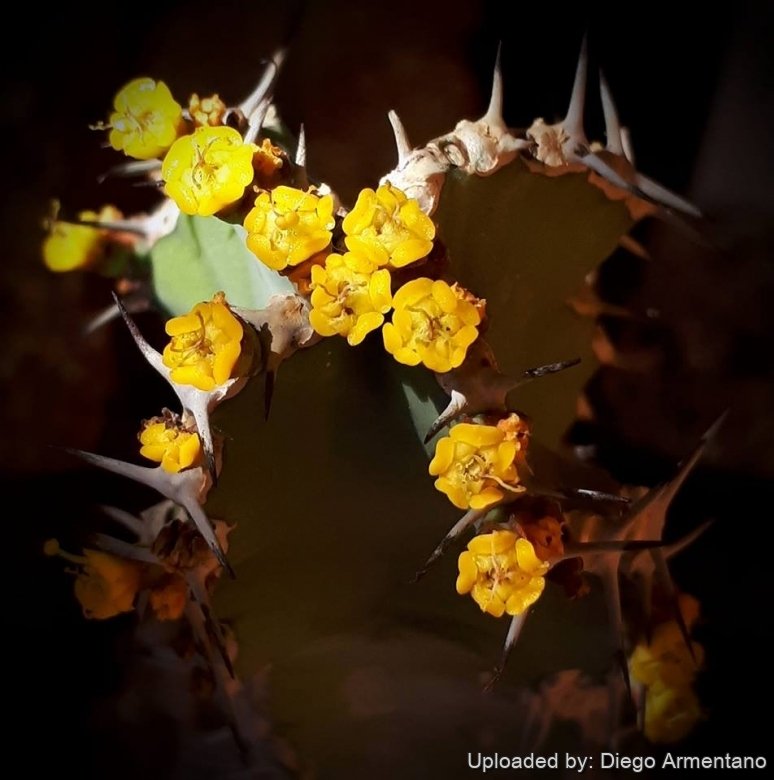
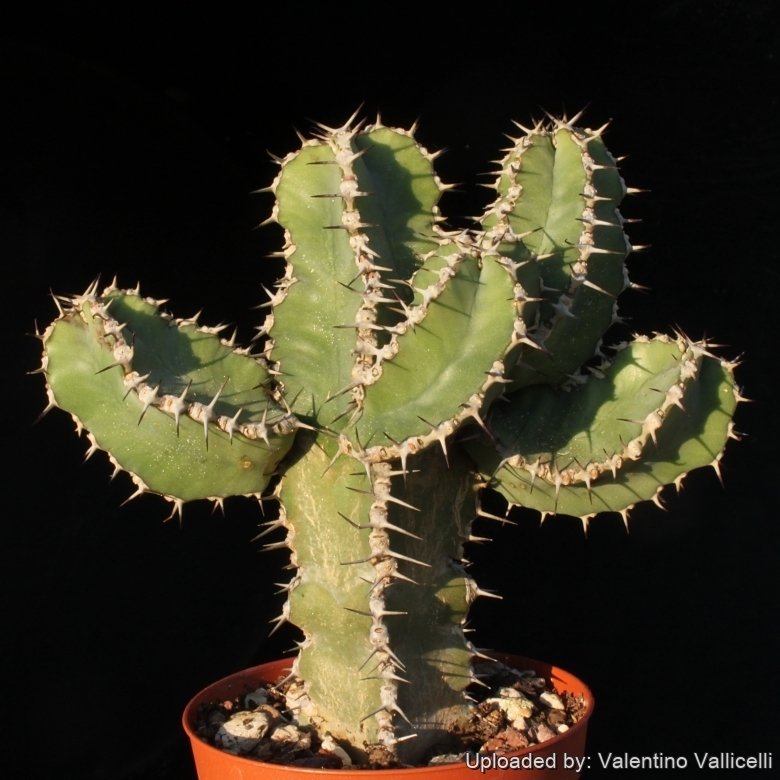
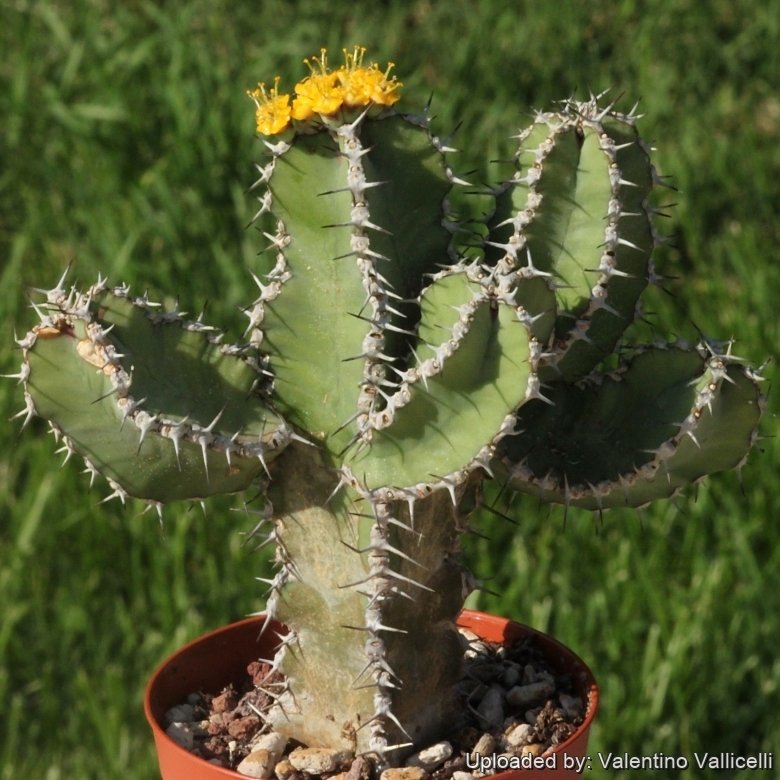
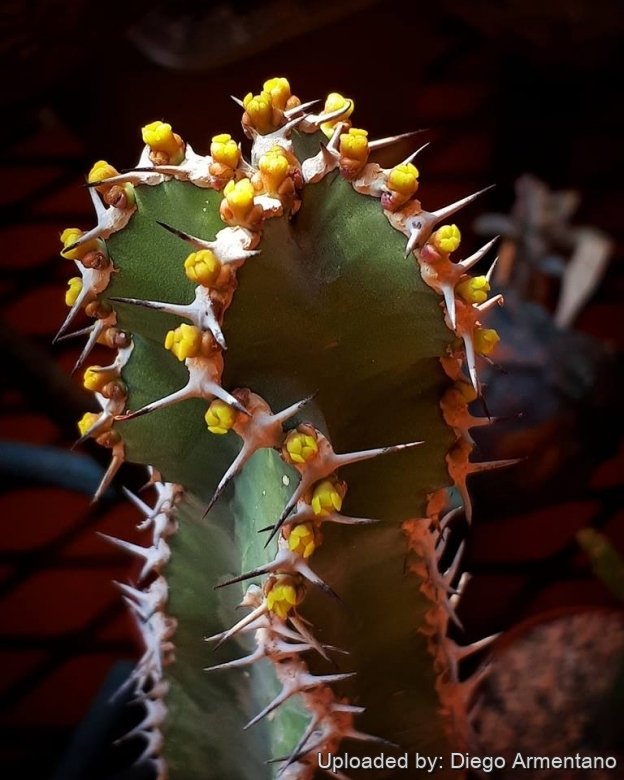
Euphorbia polyacantha is a succulent leafless spiny shrub 1-1.5 m high, occasionally to 2 metres, that is broader than high, with little or no clear trunk and numerous, and densely erect branches forming a dense rounded or almost flat crown. The flowers (cyathia) are small, yellow-green and grow from “eyes” exactly in between the spine pairs in the angles of stems.
Branches: Ascending, mostly arising at the base, grey to dark green, about 12-30 mm thick, 4?5 (to 7-angled) angled usually constricted into shallow ovate segments 20-40 mm long, glabrous. Angles compressed, with small rounded teeth or crenations with spines shield joined in a continuous horny dark grey margins, dark when young.
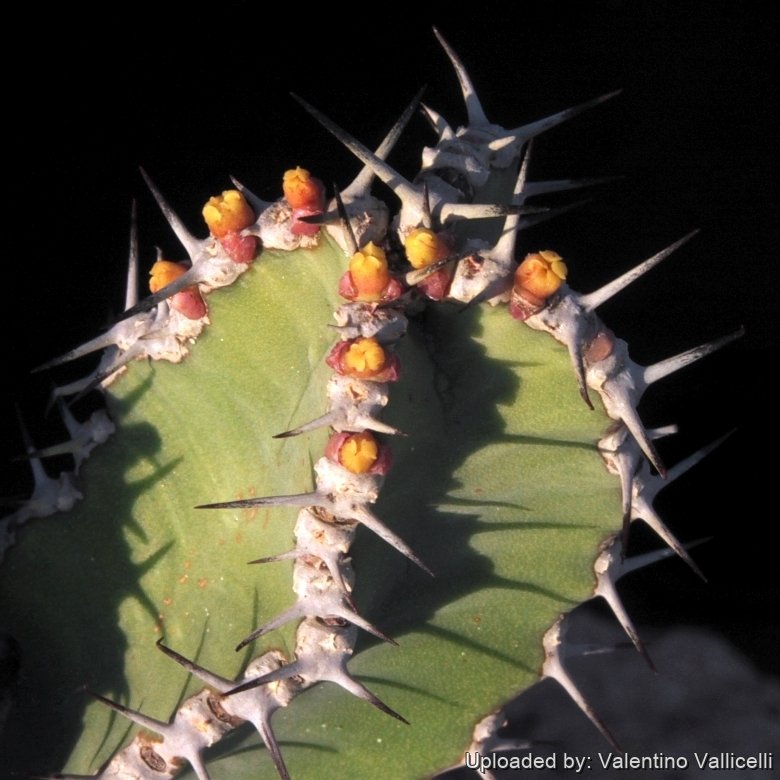
Spines: 2-5(-8) mm long, in pairs 4-7 mm apart, widely diverging, often curved upwards, dark grey.
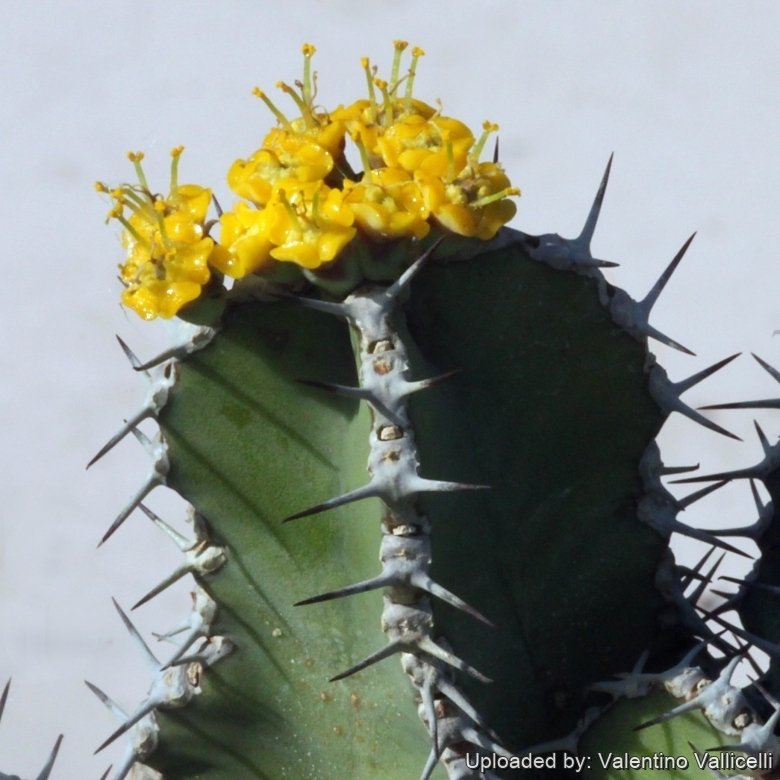
Inflorescences (Cymes): Solitary, simple, sessile or subsessile arising midway between the spine-pairs, with 1?4 cyathia together. Bracts 2 mm long, broadly ovate, obtuse, denticulate.
Flowers (cyathia): Sessile, yellow-green, 4-5 mm in diameter or the lateral rather smaller, cup-shaped, glabrous, with 5 glands and 5 erect broadly cuneate or transverse fringed lobes; glands 1-2 mm in their greater diameter, transversely oblong, entire, yellow and touching. Ovary subsessile, included, with a slightly 3-lobed calyx at its base, glabrous. Styles about 4 mm long, united to the middle and the united part included in the cyathium, free part recurved-spreading, with 2 thickened lobes at the apex.
Fruit (capsule): 3-lobed, oblong, 3-5 mm indiameter, black-purple to brown when ripe.
Seeds: Rough, grey oval less than 2 mm long.
Origin and Habitat
Ethiopia (Tigre), Sudan (Red Sea Hills), Erithraea (Ala plains and around Semenawibahri, Mehlab, Akrur, Gheleb and Nefasit) south to east Ethiopia, Somalia and Arabian Peninsula (Yemen).
Altitude range: 800-2,250 metres above sea level.
Habitat and ecology: Euphorbia polyacantha is a spiny bush which grows on stony sides of mountains in hot valleys with open deciduous Acacia or evergreen bushland to lower margins of Juniperus forest; and on shallow soils in dry hilly savannah of the Red Sea Hills. In Eritrea, this bush is common in the central highlands.
Cultivation and Propagation
Euphorbia polyacantha is sometimes planted as an ornamental in home gardens, as a live fence and for soil conservation purposes.
Traditional uses: This plant, which has the same medicinal qualities as Albizzia anthelminthica, is cut up into small pieces and drunk in hot milk or water. In Sudan the crushed stems are applied to scorpion stings.
Propagation: Euphorbia polyacantha is easy to propagate by means of cuttings.
Bibliography
Major references and further lectures
-
Urs Eggli Illustrated Handbook of Succulent Plants: Dicotyledons Springer Science & Business Media, 2002
-
J. G. Baker, with additions by C. H. Wright Flora of Tropical Africa, Vol 6, 1913
-
Gaby H. Schmelzer, Gabriella Harriet Schmelzer, Ameenah Gurib-Fakim, Medicinal Plants, Volume1, PROTA, 2008
-
Alfred C. Hollis Masai Myths, Tales and Riddles Courier Corporation, 2003
-
WeEuphorbia polyacantha bsite: African Flowering Plants Database http://www.ville-ge.ch/musinfo/bd/cjb/africa/recherche.php Publisher Conservatoire et Jardin Botaniques.
-
Euphorbia polyacantha in http://www.worldagroforestry.org/usefultrees/pdflib/Euphorbia\_polyacantha\_ERI.pdf
Gallery