Publication: Hort. Brit. [Sweet], ed. 2. 454. 1830
Description
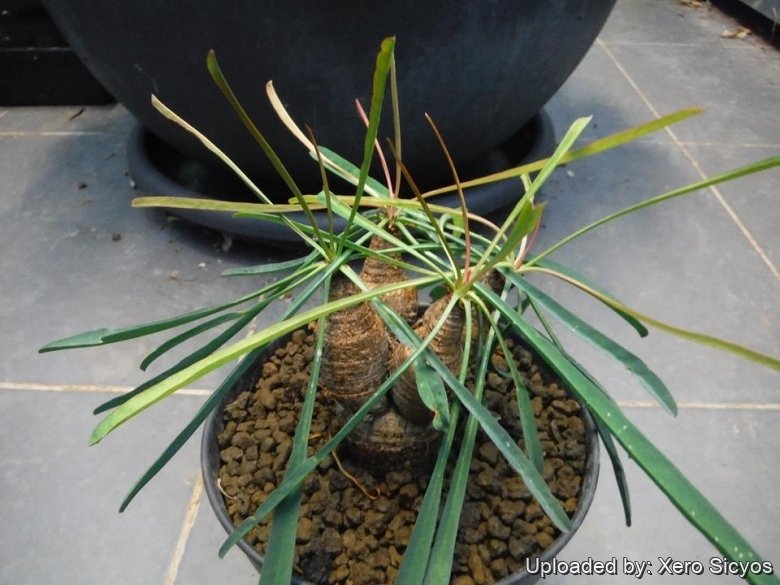
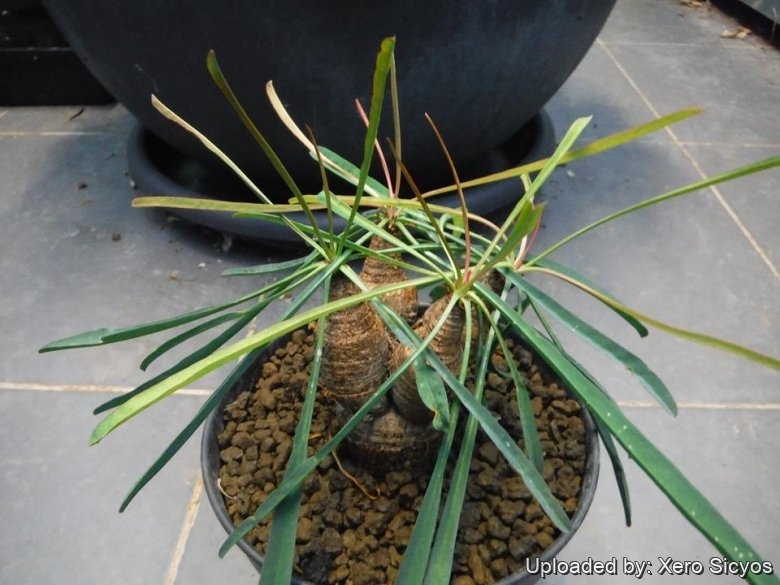
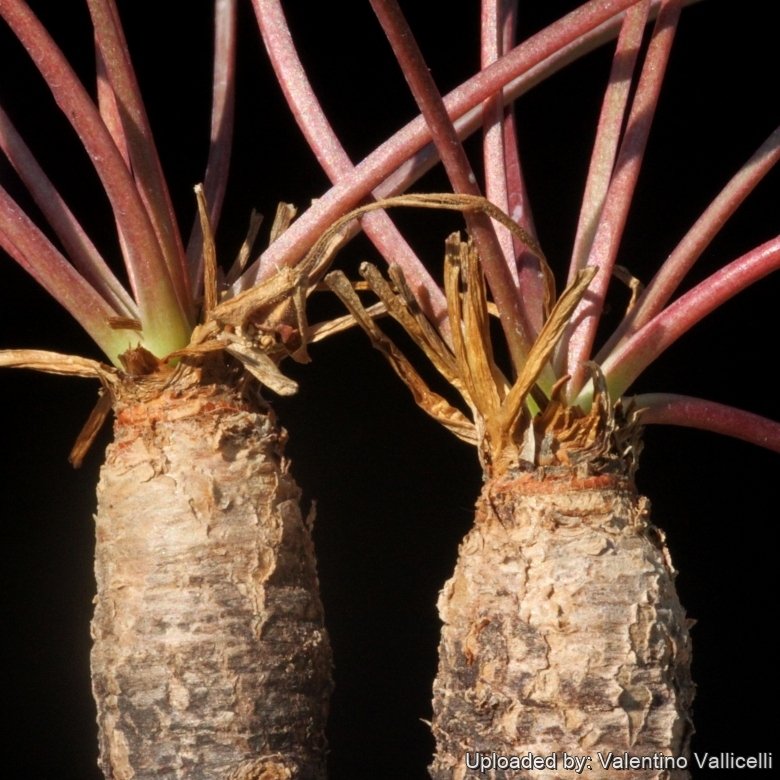
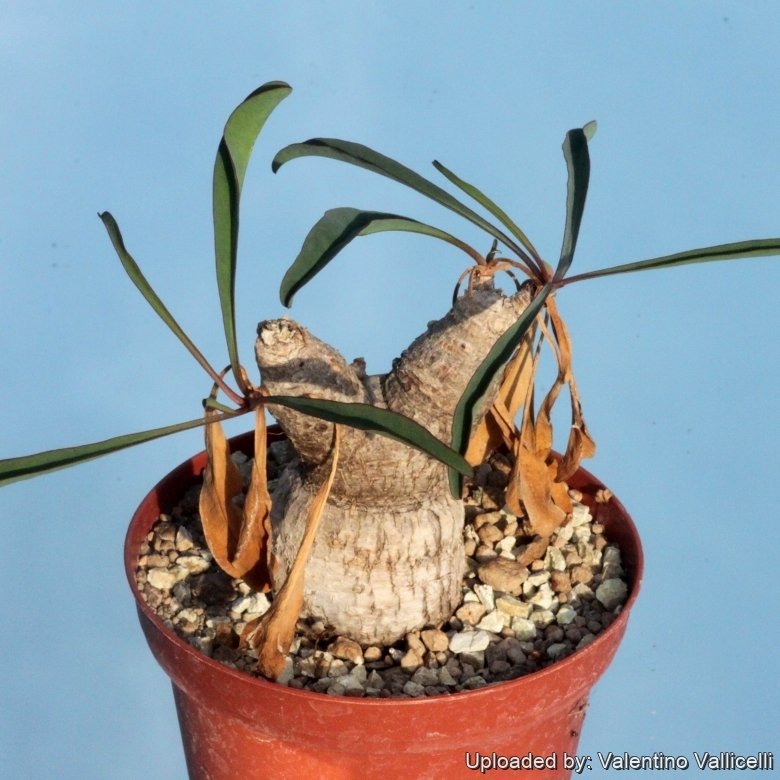
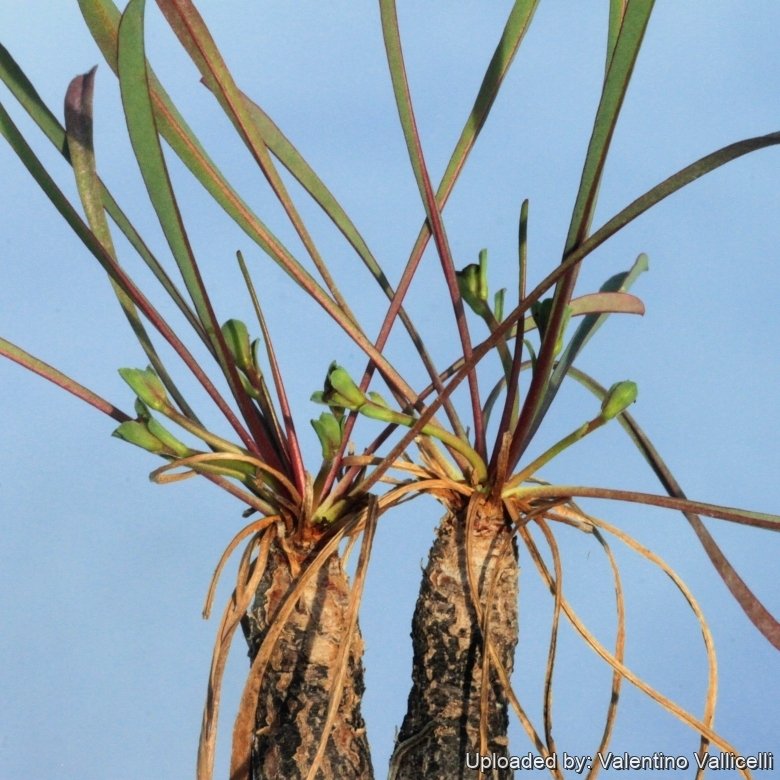
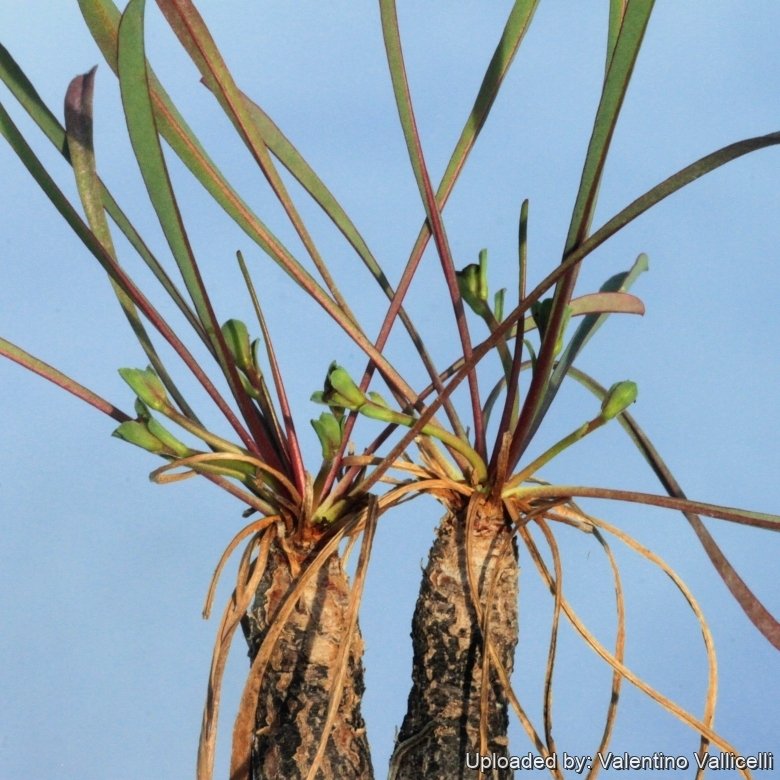
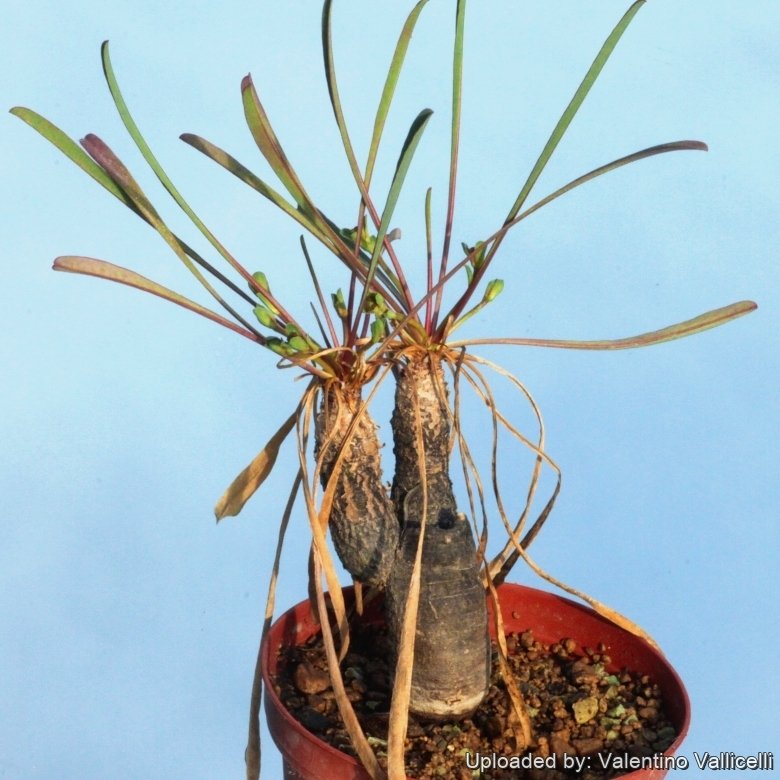
Euphorbia silenifolia (like the leaves of Silene or Catchfly) is a dioecious, perennial succulent herb with an ellipsoid, subterranean tuber (geophyte) which grows during the winter months. Its tuberose roots merging into underground stems (cudexes) with a tuft of narrow tappering leaves and flowers above ground. The plants are not visible during the summer. During autumn the thin leaves start to grow from the apex of the underground stem. Plant 150 mm tall, flowering in winter.
Root: Tuberous ellipsoid, fusiform or somewhat tapering, thick, dark brown merging into subterranean stems.
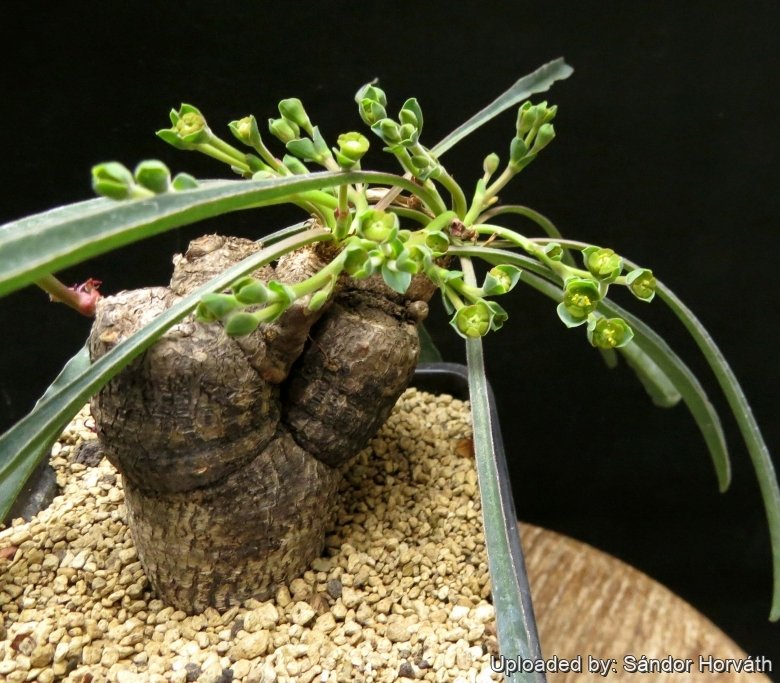
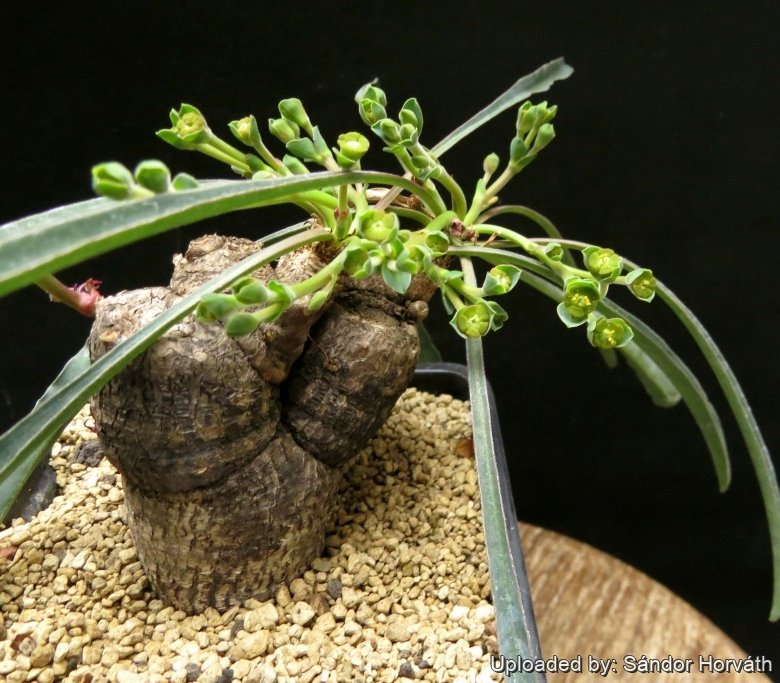
Stems: Solitary or up to three branched, elongated, approx 5 cm in diameter, with tips at ground-level with leaves and inflorescences. In habitat it is wholly below ground, although in cultivation it is usually planted at a higher level as a safeguard against waterlogging and for its highly appreciated aesthetic shape.
Leaves: Up to 10 cm long and 10-12 mm wide, deciduous, lying flat on the ground and radiating outwards, dark greyish-green and somewhat bluish-green above, paler beneath, linear-lanceolate (narrow-tapering) obtuse or occasionally acute and somewhat folded together at the apex, tapering at the base or from below the middle into a petiole up to 10 cm long, entire, glabrous on both side.
Inflorescences: Peduncles in the axils of the leaves, 2-15 cm long, minutely puberulous, with
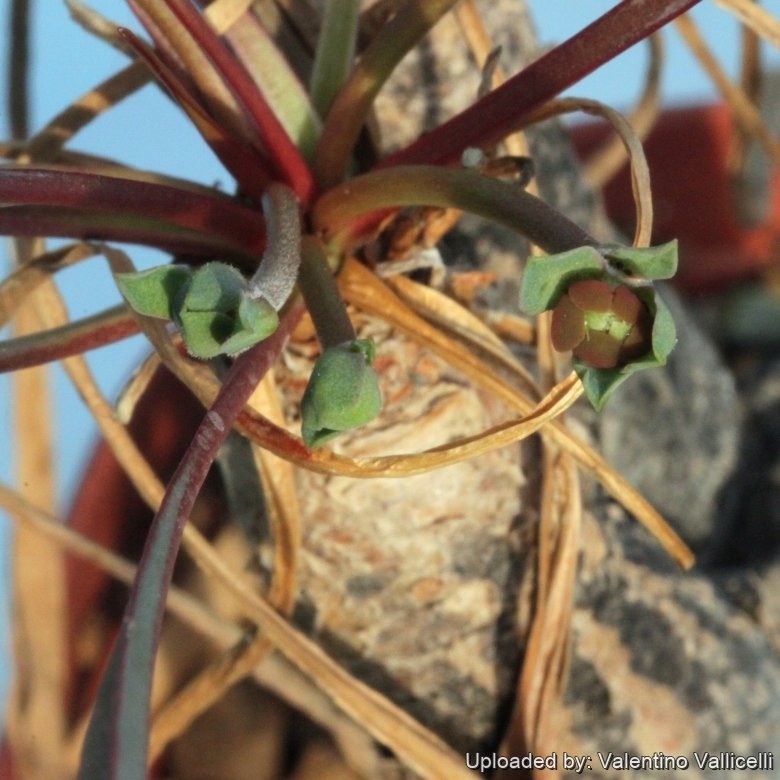
cymes in 3-5 rayed umbels, rays 6-25 mm long at their apex and a whorl of 3–5 bracts at the base of the umbel; rays with 1–3 cyathia. Bracts obovate, 10 x 6 mm wide, hairy beneath,
Flowers (cyathia): Greenish-yellow, in clusters in the centre of the plant. up to 4-6 mm in diameter, cup-shaped, hairy. Nectar-glands 5 elliptic, purple-brown or blackish-brown and 5 small oblong fringed lobes. Glands not contiguous, spreading, 2-4 mm in their greater diameter. Styles 1.5 mm long, united into a column for half their length, then spreading and deeply bifid, with widely diverging lobes at the apex;
Blooming season: May - June.
Fruit (Capsules): Trigonous-subglobose, erect, up to 6 mm in diameter, pubescent sessile.
Seeds: Ovoidal or subglobose, obscurely pointed at one end, 3 mm long, reticulately rugose, olive-brown.
Origin and Habitat
Euphorbia silenifolia extents from the Western Cape to Port Alfred, South Africa. The plants prefer areas with higher rainfall and avoid desert-like Karoo areas. It is quite common in the northern areas of the Cape Peninsula.
Habitat: This species is common in Albany Thicket and Fynbos on dry, stony hillsides, sandy or clay flats and slopes. Also on sand dunes near Port Elizabeth
Cultivation and Propagation
A very very light and warm place in full sun is highly appreciated. It does best in a mineral soil, good drainage is essential. Water sparingly during the summer months and keep dry in winter. When not in growth it is killed right away, when given too much water. It is a slow growing long lived plant and once established, it will be content in its position and with its soil for years. It can tolerate moderate shade, and a plant that has been growing in shade should be slowly hardened off before placing it in full sun as the plant will be severely scorched if moved too suddenly from shade into sun.
Frost Tolerance: Tender, it needs frost protection.
Propagation: It is propagated from seed sown during spring or summer. Germination occurs within 3 weeks.
Warning: As with all other Euphorbias when a plant get damaged it exudes a thick white milky sap known as latex. This latex is poisonous and particularly dangerous for the eyes, skin and mucous membranes. So pay extreme attention not to get any in your eyes or mouth. Cultivated plants must be handled carefully.
Notes
This species produces an unusual effect owing to the tuberous root being planted well out of the soil.
Bibliography
Major references and further lectures
-
von Staden, L. 2014. Euphorbia silenifolia (Haw.) Sweet. National Assessment: Red List of South African Plants version 2014.1. Accessed on 2015/08/23
-
Vlok, J. and Schutte-Vlok, A.L. “Plants of the Klein Karoo”. Umdaus Press, Hatfield.2010.
-
Manning, J.C. and Goldblatt, P. “Plants of the Greater Cape Floristic Region 1: The Core Cape Region.” Strelitzia 29. South African National Biodiversity Institute, Pretoria. 2012.
-
Bruyns, P.V. “Nomenclature and typification of southern African species of Euphorbia.” Bothalia 42(2):217-245. 2012.
-
Urs Eggli “Illustrated Handbook of Succulent Plants: Dicotyledons” Volume 2. Springer, 2002
-
“Euphorbia” Strawberry Press, 1987
-
Alain Campbell White, Robert Allen Dyer, Boyd L. Sloane “The succelent Euphorbisae (southern Africa)” Abbey garden press, 1941
-
Doreen Court “Succulent Flora of Southern Africa” CRC Press, 01 June 2000
-
Pauline Bohnen “Flowering plants of the Southern Cape” Still Bay Trust, 1986
-
Ernst Van Jaarsveld, Ben-Erik Van Wyk, Gideon Smith “Succulents of South Africa: A Guide to the Regional Diversity” Tafelberg, 2000
-
Gordon D. Rowley “The illustrated encyclopedia of succulents” Crown Publishers, 01 ago 1978
-
N. E. Brown, J. Hutchinson and D. Prain.“Flora Capensis”, Vol 5, Part 2, page 216, 1925
From llifle page Tithymalus attenuatus
Description
It is a compact highly branched succulent with a thickened storage root stock. It will form a dense mat with age.
Leaves: Fleshy organized in 2-6 pairs in each branch, smooth, light grey to bluish, trigonus narrowing toward the apiculate apex, keel ± oblique. Every year a few new leaves grow from the central stem.
Roots: Well developed, thickened tap-root.
Flowers: Daisy-like, organized in groups (cymes) of 1 to 3, but usually solitary, 20-30 mm in diameter, petals pure white to dark-pink with a white base, 1(-3) bracteolate. Filamentous staminodes white surrounding the stamens in a central cone. Stamens filament white, anthers yellow.
Blooming season: The long lasing flowers appears in spring.
Fruits: Dark-brown capsules, usually singles, bracteolates, base semi-globular with convex sides. Persisting for many year on the plants.
Seeds: 0.9-1 mm long, 0.6-08 mm wide.
Origin and Habitat
It is endemic to few sites in the Northern Cape, Griqualand West and Vredenfort, South Africa.
Habitat: Grows in grass land among sandstone rocks, in gravelly soil, often in pockets on rocks or or on pans. Rainfall/year: 300-500 mm in summer. This species look surprisingly like mesembs of the genus Hereroa that grow mixed together the same area but with yellow flowers in late summer.
Cultivation and Propagation
It is easy to grow and rewarding plants than can be grown in pots or in the rock-garden.. These plants grow on summer rain areas and were heading for winter dormancy. They can be watered year-round, water regularly from spring to Autumn but reduce watering frequency in winter, growth period is early Spring to late Summer, but is a very adaptable species that can grows opportunistically whenever the water availability and growing condition are favourable. Keep them cool, and half-shaded in summer, need full sun or light shade on the other seasons. Potted Ebracteola look best in a heavy soil and the same is true for plants in a rockery. Requires good drainage. Frost Tolerance: quite frost hardy and grows best where there are cold winters (it is reported to be hardy to at least -10° C if very dry).
Propagation: Seeds, cuttings.
Notes
Ebracteola has a gorgeous, thick root system and when it is potted up, the plant can be progressively raised over the ground so that some of the roots can be seen and is especially cultivated for their looks. Architecturally it is a real stunner. When the “caudex” shape of the raised roots is adequately in evidence this plant is incomparable. They also tend to grow more “heads” when they are raised.
Source: Tithymalus attenuatus, LLIFLE - Encyclopedia of living forms, CC-BY-SA, retrieved 2026-10-26.
From llifle page Tithymalus bergii
Description
It is a very peculiar candelabra-like succulent plant which looks like a grey candle with whitish-grey melted wax on it. It form densely branched candelabra-like clumps usually not more than 1 m hight by1,5 in diameter on one clump (but occasionally in habitat some plants can reach 3 m of height and an equivalent diameter). It is one of the most coveted Euphorbia species.
Roots: Spreading.
Stems: About 5 cm in diameter, greenish-grey to tan, columnar, spineless, simple, branching from the base or occasionally splitting dichotomously. Generally has 6 ribs with a somewhat wrinked, worn looking ‘skin’ with slightly raised conical tubercles. Often skin peels away revealing greener tissues beneath. The colour of the new growth is a dark brown and it will then turn to the grey tan colour. The latex is yellow.
Leaves: Very small, ephemeral.
Inflorescence: Simple cimes from the base of the tubercles.
Flower: Small cyathia about 5 mm in diameter on 8 mm long penduncles. Nectar glands yellowih. Pedicel very short.
Fruit: Vaguely lobed, about 8 mm in diameter.
Origin and Habitat
Endemic of the Abd al Kuri Island, next to Socotra Island, Yemen.
Habitat: It grows in a very arid area approximatively in a narrow band across the island at an elevation of about 150 to 200 m in the middle of the mountain. The plants are found mainly on limestone outcrops where they forms open thickets.
Cultivation and Propagation
Due to its slow growth rate and rarity it is thought difficult to grow on its own roots. It is almost always grafted Euphorbia canariensis, but it may be degrafted and rootted and, surprisingly, it’s quite easy to grow. It’s uncommon to lose a plant. It like a sunny position. It does best in a mineral soil, good drainage is essential. Water sparingly during the summer months and keep dry in winter. It is a slow growing long lived plant and once established, it will be content in its position and with its soil for years. It can tolerate moderate shade, and a plant that has been growing in shade should be slowly hardened off before placing it in full sun as the plant will be severely scorched if moved too suddenly from shade into sun. Seems to have no problems growing in a heavy summer rainfall area, in extremely well drained, mineralized soil mix.
Frost tolerance: Very frost tender needs minimum winter temperatures around 10° C (or even more)
Propagation: It is usually reproduced by grafting or cuttings, but it may be propagated from seed sown during spring or summer (seeds are seldom available).
Grafting: The plants that are grafted on a more vigorous and easier stocks are easier to keep, grow faster and produce more flowers and seeds. The method of grafting euphorbias differs little from that of other succulents, except in one important aspect. The latex must be washed or sprayed off until hardly anything remains. After the latex flow has stopped, a further 1-2 mm slice can be taken from both surfaces without a new latex flow starting. Both scion and stock need to be at the start of the growing season. The stock should be cut as near as possible to the growing tip, as here the vascular bundles are dense and not yet woody and will feed the scion in the best possible way. Where possible stock and scion should be of similar diameter. The cut surfaces are held together with elastic bands in cross style, over the plant top and under the pot. The plants should be left in an airy and shady place for 7-10 days before the bands are removed. E. abdelkuri is grown almost exclusively grafted on Euphorbia canariensis which proven to be the ideal grafting stock. The grafting are very successful, new grafts often show growth within 3 weeks.
Warning: As with all other Euphorbias when a plant get damaged it exudes a thick milky sap known as latex. This latex is poisonous and particularly dangerous for the eyes, skin and mucous membranes. So pay extreme attention not to get any in your eyes or mouth. Cultivated plants must be handled carefully.
Source: Tithymalus bergii, LLIFLE - Encyclopedia of living forms, CC-BY-SA, retrieved 2026-10-26.
Cultivars and forms (2)
Gallery