Publication: Sp. Pl., ed. 4 [Willdenow] 2(2): 886. 1799 [Dec 1799]
Description
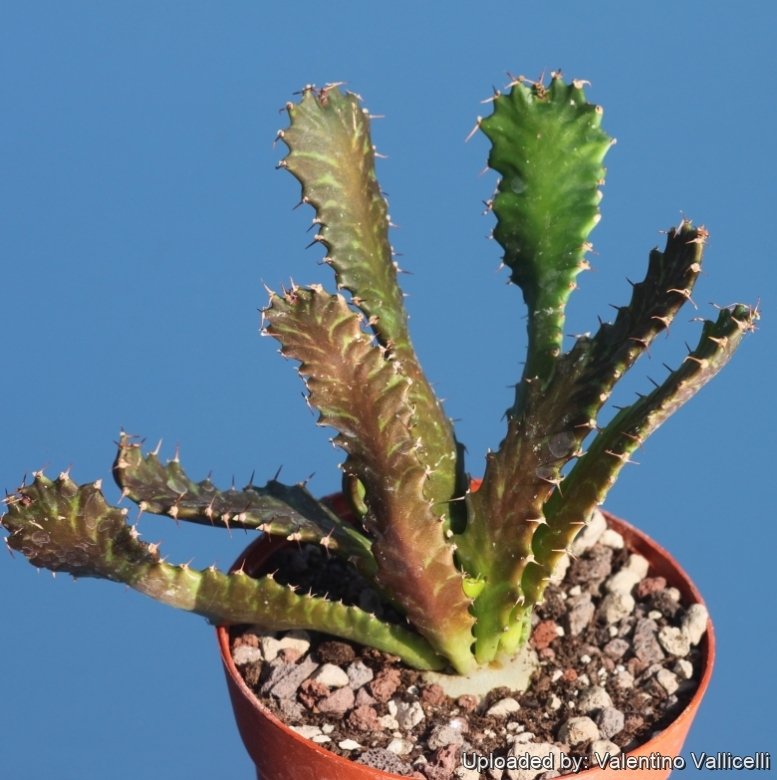
It is a small geophytic species, both a caudiciform and medusoid Euphorbia. It is very similar in body shape to the closely related Euphorbia squarrosa.
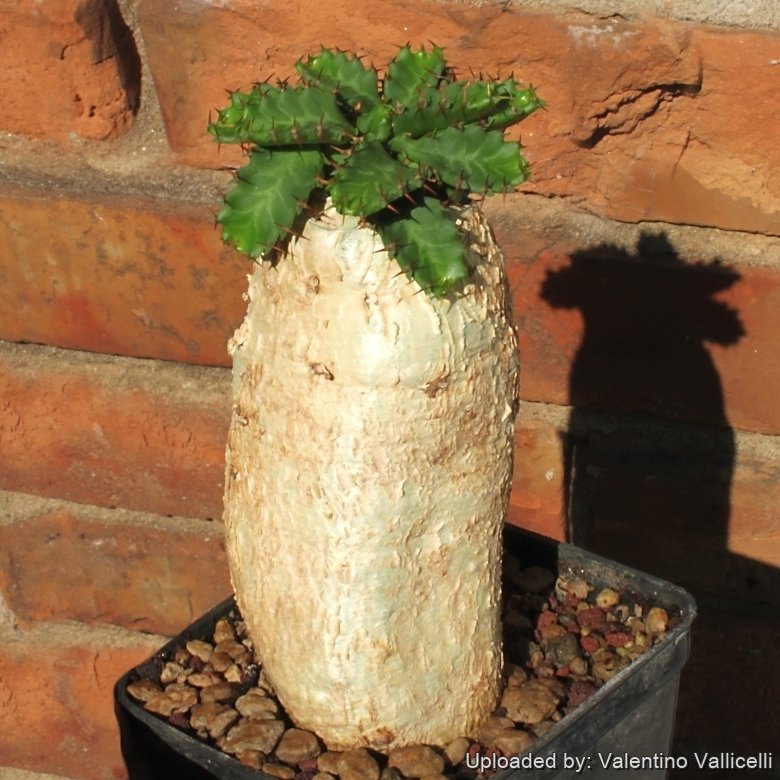
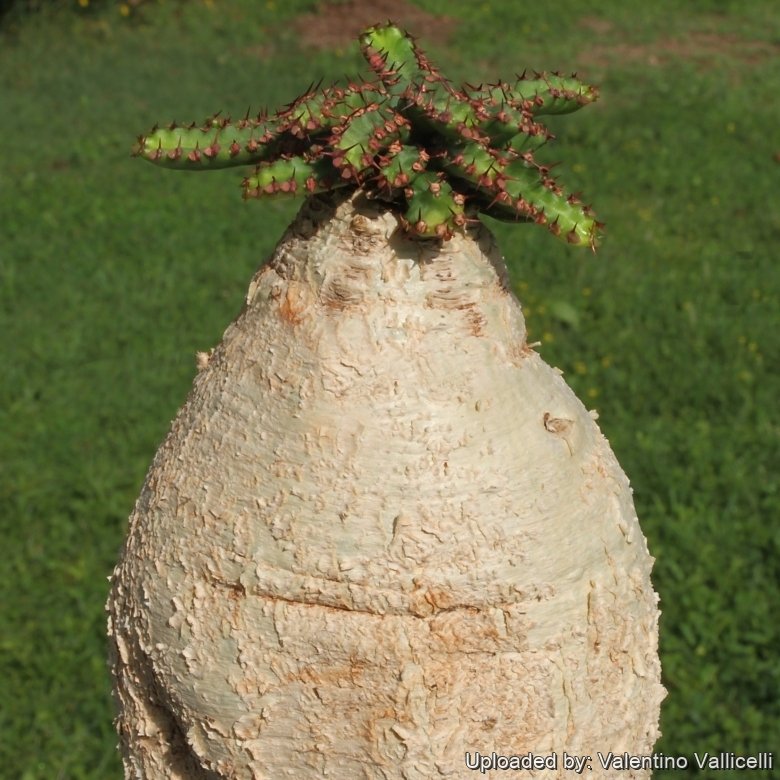
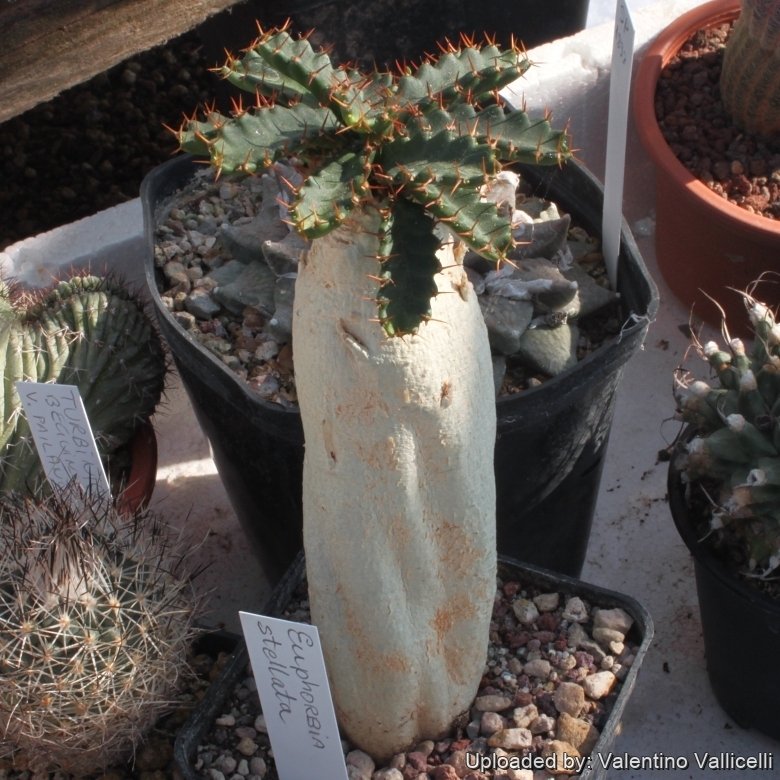
Caudex (tuberose rootstock): The short, conical to truncate stem merges with the thick turnip-shaped root forming a woody caudex 5-15 cm tall and 6-7 cm in diameter (or more). It is an underground water-storage organ so it is very resistant to drought. In cultivation the tuberous rootstock is raised over the ground so that it can be seen and is especially cultivated for its looks. Architecturally it is a real stunner.
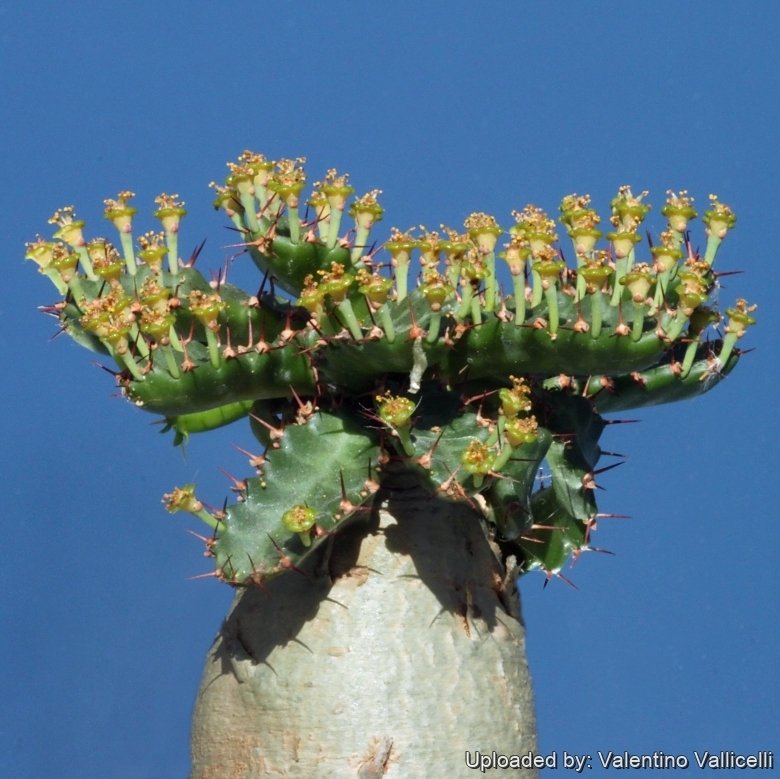
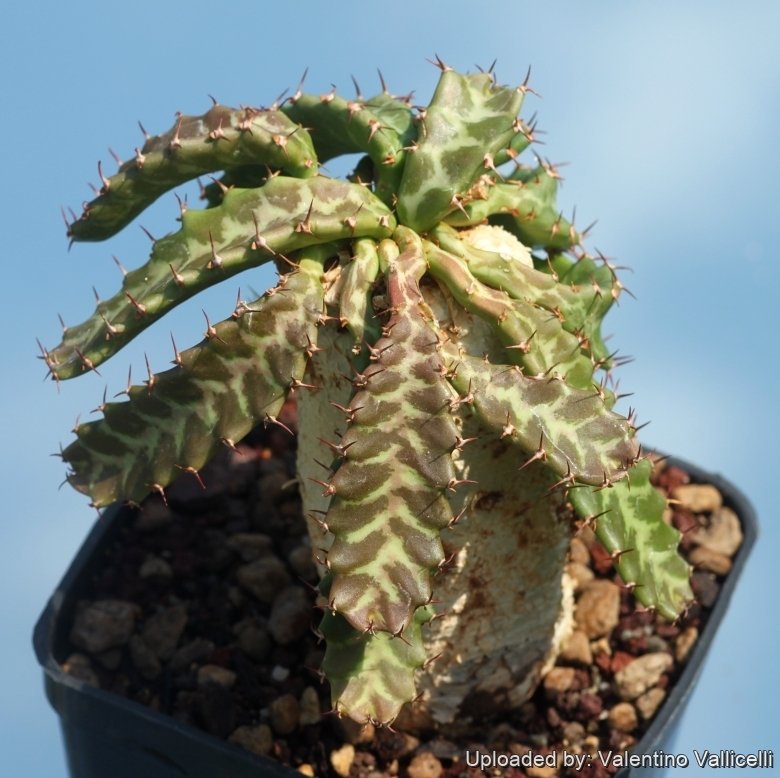
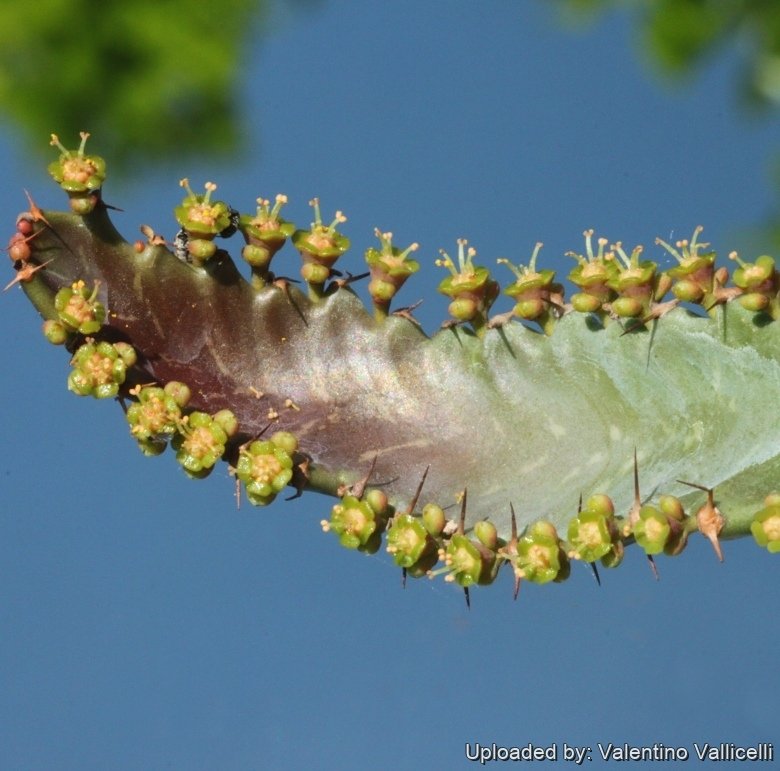
Branches: Up to 15 cm long and 14 mm wide, tufted, prostrate and radiating on the top of the rootstock at ground level, strictly bilaterally flattened, two-ribbed, dark green with feathery, whitish marking. Margins winged with sinuate teeth about 6 mm apart.
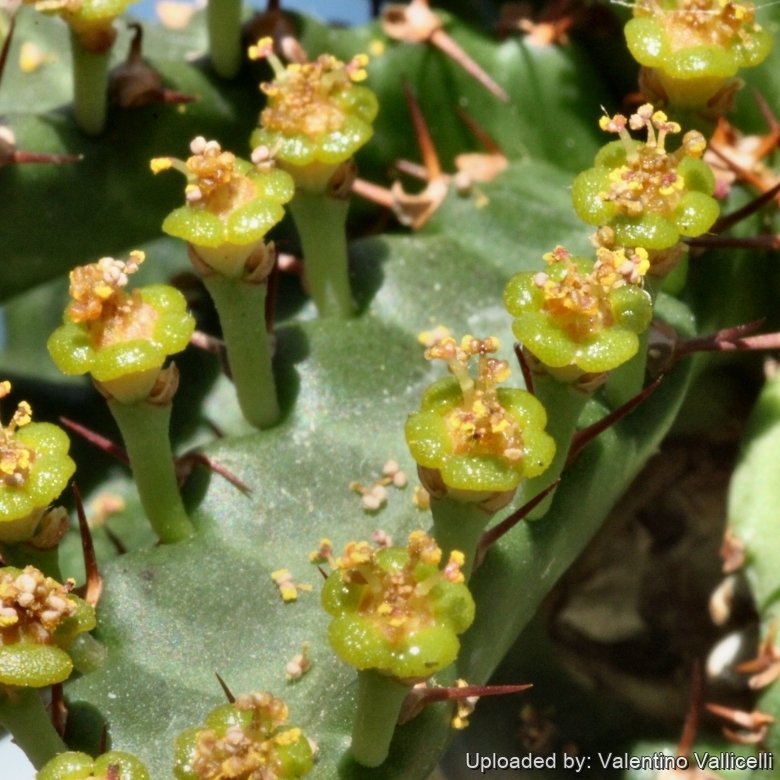
Stipular spines: Paired, circular, quite separate up to 4 mm long.
Flower: Greenish-Yellow in cymes; Pedicel about 5 mm long. Cyathia 4 mm in diameter; nectar glands oblong, yellowish almost touching.
Fruit: About 3 x 5 mm wide, strongly lobed, base truncate.
Seed: 2 x 1,7 mm broad, ovoid in shape.
Origin and Habitat
Eastern Cape (districts of Port Elizabeth, Albany and Peddie), South Africa
Habitat: It grows amongst grass and pebbles often grow fully exposed with the thick subterranean tuber, which embeds itself firmly in rocky crevices. As the name suggests, the branches radiate out from the tuber and lay prostrate against the ground.
Cultivation and Propagation
Euphorbia stellata is cultivated as an ornamental, and is a particular favourite of succulent plant enthusiasts. Cultivation of this plant is the same as that for the other tuberous varieties of Euphorbia, (e.g. Euphorbia groenewaldii, Euphorbia decidua etc.)
Growth rate: It is a slow growing species, but it it possible to increase the speed of growth to some extent by providing adequate amount of water, warmth, and fertilizer during the active growing season, but it’s susceptible to rotting if too wet and do not like a lot of water when they are on rest.
Soil and pots: It likes pots with generous drain holes, needs a very airy potting medium which mainly consists of non organic material such us clay, pumice, lava grit, and only a little peat or leaf-mould, seeing that the main trunk is planted with the majority of the roots below the caudex line. It’s rare that it will use the upper third of its soil and often this area serves like a mulch or support for the stem.
Fertilization: Need a perfect fertilizer diet in summer. Use preferably a cacti and succulents fertilizer with high potassium content including all micro nutrients and trace elements or slow release fertilizer.
Exposure: This plant has an excellent heat tolerance, and need full sun to light shade exposures, it grows well even in full blasting sun, but can tolerate moderate shade, and a plant that has been growing in shade should be slowly hardened off before placing it in full sun as the plant will be severely scorched if moved too suddenly from shade into sun. The color of this plant is much more marked if grown in full sun.
Watering: Water regularly during the active growing season. No water should ever be allowed to stand around the roots. Keep almost completely dry in winter. However this spurge will tolerate dryness and can even thrives in poor, dry soils, but do better when grown in nutrient-rich soils with regular watering.
Hardiness: Some cold tolerance. This spurge has tolerated temperatures down to –6º C. However it can be difficult to get it to look its best without a good amount of heat and sun and so it is only really suited to the tropics (USDA Zones 9-12). It can be grown outdoors in frost-free climates.
Rot: Rot is only a minor problem with Euphorbias if the plants are watered and “aired” correctly. If they are not, fungicides won’t help all that much.
Manteinance: Re-pot every two years and trim off the dead ‘arms’.
Known hazards: The latex/sap is poisonous and can cause skin rash, itching and general discomfort, and they should be handled with caution, particularly when pruning.
Propagation: The plant can be reproduced by seeds or cuttings. The seedling is best left until it is larger as it will grow faster if the root is buried. The plant may be propagated by branch cuttings which will grow and flower. Usually cuttings will not form caudexes unless double cut. Once growth is strong, the top of the green shoot needs to be cut off again to force the plant to start a caudex. Some plant form a perfectly symmetrical caudex when grown from seed, but form distorted (but often more interesting) caudexes when grown from cuttings. If you remove an offset, remember to let it dry for some days, letting the wound heal (cuttings planted too soon easily rot before they can grow roots). Lay it on the soil and insert the stem end partially into the substrate. Try to keep the cutting somewhat upright so that the roots are able to grow downward. It is better to wash the cut to remove the latex.
Bibliography
Major references and further lectures
-
Domitilla Raimondo “Red list of South African plants 2009” South African National Biodiversity Institute, 2009
-
James Cullen, Sabina G. Knees, H. Suzanne Cubey “The European Garden Flora Flowering Plants: A Manual for the Identification of Plants Cultivated in Europe, Both Out-of-Doors and Under Glass” Cambridge University Press, 11/Aug/2011
-
Urs Eggli “Illustrated Handbook of Succulent Plants: Dicotyledons” Springer, 2002
-
Doreen Court “Succulent Flora of Southern Africa” CRC Press, 01/Jun/2000
-
Hermann Jacobsen “Abromeitiella to Euphorbia” Blandford Press, 1960
-
Alain Campbell White, Robert Allen Dyer, Boyd L. Sloane “The succelent Euphorbisae (southern Africa)” Abbey garden press, 1941
From llifle page Euphorbia procumbens
Description
This is a nice large, cactus-like, candlestick, tree Euphorbia with short thorns. It form a dense crown of ascending branches usually up to 4,5 m tall (but reported to reach 9 m of height ) This is a highly variable species with several forms and making precise descriptions may be difficult.
Stems: Columnar, angular branches, constricted into ovate segment appox 15 cm long,
Ribs: 8 (4 for E. acruensis) very deep, vertical or slightly twisted with thin walls and shallow sinuate teeth 12 mm apart.
Spines: Stipular spines in pairs closely packed (almost touching) on the rib border, triangular up to 7 mm wide and 10 mm long, separate, becoming corky.
Flowers: 1-5 cyathia up to 12 mm wide born together on simple cymes, peduncles up to 5 mm long stout, nectar glands elliptic yellow, almost touching.
Fruits: About 12 x15 mm wide, subglobose, fleshy, white turning red, hardening, becoming deeply lobed at maturity.
Seeds: Smooth, subglobose, 4,5 x 3,5 mm wide,
Remarks: It has a very clean and neat appearance and is often confused with with Euphorbia ammak, Euphorbia ingens and Euphorbia erythraea . Nevertheless this plant is often leafed out, especially if warm and given plenty of water. This makes it easy to tell from , which rarely has leaves, or they are so small and insignificant. Furthermore Euphorbia abyssinica grows more vertical in form than its cousins.
Origin and Habitat
It is the the principal tree euphorbia of northeast Africa ranging from East Sudan (Red Sea Hills) to Eritrea, Northern Ethiopia and Northern Somalia.
Habitat: Grows in the most exposed places in well-drained stony soils and in the crevices of rock faces of hills and slopes, in montane dry deciduous and evergreen woodland and bushland , woodland and shrub savanna at 850 to 2200 m altitude. It occurs widely throughout dryland Africa and it is often dominant.
Cultivation and Propagation
It is an easy species to grow that is suited for any well drained soil in full sun. But young plant are happy growing indoors, where they can easily reach the ceiling. Give the plant an airy growing medium which mainly consists of non organic material such us clay, pumice, lava grit, and only a little peat or leaf-mould. Water regularly during the active growing season from March to September. No water should ever be allowed to stand around the roots. Keep almost completely dry in winter. It is a moderately fast grower, and will quickly become large landscape masterpieces in just 3-5 years. Only downside is from strong winds, the columns often smash into each other, causing permanent scarring… best to plant in such a location where winds are not a big issue. If plant becomes very red, this is a sign that the roots have not developed properly. It can tolerate moderate shade, and a plant that has been growing in shade should be slowly hardened off before placing it in full sun as the plant will be severely scorched if moved too suddenly from shade into sun. Like quite small pots, repott in very later winter, early spring. Can be pruned for shape and branching. Frost tender, frost free zones only. It is definitely more tender than Euphorbia ammak or Euphorbia ingens, and slower growing, it will be content in its position and with its soil for years.
Propagation: It is easy to propagate by cuttings in late spring to summer, just take a cutting of the plant let it dry for 1 or 2 weeks and stuff it in the ground (preferably dry, loose, extremely well draining soil).
Warning: All Euphorbias contain a white sap that can be irritating to eyes and mucous membranes. If contact is made with this white sap, take care to not touch face or eyes before washing hands with soap and water.
Uses:
Gardening: This tree can be grown in large, rocky, well-drained soil in gardens in drier areas. It is very drought resistant but susceptible to frost. It makes one of the better house plants for an Euphorbia, dealing well with low light situations (though recommend higher light if possible). Somewhat user-friendly with only sparse spines along the edges of the plant. Slightly delicate, though, and spines tear off easily, exposing that latexy sap. It is also appreciated as a live fence because it is easily propagated from untreated mature branch cuttings.
Fuel production: The Italians attempted to grow Euphorbia abyssinica in 1935-36 to use its latex to produce a gasoline-like substitute.
Fishing: It is used to stupefy fish, making it possible to catch them by hand. The fish poison is prepared by soaking a bundle of grass in the latex, tying it to a stone and throwing it into the water. Paralysed fish rise to the surface within a short period of time.
Source: Euphorbia procumbens, LLIFLE - Encyclopedia of living forms, CC-BY-SA, retrieved 2026-10-25.
Gallery