Publication: Sukkul. Euphorb. 95 1907 publ. 1906.
Description
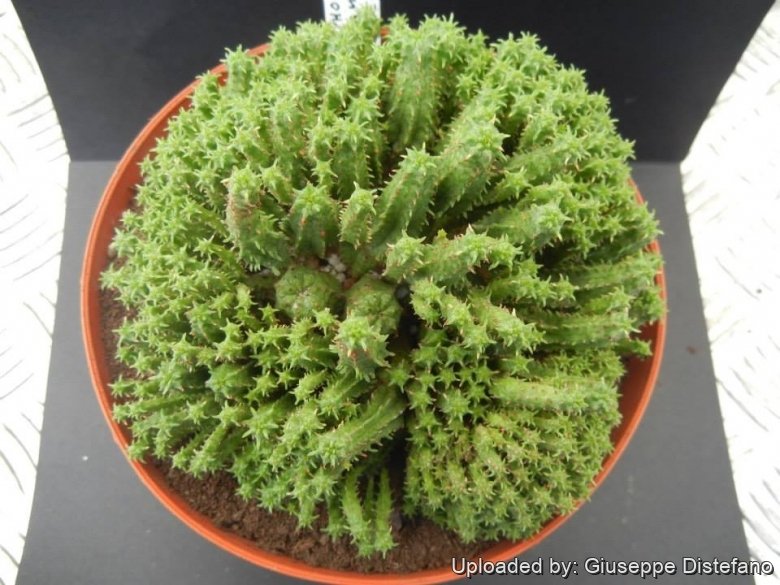
Euphorbia submamillaris, firstly described from dried material of unknown origin and distribution, is a poorly known taxon which may not be a good species (possibly a hybrid). It is known only in cultivation and appears to have some affinity with the ‘corncob’ species Euphorbia pulvinata or possibly a form of Euphorbia submamillaris. Moreover the plant found in cultivation are quite variable, and the dissimilarity among seedlings may be considerable.
Habit: It is a densely branched, dioecious, succulent perennial dwarf-shrublets to 20 cm tall, forming compact clumps.
Branches: 1.5-2.5(-4) cm in diameter, 7-to 10-ribbed, deeply grooved between. Ribs with shallow tubercles separated by horizontal grooves to 4 mm apart.
Leaves: Tiny, rudimentary only at the top of the new branch and soon deciduous. They are succulent, lanceolate, green in colour, 3-4 mm long and approx.
Spines: The “spines” are indeed solitary sterile peduncles 1 - 2 cm long, with 3 - 4 small bracts.
Flowers (cyathia): 5 mm in diameter, wine-red, solitary clustered at the end of the branches. Peduncles to 4 mm long with 5 - 6 purplish bracts to 3 mm long. Nectar-glands oblong, touching. Unisexual male and female ciathia on separate plants.
Fruits and seeds not known.
Origin and Habitat
It is known only in cultivation and possibly a hybrid. (Supposed from wild plants found in South Africa, Cape Province)
Cultivation and Propagation
Euphorbia submamillaris is an easy-to-grow plant for pot culture. It grows well in a very draining mineral potting substrate, but it isn’t picky about soil. It can be watered during the growing season, and enjoys average feeding and watering. When dormant in winter, keep it totally dry at at around 4°C. They need a lot of light to keep their compact growth-form. The plants that are not kept in full sun grow faster, but become untidy and may need support as they get larger. But one gets best colour if grown in full sun, where the chalk white stem of this low-growing clumping columnar plant has the best colour. It is also a prolific flowerer and makes a spectacular specimen.
Propagation: It is propagated by cuttings or seeds. Its branches and offsets are readily available. If you remove an offset, remember to let it dry for a week or so, letting the wound heal (cuttings planted too soon easily rot before they can grow roots). It is better to wash the cut to remove the latex. The seed can be sown just under the surface in normal seedling trays, in a sandy seed mix. Germination usually occurs within 1 - 3 weeks.
Warning: As with all other Euphorbias, when a plant get damaged it exudes a thick white milky sap known as latex. This latex is poisonous and may irritate skin, so pay extreme attention not to get any in your eyes or mouth.
Cultivated plants must be handled carefully.
Bibliography
Major references and further lectures
-
Doreen Court “Succulent Flora of Southern Africa” CRC Press, 01/Jun/2000
-
Urs Eggli “Illustrated Handbook of Succulent Plants: Dicotyledons” Springer, 2002
-
Alfred Byrd Graf “Exotica, series 4 international: pictorial cyclopedia of exotic plants from tropical and near-tropic regions” Roehrs Co. Publishers, 1985.
-
White, A., Dyer, R.A. & Sloane, B.L. ”The succulent Euphorbieae“ Abby Garden Press. Pasadena, California. 1941
From llifle page Euphorbia pfersdorfii
Description
Euphorbia submammillaris f. pfersdorfii (Euphorbia pfersdorfii) is a curious and rare plant, showing extreme reduction in stems size. It is supposed by some to be a mutant form of Euphorbia submammillaris or maybe an hybrid. It produces innumerable small, few-angled branchlets and forms compact crowded cushions. It is known only as a cultivars.
Stem (branches): Clavate 2-5(-8) mm in diameter, 5-45 (or more) mm tall, 5-ribbed, with tooth-like tubercles, bright green. As the stems continue to grow, they will become brown and woody looking, except for the green buttons on the top.
Spines: The “spines” are indeed solitary lignified reddish inflorescence stems sterile c. 5-10 mm long long, with 3 - 4 small bracts.
Leaves: Short-lived, lanceolate (about 5 mm long).
Origin and Habitat
It is known only as a cultivar.
Cultivation and Propagation
It is an easy to grow plant for pot culture.
Growth rate: It is a relatively rapidly growing species that will make large clumps whit hundreds or even thousands heads given the best conditions.
Soil: It grows well in a very draining mineral potting substrate, but it isn’t picky about soil.
Repotting: Use pot with good drainage.
Watering: During the summer they enjoy average watering, but do not overwater (Rot prone), keep dry in winter.
Fertilization: Feed with a high potassium fertilizer in summer.
Hardiness: When dormant in winter, keep it totally dry at or around 4°C, even though it seems to tolerate light frosts well.
Exposure: They do need a lot of light to keep their compact growth-form. They get a rich purple tinge if grown in full sun, however some protection in light shade is recommended during the hottest hours in summer.
Uses: It is an excellent plant for container growing. It always looks good and stays small. It looks fine in a cold greenhouse and frame.
Warning: As with all other Euphorbias when a plant get damaged it exudes a thick white milky sap known as latex. This latex is poisonous, and may irritate skin. Pay extreme attention not to get any in your eyes or mouth.
Cultivated plants must be handled carefully.
Rot: Rot it is only a minor problem with Euphorbias if the plants are watered and “aired” correctly. If they are not, fungicides won’t help all that much.
Propagation: It is propagated by cuttings (It branches enthusiastically, and offsets are readily available). If you remove an offset, remember to let it dry for some days, letting the wound heal (cuttings planted too soon easily rot before they can grow roots). Lay it on the soil and insert the stem end partially into the substrate. Try to keep the cutting somewhat upright so that the roots are able to grow downward. It is better to wash the cut to remove the latex.
Bibliography
Major references and further lectures
-
Alain Campbell White, Robert Allen Dyer, Boyd L. Sloane “The succelent Euphorbisae (southern Africa)” Abbey garden press, 1941.
-
W.G. Tolton “Canadian Florist” Volume 44 1949.
Source: Euphorbia pfersdorfii, LLIFLE - Encyclopedia of living forms, CC-BY-SA, retrieved 2026-10-25.
Gallery