Publication: Euphorbia World 3: 5 2007
Description
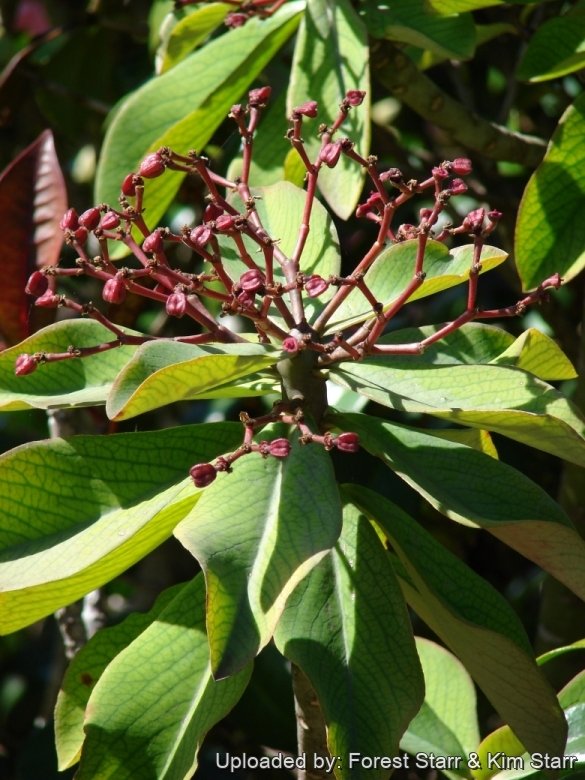
Euphorbia umbellata best known in cultivation as Synadenium grantii is a thornless semi-succulent, evergreen shrub or small tree, erect, richly branched from near the base and in its habitat becoming up to 3,5(-10) m in height with an equal spread. It is widely grown in the tropics for its giant fleshy leaves as an ornamental and hedge or cover plant and under glass in colder regions.
Stem: Main stem up to 12 or 15 cm thick branching from the base, with the bark of the older parts pale greyish. Younger branches, round, cylindrical, terete, glabrous, exuding milky sap, rubbery green, purplish-green or wine-coloured, and somewhat fleshy, 8-20 mm thick becoming woody and thickening with age.
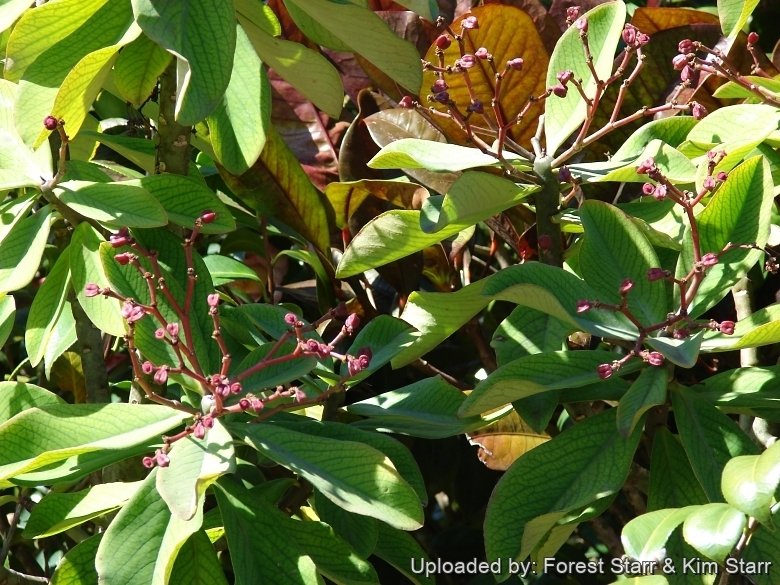
Leaves: Crowded at the tips, slightly alternate, simple, thinly fleshy, obovate, obovate-spatulate, or oblanceolate with obtuse, subacute or apiculate tip, 14-20 cm long and 2,5-7 cm wide sessile or gradually tapering from above the middle into a short stout petiole approximately 8 mm long, sparsely hairy towards the base, glabrous on both sides, reticulately veined with darker green with prominent midribs rounded beneath, uniformly green, paler beneath and often tinted with reddish on the prominent obtuse midrib. Margins entire or finely toothed towards the apex, flat or lightly wavy.
Inflorescences: Axillary and terminal, with 2 - 5 lax cymes, 7–15 cm long (including the 3-5 cm long peduncle), 5-10 cm broad, 2- to 6-forkedt hinly pubescent with spreading hairs on the upper part, glabrous below. Bracts 1 - 3 cm long, reddish-green subquadrate, very obtuse or subtruncate, entire, minutely pubescent.
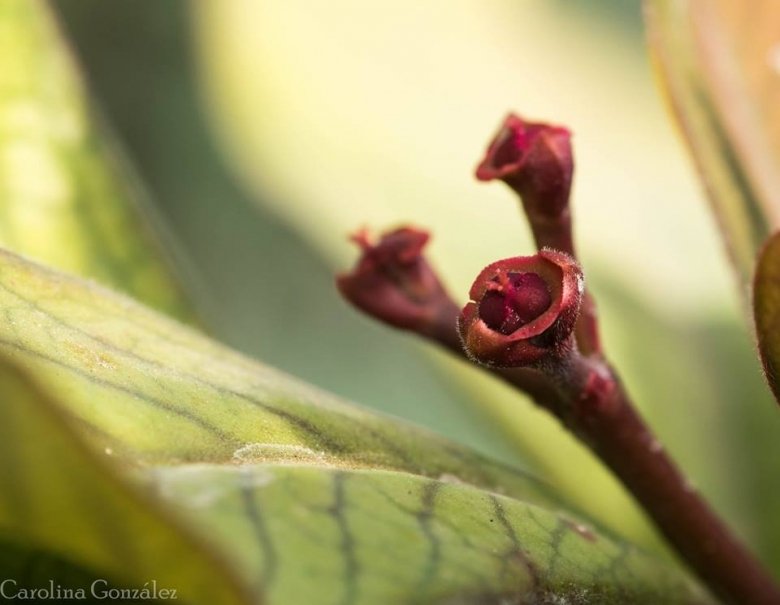
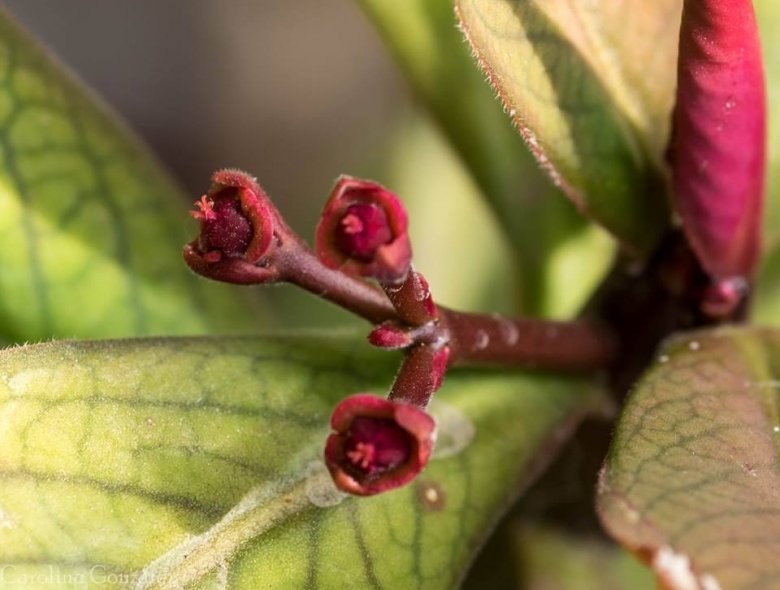
Flowers (cyathia): Small and inconspicuous, bisexual or entirely male, broadly funnel-shaped or saucer-shaped, 6.5 mm in diameter, and 2 mm deep, brownish-red cyathia, in a small cup with a rim of nectar glands which are c. 1 mm wide, deeply furrowed and crimson pubescent on the basal part. Ovary puberulous, or pubescent. Lobes wholly overtopping the rim, glabrous. Perianth scarcely more than a mere truncate or minutely 3-lobed rim. Style 2 mm long connate at the basal half, deeply bifid above: Stigmas diverging-recurved.
Blooming season: Winter or early spring.
Fruits: 7 x 8 mm, pubescent, red, pedicel ± 5 mm long.
Seeds: Ovoid, 2.5 x 2 mm, minutely tuberculate, caruncle rudimentary.
Origin and Habitat
Tropical Africa,Zambesi Valley, Malawi,West Kenya and Uganda South-wards on each side of Lake Tanganyika, but introduced and naturalized in many tropical and subtropical countries.
Altitude: 500-2100 metres above sea level.
Habitat: Rocky outcrops and exposed granite slopes, often also beside rivers, in dry open woodland or forests; often cultivated.
Cultivation and Propagation
Euphorbia umbellata (Synadenium grantii) is very suited to growing on sunny terraces of warm areas need full sun to light shade with a very well drained soil mix with sand or perlite with small gravel added to ensure good drainage. Water them thoroughly and allow to dry before watering again. Fertilize the plants only once during the year with a balanced fertilizer.
Maintenance: The size of the plants is easily controlled by container size. The most important thing about growing these plants is be very careful not to over water them.
Propagation: Cutting and seed. The fresh cuts should be dipped in charcoal dust to stop the leaking of milky sap and should be struck in sand to root.
Warning: The latex is extremely irritant and can cause contact dermatitis. All plants parts are considered very poisonous. This one should not be grown around small children or animals that like to eat plants and be very careful to avoid the wounded surfaces when repotting or trimming up unwanted growth because of the corrosive milky sap.
Symptoms: Immediate or delayed irritation (burning, redness, blisters, swelling) to skin and eyes following contact with milky latex; ingestion causes irritation of lips, tongue, and throat.
Toxic Principle: Diterpene esters.
Severity: Highly toxic, maybe fatal if eaten. Skin irritation severe.
Bibliography
Major references and further lectures
-
Forest & Kim Starr “Synadenium grantii (African milkbush)”. Plants of Hawaii. <http://www.starrenvironmental.com\>. Web. 27 Sep. 2014.
-
Umberto Quattrocchi “CRC World Dictionary of Medicinal and Poisonous Plants: Common Names, Scientific Names, Eponyms, Synonyms, and Etymology” (5 Volume Set) CRC Press, 03/May/2012
-
Nellie Neal “Gardener’s Guide to Tropical Plants: Cool Ways to Add Hot Colors, Bold Foliage, and Striking Textures” Cool Springs Press, 15/Aug/2012
-
J. G. Baker, with additions by C. H. Wright. “Flora of Tropical Africa” Vol 6 1913
-
Urs Eggli “Illustrated Handbook of Succulent Plants: Dicotyledons” Springer Science & Business Media, 2002
-
George E. Burrows, Ronald J. Tyrl “Toxic Plants of North America” John Wiley & Sons, 15/Oct/2012
-
Wikipedia contributors. “Euphorbia grantii.” Wikipedia, The Free Encyclopedia. Wikipedia, The Free Encyclopedia, 11 Mar. 2013. Web. 5 Oct. 2014.
-
Verdourt, Bernard; E.C. Trump and M.E. Church “Common poisonous plants of East Africa.” London: Collins. 1969
-
Govaerts, R., Frodin, D.G. & Radcliffe-Smith, A. “World Checklist and Bibliography of Euphorbiaceae (and Pandaceae).” 2000
From llifle page Euphorbia pseudograntii
Description
This is a thornless semi-succulent, evergreen shrub or small tree, erect, richly branched from the base and in its habitat becoming up to 3,5(-6) m in height with an equal spread. It is widely grown for its giant leaves in the tropics as an ornamental and hedge or cover plant and under glass in colder regions.
Stem: Round, cylindrical, exuding milky sap, rubbery green, which gives rise to a light grey bark, and grow up to 2 cm in diameter.
Leaves: Crowded at the tips, slightly alternate, simple, fleshy, obovate, obovate-spatulate, or oblanceolate with obtuse tip,14-20 cm long and 2,5-7 cm wide with a short stout petiole approximately 8 mm long, light green, with prominent midribs and traced with dark veins, smooth or finely thoothed and lightly wavy at the margins
Flowers: Small and inconspicuous brownish-red cyathia, in a small cup with a red rim of glands are borne in axillary and terminal cymes.
Blooming season:*** Winter or early spring.
Origin and Habitat
Zambesi Valley in East Africa (semi-succulent, evergreen shrub) but introduced and naturalized in many tropics countries.
Altitude: 500-2100 m
Habitat: Rocky outcrops and exposed granite slopes, often also beside rivers, in dry open woodland or forests; often cultivated.
Cultivation and Propagation
Synadenium grantii is very suited to growing on sunny terraces of warm areas need full sun to light shade with a very well drained soil mix with sand or perlite with small gravel added to ensure good drainage. Water them thoroughly and allow to dry before watering again. Fertilize the plants only once during the year with a balanced fertilizer.
Maintenance: The size of the plants is easily controlled by container size. The most important thing about growing these plants is be very careful not to over water them.
Propagation: Cutting and seed. The fresh cuts should be dipped in charcoal dust to stop the leaking of milky sap and should be struck in sand to root.
Warning: The latex is extremely irritant and can cause contact dermatitis. All plants parts are considered very poisonous. This one should not be grown around small children or animals that like to eat plants and be very careful to avoid the wounded surfaces when repotting or trimming up unwanted growth because of the corrosive milky sap.
Symptoms: Immediate or delayed irritation (burning, redness, blisters, swelling) to skin and eyes following contact with milky latex; ingestion causes irritation of lips, tongue, and throat.
Toxic Principle: Diterpene esters.
Severity: Hihly toxic, maybe fatal if eaten. Skin irritation severe.
Source: Euphorbia pseudograntii, LLIFLE - Encyclopedia of living forms, CC-BY-SA, retrieved 2026-10-25.
Cultivars and forms (1)
Cultivars (1)
Gallery