Publication: Z. Sukkulentenk. 2: 177 1926.
Description
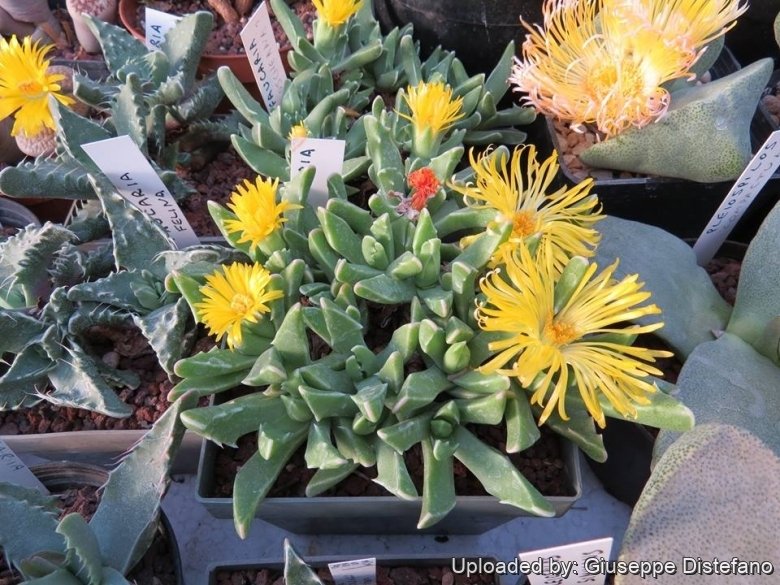
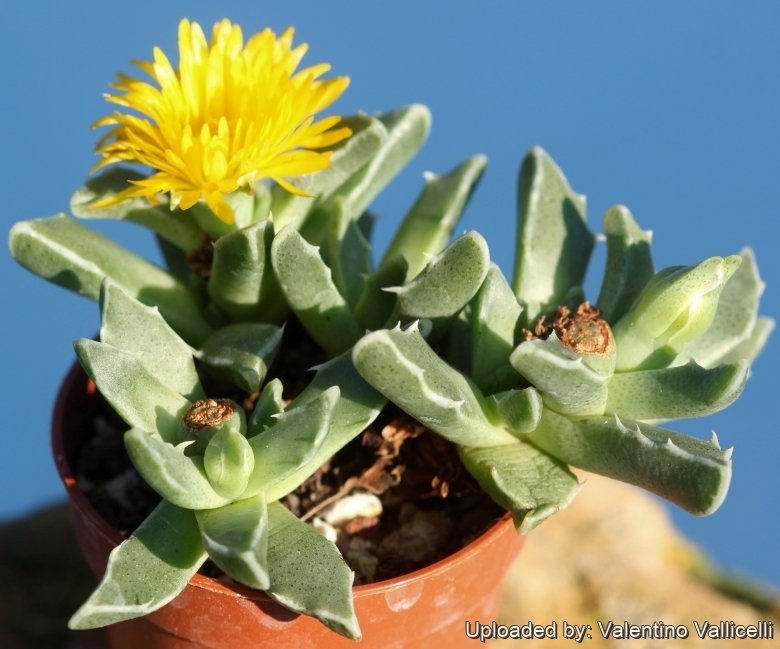
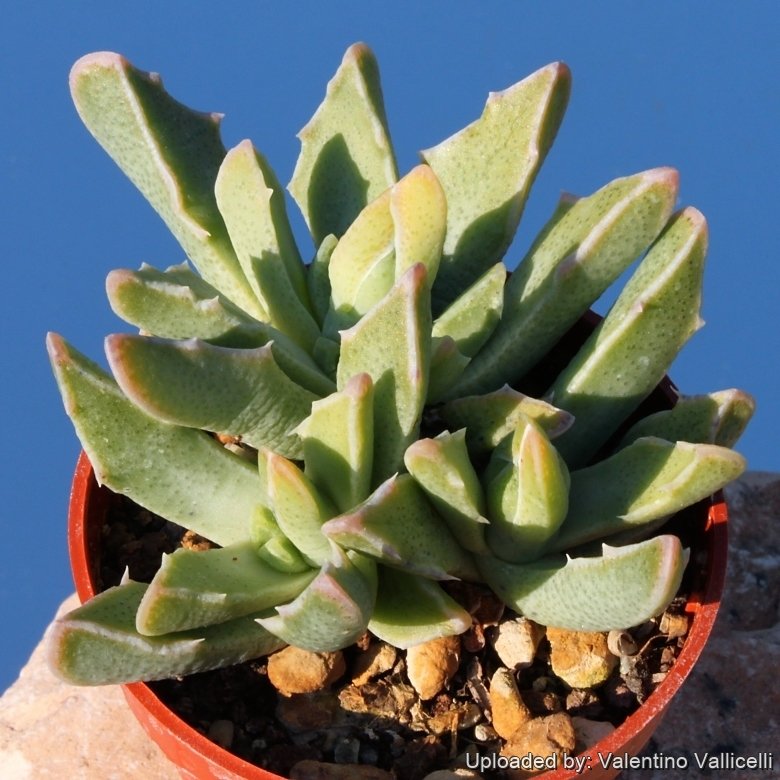
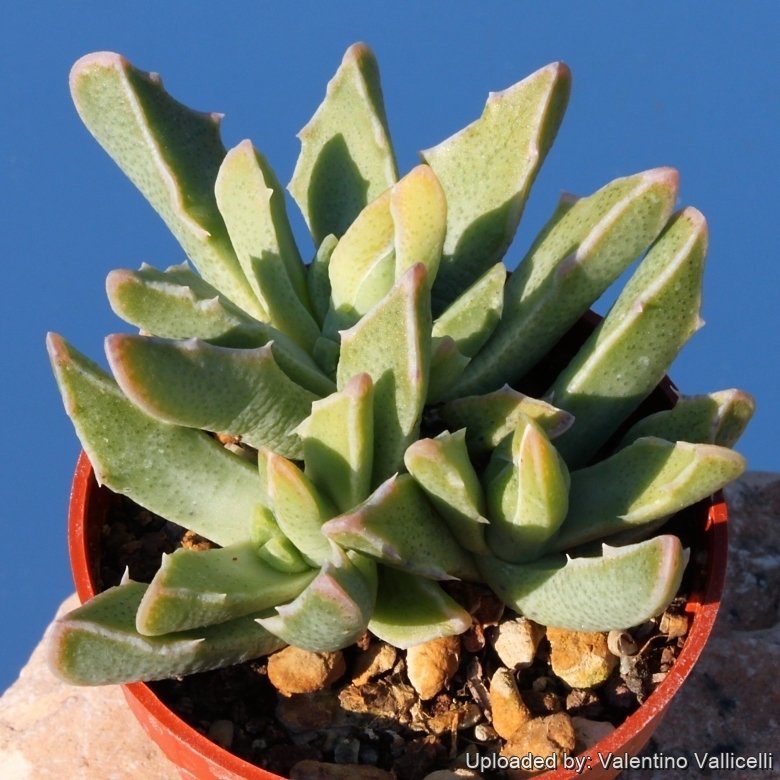
Faucaria bosscheana is somewhat different from the other members of this genus as it has smaller, narrower, unmarked leaves with only 1 to 3 pairs of teeth. This species is quite variable and the shape of the leaves varies slightly in plant from different provenance. As with many other Faucaria species, several varieties have been described on the basis of variation of the leaves, the status of these uncertain.
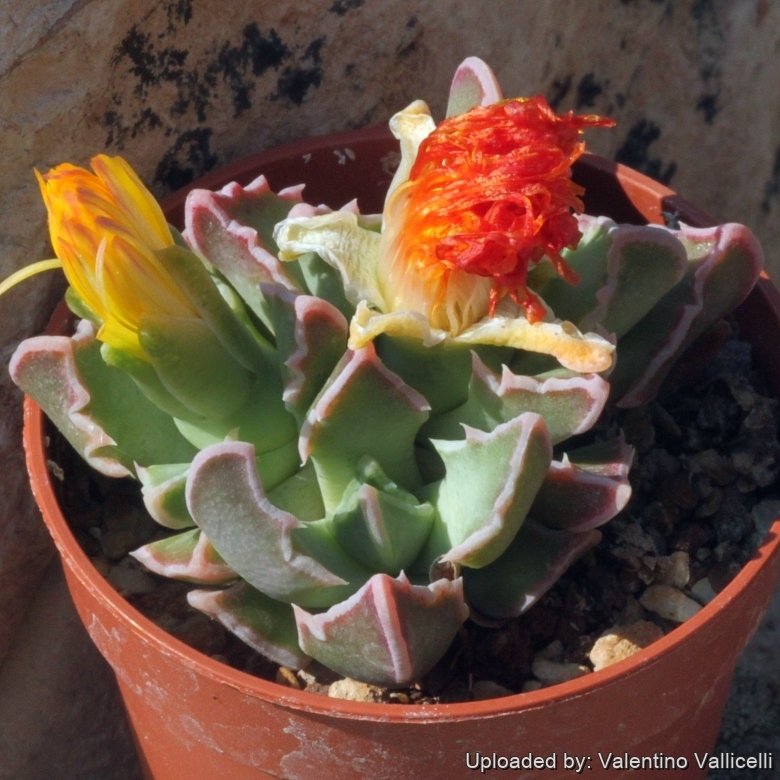
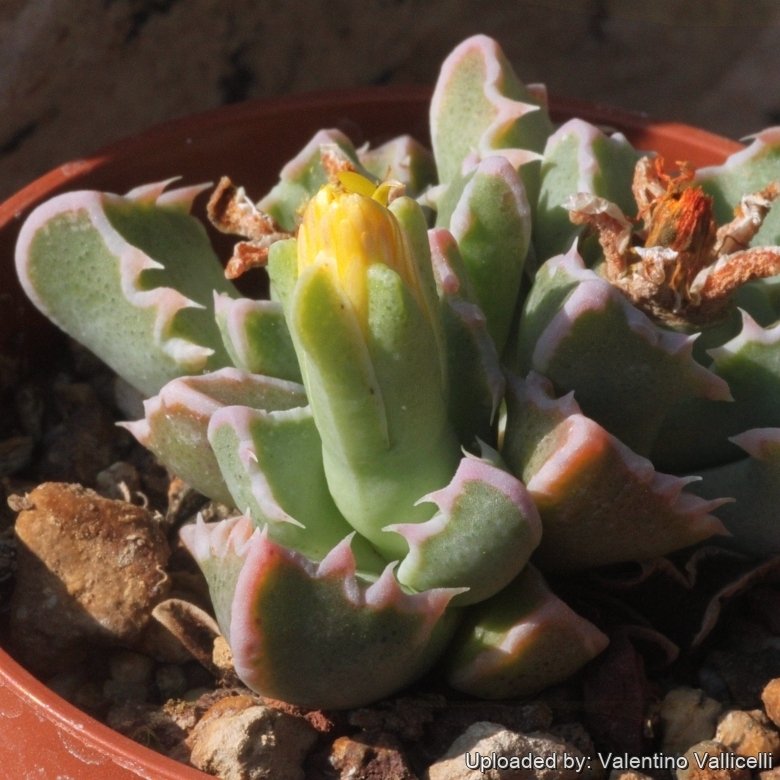
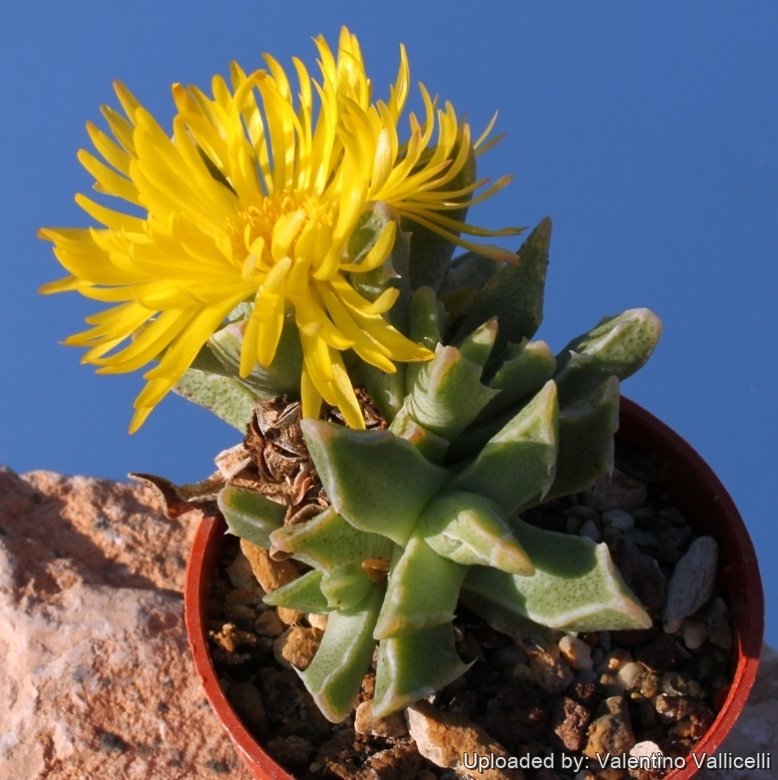
Leaves: Glossy green, canoe-shaped in outline (broadly rhomboid or lanceolate ) about 3-4 cm long, 0,5-10 mm wide, the margins are horny-white and armed with 2-3 long teeth. Tubercles absent from upper leaf-surface.
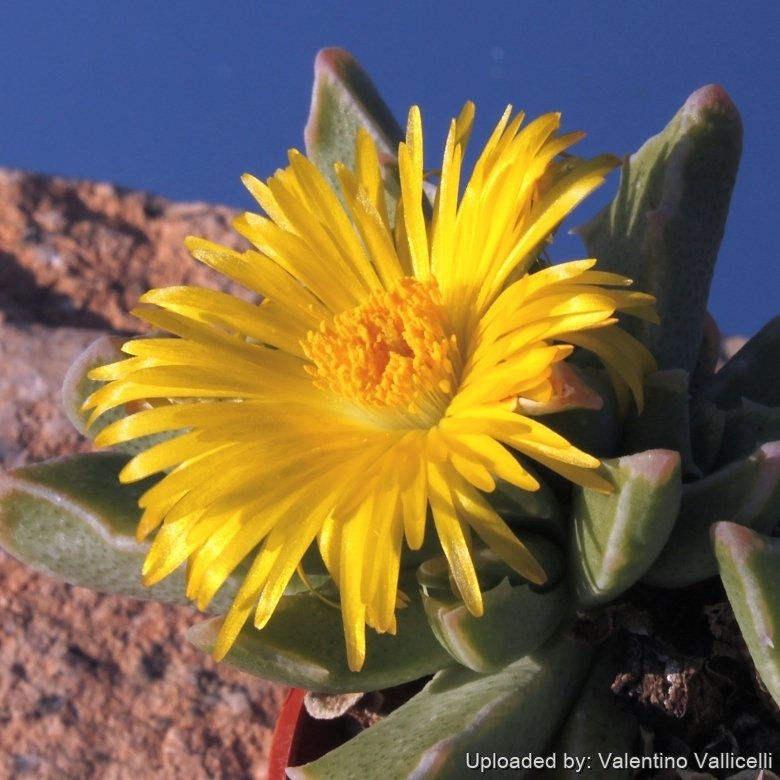
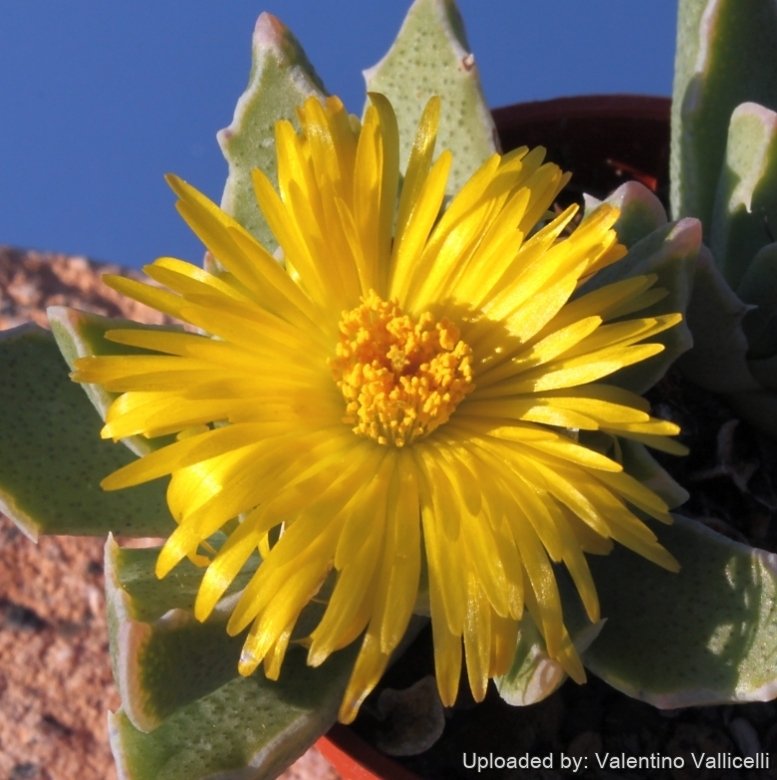
Flowers: Large yellow. It often flowers when two years old.
Origin and Habitat
South Africa (Cape province)
Cultivation and Propagation
Faucarias are la good choice for anyone wanting to start growing succulents. They are quite hardy and can take a short period of light frost and in very dry warm regions these succulents make very impressive out door ground covers. They need full sun to light shade with a well-drained soil mix, but can tolerate a wide variety of soil types and growing locations as long as there is plenty of sun. The plants are well watered during the growing season and allowed to dry thoroughly before watering again and will tolerate some over watering, but the challenge is to help them keep their compact form and prevent elongation of the stem. During the winter months, the plants should be kept very dry, only watering enough to keep the leaves from shrivelling.
As house plants they tend to grow in fair weather and rest when temperatures are too hot or too cool.
Propagation: Faucaria is very easy to start from seed. Seeds germinate in 7-14 days at 21°C. Although they will start from cuttings, it is quite difficult to get them to root. If they start to rot there is usually part of the plant that can be removed and possibly rooted.
Bibliography
Major references and futher lectures
-
Heidrun E. K. Hartmann “Illustrated Handbook of Succulent Plants: Aizoaceae F-Z” Springer, 2002
-
Ernst Van Jaarsveld, Ben-Erik Van Wyk, Gideon Smith “Succulents of South Africa: A Guide to the Regional Diversity” Tafelberg Publishers, Limited, 01/lug/2000
-
Gordon D. Rowleyna anteriore “The illustrated encyclopedia of succulents” Crown Publishers, 01/ago/1978
-
Werner Rauh “The Wonderful World of Succulents: Cultivation and Description of Selected Succulent Plants Other Than Cacti” Smithsonian Institution Press, 1984
From llifle page Faucaria albidens
Description
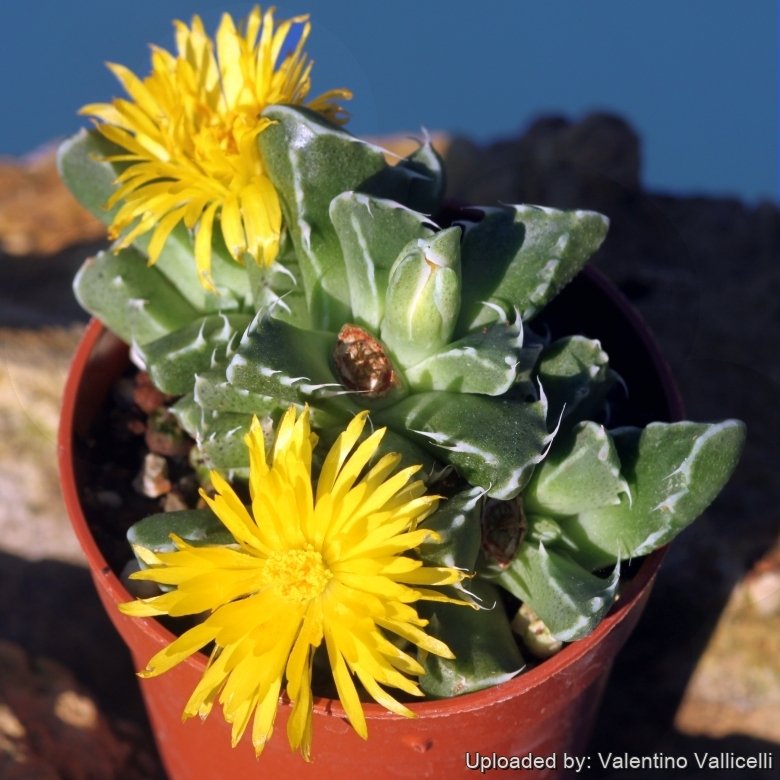
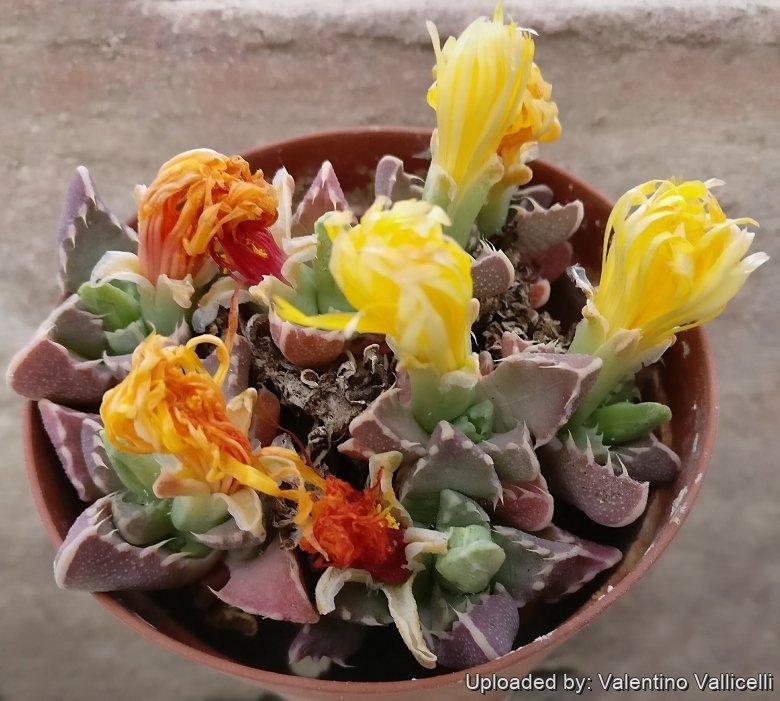
Faucaria albidens is a local or morphological form of the widespread and variable Faucaria bosscheana. Faucaria albidens differs mainly for its beautiful white teeth and leaf margins which appear as if coated with white enamel and this accounts for the name albidens, which means white toothed. However the distinguishing characteristics of Faucaria albidens, appear to fall within the natural variation of Faucaria bosscheana and it should be synonymized with the latter, but it still has a value for a collector because they identify plants with particular characters.
Leaves: The species has compact rosettes with 5 or 6 pairs of leaves 2,5 cm long, wider in the middle, elongated, triangular and tapering; they are fresh green with small dots, and the white margins have 3 to 5 recurved teeth.
Leaves: Small, glossy green leaves, dotted on surface, and a few whitish teeth.
Flower: Golden-yellow. Easily grown it blooms in late summer.
Bibliography
Major references and further lectures
-
John Robert Brown “Unusual Plants: 110 Spectacular Photographs of Succulents” Abbey Garden Press, 1954
-
S. H. Scott “The Observer’s Book of Cacti and Other Succulents” F. Warne, 1958
Source: Faucaria albidens, LLIFLE - Encyclopedia of living forms, CC-BY-SA, retrieved 2026-10-25.
From llifle page Faucaria kendrewensis
Origin and Habitat
Afr. austr. (Cape Prov.)
Source: Faucaria kendrewensis, LLIFLE - Encyclopedia of living forms, CC-BY-SA, retrieved 2026-10-25.
From llifle page Faucaria paucidens
Description
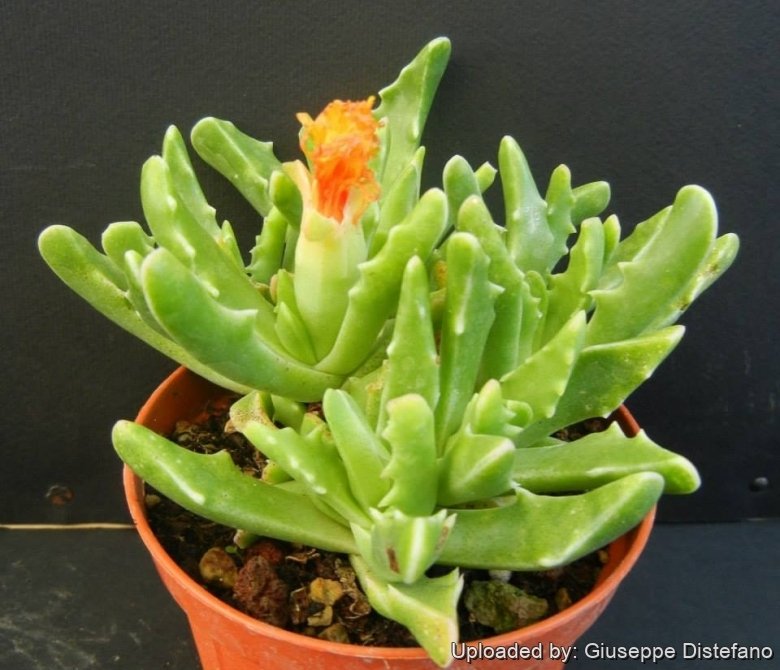
Faucaria paucidens is one of the morphological or local forms of Faucaria bosscheana, and the two plants are not readily distinguishable, if not for the geographical provenance.
Leaves: Canoe-shaped in outline (broadly rhomboid or lanceolate ) about 3-5 cm long, 8-9 mm wide at broadest point, 5-6 mm thick at the base, upper surface linear, pointed, flat, below roundly keeled and slightly compressed at apex, the margins are horny-white and armed with 1-3 denticles. Epidermis pale green, glossy, densely covered with small, dark green spots. Tubercles absent from upper leaf-surface.
Flowers: 3- 4 cm in diameter, yellow.
Blooming season: Autumn to early winter (March—May). They need full sun to open, open around noon and close at night.
Origin and Habitat
Eastern Cape, Province of South Africa.
Cultivation and Propagation
Faucarias are the good choice for anyone wanting to start growing succulents. They are quite hardy and can take a short period of light frost and in very dry warm regions these succulents make very impressive out door ground covers. They need full sun to light shade with a well-drained soil mix, but can tolerate a wide variety of soil types and growing locations as long as there is plenty of sun. The plants are well watered during the growing season and allowed to dry thoroughly before watering again and will tolerate some over watering, but the challenge is to help them keep their compact form and prevent elongation of the stem. During the winter months, the plants should be kept very dry, only watering enough to keep the leaves from shrivelling.
As house plants they tend to grow in fair weather and rest when temperatures are too hot or too cool.
Propagation: Faucarias are very easy to start from seed. Seeds germinate in 7-14 days at 21°C. Although they will start from cuttings, it is quite difficult to get them to root. If they start to rot there is usually part of the plant that can be removed and possibly rooted.
Bibliography
Major references and futher lectures
-
Hermann Jacobsen “Handbuch der sukkulenten Pflanzen: Mesembryanthemaceae” G. Fischer, 1955
-
Ernst Van Jaarsveld, Ben-Erik Van Wyk, Gideon Smith “Succulents of South Africa: A Guide to the Regional Diversity” Tafelberg Publishers, Limited, 01/lug/2000
-
Gordon D. Rowleyna anteriore “The illustrated encyclopedia of succulents” Crown Publishers, 01/ago/1978
-
Werner Rauh “The Wonderful World of Succulents: Cultivation and Description of Selected Succulent Plants Other Than Cacti” Smithsonian Institution Press, 1984
-
Heidrun E. K. Hartmann “Illustrated Handbook of Succulent Plants: Aizoaceae F-Z” Springer, 2002
Source: Faucaria paucidens, LLIFLE - Encyclopedia of living forms, CC-BY-SA, retrieved 2026-10-25.
Gallery