Publication: Cactaceae Consensus Init. 6: 16. 1998
Description
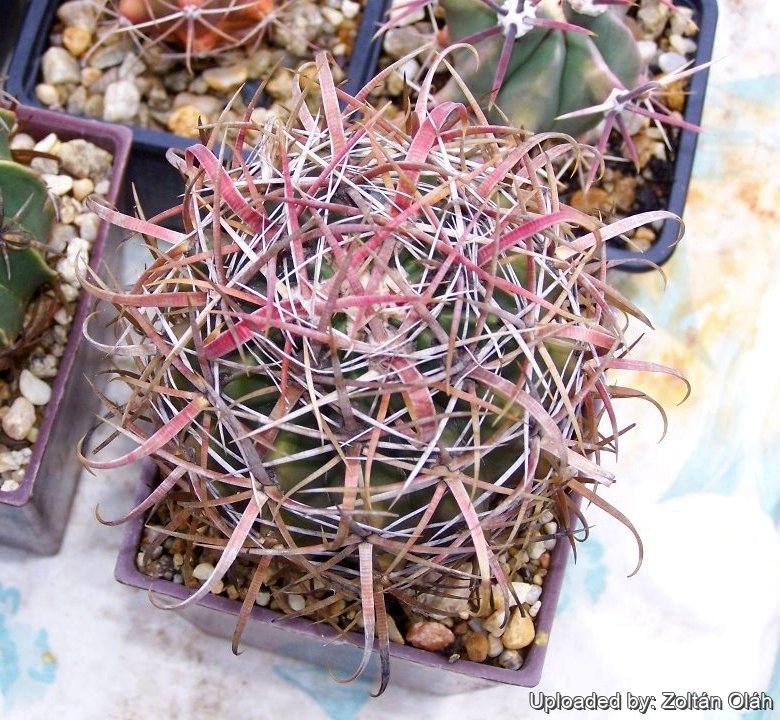
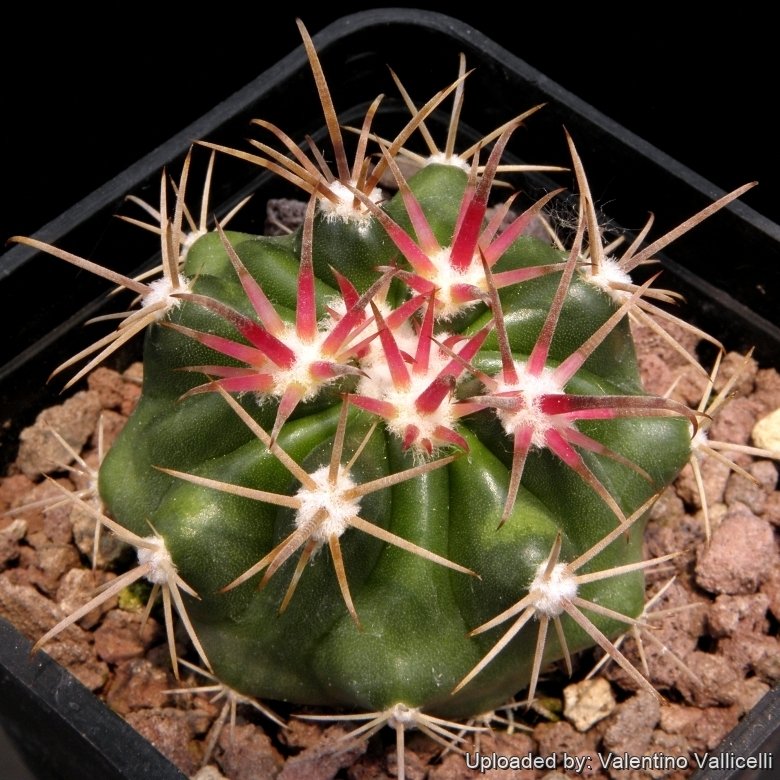
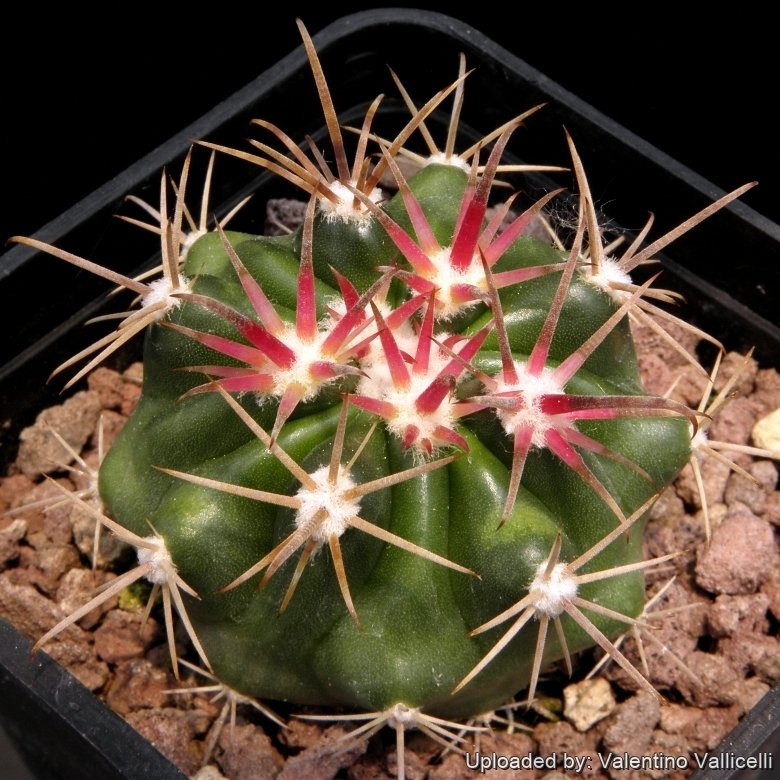
Ferocactus gracilis var. coloratus is a particularly attractive cactus with remarkably spines, that differs from the type species in having shorter stems and shorter spines with upper and lower of four principal centrals at least 6 mm and often over 1 cm wide; lowers spines similar to those of Ferocactus gracilis but with less red pigment and less broadly expanded; seeds more angular, irregular, and slightly larger than those of gracilis. The population of barrel cacti in which F. gracilis var. coloratus occurs is variable, and the specimens which have been collected to represent coloratus are usually the extreme examples. It is possible that the population may actually represent a hybrid swarm containing genetic material from both Ferocactus gracilis and Ferocactus peninsulae , which occurs in the adjacent Sierra San Florias, and Ferocactus peninsulae var. viscainensis, which occurs in the Vizcaino Desert to the south.
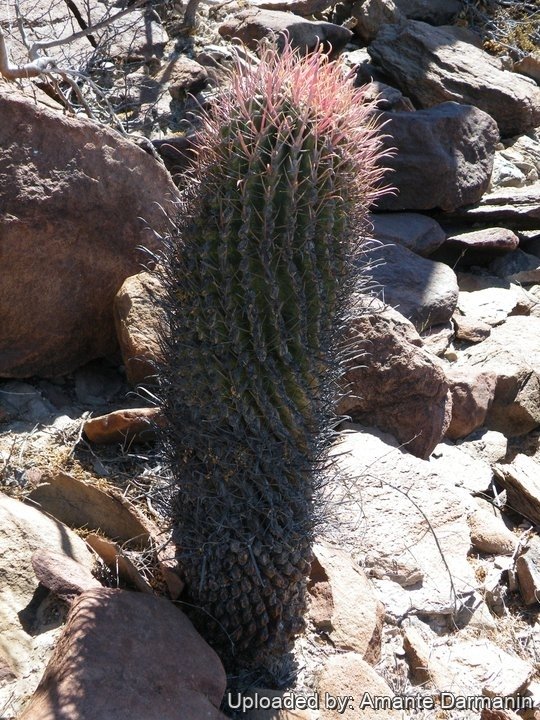
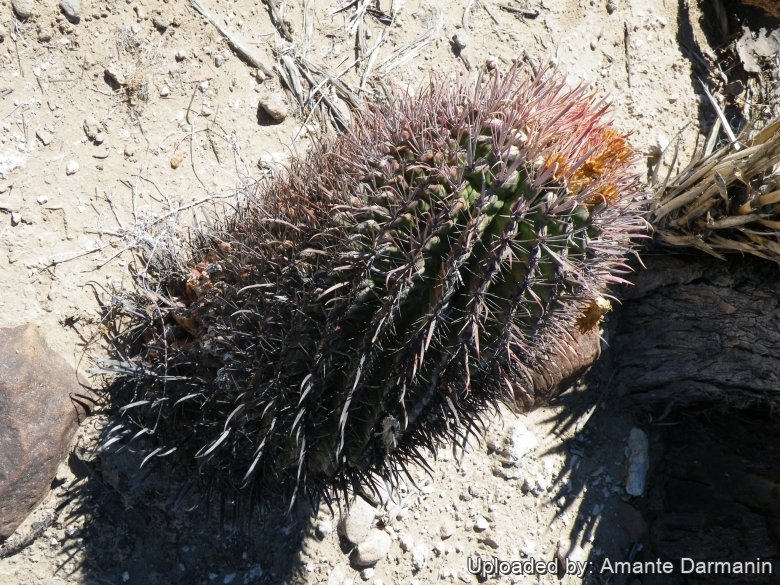
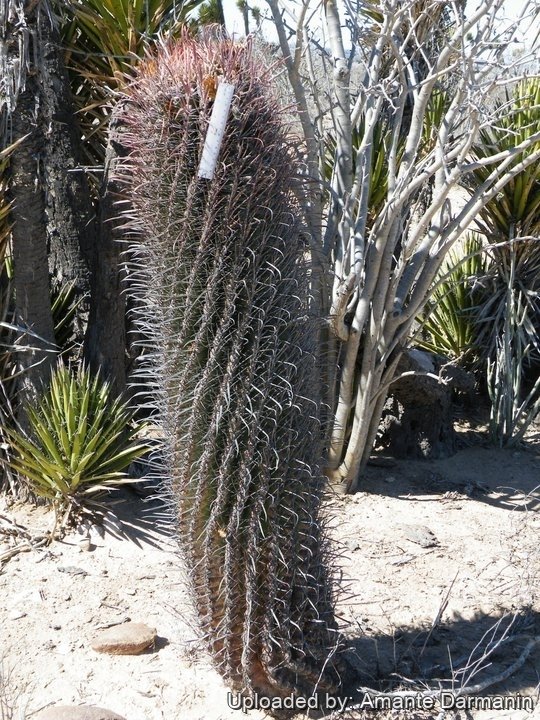
Habit: It is a large solitary, ribbed barrel cactus, becoming cylindric in age and attaining exceptionally a height of 3 metres.
Stem: Unbranched, deep green, at first globular and later cylindrical, erect, up to 1,5(or more) meters high (but usually about 70 cm), up to 30 wide.
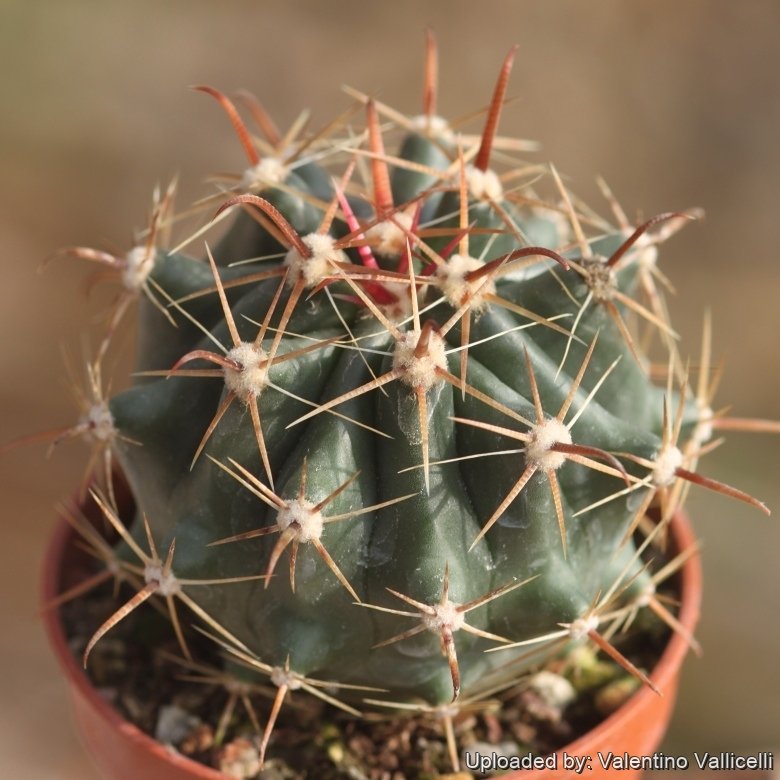
Ribs: 16 to 24, prominent, acute, slightly tuberculate and expanded under areoles, 2 cm. high.
Areoles: Young areoles light-grey felted, oval to elliptic, 15-20 mm long, 6 mm wide constricted between the flower and the spine-bearing section, 4 cm apart or even less in old plants.
Spines: Clearly differentiated into stout coloured centrals and fine, white radials.
Central spines: 7-13 in two series, reddish with yellow tips, greyish or brown, banded, somewhat curved, twisted and tangled, annulate, the main 4 forming a cross, upper and lower flattened, lateral two subulate, lower longest, less than 7 cm long, 6-10 mm wide, rather convolute and curved or booked at tip
Radial spines: 8-12 whitish, spreading, to 6 cm long, variable, slender, straight, flattened-setaceous,sometimes twisted, lower three stouter acicular to subulate.
Flowers: Funnelform, about 4 long and 3,5 cm in diameter, reddish with darker red midveins. Ovary with widely placed scales intergrading into obtuse, red, outer perianth segments. Inner inner perianth segments linear-lanceolate, 25 mm long, 5-7 mm. wide, midstripe lavender-red, margins yellow, serrulate. Filaments numerous, fine, appressed against style. Style 22 mm. long, yellow and red above, stigma lobes 9.
Blooming season: The plants usually bloom during late spring or early summer, occasionally in late summer. Solitary bees are probably the most important pollinators. Ants visit extrafloral nectaries on the plant apex and may protect the cactus from insect herbivores.
Fruit: Oblong cylindrical, yellowish, 2,5 cm long, bearing broad rounded scales, not dehiscing by basal pores.
Seeds. Rounded, somewhat angled, irregular, and slightly larger than those of gracilis, black and shiny.
Origin and Habitat
Known only from the area between Punta Pricta and Miller’s Landing, Baja California, North West Mexico.
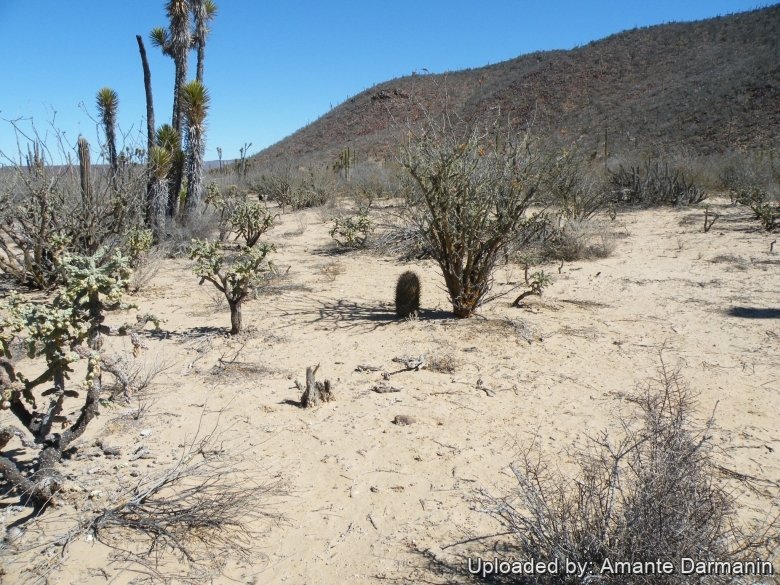
Habitat: It grows at low elevation on rocky hillsides and gravelly plains together with Idria columnaris and Mammillaria blossfeldiana.
Cultivation and Propagation
Ferocactus gracilis subsp. coloratus is a summer-growing and pretty easy plant thought slow to start. It makes great potted specimens, and is a great cactus for beginning collectors.
Growth rate: It is a slow growing species. Plant in good conditions will start to bloom when reach the diameter of only 20-25 cm.
Soil: It grows well in a rich, well drained soil such us clay, pumice, lava grit, and only a little peat or leaf-mould, but it isn’t picky about soil.
Repotting: If potted, repot them preferably in the spring, if their roots become cramped. Generally, they should be repotted every other year in order to provide fresh soil. However, this doesn’t necessarily mean they’ll need larger containers. Fill about a quarter of the pot with broken crocks, gravel, etc. to promote good drainage. After repotting, do not water for a week or more. Use pot with good drainage. Eventually, as the plant becomes mature grow it slowly, and adopt a new repotting period, using intervals of every 2 - 3 years. Additionally grow it under drier conditions or with stronger sunlight.
Watering: Water regularly during the summer so long as the plant pot is allowed to drain and not sit in a tray of water (It rots easily, especially if over wet), and also needs to be avoided wetting the body of this plant while it is in sunlight. A wet cactus in the sun light can cause sun burning which can lead to scars or even fungal infections and death.. Let dry between watering. During hot weather you may need to water the plants more frequently so long as the plant is actively growing. From late September watering should be reduced to force the plant to go in to a state of semi dormancy, by October you should be back in to the winter watering regime. If the soil is allowed to be dry for too long root loss could follow but equally the same result would occur if the plants are both wet and cold. From March onward the plant will begin to grow and watering should be increased gradually until late May when the plant should be in full growth
Fertilization: Feed with a high potassium fertilizer in summer. Feeding may not be necessary at all if the compost is fresh then, feed in summer only if the plant hasn’t been repotted recently. Do not feed the plants from September onward as this can cause lush growth which can be fatal during the darker cold months.
Hardiness: When dormant, the plant is slightly cold tolerant (down to nearly -2° C or less), but when left out it is more sensitive to frost. However warmth throughout the year will increase the grower’s success (at minimum temperatures above 5 degrees centigrade during rest season). During the summer it is best to keep the plants outside where the temperature can rise to over 30 C with no harm to the plant. This plants need a period of cool rest in winter to produce flowers abundantly.
Exposure: They do need a lot of light to develop their typical spination, but different clones vary in their tolerance of full sunshine. However some protection in light shade is recommended during the hottest hours in summer. It can tolerate moderate shade, and a plant that has been growing in shade should be slowly hardened off before placing it in full sun as the plant will be severely scorched if moved too suddenly from shade into sun. If kept too dark they may become overly lush and greener and could be prone to rotting due to over watering.
Uses: It is an excellent plant for container growing. It always looks good and stays small. It looks fine in a cold greenhouse and frame.
Diseases and pests: Watch for infestations of mealybugs, scale insects and spider mite. Rot is only a minor problem with cacti if the plants are watered and “aired” correctly. If they are not, fungicides won’t help all that much.
Propagation: Seeds are the only way of reproducing, remembering that seedlings dislike strong light and dry conditions and need to be repotted frequently. Seed Collecting: Permit fruit to ripen. Fruit must be significantly overripe before harvesting seed; clean and dry seeds.
Notes
Ferocactus gracilis var. coloratus and Ferocactus peninsulae have much brighter red spines after being wetted.
Bibliography
Major references and further lectures
-
James Cullen, Sabina G. Knees, H. Suzanne Cubey “The European Garden Flora Flowering Plants: A Manual for the Identification of Plants Cultivated in Europe, Both Out-of-Doors and Under Glass” Cambridge University Press, 11/Aug./2011
-
David Hunt, Nigel Taylor “The New Cactus Lexicon” DH Books, 2006 ISBN 0953813444, 9780953813445.
-
Edward F. Anderson “The Cactus Family” Timber Press, 2001
-
Blom, P. E., W. H. Clark, “Observations of ants (Hymenoptera: Formicidae) visiting extrafloral nectaries of the barrel cactus, Ferocactus gracilis Gates (Cactaceae), in Baja California, Mexico.” Southwestern Naturalist 25:181–96 1980
-
Jeanette Coyle, Norman C. Roberts “A field guide to the common and interesting plants of Baja California” Natural History Pub. Co., 1975
-
Forrest Shreve, Ira Loren Wiggins “Vegetation and Flora of the Sonoran Desert, Volume 1” Stanford University Press, 1964
-
Raymond M. Turner, Janice Emily Bowers, Tony L. Burgess “Sonoran Desert Plants: An Ecological Atlas” University of Arizona Press, 2005.
From llifle page Ferocactus peninsulae subs. viscainensis
Description
Ferocactus peninsulae subs. viscainensis is a large barrel cactus which is often considered a separate species. It distinguishes for the dull olive green body, more ribs, (13-21) which are distinctly tuberculate, thin, deep and undulate. It is also known by many to be synonymous with Ferocactus gracilis.
Habit: It is a large ribbed barrel cactus, simple, becoming cylindric in age and attaining a height of 1,5 metres (or more).
Stem: Unbranched, globose to subcylindric, clavate, erect, up to 1,5 meters high (but usually about 70 cm), up to 30 across, dull olive green.
Ribs: 13 to 21, prominent, distinctly tuberculate, thin, deep and undulate.
Areoles: Young areoles brown-felted, elliptic, 15-20 mm long, constricted between the flower and the spine-bearing section, 4 cm apart or even less in old plants.
Central spines: 4 (or more), forming a cross, reddish with yellow tips, greyish or brown, the lower one flattened up to 7 cm long, somewhat curved, twisted and tangled and hooked, annulate.
Radial spines: 8-12 whitish, spreading, variable, straight, slender, terete.
Flowers: Broadly funnelform, 5-6 cm long red to yellow with orange to red midveins.
Blooming season: Spring to autumn.
Fruit: Oblong cylindrical, yellowish often tinged reddish, 2,5-7,5 cm long, bearing broad rounded scales.
Seeds: 1,7-2,5 mm long, brown to black, finely pitted to noticeably reticulate.
Origin and Habitat
Central/northern Baja California, North West Mexico. It is one of the rarer Ferocactus species in the area.
Cultivation and Propagation
Ferocactus peninsulae subs. viscainensis is a summer-growing and pretty easy plant thought slow to start. It makes great potted specimens, and is a great cactus for beginning collectors.
Growth rate: It is a slow growing species. Plant in good conditions will start to bloom when reach the diameter of only 20-25 cm.
Soil: It grows well in a rich, well drained soil such us clay, pumice, lava grit, and only a little peat or leaf-mould, but it isn’t picky about soil.
Repotting: If potted, repot them preferably in the spring, if their roots become cramped. Generally, they should be repotted every other year in order to provide fresh soil. However, this doesn’t necessarily mean they’ll need larger containers. Fill about a quarter of the pot with broken crocks, gravel, etc. to promote good drainage. After repotting, do not water for a week or more. Use pot with good drainage. Eventually, as the plant becomes mature grow it slowly, and adopt a new repotting period, using intervals of every 2 - 3 years. Additionally grow it under drier conditions or with stronger sunlight.
Watering: Water regularly during the summer so long as the plant pot is allowed to drain and not sit in a tray of water (It rots easily, especially if over wet), and also needs to be avoided wetting the body of this plant while it is in sunlight. A wet cactus in the sun light can cause sun burning which can lead to scares or even fungal infections and death.. Let dry between watering. During hot weather you may need to water the plants more frequently so long as the plant is actively growing. From late September watering should be reduced to force the plant to go in to a state of semi dormancy, by October you should be back in to the winter watering regime. If the soil is allowed to be dry for too long root loss could follow but equally the same result would occur if the plants are both wet and cold. From March onward the plant will begin to grow and watering should be increased gradually until late May when the plant should be in full growth
Fertilization: Feed with a high potassium fertilizer in summer. Feeding may not be necessary at all if the compost is fresh then, feed in summer only if the plant hasn’t been repotted recently. Do not feed the plants from September onward as this can cause lush growth which can be fatal during the darker cold months.
Hardiness: When dormant, the plant is slightly cold tolerant (down to nearly -2° C or less), but when left out it is more sensitive to frost. However warmth throughout the year will increase the grower’s success (at minimum temperatures above 5 degrees centigrade during rest season). During the summer it is best to keep the plants outside where the temperature can rise to over 30 C with no harm to the plant. This plants need a period of cool rest in winter to produce flowers abundantly.
Exposure: They do need a lot of light to develop their typical spination, but different clones vary in their tolerance of full sunshine. However some protection in light shade is recommended during the hottest hours in summer. It can tolerate moderate shade, and a plant that has been growing in shade should be slowly hardened off before placing it in full sun as the plant will be severely scorched if moved too suddenly from shade into sun. If kept too dark they may become overly lush and greener and could be prone to rotting due to over watering.
Uses: It is an excellent plant for container growing. It always looks good and stays small. It looks fine in a cold greenhouse and frame.
Traditional uses: Mexicans on the peninsula of Lower California often cut off the spines of this plant and use it as feed for cattle.
Diseases and pests: Watch for infestations of mealybugs, scale insects and spider mite. Rot is only a minor problem with cacti if the plants are watered and “aired” correctly. If they are not, fungicides won’t help all that much.
Propagation: Seeds are the only way of reproducing, remembering that seedlings dislike strong light and dry conditions and need to be repotted frequently. Seed Collecting: Permit fruit to ripen. Fruit must be significantly overripe before harvesting seed; clean and dry seeds.
Bibliography
Major references and further lectures
-
James Cullen, Sabina G. Knees, H. Suzanne Cubey “The European Garden Flora Flowering Plants: A Manual for the Identification of Plants Cultivated in Europe, Both Out-of-Doors and Under Glass” Cambridge University Press, 11/Aug./2011
-
David Hunt, Nigel Taylor “The New Cactus Lexicon” DH Books, 2006 ISBN 0953813444, 9780953813445.
-
Edward F. Anderson “The Cactus Family” Timber Press, 2001
-
Nathaniel Lord Britton, Joseph Nelson Rose “Cactaceae: Descriptions and Illustrations of Plants of the Cactus Family” Volume 3, 1922
-
Jeanette Coyle, Norman C. Roberts “A field guide to the common and interesting plants of Baja California” Natural History Pub. Co., 1975
Source: Ferocactus peninsulae subs. viscainensis, LLIFLE - Encyclopedia of living forms, CC-BY-SA, retrieved 2026-10-25.
Gallery