Publication: Cactaceae Consensus Init. 6: 16. 1998
Description
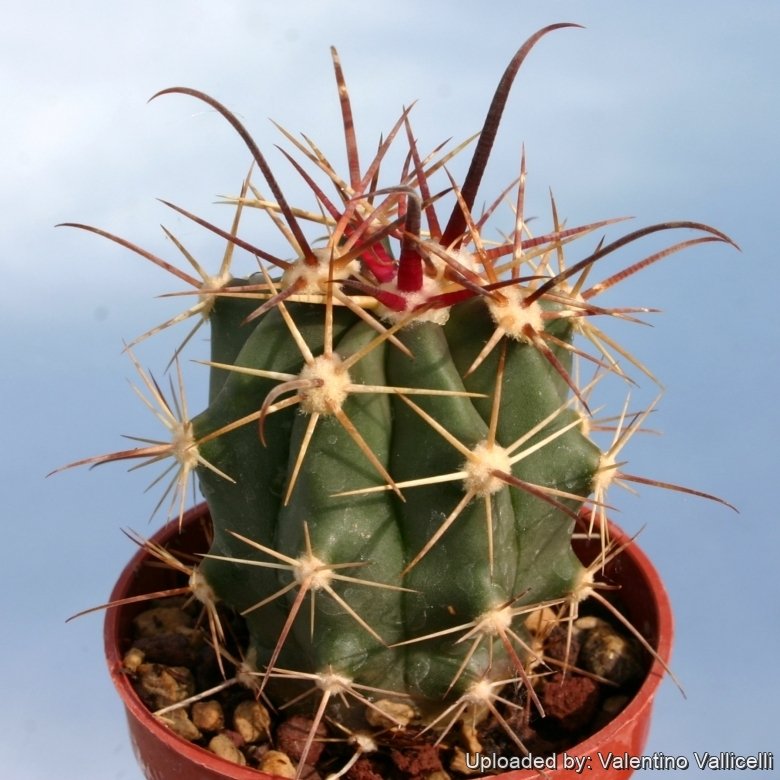
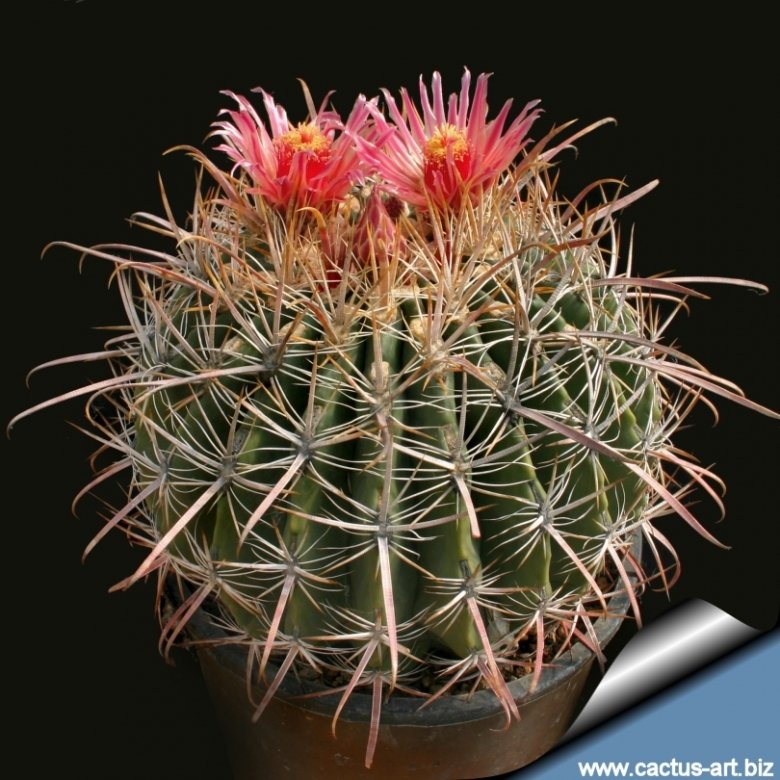
Ferocactus gracilis var. gatesii is a particularly attractive cactus with remarkably spines, thet differs from Ferocactus gracilis in having stems up to 1,5 m tall (occasionally up to 3 m tall), more ribs (24-32) and the central spines are shorter, curved but not hooked and only 3 mm wide. It is closely related to the northern Ferocastus cylindraceus.
Habit: It is a large solitary, ribbed barrel cactus, becoming cylindric in age and attaining exceptionally a height of 3 metres.
Stem: Unbranched, deep green, at first globular and later cylindrical, erect, up to 1,5(or more) meters high, up to 30 wide.
Ribs: 24-32, prominent, acute, slightly expanded under areoles, 2,5 cm deep.
Areoles: Young areoles light-grey felted, oval to elliptic, 15-20 mm long, 6 mm wide constricted between the flower and the spine-bearing section, 4 cm apart or even less in old plants.
Spines: Clearly differentiated into stout coloured centrals and fine, white radials.
Central spines: 7-13 in two series, reddish-browm or greyish-pink with paler tips, banded, the main 4 forming a cross, upper and lower flattened, lateral two subulate, lower longest, 2,5-4 cm(rarely up to 6 cm)long, 6-10 mm wide, rather convolute and curved but not hooked at tip.
Radial spines: 5-6(-8)whitish, spreading, 2,5-4 cm long, variable, slender, straight, flattened-setaceous, sometimes twisted.
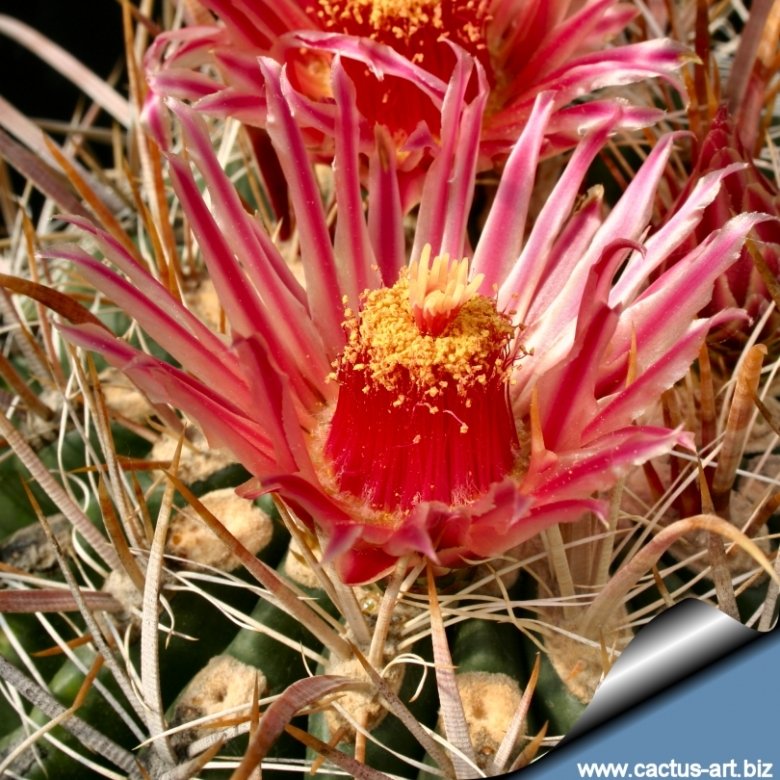
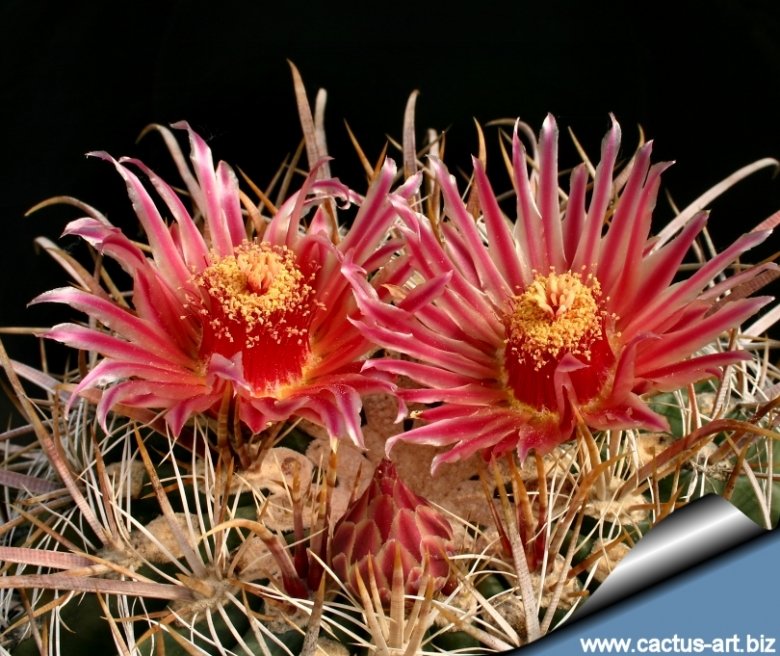
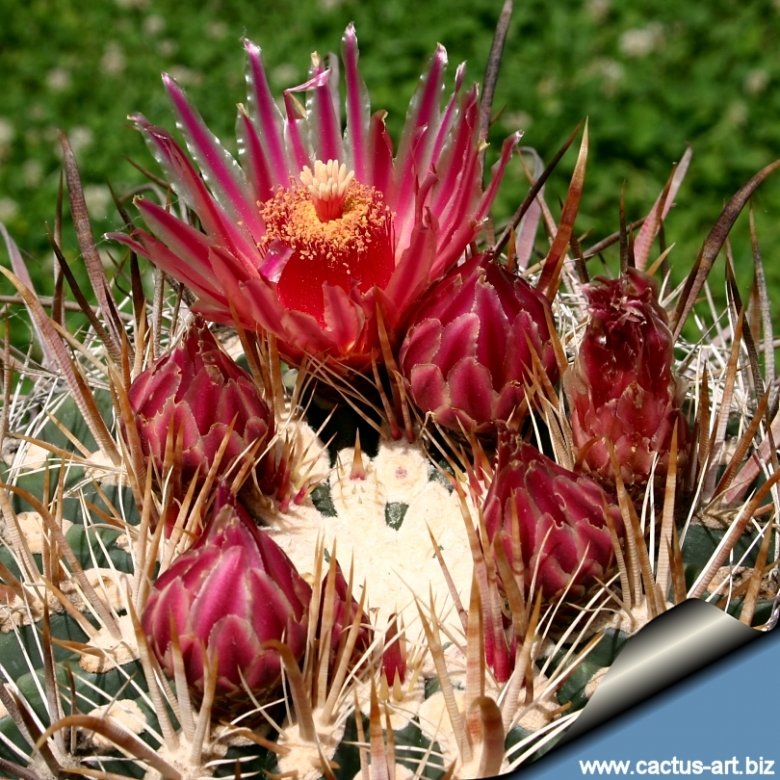
Flowers: Diurnal, funnelform, about 4 long and 3,5 cm in diameter, reddish with darker red midveins. Ovary with widely placed scales intergrading into obtuse, red, outer perianth segments. Inner inner perianth segments linear-lanceolate, 25 mm long, 5-7 mm. wide, midstripe lavender-red, margins yellow, serrulate. Filaments numerous, red, fine, appressed against style. Style 22 mm. long, yellow and red above, stigma lobes about 9.
Blooming season: The plants usually bloom during late spring or early summer, occasionally in late summer. Solitary bees are probably the most important pollinators. Ants visit extrafloral nectaries on the plant apex and may protect the cactus from insect herbivores.
Fruit: Oblong cylindrical, yellowish, bearing broad rounded scales.
Origin and Habitat
Mexico, only known from the islets in the mouth of the Bahia de los Angeles and along the coast in the gulf of California (Smith Islands group in the Sea of Cortez). This species appears to be relictual from cooler times when Ferocactus cylindraceus reached further south in the in the northern peninsula of California.
Habitat: Coastal fog desert.
Cultivation and Propagation
Slow growing to start, but it does well under cultivation. Suited for any rich, well drained soil in full sun throughout the year. Water during the aestival growth cycle (this plant needs plenty of water). But it’s necessary to avoid wetting the bodies of these plants while they are in sunlight. A wet cactus in the sun can suffer sun burning, which can lead to scars or even fungal infections and death. In winter keep completely dry at 10°C, but it can tolerate sporadic light frost.
Propagation: They are easily grown from seed!
Bibliography
Major references and further lectures
-
James Cullen, Sabina G. Knees, H. Suzanne Cubey “The European Garden Flora Flowering Plants: A Manual for the Identification of Plants Cultivated in Europe, Both Out-of-Doors and Under Glass” Cambridge University Press, 11/Aug./2011
-
David Hunt, Nigel Taylor “The New Cactus Lexicon” DH Books, 2006
-
Edward F. Anderson “The Cactus Family” Timber Press, 2001
-
Blom, P. E., W. H. Clark, “Observations of ants (Hymenoptera: Formicidae) visiting extrafloral nectaries of the barrel cactus, Ferocactus gracilis Gates (Cactaceae), in Baja California, Mexico.” Southwestern Naturalist 25:181–96 1980
-
Jeanette Coyle, Norman C. Roberts “A field guide to the common and interesting plants of Baja California” Natural History Pub. Co., 1975
-
Forrest Shreve, Ira Loren Wiggins “Vegetation and Flora of the Sonoran Desert, Volume 1” Stanford University Press, 1964
-
Raymond M. Turner, Janice Emily Bowers, Tony L. Burgess “Sonoran Desert Plants: An Ecological Atlas” University of Arizona Press, 2005.
-
Ted J. Case, Martin L. Cody, Exequiel Ezcurra “A New Island Biogeography of the Sea of Cortes” Oxford University Press, 23/ott/2002
Gallery