Publication: Succulenta (Netherlands) 74: 130 1995
Description
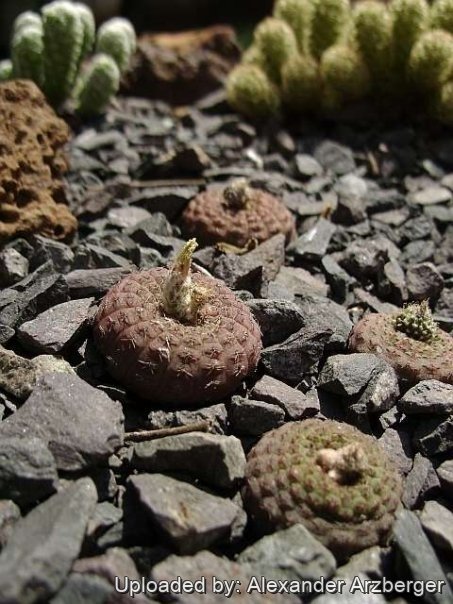
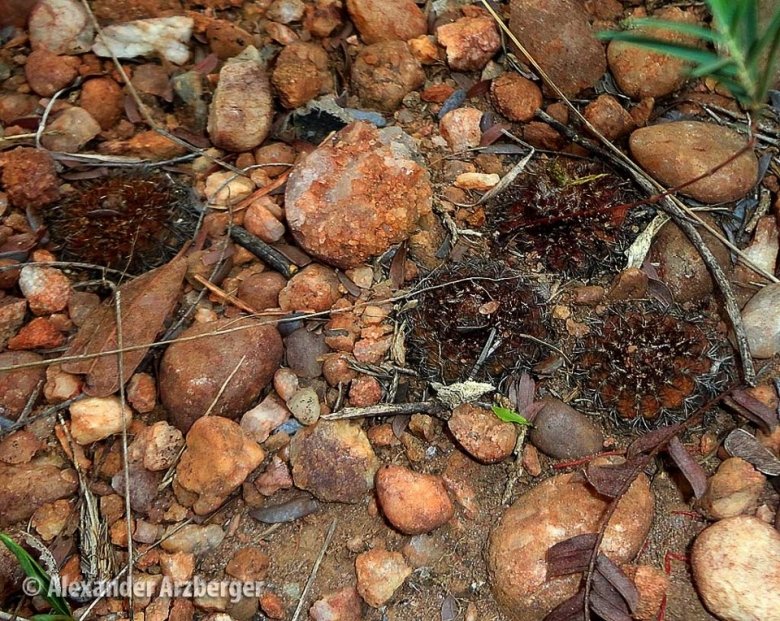
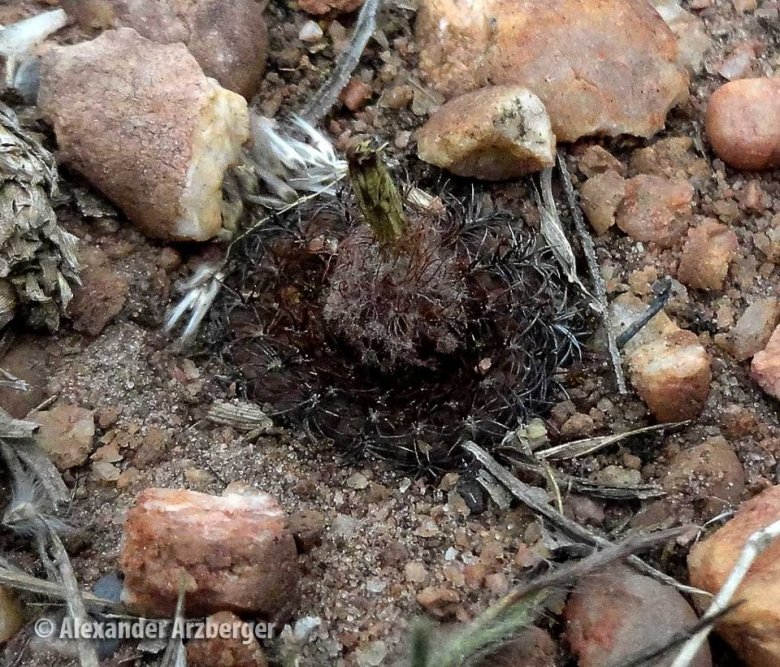
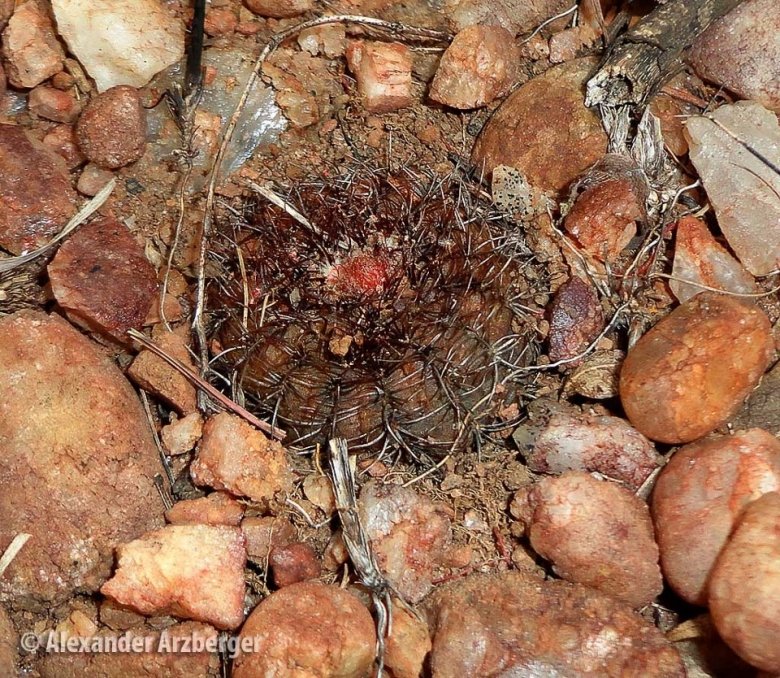
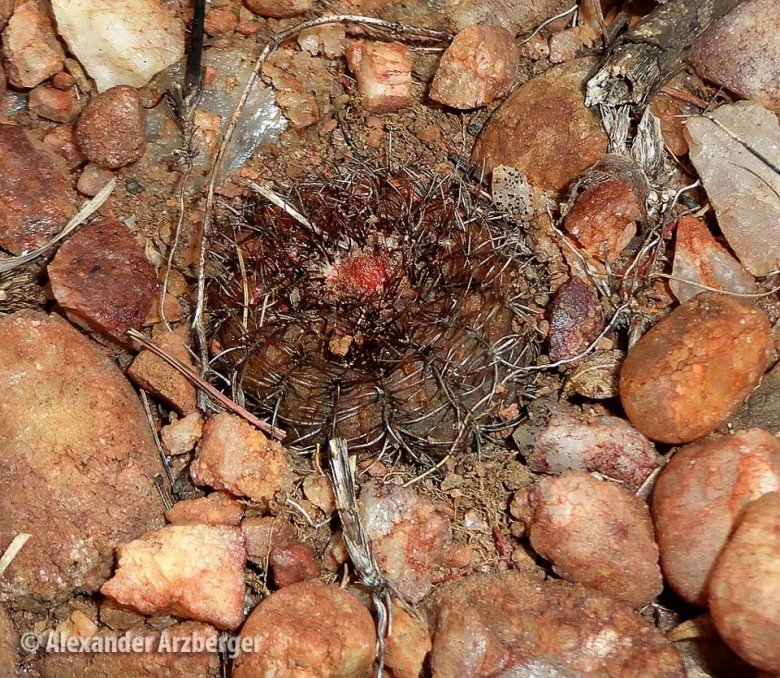
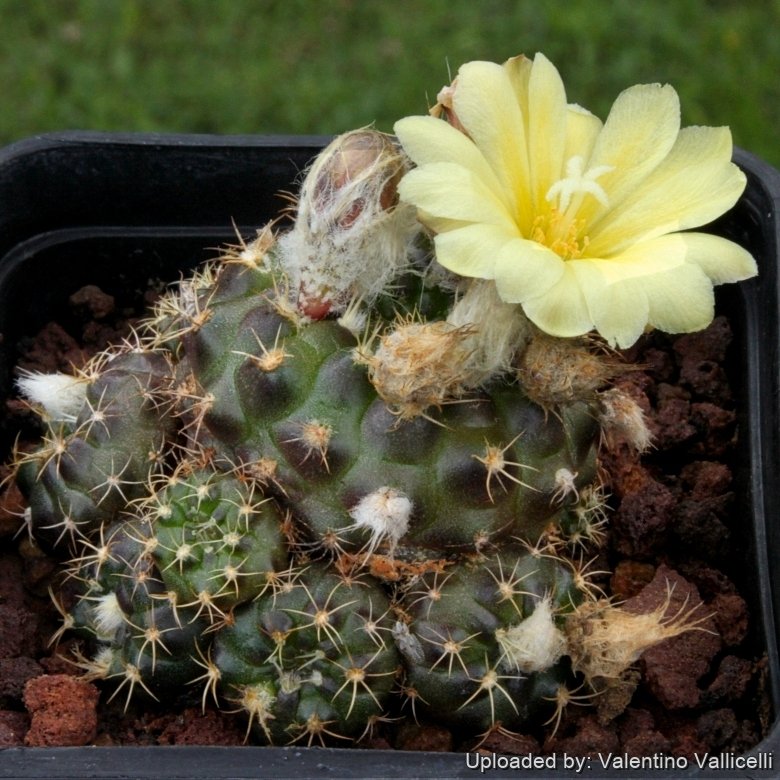
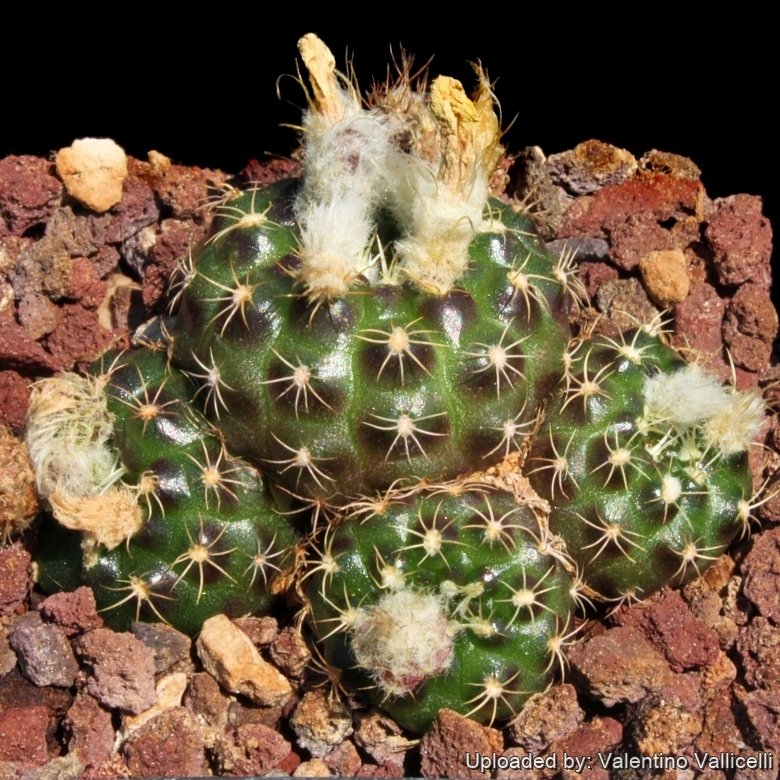
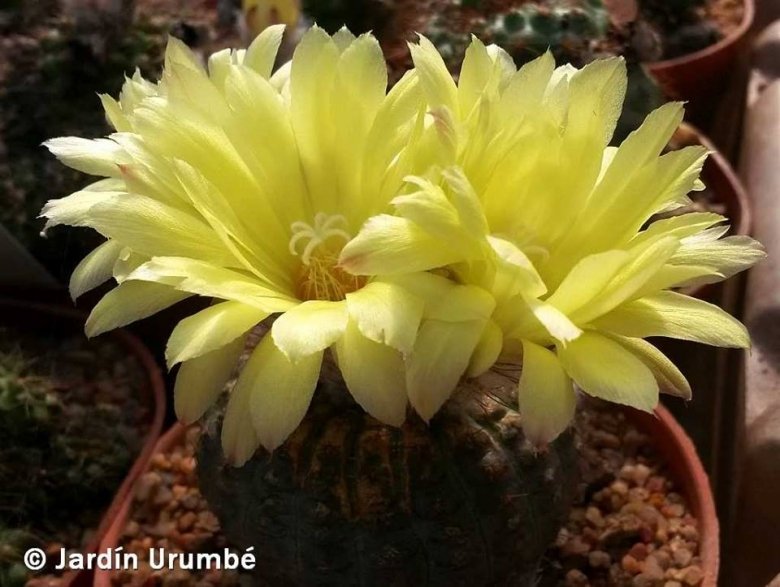
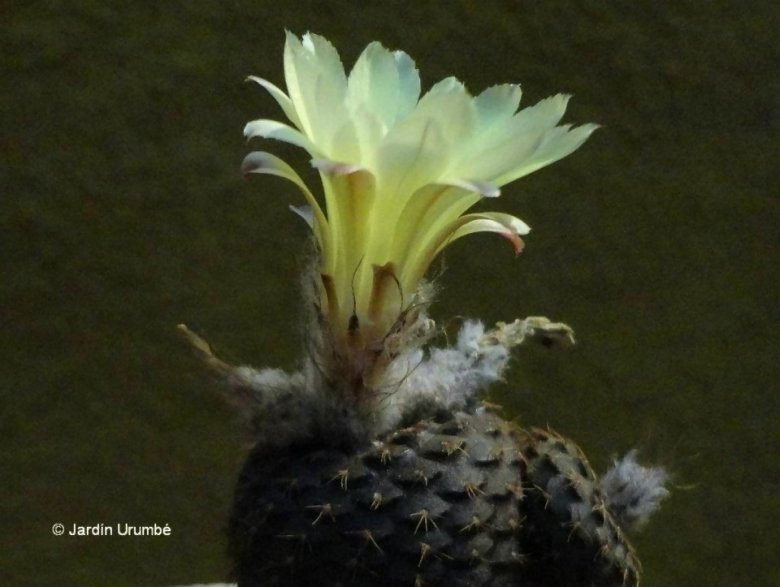
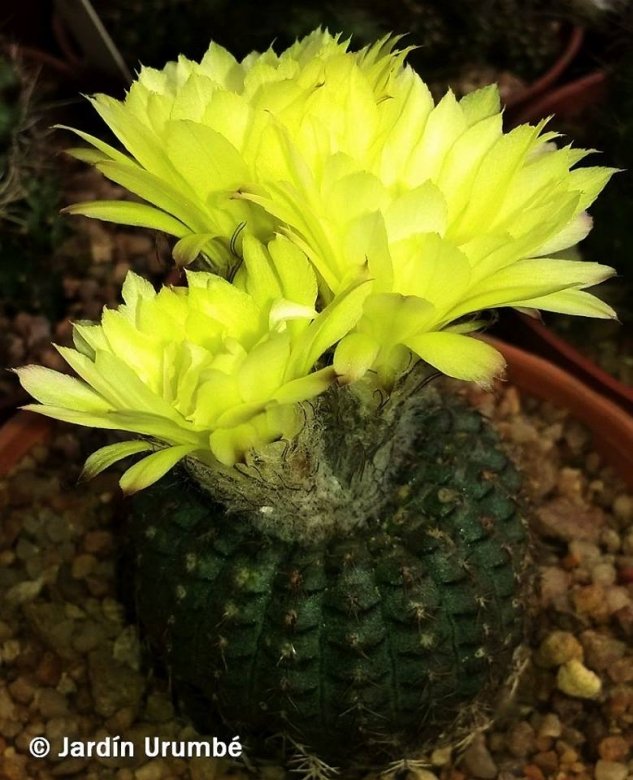
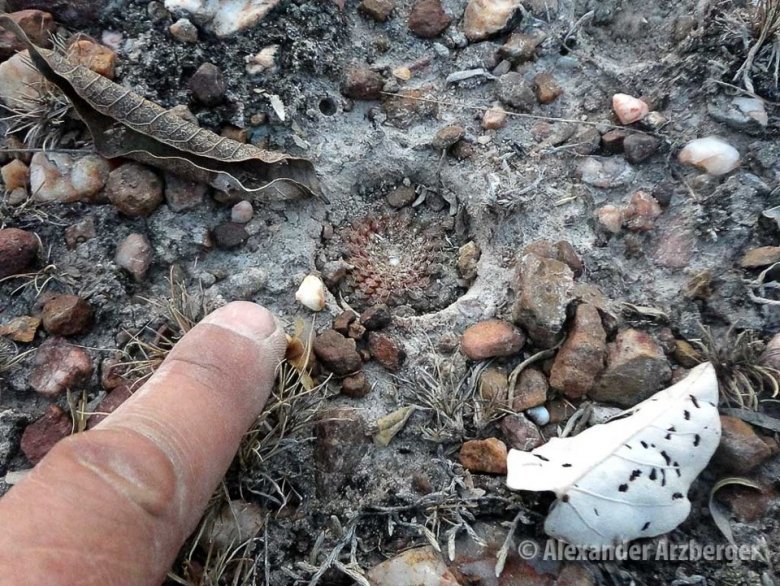
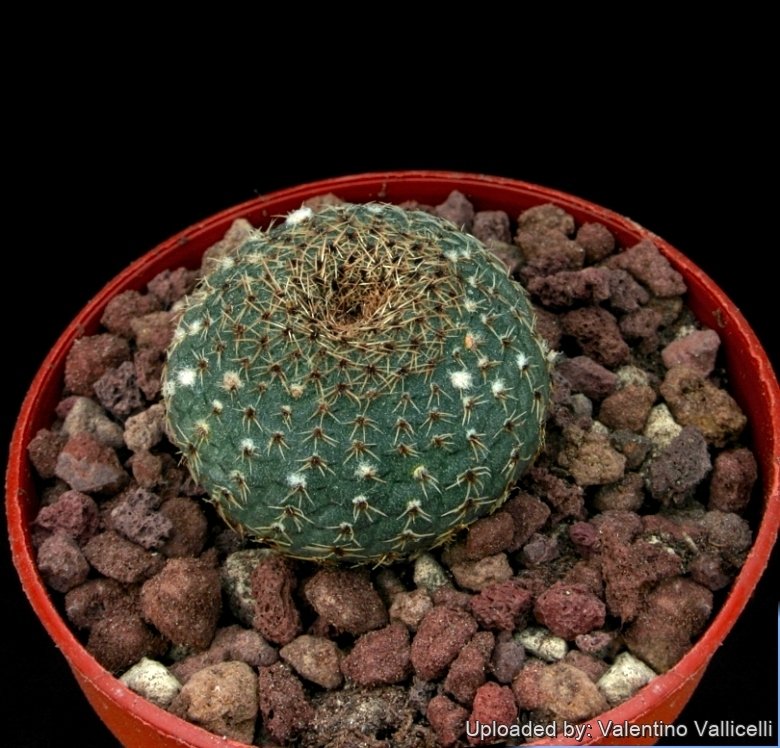
Frailea cataphracta subsp. duchii is an extremely diminutive cactus with unique and remarkably beautiful form. It is one of the many geographical relatives of the widespread and morphologically variable Frailea cataphracta. The subsp. duchii is very variable too, and some of its morphological variant was early classified as different independent species, but nowadays all this plant are considered part of a multiform subspecies, where each form is linked to others by plants with intermediate characteristics. Frailea cataphracta subsp. duchii distinguishes for the dirty bronze bodies with less than 18 ribs and less adpressed spines up to 4 mm long with often 1-2 central spines. The genus is cleistogamous, the colour of the flower is yellow.
Habit: It is a s small depressed perennial stem succulent that do usually not sprout much in nature, but in culture with age begins to clump around the base and grow oddly. It grows deep seated flat to the ground surface. Only in cultivation plants may have a spherical till columnar shape.
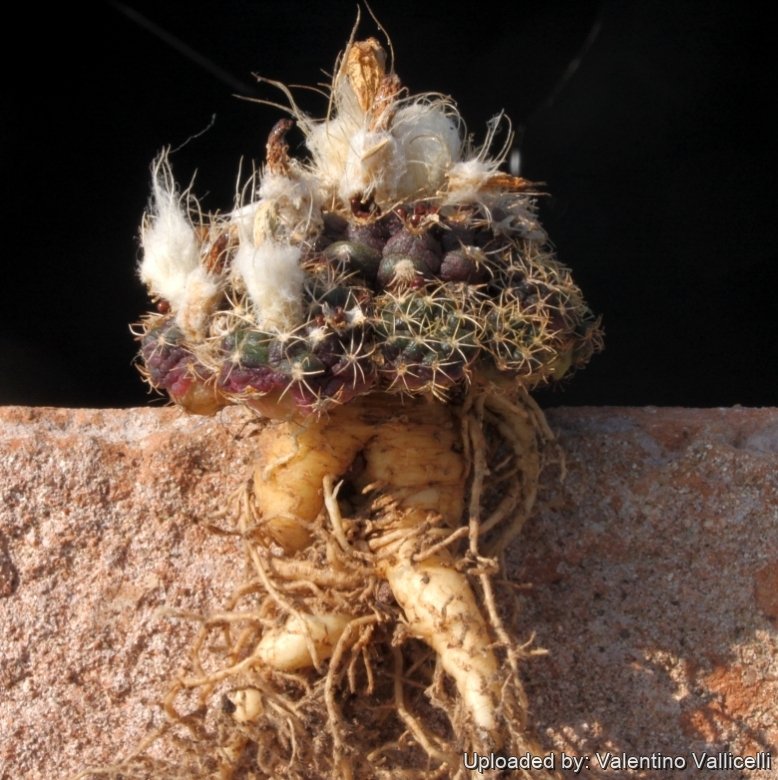
Roots: The rootstock is fleshy, turnip-like, with fine diffuse roots.
Stem: Spherical-depressed, dull-green to dirty bronze, up to 4 cm in diameter, 2,5 cm tall more or less imbilicate at apex
Ribs:less than 18 with low and broad tubercles flatted above with a purple-brown lunate, blots situated below the areoles.
Areoles: Rounded with conspicuous whitish wool.
Radial spines: 5-9 straight or slightly curved inward, up to 4 mm long, deciduous or persistent, adpressed to spreading, whitish, yellowish grey, amber coloured or reddish brown to almost black.
Central spines: Absent or 1-2.
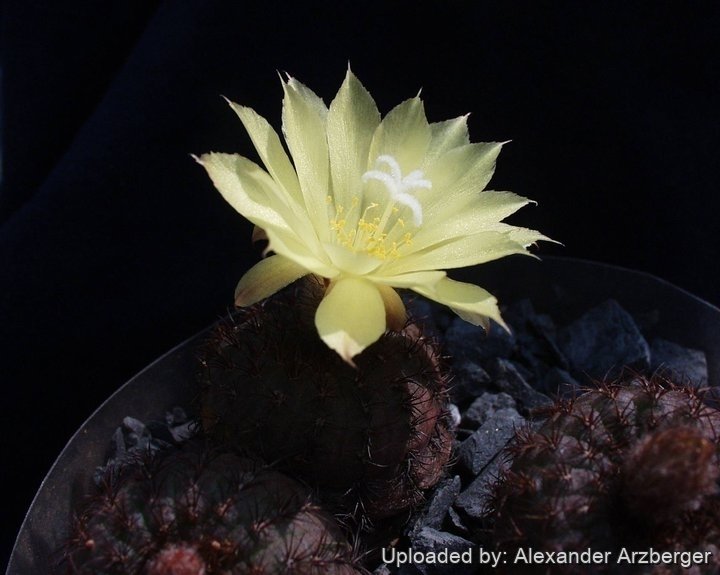
Flowers: Apical, diurnal, radial, sulphur yellow from the top of the plant, sometimes larger than the plant itself (4 cm diameter). But don’t be disappointed when the easily produced buds fail to open. Fraileas are cleistogamous meaning that their flowers produce seed without even opening. Without the need for pollination, hence the buds rarely reach full bloom and remain closed. They will open only in great heat in the hottest, brightest, afternoon sun, if at all.
Fruits: Dry indehiscent with scales and bristles that detach easily, pericarp membranous, fragile that break easily releasing the seed.
Seeds: Comparatively large, black and shining, up to 2 mm wide, with a triangular, deeply concave face.
Origin and Habitat
South-east of Asuncion, Paraguay.
Altitude: 100-300 metres above sea level.
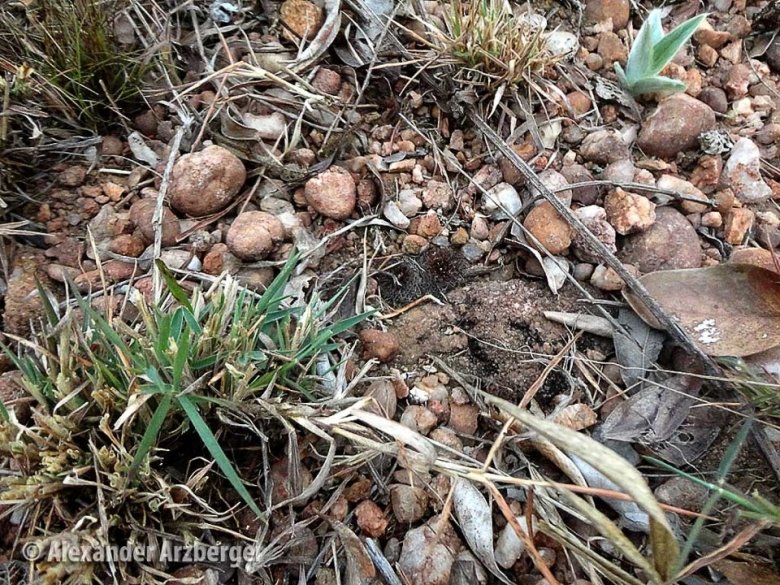
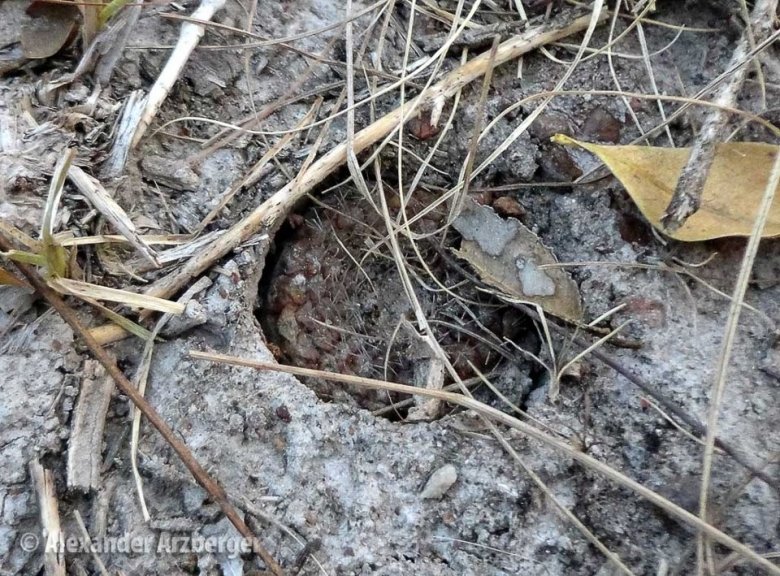
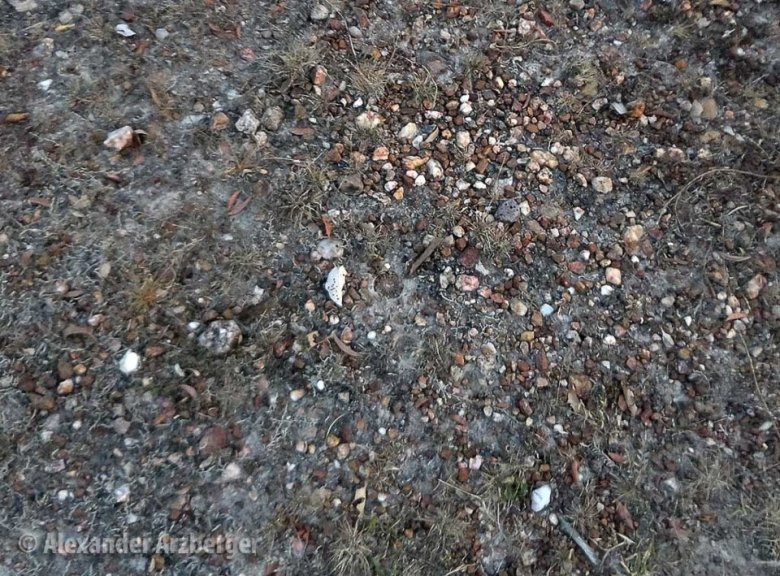
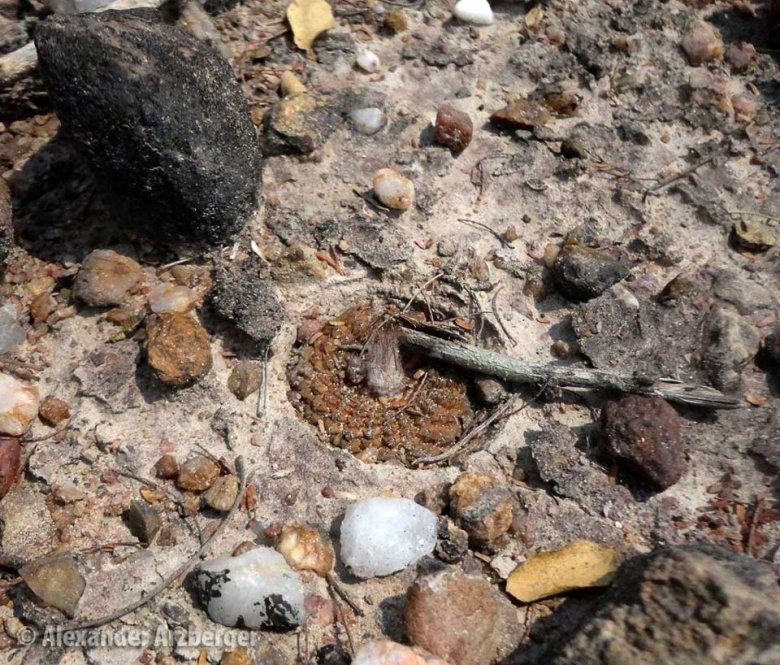
Habitat: It is found growing grows between plates of sandstone, often in the umbrage of small bushes and shrubs.
Cultivation and Propagation
Frailea cataphracta subs. duchii is a summer grower species relatively easy to grow. It is sometime seen as a grafted plant but grows very well on its own roots too. Characteristically, during the dry season plants retract completely under the ground both in the wild and in cultivation too.
Growth rate: Fraileas are relatively short-lived plants, only lasting few years (rarely more than 10-15 years in cultivation) and, possible annuals in habitat! In fact they reseed readily around the base of the mother plant from self-set seed if kept reasonably moist during warm weather. It is a
good idea to keep restarting them from seed; what looks like a healthy big plant may suddenly die of old age without warning.
Soil: Use mineral well permeable substratum with little organic matter (peat, humus), plants may become too elongated if compost is too rich.
Repotting: Re-pot every 2 years. Use pot with good drainage.
Fertilization: It grows much faster with a low nitrogen content fertilizer in spring and summer. Potassium helps maintaining the plants compact and healthy.
Watering: Requires careful watering to keep plant compact. Water sparingly from March till October, the thin, fibrous roots suffer if there is humidity, therefore the plant should be watered only when the surrounding terrain is dry. Keep dry as soon as the temperature starts dropping in October and keep it perfectly dry in winter at temperatures from 5 to 15 degrees centigrade.
Hardiness: They need a minimum temperature of 5-10° C (but occasionally temperatures of a few degrees below 0° are not dangerous if kept on the dry side prior to, and during, cold weather). It tends to rot in winter during the resting phase, if kept wet. In the rest period no high atmospheric humidity!!
Sun Exposure: Light shade to full sun, its colour tends to richer and darker when grown in light shade. In a shaded position the plants grow faster, but are not flat shaped and dark coloured.
Uses: It is an excellent plant for container growing. It always looks good and stays small.
Pests & diseases: It may be attractive to a variety of insects, but plants in good condition should be nearly pest-free, particularly if they are grown in a mineral potting-mix, with good exposure and ventilation. Nonetheless, there are several pests to watch for:
- Red spiders: Red spiders may be effectively rubbed up by watering the infested plants from above.
- Mealy bugs: Mealy bugs occasionally develop aerial into the new growth among the wool with disfiguring results, but the worst types develop underground on the roots and are invisible except by their effects.
- Scales: Scales are rarely a problem.
- Rot: Rot is only a minor problem with cacti if the plants are watered and “aired” correctly. If they are not, fungicides won’t help all that much. To prevent rottenness it is also advisable to surround its root neck by very rough sand or grit, this help a fast water drainage.
Propagation: With fresh harvested seeds or (rarely) by grafting. Fraileas set seed (when well grown) and grow easily from seed. In fact, they are reported to set seed even if the flower doesn’t open. This self-fertilization is called cleistogamy. Seedlings dislike strong light and dry conditions and need to be repotted frequently during the first few years. However, old plants become senile and have a tendency to succumb to disease and a weak root system. At this stage, as is well known, they die suddenly. So, after they reach about 4-5 cm in diameter grow them slowly, and adopt a new repotting period, using intervals of every 3-4 years. Additionally grow them under drier conditions or with stronger sunlight. But plants are sometine grafted to accelerate growth, but the grafted plants are typical rather tall growing, compared with plants on their own roots that are usually more flat to the ground.
Bibliography
Major references and further lectures
-
Walther Haage “Kakteen von A bis Z” Neumann Verlag 1981
-
Edward Anderson “The Cactus family” Timber Press, Incorporated, 2001
-
James Cullen, Sabina G. Knees, H. Suzanne Cubey “The European Garden Flora Flowering Plants: A Manual for the Identification of Plants Cultivated in Europe, Both Out-of-Doors and Under Glass” Cambridge University Press, 11/Aug/2011
-
David R Hunt; Nigel P Taylor; Graham Charles; International Cactaceae Systematics Group. “The New Cactus Lexicon” dh books, 2006
From llifle page Astrophytum matoanum
Description
Frailea matoana is generally included within (as a synonym of) Frailea cataphracta subs. duchii, suggesting that there is not really a fundamental difference between the two, and hard to name accurately without knowing where they come from, and there remains a considerable confusion surrounding the true identity of this this plant.
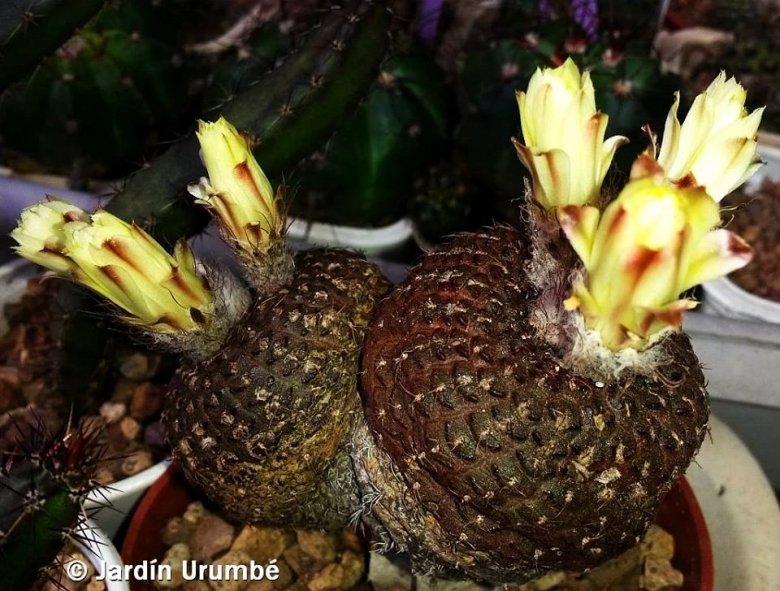
Distinguishing characteristics. Frailea matoana is a very small depressed cactus to only 25 mm diameter and 11 mm high that, despite belonging to the “cataphracta” group, has reddish to dark brown body with 15 ribs, areoles with brown or blackish spines to 4 mm long, and yellow flower. Usually it do not sprout in nature, but in culture with age begins to clump around the base and grow oddly.
Derivation of specific name: “matoana” for the occurrence in the State of Mato Grosso do Sul, Brazil.
Stem: Globose, deeply imbilicate at apex, to only 25 mm diameter, reddish, dark dirty bronze or dark brown.
Roots: Branched.
Ribs: About 15, vertical, 4-5 mm wide, divided by transverse minute furrows into small square, globular tubercles.
Areoles: With conspicuous dirty white wool when young contrasting strongly with the dark body, later bare, c. 2 mm apart.
Radial spines: Small. 4 more or less pectinate, on both sides, 1 or 2 pointing downwards, often 1-2 smaller upper ones up to 4 mm long, not much adpressed curved inward, shining, reddish-brown to almost black, deciduous or persistent.
Central spines: Absent (or occasionally 1 short and straight)
Flowers: Funnel-shaped 21 mm long, 20 mm wide, sulphur yellow from the top of the plant, sometimes larger than the plant itself. Pericarpel 6 mm long, 5 mm broad, naked beneath, but with whitish to orangish hairs above. Receptacle 5-6 mm long, hairs whitish to orangish. Outer perianth segments pale yellow, spathulate, acute, the tip slightly toothed and pinkish. Style 12 mm tall, yellowish-white. Stigma-lobes 8, 3 mm long, white. Filaments in two rows, primary filament pale yellow 7 mm long inserted at the base of the style; Secondary 6 mm long, parietal, yellow. Anthers to 0.8 mm long, yellow. Nectar chamber of 0.4 mm wide. But don’t be disappointed when the easily produced buds fail to open. Fraileas are cleistogamous meaning that their flowers produce seed without even opening. Without the need for pollination, hence the buds rarely reach full bloom and remain closed. They will open only in great heat in the hottest, brightest, afternoon sun, if at all.
Fruits: Round more or less flattened, 6-7 mm in diameter, tawny brown, dry indehiscent with scales and bristles that detach easily, pericarp membranous, fragile that break easily releasing the seed and the flower remains are persistent.
Seeds: Boat-shaped, 2.1-2.2 mm long, 1.8 mm broad, comparatively large, chestnut-brown, and shining reticulate. Hilum oblong-round.
Origin and Habitat
Sierra de Maracaju, Maneco to Limaira (municípios de Antonio João), southern part of Mato Grosso do Sul, Brazil (near the border with Paraguay)
Altitude: 270-720 metres above sea level.
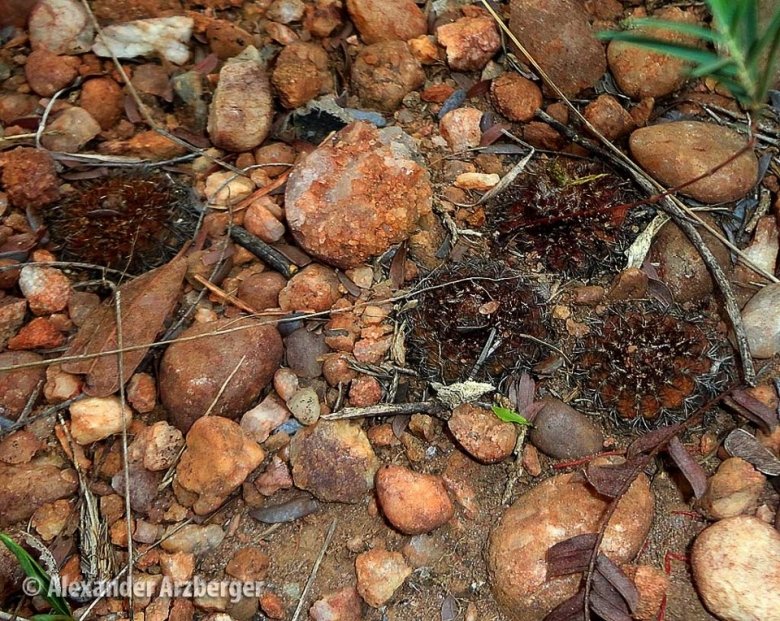
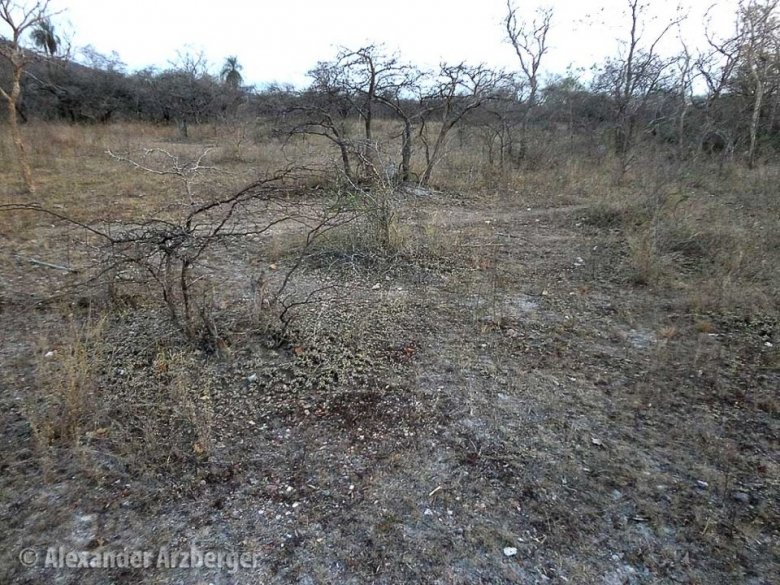
Habitat and ecology: Frailea matoana, which was already declared as extinct by Pierre Braun, still grows among boulder exclusively in the highest places of small hills. The scarce vegetation consists of grass and some small bushes limited in their growth by very scarce soil nutrients. The substrate is sandy-clayey and fairly compact. It is very difficult to find these little plants when do not in bloom, they also grow solitary and very scattered. The weather is quite hot and humid throughout the year. However, this Frailea is quite delicate and doesn’t like high humidity.
Cultivation and Propagation
Frailea matoana is a summer grower species relatively easy to grow. It is sometime seen as a grafted plant but grows very well on its own roots too. Characteristically, during the dry season plants retract completely under the ground both in the wild and in cultivation too.
Growth rate: Fraileas are relatively short-lived plants, only lasting few years (rarely more than 10-15 years in cultivation) and, possible annuals in habitat! In fact they reseed readily around the base of the mother plant from self-set seed if kept reasonably moist during warm weather. It is a
good idea to keep restarting them from seed; what looks like a healthy big plant may suddenly die of old age without warning.
Soil: Use mineral well permeable substratum with little organic matter (peat, humus), plants may become too elongated if compost is too rich.
Repotting: Re-pot every 2 years. Use pot with good drainage.
Fertilization: It grows much faster with a low nitrogen content fertilizer in spring and summer. Potassium helps maintaining the plants compact and healthy.
Watering: Requires careful watering to keep plant compact. Water sparingly from March till October, the thin, fibrous roots suffer if there is humidity, therefore the plant should be watered only when the surrounding terrain is dry. Keep dry as soon as the temperature starts dropping in October and keep it perfectly dry in winter at temperatures from 5 to 15 degrees centigrade.
Hardiness: They need a minimum temperature of 5-10° C (but occasionally temperatures of a few degrees below 0° are not dangerous if kept on the dry side prior to, and during, cold weather). It tends to rot in winter during the resting phase, if kept wet. In the rest period no high atmospheric humidity!!
Sun Exposure: Light shade to full sun, its colour tends to richer and darker when grown in light shade. In a shaded position the plants grow faster, but are not flat shaped and dark coloured.
Uses: It is an excellent plant for container growing. It always looks good and stays small.
Pests & diseases: It may be attractive to a variety of insects, but plants in good condition should be nearly pest-free, particularly if they are grown in a mineral potting-mix, with good exposure and ventilation. Nonetheless, there are several pests to watch for:
- Red spiders: Red spiders may be effectively rubbed up by watering the infested plants from above.
- Mealy bugs: Mealy bugs occasionally develop aerial into the new growth among the wool with disfiguring results, but the worst types develop underground on the roots and are invisible except by their effects.
- Scales: Scales are rarely a problem.
- Rot: Rot is only a minor problem with cacti if the plants are watered and “aired” correctly. If they are not, fungicides won’t help all that much. To prevent rottenness it is also advisable to surround its root neck by very rough sand or grit, this help a fast water drainage.
Propagation: With fresh harvested seeds or (rarely) by grafting. Fraileas set seed (when well grown) and grow easily from seed. In fact, they are reported to set seed even if the flower doesn’t open. This self-fertilization is called cleistogamy. Seedlings dislike strong light and dry conditions and need to be repotted frequently during the first few years. However, old plants become senile and have a tendency to succumb to disease and a weak root system. At this stage, as is well known, they die suddenly. So, after they reach about 4-5 cm in diameter grow them slowly, and adopt a new repotting period, using intervals of every 3-4 years. Additionally grow them under drier conditions or with stronger sunlight. But plants are sometine grafted to accelerate growth, but the grafted plants are typical rather tall growing, compared with plants on their own roots that are usually more flat to the ground.
Bibliography
Major references and further lectures
-
Clive Innes “Complete Handbook of Cacti and Succulents” Van Nostrand Reinhold Company, 01 December 1981
-
Jardín Urumbé Cultivo de Cactus y otras Suculentas “Una pequeña joya – Frailea matoana (AA162)” retrieved on 25 June 2016 from <https://urumbe.wordpress.com/2010/03/15/una-pequena-joya-frailea-matoana-aa162/\>
-
Paul C. Laney Frailea - Hidden treasures “Frailea matoana” retrieved on 25 June 2016 from <http://www.frailea.com/Species/Frailea\_matoana.htm\>
-
“Alweer een artikel over Frailea’s.” J.J. De Morree, in Succulenta (Netherlands) 68(5): 100-103, 1989.
-
“Frailea matoana Buining & Brederoo Sp. Nov. A. F. H. Buining.” in Cactus and Succulent Journal Vol. XLIII (4): 139-142, 1971
-
“Frailea’s ook in Paraguay.” Ludwig Bercht & Volker Schädlich. In Succulenta (Netherlands) 87(1):36-42. 2008.
-
Edward Anderson “The Cactus family” Timber Press, Incorporated, 2001
-
David R Hunt; Nigel P Taylor; Graham Charles; International Cactaceae Systematics Group. “The New Cactus Lexicon” dh books, 2006
-
Marlon C Machado “Fascinating Frailea, Part 2: Review of the species from Rio Grande do Sul” Cactus World (BCSS) Volume 25 No. 2 June 2007
Source: Astrophytum matoanum, LLIFLE - Encyclopedia of living forms, CC-BY-SA, retrieved 2026-10-25.
From llifle page Astrophytum uhligianum
Description
Frailea uhligiana is a dwarf cactus with unique and remarkably beautiful shape. It is one of the geographical forms of the morphologically variable Frailea cataphracta subsp. duchii and it is distinguished for the green to bronze bodies with up to 25 ribs and less adpressed spines up to 4 mm long. The genus is cleistogamous, the colour of the flower is yellow.
Habit: It is a s small depressed perennial stem succulent with age begins to clump around the base and grow oddly. It grows deep seated flat to the ground surface. Only in cultivation plants may have a spherical till columnar shape.
Roots: The rootstock is fleshy, turnip-like, with fine diffuse roots.
Stem: Spherical-depressed, outdoors red brown to to dirty bronze red, with glass protection green, up to 3,5 cm in diameter, 2,5 cm tall more or less imbilicate at apex
Ribs: Up to 25, with noticeable tubercles only in the new growth, later flatted above and with a purple-brown lunate, blots situated below the areoles.
Areoles: Rounded almost bare or with whitish or brownish wool.
Radial spines: 8-10 straight or slightly curved inward, very small, only about 2-4 mm long, adpressed to spreading, whitish, yellowish grey, amber coloured or reddish brown to almost black
Central spines: Absent (occasionally 1 or 2).
Flowers: Apical, diurnal, radial, sulphur yellow from the top of the plant, about 3 cm in diameter. Buds with light brown wool. But don’t be disappointed when the easily produced buds fail to open. Fraileas are cleistogamous meaning that their flowers produce seed without even opening. Without the need for pollination, hence the buds rarely reach full bloom and remain closed. They will open only in great heat in the hottest, brightest, afternoon sun, if at all.
Fruits: Dry indehiscent with scales and bristles that detach easily, pericarp membranous, fragile that break easily releasing the seed.
Seeds: Comparatively large, blackish and shining, up to 2 mm wide, circular, hat shaped with a prominent edge.
Origin and Habitat
San Jose, Chiquito, between Santa Cruz and Corumba, Bolivia
Altitude: 300-500m.
Habitat: Fraileas are specialized plant that live restricted in a narrow ecological niche among large rock domes protruding from surrounding ground in the zone where the soil meets the rock and is less than 2-3 cm deep. The soil is fine sandy-loamy or fine grained and permeable, but too shallow for a lot of plants that otherwise would shade out the tiny frailea. Frailea uhligiana forms dense colonies in all sizes and grows together with Gymnocalycium chiquitanum and Gymnocalycium damsii v. torulosum.
Cultivation and Propagation
Frailea cataphracta subs. uhligiana is a summer grower species relatively easy to grow. It is sometime seen as a grafted plant but grows very well on its own roots too. Characteristically, during the dry season plants retract completely under the ground both in the wild and in cultivation too.
Growth rate: Fraileas are relatively short-lived plants, only lasting few years (rarely more than 10-15 years in cultivation) and, possible annuals in habitat! In fact they reseed readily around the base of the mother plant from self-set seed if kept reasonably moist during warm weather. It is a good idea to keep restarting them from seed; what looks like a healthy big plant may suddenly die of old age without warning.
Soil: Use mineral well permeable substratum with little organic matter (peat, humus), plants may become too elongated if compost is too rich.
Repotting: Re-pot every 2 years. Use pot with good drainage.
Fertilization: It grows much faster with a low nitrogen content fertilizer in spring and summer. Potassium helps maintaining the plants compact and healthy.
Watering: Requires careful watering to keep plant compact. Water sparingly from March till October, the thin, fibrous roots suffer if there is humidity, therefore the plant should be watered only when the surrounding terrain is dry. Keep dry as soon as the temperature starts dropping in October and keep it perfectly dry in winter at temperatures from 5 to 15 degrees centigrade.
Hardiness: They need a minimum temperature of 5-10° C (but occasionally temperatures of a few degrees below 0° are not dangerous if kept on the dry side prior to, and during, cold weather). It tends to rot in winter during the resting phase, if kept wet. In the rest period no high atmospheric humidity!!
Sun Exposure: Light shade to full sun, its colour tends to richer and darker when grown in light shade. In a shaded position the plants grow faster, but are not flat shaped and dark coloured.
Uses: It is an excellent plant for container growing. It always looks good and stays small.
Pests & diseases: It may be attractive to a variety of insects, but plants in good condition should be nearly pest-free, particularly if they are grown in a mineral potting-mix, with good exposure and ventilation. Nonetheless, there are several pests to watch for:
- Red spiders: Red spiders may be effectively rubbed up by watering the infested plants from above.
- Mealy bugs: Mealy bugs occasionally develop aerial into the new growth among the wool with disfiguring results, but the worst types develop underground on the roots and are invisible except by their effects.
- Scales: Scales are rarely a problem.
- Rot: Rot is only a minor problem with cacti if the plants are watered and “aired” correctly. If they are not, fungicides won’t help all that much. To prevent rottenness it is also advisable to surround its root neck by very rough sand or grit, this help a fast water drainage.
Propagation: With fresh harvested seeds or (rarely) by grafting. Fraileas set seed (when well grown) and grow easily from seed. In fact, they are reported to set seed even if the flower doesn’t open. This self-fertilization is called cleistogamy. Seedlings dislike strong light and dry conditions and need to be repotted frequently during the first few years. However, old plants become senile and have a tendency to succumb to disease and a weak root system. At this stage, as is well known, they die suddenly. So, after they reach about 4-5 cm in diameter grow them slowly, and adopt a new repotting period, using intervals of every 3-4 years. Additionally grow them under drier conditions or with stronger sunlight. But plants are sometine grafted to accelerate growth, but the grafted plants are typical rather tall growing, compared with plants on their own roots that are usually more flat to the ground.
Source: Astrophytum uhligianum, LLIFLE - Encyclopedia of living forms, CC-BY-SA, retrieved 2026-10-25.
From llifle page Astrophytum melitae
Description
Frailea cataphracta subsp. melitae (firstly described as Frailea melitae by Buining & Bredero in 1974) is a local or morphological form of Frailea cataphracta subs. duchii. It has less than 21 flattened, but noticeably tuberculate ribs (in subsp. duchii the ribs are less than 18). However the distinguishing characteristics of subsp. melitae, appear to fall within the natural variation of subs. duchii, and the two plants are not readily distinguishable, if not for the geographical provenance. More likely they are one and the same species.
Derivation of specific name: This member of the Cactaceae family was given this name for Melita Horst, wife of the Brazilian plant collector Leopoldo Horst.
Stem: Solitary, not clumping, globular, rootstock conical sunk into the earth, 1.5 cm tall and to 4 cm in diameter, dark olive-green to brown or purplish.
Ribs: Up to 21, quite flat divided by transverse depression into tiny tubercles, darker V-shaped , blots can be seen below the areoles.
Areoles: With conspicuous, glassy white wool, later glabrous.
Spines: Thin, straight, glassy white, a little stronger and light brown at the base, deciduous or persistent. Radial spines pectinated up to 4 on each side, 3 to 4 mm long, at times with a small central spine 3 mm long.
Flowers: Funnel-shaped, 27 mm long and up to 37 mm wide when open, shiny golden yellow. Corolla tube, with tawny hair and up to 8 mm long bristles overgrowing the receptacle. Inner wall of the receptacle red at the base, outer receptacle wall covered with scales, bristle and hair. Petals, golden yellow, spathulate, pointed at the ends, upper margin finely notched. Style white. Stamens white, red in the lower part. Anthers yellow.
Fruit: Fruits 9 mm long, 8 mm wide covered by light yellow bristles and white hairs.
Seeds: Cap-shaped, 2 mm long and 1.5 mm wide, smooth and shiny, brown.
Origin and Habitat
East of Porto Murtinho, North of Rio Apa, Mato Grosso del Sur, Brazil.
Altitude range: 120-145 metres above sea level.
Habitat and ecology: Frailea cataphracta subsp. melitae grows in partial shade, under bushes and small shrubs together with Gymnocalycium damsii, Echinopsis spec., Harrisia bonplandii, Cereus kroehnleinii, Cleistocactus baumanii and Stetsonia coryne. The substrate is clayey and fairly compact. This species previously believed extinct was fortunately found again, in multiple locations and in large number. The reason for such belief is due to the fact that often in habitat, during the dry season the small plants are not found, because they are completely buried in the ground and almost invisible.
Cultivation and Propagation
Frailea melitae is a summer grower species relatively easy to grow. It is sometime seen as a grafted plant but grows very well on its own roots too. Characteristically, during the dry season plants retract completely under the ground both in the wild and in cultivation too.
Growth rate: Fraileas are relatively short-lived plants, only lasting few years (rarely more than 10-15 years in cultivation) and, possible annuals in habitat! In fact they reseed readily around the base of the mother plant from self-set seed if kept reasonably moist during warm weather. It is a
good idea to keep restarting them from seed; what looks like a healthy big plant may suddenly die of old age without warning.
Soil: Use mineral well permeable substratum with little organic matter (peat, humus), plants may become too elongated if compost is too rich.
Repotting: Re-pot every 2 years. Use pot with good drainage.
Fertilization: It grows much faster with a low nitrogen content fertilizer in spring and summer. Potassium helps maintaining the plants compact and healthy.
Watering: Requires careful watering to keep plant compact. Water sparingly from March till October, the thin, fibrous roots suffer if there is humidity, therefore the plant should be watered only when the surrounding terrain is dry. Keep dry as soon as the temperature starts dropping in October and keep it perfectly dry in winter at temperatures from 5 to 15 degrees centigrade. High nocturnal humidity promote growth.
Hardiness: They need a minimum temperature of 5-10° C (but occasionally temperatures of a few degrees below 0° are not dangerous if kept on the dry side prior to, and during, cold weather). It tends to rot in winter during the resting phase, if kept wet. In the rest period no high atmospheric humidity!!
Sun Exposure: Light shade to full sun, its colour tends to richer and darker when grown in light shade. In a shaded position the plants grow faster, but are not flat shaped and dark coloured.
Uses: It is an excellent plant for container growing. It always looks good and stays small.
Pests & diseases: It may be attractive to a variety of insects, but plants in good condition should be nearly pest-free, particularly if they are grown in a mineral potting-mix, with good exposure and ventilation. Nonetheless, there are several pests to watch for:
- Red spiders: Red spiders may be effectively rubbed up by watering the infested plants from above.
- Mealy bugs: Mealy bugs occasionally develop aerial into the new growth among the wool with disfiguring results, but the worst types develop underground on the roots and are invisible except by their effects.
- Scales: Scales are rarely a problem.
- Rot: Rot is only a minor problem with cacti if the plants are watered and “aired” correctly. If they are not, fungicides won’t help all that much. To prevent rottenness it is also advisable to surround its root neck by very rough sand or grit, this help a fast water drainage.
Propagation: With fresh harvested seeds or (rarely) by grafting. Fraileas set seed (when well grown) and grow easily from seed. In fact, they are reported to set seed even if the flower doesn’t open. This self-fertilization is called cleistogamy. Seedlings dislike strong light and dry conditions and need to be repotted frequently during the first few years. However, old plants become senile and have a tendency to succumb to disease and a weak root system. At this stage, as is well known, they die suddenly. So, after they reach about 4-5 cm in diameter grow them slowly, and adopt a new repotting period, using intervals of every 3-4 years. Additionally grow them under drier conditions or with stronger sunlight. But plants are sometine grafted to accelerate growth, but the grafted plants are typical rather tall growing, compared with plants on their own roots that are usually more flat to the ground.
Bibliography
Major references and further lectures
-
“Frailea cataphracta (Dams) Br. & R. subspec. melitae(Buining et Brederoo) Prestle comb.nov.” by K.H. Prestlé “Die Gattung Frailea Br. & R” pp. 63-64
-
Stuart Max Walters “European Garden Flora: A Manual for the Identification of Plants Cultivated in Europe, Both Out-of-Doors and Under Glass” Cambridge University Press, 27 July 1989
-
Pierre J. Braun en Eddie Esteves Pereira. “Nieuwe combinaties en namen voor cactussen uit Brazilie, Bolivia en Paraguay.” in Succulenta (Netherlands) 74 (3): 130-135, 1995.
-
L. Berka, “Endangered miniatures - Frailea matoana and Frailea melitae” in KAKTUSY Vol. 29(-3) ( p. 53) 1993
Source: Astrophytum melitae, LLIFLE - Encyclopedia of living forms, CC-BY-SA, retrieved 2026-10-25.
From llifle page Frailea cataphractoides
Description
Frailea cataphractoides is a dwarf cactus with unique and remarkably beautiful shape. It is one of the geographical forms of the morphologically variable Frailea cataphracta subsp. duchii and is distinguished for the greyish-olive-green bodies (purplish to black in full sun) with very closely set brown areoles and spines up to 4 mm long.
Habit: It is a s small depressed perennial stem succulent with age begins to clump around the base and grow oddly. It grows deep seated flat to the ground surface. Only in cultivation plants may have a spherical till columnar shape.
Roots: The rootstock is fleshy, turnip-like, with fine diffuse roots.
Stem: Spherical-depressed, outdoors red brown to to dirty bronze red, with glass protection greyish-olive-green, up to 3,5 cm in diameter, 2,5 cm tall more or less imbilicate at apex
Ribs: Up to 25, with scarcely noticeable tubercles only in the new growth, later flatted above and with a more or less evident purple-brown lunate, blots situated below the areoles.
Areoles: More closely set than in the type, rounded brown almost bare or with brownish or whitish wool.
Radial spines: 8-10 straight or slightly curved inward, very small, only about 2-4 mm long, adpressed, whitish, yellowish grey, amber coloured or reddish brown.
Central spines: Absent.
Flowers: Apical, diurnal, radial, sulphur yellow from the top of the plant, about 3 cm in diameter. Buds with light brown wool. But don’t be disappointed when the easily produced buds fail to open. Fraileas are cleistogamous meaning that their flowers produce seed without even opening. Without the need for pollination, hence the buds rarely reach full bloom and remain closed. They will open only in great heat in the hottest, brightest, afternoon sun, if at all.
Fruits: Dry indehiscent with scales and bristles that detach easily, pericarp membranous, fragile that break easily releasing the seed.
Seeds: Comparatively large, blackish and shining, up to 2 mm wide. The seed is shaped strangely for a cactus, and is often described as “hat” or “boat” shaped with a prominent edge. That is a good description, for it is among the few cactus seeds that float! They are thought to be dispersed in habitat by floating away on runoff.
Origin and Habitat
Bolivia
Habitat: Fraileas are specialized plant that live restricted in a narrow ecological niche among large rock domes protruding from surrounding ground in the zone where the soil meets the rock and is less than 2-3 cm deep. The soil is fine sandy-loamy or fine grained and permeable, but too shallow for a lot of plants that otherwise would shade out the tiny frailea. Climate is warm and humid. The rainfalls happen all around the year with a relatively high amount and with much thaw during the night.
Cultivation and Propagation
Frailea cataphractoides is a summer grower species relatively easy to grow. It is sometime seen as a grafted plant but grows very well on its own roots too. Characteristically, during the dry season plants retract completely under the ground both in the wild and in cultivation too.
Growth rate: Fraileas are relatively short-lived plants, only lasting few years (rarely more than 10-15 years in cultivation) and, possible annuals in habitat! In fact they reseed readily around the base of the mother plant from self-set seed if kept reasonably moist during warm weather. It is a
good idea to keep restarting them from seed; what looks like a healthy big plant may suddenly die of old age without warning.
Soil: Use mineral well permeable substratum with little organic matter (peat, humus), plants may become too elongated if compost is too rich.
Repotting: Re-pot every 2 years. Use pot with good drainage.
Fertilization: It grows much faster with a low nitrogen content fertilizer in spring and summer. Potassium helps maintaining the plants compact and healthy.
Watering: Requires careful watering to keep plant compact. Water sparingly from March till October, the thin, fibrous roots suffer if there is humidity, therefore the plant should be watered only when the surrounding terrain is dry. Keep dry as soon as the temperature starts dropping in October and keep it perfectly dry in winter at temperatures from 5 to 15 degrees centigrade.
Hardiness: They need a minimum temperature of 5-10° C (but occasionally temperatures of a few degrees below 0° are not dangerous if kept on the dry side prior to, and during, cold weather). It tends to rot in winter during the resting phase, if kept wet. In the rest period no high atmospheric humidity!!
Sun Exposure: Light shade to full sun, its colour tends to richer and darker when grown in light shade. In a shaded position the plants grow faster, but are not flat shaped and dark coloured.
Uses: It is an excellent plant for container growing. It always looks good and stays small.
Pests & diseases: It may be attractive to a variety of insects, but plants in good condition should be nearly pest-free, particularly if they are grown in a mineral potting-mix, with good exposure and ventilation. Nonetheless, there are several pests to watch for:
- Red spiders: Red spiders may be effectively rubbed up by watering the infested plants from above.
- Mealy bugs: Mealy bugs occasionally develop aerial into the new growth among the wool with disfiguring results, but the worst types develop underground on the roots and are invisible except by their effects.
- Scales: Scales are rarely a problem.
- Rot: Rot is only a minor problem with cacti if the plants are watered and “aired” correctly. If they are not, fungicides won’t help all that much. To prevent rottenness it is also advisable to surround its root neck by very rough sand or grit, this help a fast water drainage.
Propagation: With fresh harvested seeds or (rarely) by grafting. Fraileas set seed (when well grown) and grow easily from seed. In fact, they are reported to set seed even if the flower doesn’t open. This self-fertilization is called cleistogamy. Seedlings dislike strong light and dry conditions and need to be repotted frequently during the first few years. However, old plants become senile and have a tendency to succumb to disease and a weak root system. At this stage, as is well known, they die suddenly. So, after they reach about 4-5 cm in diameter grow them slowly, and adopt a new repotting period, using intervals of every 3-4 years. Additionally grow them under drier conditions or with stronger sunlight. But plants are sometine grafted to accelerate growth, but the grafted plants are typical rather tall growing, compared with plants on their own roots that are usually more flat to the ground.
Notes
Seasonal growth and contraction. Frailea cataphractoides, like many other diminutive cacti, such as, for instance, Turbinicarpus, Mammillaria, Rebutia, has a well-developed contractile tuberous root system. These tuberose roots have the function of storing enough sustenance so that plants can survive the periods of drought that they have to endure. Tuberous roots also have the function of anchoring the plants into the ground. The tuberose contractile roots continually pull the plants deeper into the ground as the stem elongates so the plants remain subterranean or at an appropriate level in the ground. Contractile roots are usually broad, fleshy, vertical, tapering, and very distinct of the fine absorbent roots and are capable of incredible effort. As commonly happens with tuberous-rooted cacti, in times of drought the plants lose water and shrink, the swollen root contracting and pulling the stem down, resulting in the top of the plant body lying level with, or sometimes even below, ground level. In most cases, contractile roots not only produce a strong pulling force, but also push away the substratum and create a soil channel in which plant movement is made easier. The fleshy contractile roots swell with moisture in the wet season creating a space in the substrate then during the dry season they leave an empty space in the substratum that allow plant movement with minimum or no resistance, at the same time the root dehydrates and shrinks vertically, drawing the plant down into the ground. This is repeated early permitting the top of the plant to remain constantly at the soil level or even completely under the soil level, and frequently the flowers push up through the dirt from the underground cactus body. In fact, even though these plants show a good amount of new growth each year, they hardly get any larger, and their dimensions remain unvaried year after year, as the individual stems tend to contract at the base. The new growth produced during the vegetative season compacts considerably and retracts sometime, pulling the plant down completely under the soil in the hottest months of summer and coldest months of winter. It should be noted that “when specimens are in this withdrawn state, it becomes difficult to find them in their natural state, even though their exact locality is known” This is especially true of the disciform, flat-bodied Frailea species such as Frailea cataphracta, Frailea phaeodisca and Frailea castanea, which can be drawn completely below ground when dehydrated
Bibliography
Major references and further lectures
-
Walther Haage “Kakteen von A bis Z” Neumann Verlag 1981
-
Edward Anderson “The Cactus family” Timber Press, Incorporated, 2001
-
James Cullen, Sabina G. Knees, H. Suzanne Cubey “The European Garden Flora Flowering Plants: A Manual for the Identification of Plants Cultivated in Europe, Both Out-of-Doors and Under Glass” Cambridge University Press, 11/Aug/2011
-
David R Hunt; Nigel P Taylor; Graham Charles; International Cactaceae Systematics Group. “The New Cactus Lexicon” dh books, 2006
-
Marlon C Machado. “Fascinating Frailea, Part 1: General impressions.” Cactus World (BCSS) Volume 25 No. 1 March 2007
-
Marlon C Machado.”Fascinating Frailea, Part 2: Review of the species from Rio Grande do Sul.” Cactus World (BCSS) Volume 25 No. 2 June 2007
Source: Frailea cataphractoides, LLIFLE - Encyclopedia of living forms, CC-BY-SA, retrieved 2026-10-25.
Gallery