Publication: Aloe 29(1): 12, 28 (1992)
Description
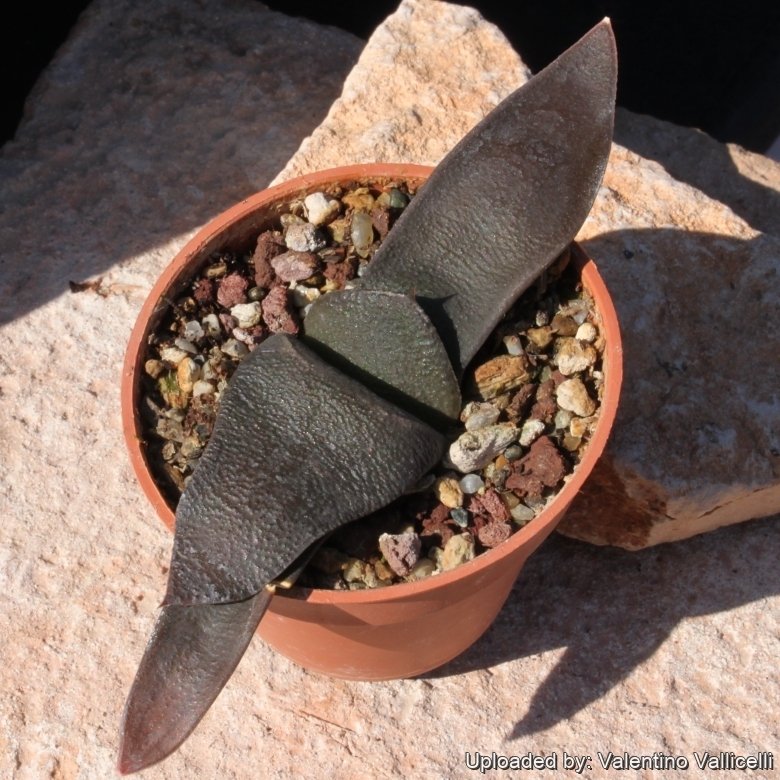
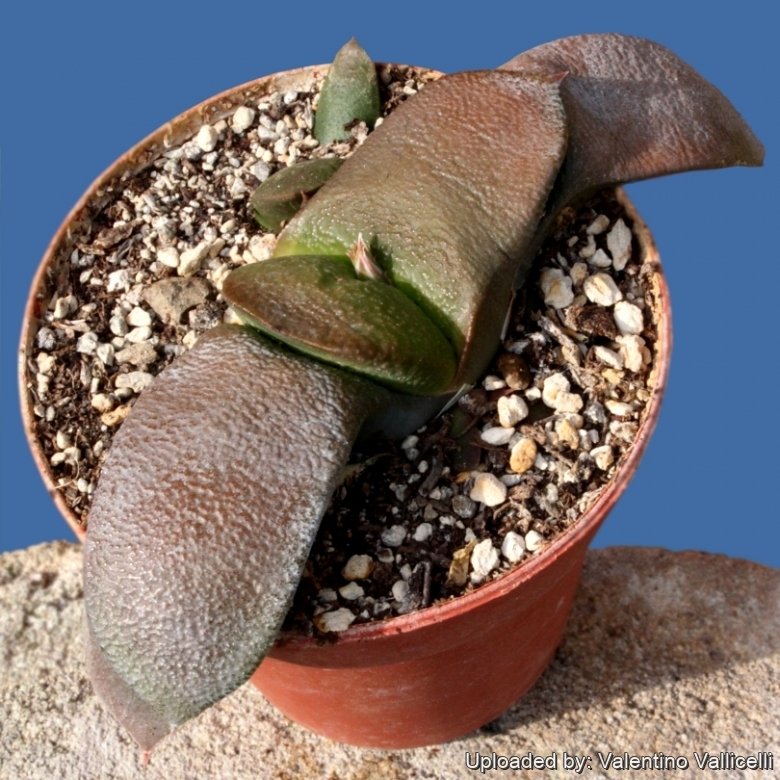
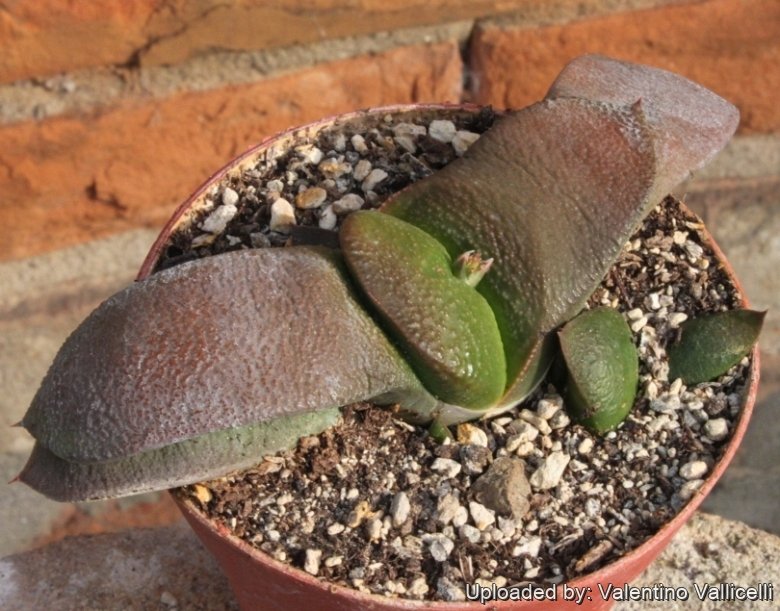
Gasteria armstrogii is a distinctive neotenic miniature succulent with short, rounded and thick distichous rosettes of two to four leaves up to 10 in diameter. Old specimens cluster naturally with new plants around the original. It is very slow growing.
Stem: Acaulescent.
Roots: Thick, fusiform and succulent up to 12 mm in diameter, with little branching, and endowed with the ability to contract, physically pulling the plant down into the ground during dry weather.
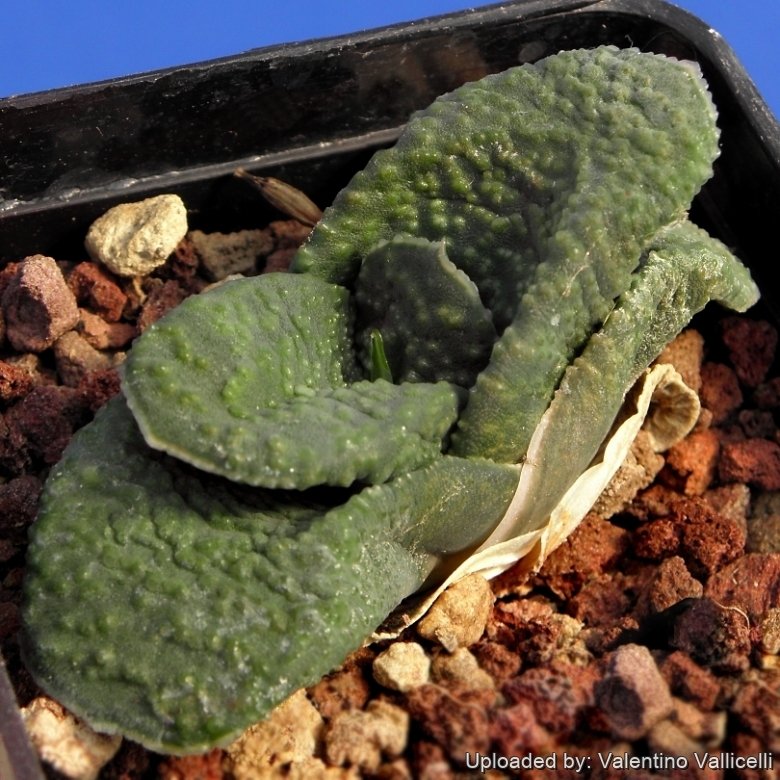
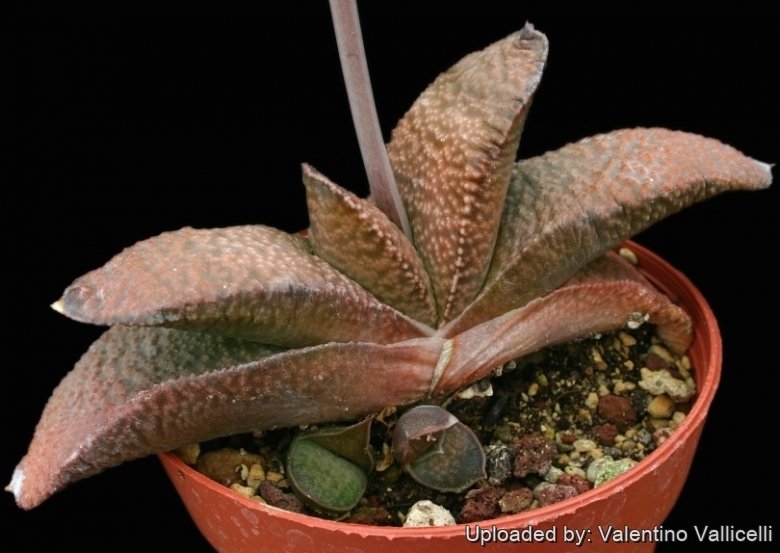
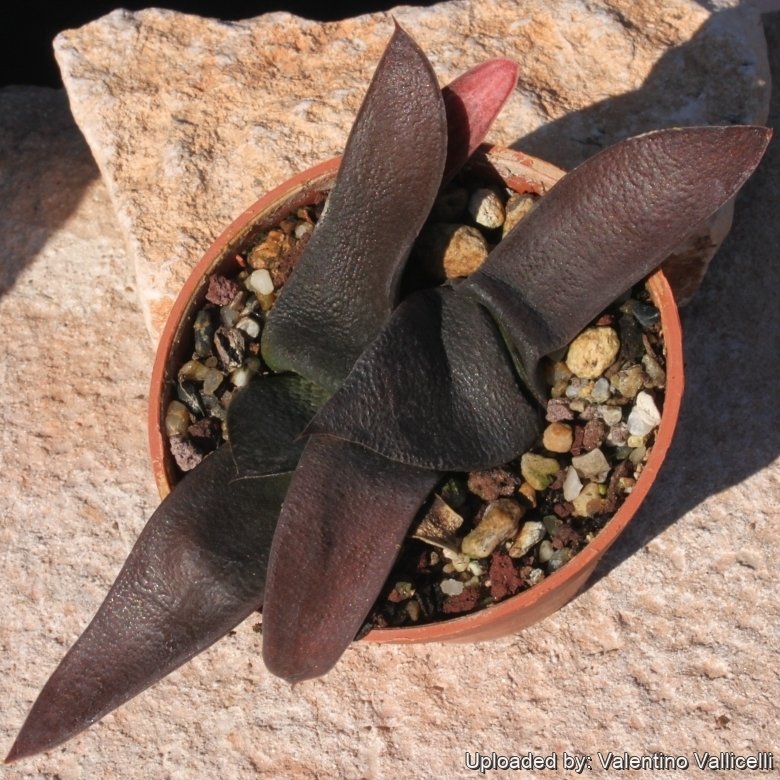
Leaves: Distichous (grow in two planes only), dark green to nearly black that can take maroon-red colouring in full sun, very strong, compact and thick that lie flat to the ground and have a rough, bumpy, tongue-like appearance, leaves in nature rarely more than 60 mm in overall length. Sometimes with prominent paler tubercles or warts that may develop with age. Tip somewhat retuse, obtuse or truncate. Margin entire or slightly tuberculate. Often the leave has a deep V-shaped proximal depression.
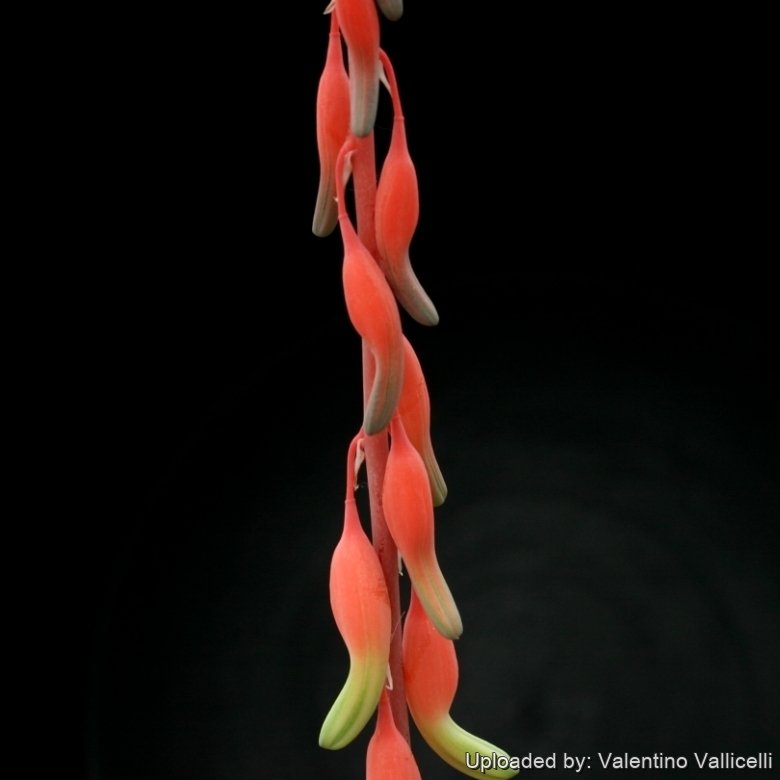
Flower: The inflorescences are smaller up to 50 cm tall and unbranched but bear 20 mm long flowers. Flowers 20-25 mm long, pinkish-red, stomach-shaped for about half of the perianth length. Perianth tips yellowish-green.
Blooming season: Summer.
Fruits: Oblong about 25 x 8 mm wide.
Origin and Habitat
Restricted to a comparatively limited coastal region mainly in and around Humansdorp, Eastern Cape Province.
Habitat: grows on a rocky soil with conglomerate or quartzite sandstone, this plant can be exceedingly difficult to locate in habit in fact the leaves are more or less horizontal and when the whole plant is at or below grade, the surrounding soil begins to cover up the plant!
Cultivation and Propagation
They are slow growing but long-lived plants of easy culture which makes them a good houseplant and can be an excellent subject for the beginning gasteriaphile (it can grow easily on window sills, verandas and in miniature succulent gardens where they are happy to share their habitat with other smaller succulent plants, or in outdoor rockeries) Need light shade to shade, but will take full sun part of the day. (with some sun exposure the leaf develops a nice reddish tint and remain compact) They are tolerant of a wide range of soils and habitats, but prefer a very porous potting mix to increase drainage. During the hot summer months, the soil should be kept moist but not overly wet. The plants are fertilized only once during the growing season with a balanced fertilizer diluted to ½ the recommended strength. During the winter months, water only when the soil becomes completely dry. Frost hardy to -1°C (Or less).
***Propagation:**Gasteria a is easily propagated by the removal of offshoots or by leaf cuttings in spring or summer. To use offshoots It should stay intact in the post though every head will have its own root system and it could easily be split for propagation.
To propagate by leaf cuttings, remove a leaf and let it lie for about one month (e.g. in a cool window sill), giving the wound time to heal. Then lay the leaf on its side with the basal part buried in the soil. This leaf should root within a month or two, and small plants will form at the leaf base. Young plants can be harvested the following season. They can also grown from seed. Seed should be sown during summer in sandy well drained soil and preferably protected from full sun. The seedlings are slow growing and can be planted out in small containers when they are large enough to handle. The soil should preferably be enriched with compost. They react very well to a liquid organic fertilizer.
Notes
Gasteria armstrongii has for a long time been just considered a “kind” of nitida (Gasteria nitida var. armstrongii) but it is very different indeed from the typical Gasteria nitida. Nowadays the taxonomist Ernst van Jaarsveld has decided, by virtue of DNA studies, that armstrongii is a species in its own right. Seedlings of Gasteria nitida appear much the same until they produce erect pointed leaves.
This specie has been widely selected and hybridized and nowadays many clones are available most of which were developed in Japan.
Bibliography
Major references and further lectures
-
Van Jaarsveld, E.J. “Gasterias of South Africa.” Fernwood Press. 1994
-
Urs Eggli “Illustrated Handbook of Succulent Plants: Monocotyledons” Springer, 2001
-
Stuart Max Walters “The European Garden Flora: Pteridophyta, Gymbospermae, Angiospermae-Monocotyledons” Cambridge University Press, 1984
-
Mucina, L. & Rutherford, M.C. (eds) 2006. “The vegetation of South Africa, Lesotho and Swaziland.” Strelitzia 19. South African National Biodiversity Institute, Pretoria.
-
Van Jaarsveld, E.J. “The genus Gasteria, a synoptic review.” in: Aloe 44: 4: 84–103 2007
-
Ernst Van Jaarsveld, Ben-Erik Van Wyk, Gideon Smith “Succulents of South Africa: A Guide to the Regional Diversity” Tafelberg Publishers, Limited, 01/lug/2000
From llifle page Gasteria armstrongii (Long leaved form)
Description
Tongue shaped, Gasteria nitida var. armstrongii (long leaved form) is a slim-leafed variety (or hybrid) distinguished from the standard species for its unusual long leaves. There are several clones in cultivation with leaves ranging from small to broad and more or less long.
Remarks: Gasteria nitida var. armstrongii has been widely selected and hybridized and nowadays many clones are available most of which were developed in Japan.
Habit: It is a distinctive neotenic miniature succulent with short, rounded and thick distichous rosettes of two to four leaves up to 10 in diameter. Old specimens cluster naturally with new plants around the original. It is very slow growing.
Stem: Acaulescent.
Roots: Thick, fusiform and succulent up to 12 mm in diameter, with little branching, and endowed with the ability to contract, physically pulling the plant down into the ground during dry weather.
Leaves: Distichous (grow in two planes only), dark green to nearly black that can take maroon-red colouring in full sun, very strong, compact and thick that lie flat to the ground and have a rough, bumpy, tongue-like appearance. Sometimes with prominent paler tubercles or warts that may develop with age. Tip somewhat retuse, obtuse or truncate. Margin entire or slightly tuberculate. Often the leave has a deep V-shaped proximal depression.
Flower: The inflorescences are smaller up to 50 cm tall and unbranched but bear 20 mm long flowers. Flowers 20-25 mm long, pinkish-red, stomach-shaped for about half of the perianth length. Perianth tips yellowish-green.
Blooming season: Summer.
Fruits: Oblong about 25 x 8 mm wide.
Origin and Habitat
Garden origin (Nursery produced cultivar)
Cultivation and Propagation
Gasteria armstrongii is of easy culture which makes it a good houseplant and can be an excellent subject for the beginning gasteriaphile (it can grow easily on window sills, verandas and in miniature succulent gardens where they are happy to share their habitat with other smaller succulent plants, or in outdoor rockeries)
Growth rate: It is a slow growing but long-lived plant that offsets to form small clusters with time.
Soil: It is tolerant of a wide range of soils and habitats, but prefers a very porous potting mix to increase drainage. A non-acid soil is ideal. You can grow a plant in a 10-15 cm pot for years and have perfectly happy plants. For best results, use a shallow pot.
Exposure: Need light shade to shade, but will take full sun part of the day. (with some sun exposure the leaf develops a nice reddish tint and remain compact) During the hot summer months, the soil should be kept moist but not overly wet.
Watering: During the hot summer months, the soil should be kept moist but not overly wet. During the winter months, water only when the soil becomes completely dry. Wet soil quickly causes root and stem rot, especially during chilly winter months. No water should ever be allowed to stand around the roots. Low ambient humidity is always needed.
Feeding: The plants are fertilized only once during the growing season with a balanced fertilizer diluted to ½ the recommended strength.
Hardiness: During the winter months, water only when the soil becomes completely dry. Frost hardy to -1°C (Or less). Gasteria armstrongii is among the rather limited number of plants which can hold their own in overheated apartments and homes.
Pest and diseases: Rot is only a minor problem with Gasteria if the plants are watered and “aired” correctly. If they are not, fungicides won’t help all that much. Incorrect watering, poor drainage or too much shade can lead to attack by pests and diseases. Care must be given in watering, keeping them warm and wet while growing, and cooler and dry when dormant.
Remarks: Gasterias are best planted in a shaded and airy part of the greenhouse, and not too close to the glass roof or sides of the house as the plants can overheat during hot spells.
Propagation: Gasterias are easily propagated by the removal of offshoots or by leaf cuttings in spring or summer. To propagate by leaf cuttings, remove a leaf and let it lie for about one month, giving the wound time to heal. Then lay the leaf on its side with the basal part buried in the soil. This leaf should root within a month or two, and small plants will form at the leaf base. They can also grown from seed.
Source: Gasteria armstrongii (Long leaved form), LLIFLE - Encyclopedia of living forms, CC-BY-SA, retrieved 2026-10-25.
From llifle page Gasteria armstrongii (Short leaved form)
Description
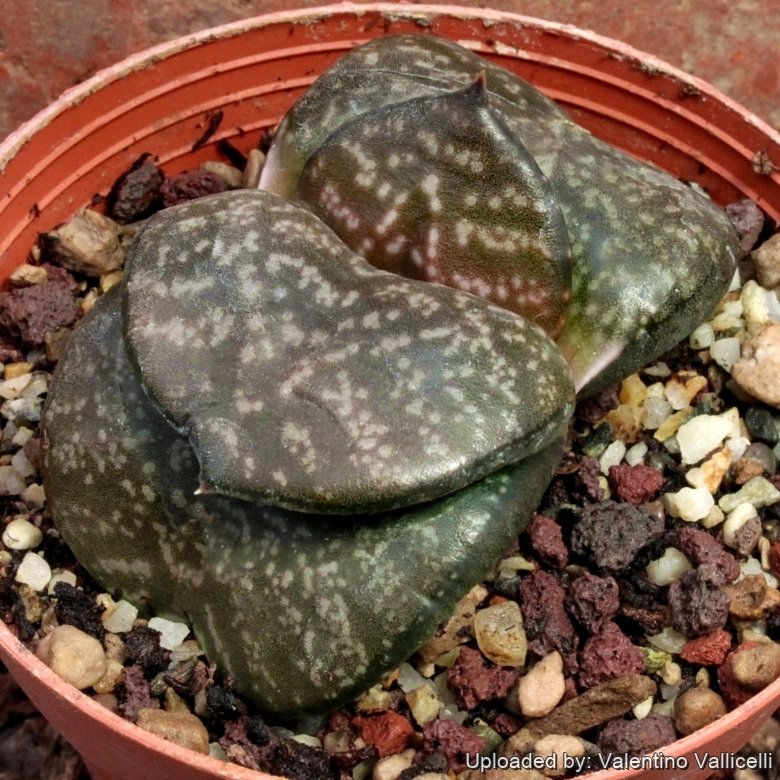
Fat and stocky, Gasteria nitida var. armstrongii (Short leaved form) is a compact variety very priced by enthusiasts Gasterophiles for its very eye-catching shapes. There are several clones in cultivation with rosettes ranging from small to very broad and more or less flat or succulent. The broader and flatter the better.
Habit: It is a distinctive neotenic miniature succulent with short, rounded and thick distichous rosettes of two to four leaves up to 10 in diameter. Old specimens cluster naturally with new plants around the original. It is very slow growing.
Stem: Acaulescent.
Roots: Thick, fusiform and succulent up to 12 mm in diameter, with little branching, and endowed with the ability to contract, physically pulling the plant down into the ground during dry weather.
Leaves: Distichous (grow in two planes only), dark green to nearly black that can take maroon-red colouring in full sun, very strong, compact and thick that lie flat to the ground and have a rough, bumpy, tongue-like appearance. Sometimes with prominent paler tubercles or warts that may develop with age. Tip somewhat retuse, obtuse or truncate. Margin entire or slightly tuberculate. Often the leave has a deep V-shaped proximal depression.
Flower: The inflorescences are smaller up to 50 cm tall and unbranched but bear 20 mm long flowers. Flowers 20-25 mm long, pinkish-red, stomach-shaped for about half of the perianth length. Perianth tips yellowish-green.
Blooming season: Summer.
Fruits: Oblong about 25 x 8 mm wide.
Cultivation and Propagation
Gasteria armstrongii is of easy culture which makes it a good houseplant and can be an excellent subject for the beginning gasteriaphile (it can grow easily on window sills, verandas and in miniature succulent gardens where they are happy to share their habitat with other smaller succulent plants, or in outdoor rockeries)
Growth rate: It is a slow-growing plant that offsets freely to form small clusters.
Soil: It is tolerant of a wide range of soils and habitats, but prefers a very porous potting mix to increase drainage. A non-acid soil is ideal. You can grow a plant in a 10-15 cm pot for years and have perfectly happy plants. For best results, use a shallow pot.
Exposure: Need light shade to shade, but will take full sun part of the day. (with some sun exposure the leaf develops a nice reddish tint and remain compact) During the hot summer months, the soil should be kept moist but not overly wet.
Watering: During the hot summer months, the soil should be kept moist but not overly wet. During the winter months, water only when the soil becomes completely dry. Wet soil quickly causes root and stem rot, especially during chilly winter months. No water should ever be allowed to stand around the roots. Low ambient humidity is always needed.
Feeding: The plants are fertilized only once during the growing season with a balanced fertilizer diluted to ½ the recommended strength.
Hardiness: During the winter months, water only when the soil becomes completely dry. Frost hardy to -1°C (Or less). Gasteria armstrongii is among the rather limited number of plants which can hold their own in overheated apartments and homes.
Pest and diseases: Rot is only a minor problem with Gasteria if the plants are watered and “aired” correctly. If they are not, fungicides won’t help all that much. Incorrect watering, poor drainage or too much shade can lead to attack by pests and diseases. Care must be given in watering, keeping them warm and wet while growing, and cooler and dry when dormant.
Remarks: Gasterias are best planted in a shaded and airy part of the greenhouse, and not too close to the glass roof or sides of the house as the plants can overheat during hot spells.
Propagation: Gasterias are easily propagated by the removal of offshoots or by leaf cuttings in spring or summer. To propagate by leaf cuttings, remove a leaf and let it lie for about one month, giving the wound time to heal. Then lay the leaf on its side with the basal part buried in the soil. This leaf should root within a month or two, and small plants will form at the leaf base. They can also grown from seed.
Source: Gasteria armstrongii (Short leaved form), LLIFLE - Encyclopedia of living forms, CC-BY-SA, retrieved 2026-10-25.
Gallery