Publication: [Basionym: Micropuntia barkleyana Daston 1946]
Description
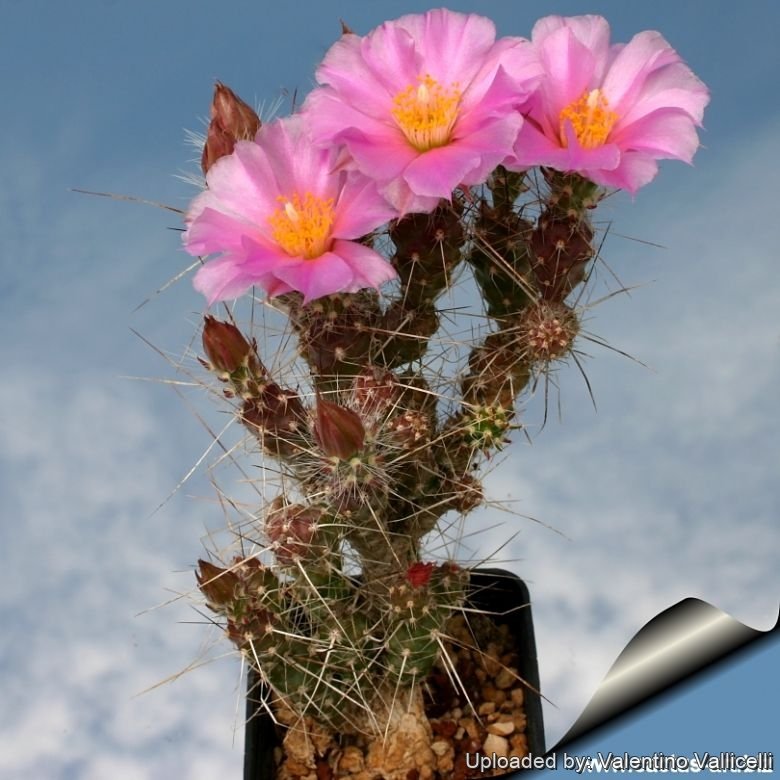
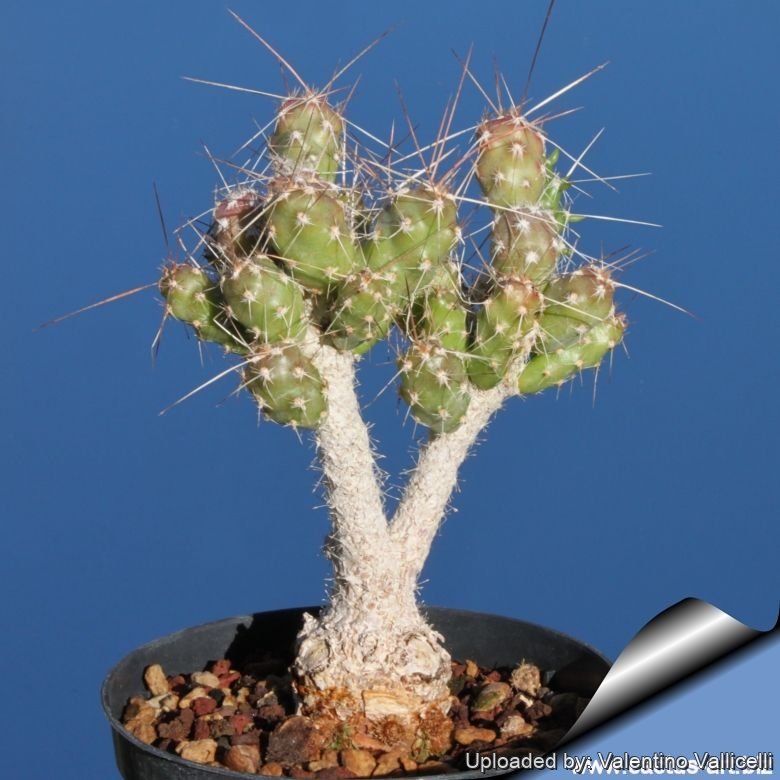
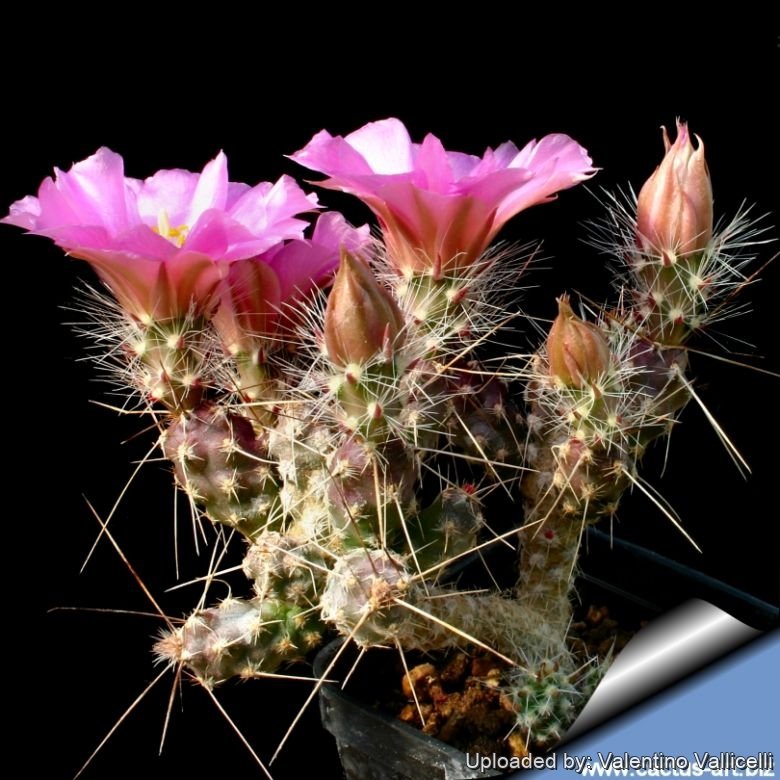
Attractive mini Opuntia, forming low sub-erected shrubs more or less dense and large, spread cushions hiding a large tuber below ground.
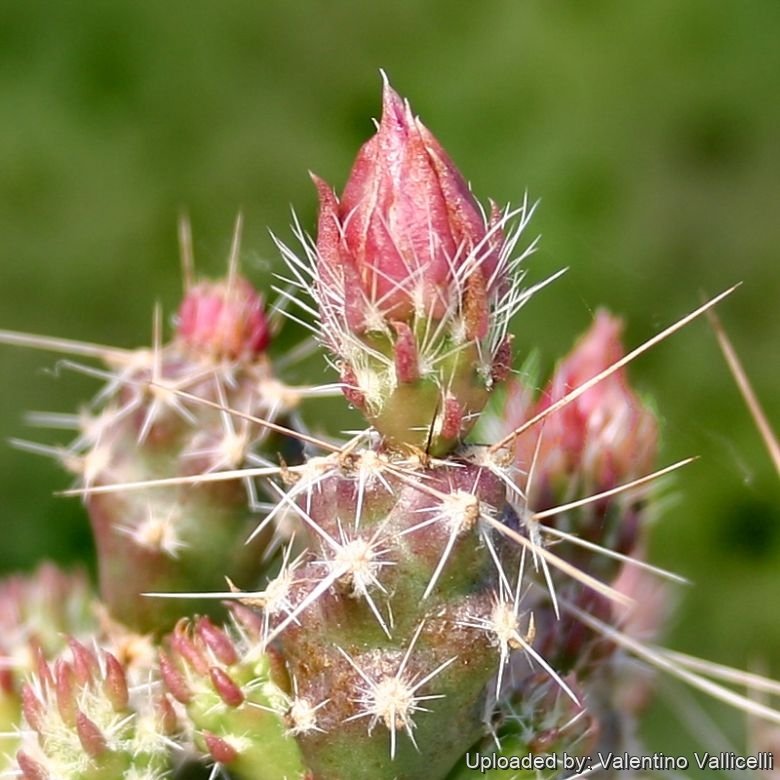
Stem: Segmented. The segments are cylindrical to ellipsoid, clavate, 1-4(-10) × 0.5-1.2(-2.5) cm; tubercles purple tinged rather prominent, 5-9 mm;
Spines: 8-15 per areole, mostly in distal areoles at the tip of the stem, divergent to deflexed, red-brown or white, aging grey, somewhat flattened, with woolly areoles white to grey.
Flowers: rose to purple; 15-35 mm; filaments green to yellow; style purplish; stigma lobes white to yellowish. Flowering late spring (May-June).
Roots: The root system of young specimens is fibrous, but will slowly enlarge to form a corky caudex with short tuberose roots.
Fruits: Reddish obconic to ellipsoids, 15-30 × 8-12 mm smooth and juicy in a first time, becoming quickly dry.
Remarks: The Grusonia (Opuntia) pulchella group-complex is indeed quite variable and includes several controversial minor forms that have been named as separated species under the genus Micropuntia (Daston, 1946), i.e., MicrSN’>9919’ alt=‘9920’>Opuntia barkleyana#SN#9920’>Micr[[Opuntia barkleyanaSN’ style=‘border:none;’>, M. brachyrhopalica, and M. spectatissima***.
This morphotypes ( “aberrant forms”) is based upon absence of glochids (these, however, being deciduous in age along with the areoles), special spine types (This being highly variable in all populations and within the same population too), the small type produced after injury, disease or dehydration. And also because the blooms and fruit while they are still in juvenile stages, there is confusion.
Origin and Habitat
Northern Mojave Desert from eastern California (Deep Springs Valley) to southern Utah and Nevada (Churchill, Douglas, Esmeralda, Lander, Lincoln, Mineral, Nye, Pershing, and Washoe counties) and Arizona. Elevation : 1100-1900 meters.
Habitat: “Sand Mountain, Sand of dunes, dry-lake borders, river bottoms, washes, valleys, sandy to rocky flats or slopes, and plains in the desert. Mainly on sandy soils but also found in a variable range of soil types “
Cultivation and Propagation
This plant is not easy to grow. Good resistance to the cold (-10°C) but it can’t stand humidity. Plants are susceptible to overwatering and are extremely rot-prone. They have sensitive roots . Keep the plants away from places with elevated humidity in the air. They need to grow in a very ventilated and dry environment, in full sun. They need to be kept in a cool (and dry) place during winter rest (at -5 / 10°C). This is important for the flowers as well as for their health. Without this cool winter period they normally won’t get many buds.
Propagation: Cutting or (rarely) seeds. Rooting of cuttings is generally difficult.
Bibliography
The Native Cacti of California by Lyman D. Benson