Publication: Kakteen (Berger) 1933
Description
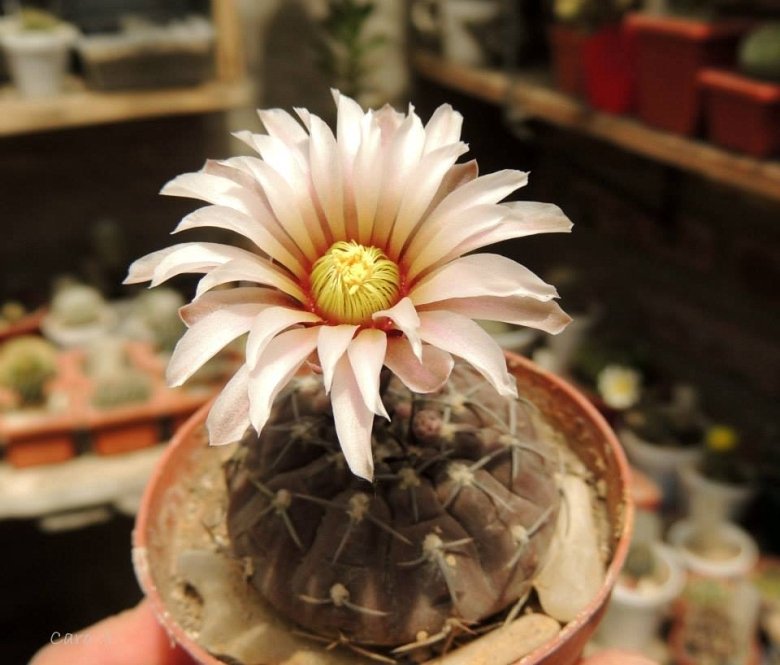
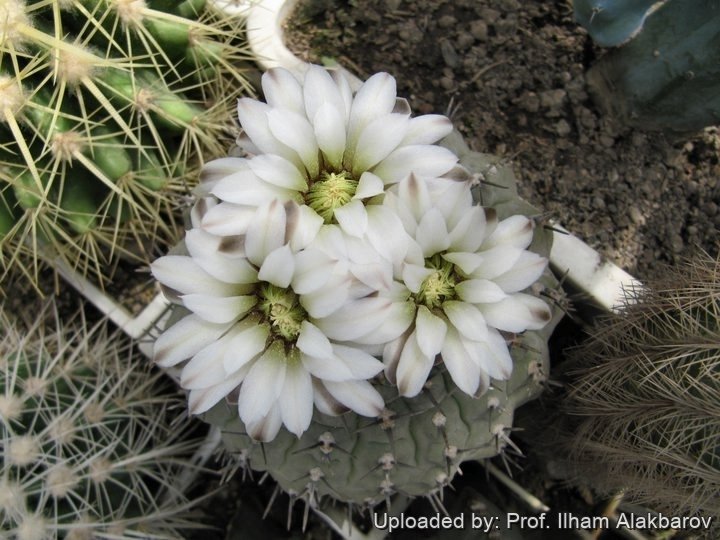
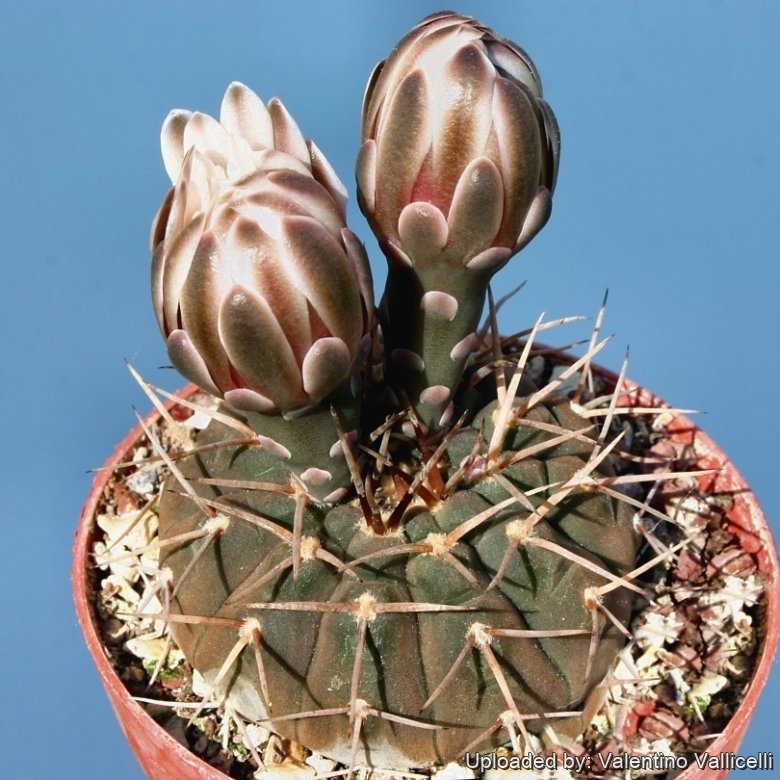
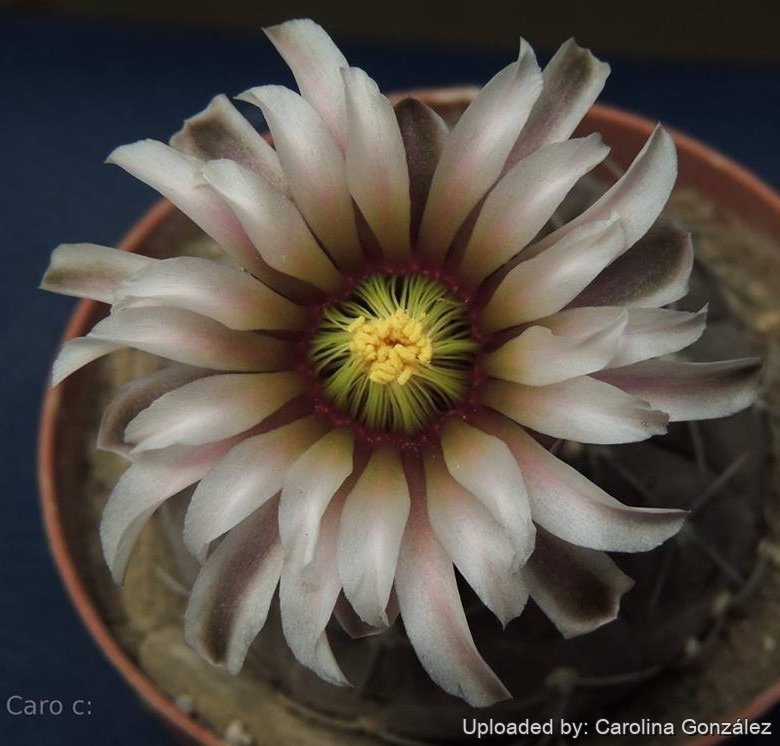
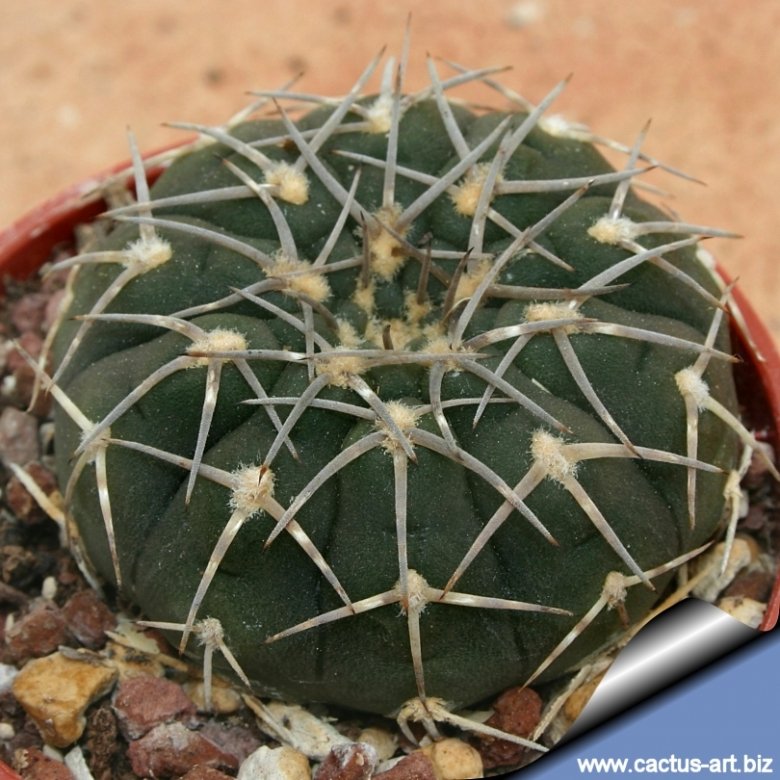
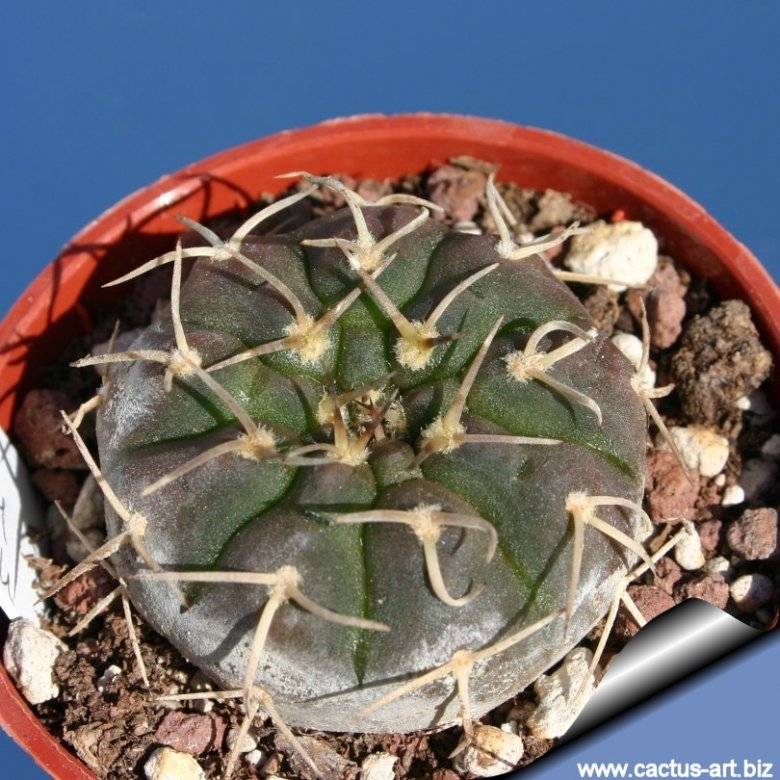
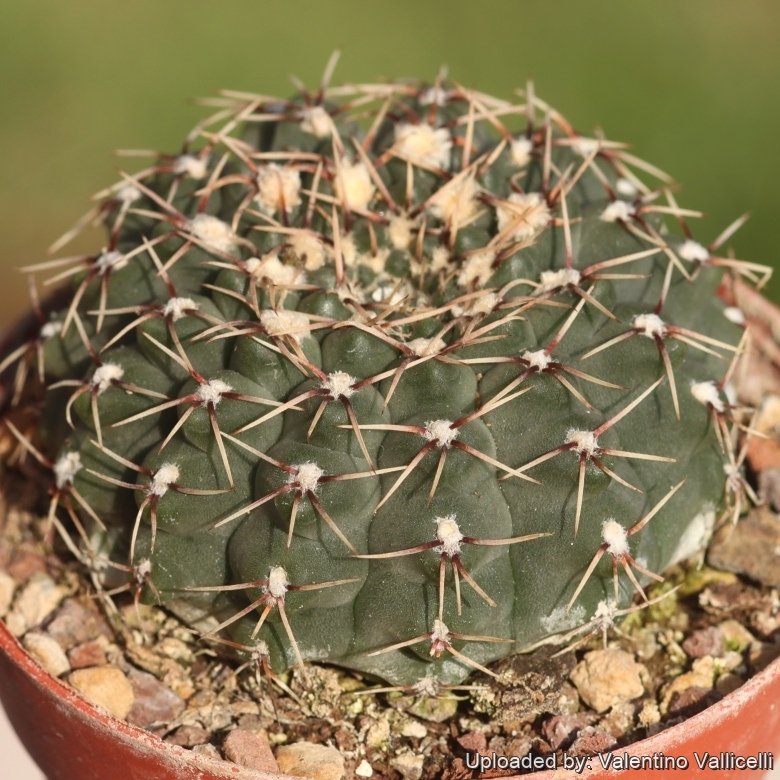
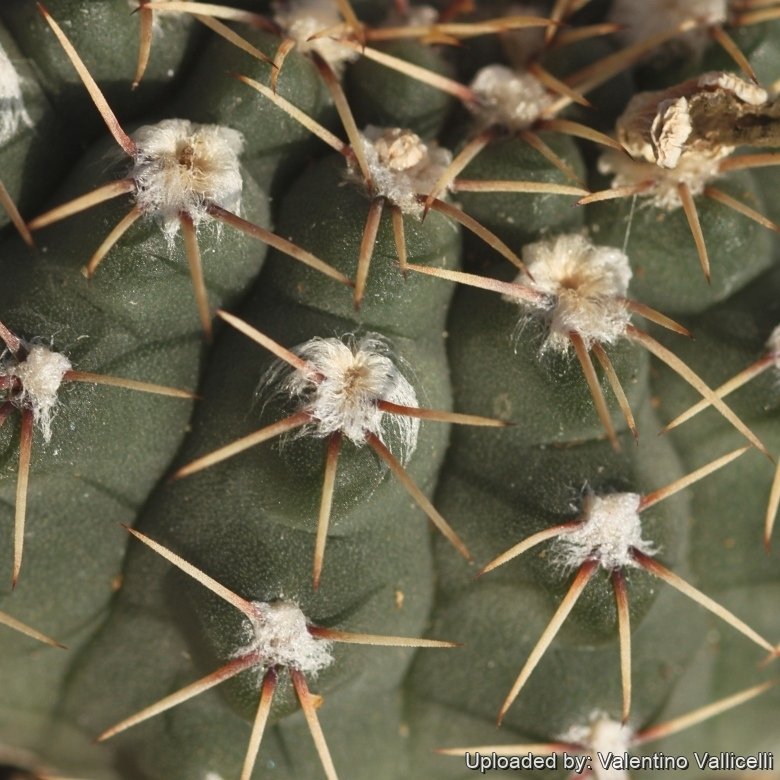
Gymnocolycium bodenbenderianum is a low-growing, flattish cactus species characterized by brownish-green stems and white flowers often pink flushed. It is commonly known as “Chin-cactus” because of its characteristic tubercles featuring a chin below the areoles.
Habit: It is a geophyte stem succulent plant usually solitary and barely rising above ground level with a swollen underground root system.
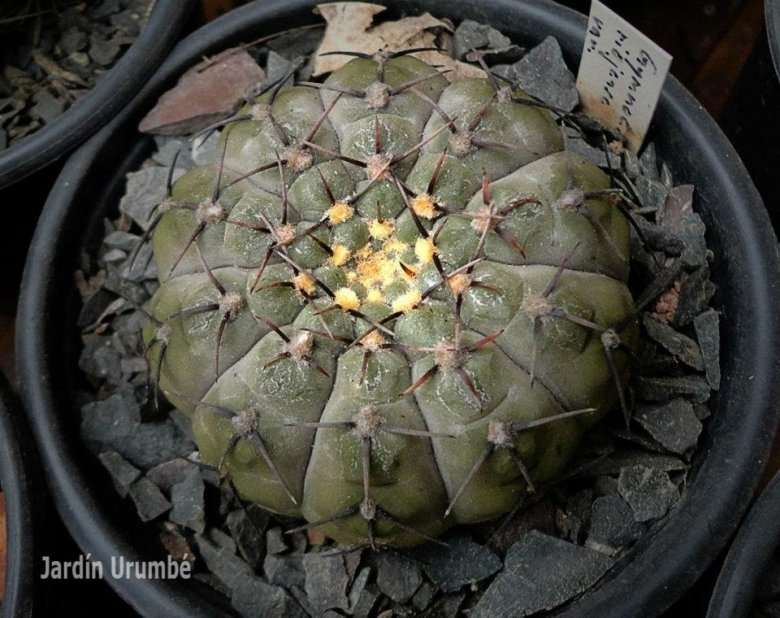
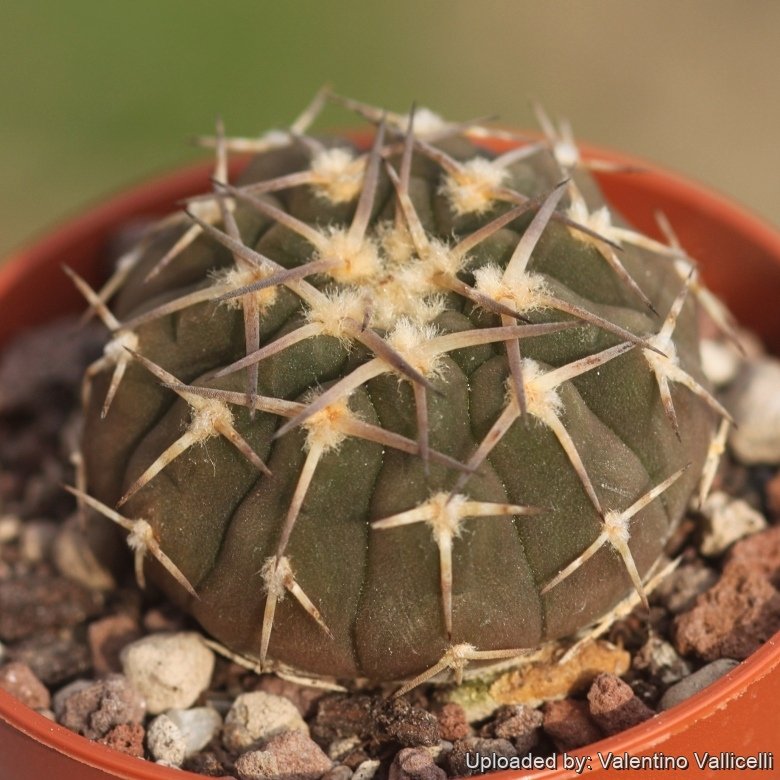
Stem: Flat, disc-shaped, 2-3 cm tall and up to 8 cm in diameter, brownish to grey-green,
Ribs: 11-15 low, rounded and distinctly tuberculate.
Central spines: Absent.
Radial spines: 3 to 7 up to 10 millimetres long, sharp, stout, but not harmful, backward curved, blackish brown, becoming grey with age.
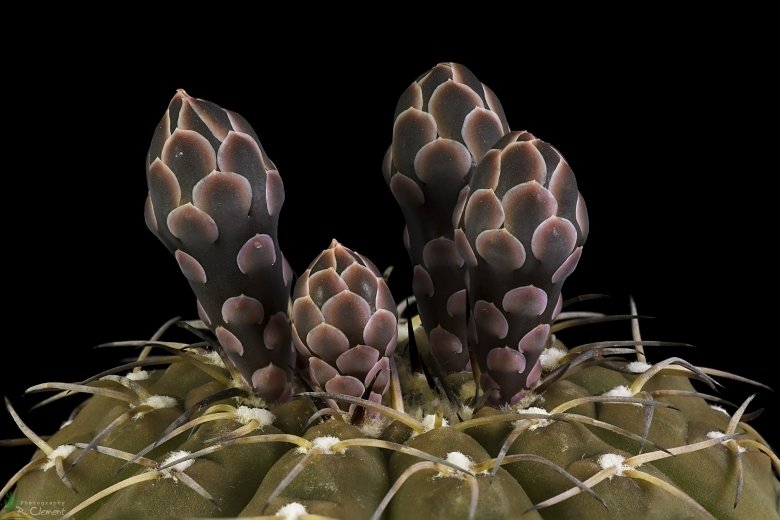
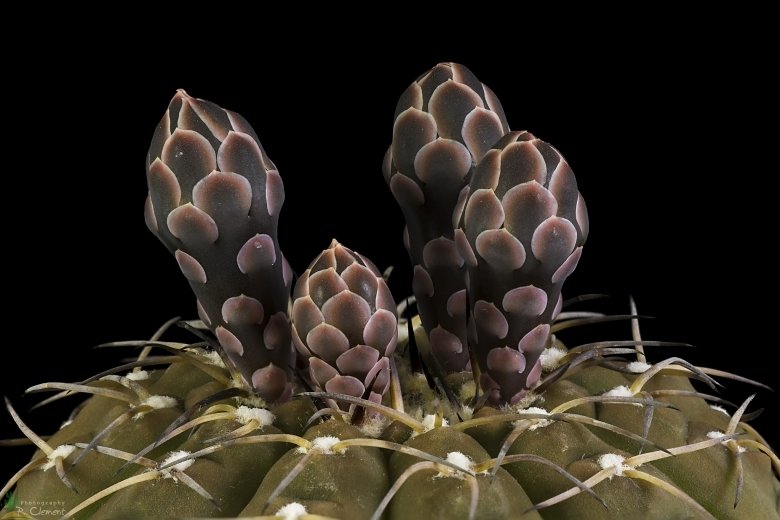
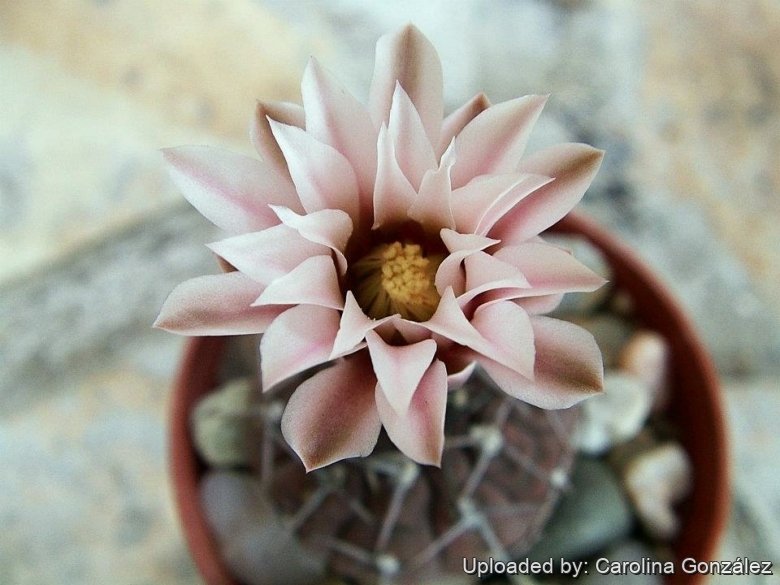
Flowers: Near the apex, white to pale pink, 3,5 to 6 cm long. Flower tube narrow with green scales tinged brown; outer tepals pale brownish-green; inner perianth-segments linear-lanceolate, white or pinkish. Throat reddish.
Flowering time: Blooms appear recurrently from June to autumn. It flowers quite readily as a young seedling.
Fruits: Blue-green, ovoid, up to 2 cm long (or longer) and up to 1 cm in diameter.
Origin and Habitat
Gymnocalycium bodenbenderianum has a wide range in Argentina, where it occurs in Catamarca, Córdoba, La Rioja, San Juan, and Santiago del Estero.
Altitude range: This species grows at elevations of 100 to 1,100 (2500 ?) metres above sea level.
Habitat and Ecology: The species grows in monte, in saline grasslands, in chaco forest, rocky slopes and grass-covered hills with rock inclusions. The species is common and abundant throughout its range. There is no known use or trade of this species.
Cultivation and Propagation
Gymnocalycium bodenbenderianum is a summer grower species that is easy to cultivate.
Growth rate: It is a relatively slow growing and easily flowering species that will make clumps given the best conditions.
Soils: It likes very porous standard cactus mix soil. Prefer a low pH compost, avoid substrata rich in limestone; otherwise growth will stop altogether.
Repotting: This plant needs plenty of space for its roots, repotting should be done every other year or when the it has outgrown its pot. Use pot with good drainage.
Watering: Needs moderate to copious waterings in summer, but do not overwater (Rot prone), keep dry in winter at a minimum temperature of 0°C.
Fertilization: Feed with a high potassium fertilizer in summer.
Hardiness: Reputedly resistant to frost if kept on the dry side prior to, and during, cold weather (hardy to -5 C ° C, or less for short periods).
Exposition: The plant tolerates extremely bright situations but enjoys filtered sunlight or afternoon shade, inside it needs bright light, and some direct sun. Tends to bronze in strong light, which encourages flowering and heavy spine production, but is likely to suffer from sun scorch or stunted growth if over exposed to direct sunlight during the hottest part of the day in summer. In full sun turns an uneven brownish red colour.
Uses: It is an excellent plant for container growing. It always looks good and stays small. It look fine in a cold greenhouse and frame or outdoor in a rockery.
Pests & diseases: It may be attractive to a variety of insects, but plants in good condition should be nearly pest-free, particularly if they are grown in a mineral potting-mix, with good exposure and ventilation. Nonetheless, there are several pests to watch for:
- Red spiders: Red spiders may be effectively rubbed up by watering the plants from above.
- Mealy bugs: Mealy bugs occasionally develop aerial into the new growth among the wool with disfiguring results, but the worst types develop underground on the roots and are invisible except by their effects.
- Scales: Scales are rarely a problem.
- Rot: This species is particularly easy and accommodating, seldom suffer of cryptogamic diseases. Rot it is only a minor problem with gymnocalyciums if the plants are watered and “aired” correctly. If they are not, fungicides won’t help all that much.
Propagation: Direct sow after last frost. Seeds germinate in 7-14 days at 21-27° C in spring, remove gradually the glass cover as soon the plants will be well rooted (ca 1-2 weeks) and keep ventilated, no full sun for young plants!
Notes
Major references and further lectures
-
Edward Anderson “The Cactus family” Timber Press, Incorporated, 2001
-
James Cullen, Sabina G. Knees, H. Suzanne Cubey “The European Garden Flora Flowering Plants: A Manual for the Identification of Plants Cultivated in Europe, Both Out-of-Doors and Under Glass” Cambridge University Press, 11/Aug/2011
-
David R Hunt; Nigel P Taylor; Graham Charles; International Cactaceae Systematics Group. “The New Cactus Lexicon” dh books, 2006
-
N. L. Britton, J. N. Rose “The Cactaceae. Descriptions and Illustrations of Plants of the Cactus Family.” Volume 4, The Carnegie Institution of Washington, Washington 1923
-
Curt Backeberg “Die Cactaceae: Handbuch der Kakteenkunde” Gustav Fischer Verlag, Stuttgart New York 1982–1985
-
Demaio, P., Perea, M. & Trevisson, M. 2013. Gymnocalycium bodenbenderianum. The IUCN Red List of Threatened Species. Version 2014.3. <www.iucnredlist.org>. Downloaded on 11 May 2015.
From llifle page Gymnocalycium paucispinum
Origin and Habitat
Argentina (Cordoba, Catamarca)
Cultivation and Propagation
This Gymnocalycium is supposed to be one of the most difficult species in cultivation, and very slow to get to a reasonable size. It will offset after a considerable period of time. It is a summer growing species that needs regular water in summer (but do not over-water ). Keep rather dry in winter. This plant does not like extremely bright situations. Give it some shade during the hottest part of the day. Keep this plant in a low pH compost; otherwise growth will stop altogether. Feed it with a high potassium fertilizer in summer. It is quite frost resistant if kept dry (hardy to -5° C)
.
Propagation: Direct sow after last frost.(seldom produces offsets)
Notes
The ‘Gymnocalycium asterias ( or asterium)’ synonym was recently deemed an illegitimate name during reclassifications, but it is still widely used.
Source: Gymnocalycium paucispinum, LLIFLE - Encyclopedia of living forms, CC-BY-SA, retrieved 2026-10-25.
From llifle page Gymnocalycium platygonum
Description
Gymnocalycium platygonum (firstly described as Gymnocalycium riojense var. platygonum Schütz ex Till & W. Till in 1991) is a local or morphological form of the widespread and variable Gymnocalycium bodenbenderianum. It has a hemispherical, usually much depressed brownish-grey stem, with pearl-white scented flowers and 3 claw-shaped spines. However the distinguishing characteristics of Gymnocalycium platygonum, appear to fall within the natural variation of Gymnocalycium bodenbenderianum and it should be synonymized with the latter, but it still has a value for a collector because they identify plants with particular characters. This taxon grows close to the habitats of Gymnocalycium ragonesei and Gymnocalycium obductum and is closely related to Gymnocalycium riojense subs. paucispinum.
Stem: Disc-shaped, flat, epidermis brownish-grey to brown-green.
Root: Turnip like, spherical, merging with the stem.
Ribs: 10 to 12, separated by a straight, longitudinal furrow, 23-24 mm wide, flat, more lifted towards the tip or the stem, with small chin-like protrusions.
Areole: Small, round, slightly nested, 3 x 3 mm, only the youngest with white felt, almost bare as they ages.
Spines: 3, claw-shaped, pointing downward, adpressed to the body, firm, brown when young, early greying, the two lateral 7-9 mm long, the intermediate one 3-5 mm long.
Flowers: From areoles near the top of fragrant, 45-48 mm long, 40-44 mm in diameter, pearly white with pink gloss, pink throat, sometimes brownish yellow. Outer tepals lanceolate, 22-24 mm long, 5-6 mm wide, pearly white with a pink belt and pink middle, sometimes greenish-brown at the base. Inner petals lanceolate, 18-21 mm long, 4 mm wide, pearly white, with pink, sometimes greenish-yellow base. Filaments greenish pink at the base, 6-8 mm long, arranged in two rows, the lowermost row close to the large pink nectarium (c.3.5 x 3.5 mm), the other inserted on the tube wall, anthers oval to oblong, yellow. Pistil about 17 mm long, 1.5 mm in diameter, stigma lobes mostly 7, yellow. Ovary with a heart-shaped chamber, 11-15 mm long, 5-7 mm wide.
Fruits: Oval to oblong-oval, 33-35 mm long and 10-11 mm in diameter, brownish-green, sometimes purple frosted, green seed loops.
Seed: With a wide concave horseshoe-shaped edge, that almost entirely covers the hilum area. Testa shiny, light brown, with small papillae.
Origin and Habitat
Argentina, from north of Salinas Grandes, Catamarca, to East of Sierra Mazan, La Rioja.
Source: Gymnocalycium platygonum, LLIFLE - Encyclopedia of living forms, CC-BY-SA, retrieved 2026-10-25.
From llifle page Gymnocalycium riojense
Description
Gymnocalycium riojense is a low growing cactus with a solitary brown body that will grow up to about 10 cm in diameter but it can take twenty years of culture to do so. However, the white-pink flowers are produced from the crown on much younger plants when only 5 cm in diameter. It is quite variable.
Taxonomy note. What is Gymnocalycium riojense? Even the arch-splitter Backeberg abandoned G. riojense with the revealing comment that that G. riojense was probably Gymnocalycium bodenbenderianum. Today most authors accepts the point of view Backeberg that G. riojense and G. bodenbenderianum are synonymous and that G. bodenbenderianum has priority. Jörg Piltz considered G. riojense Frič ex H. Till & W. Till to be a more recent synonym of G. bodenbenderianum. The same view is held by D. Hunt and G. Charles. Hower the opinion that G. bodenbenderianum and G. riojense are separated species persist among the association of Gymnocalycium friends, the different spination as well as a separate distribution area are quoted as reasons. Much space is dedicated to this theory in various, partly extensive, papers (Till et Till 1991, Amerhauser 2009). It is suggested here that G. riojense grows in the Valle Fertil (Province San Juan), Chamical (Province La Rioja) and Casa de Piedra (Province Catamarca), whereas G. bodenbenderianum is found in the Sierra de Malanzan (Sierra de Argañaraz, Sierra de Abajo) and around Sierra de Ulapes.
Derivation of specific name: This member of the Cactaceae family was named after the Argentine province of La Rioja.
Stems: Flattened-globose, grey-green, olive green, greenish-brown to chocolate, 5-8 cm tall and 8-11 cm in diameter. Apex depressed, spineless, woolly.
Root: Napiform.
Ribs: 10-16, vertical, straight, rather acute, divided into conical tubercles with conical chins, separated by very apparent V-shaped transverse furrows.
Areoles: Oval, 3 × 4-5 mm, with yellowish felt, becoming greyish, then naked.
Spines: 3-5(-7) all radials, straight, overlapping, up to 15 mm long. Young spines light brown to blackish-brown, passing then to light grey with a dark point. Central spines absent.
Flowers: Apical up to 50 mm tall, and 40 mm in diameter. Pericarpel 15-20 mm long, olive-green to glaucous-green, the scales widely edged with white and with a pink point, passing gradually to the external tepals. The latter spatulate, white to rosy white, with an olive-green wide median band. Internal tepals lanceolate, white with a pink central line and carmine base. Throat dark carmine. Filaments pale green; anthers sulphur-yellow. Style greenish white with a pink base. Stigma yellowish white, with 9-12 lobes, between the primary and secondary stamens.
Origin and Habitat
Northern Argentina (La Rioja, San Juan and Catamarca).
Altitude range. 450-1600 metres above sea level.
Habitat and ecology:* This is one of a number of similar species that grow in flat ground or on gentle rocky slopes, often under bushes.
Cultivation and Propagation
Gymnocalycium riojense is a summer grower species that is easy to cultivate.
Growth rate: It is a relatively slowly growing but easily flowering species.
Soils: It likes very porous standard cactus mix soil. Prefer a low pH compost, avoid substrata rich in limestone; otherwise growth will stop altogether.
Repotting: This plant needs plenty of space for its roots, repotting should be done every other year or when the it has outgrown its pot. Use pot with good drainage.
Watering: Needs moderate to copious waterings in summer, but do not overwater (Rot prone), keep dry in winter at a minimum temperature of 0°C.
Fertilization: Feed with a high potassium fertilizer in summer.
Hardiness: Reputedly resistant to frost if kept on the dry side prior to, and during, cold weather (hardy to -5 C ° C, or less for short periods).
Exposition: The plant tolerates extremely bright situations but enjoys filtered sunlight or afternoon shade, inside it needs bright light, and some direct sun. Tends to bronze in strong light, which encourages flowering and heavy spine production, but is likely to suffer from sun scorch or stunted growth if over exposed to direct sunlight during the hottest part of the day in summer. In full sun turns an uneven brownish red colour.
Uses: It is an excellent plant for container growing. It always looks good and stays small. It look fine in a cold greenhouse and frame or outdoor in a rockery.
Pests & diseases: It may be attractive to a variety of insects, but plants in good condition should be nearly pest-free, particularly if they are grown in a mineral potting-mix, with good exposure and ventilation. Nonetheless, there are several pests to watch for:
- Red spiders: Red spiders may be effectively rubbed up by watering the plants from above.
- Mealy bugs: Mealy bugs occasionally develop aerial into the new growth among the wool with disfiguring results, but the worst types develop underground on the roots and are invisible except by their effects.
- Scales: Scales are rarely a problem.
- Rot: This species is particularly easy and accommodating, seldom suffer of cryptogamic diseases. Rot it is only a minor problem with gymnocalyciums if the plants are watered and “aired” correctly. If they are not, fungicides won’t help all that much.
Propagation: Direct sow after last frost. Seeds germinate in 7-14 days at 21-27° C in spring, remove gradually the glass cover as soon the plants will be well rooted (ca 1-2 weeks) and keep ventilated, no full sun for young plants!
Bibliography
Major references and further lectures
-
J.G. Lambert “Cacti of Argentina” 2nd edition Revised and supplemented 1997 <https://www.cactuspro.com/biblio\_fichiers/pdf/Lambert/LambertEN.pdf\>
-
Graham Charles “Cacti and Succulents: An illustrated guide to the plants and their cultivation” Crowood, 30 April 2014
-
Amerhauser, H. (2009) “Gymnocalycium” 22(2): 857ff.
-
Berger, A. (1929) “Kakteen”.-Eugen Ulmer, Stuttgart.
-
Charles, G. (2009) “Gymnocalycium in habitat and culture”. - Eigenverlag - Ketton, Stamford.
-
Cocucci, A. E. (2003) C. C. Hosseus - “Notas Autobiograficas”. - Acad. Nac. Cient. Cord.
-
Papsch - “Comments on Gymnocalycium bodenbenderianum and Gymnocalycium riojense” Schütziana 5(2): pp. 3-14. 2014.
-
Crkal, K. (1983) “Lovec Kaktusů (A. V. Frič).” - Verlag Academia-Prag.
-
Frič, A. V. (1929) “Kakteenjäger”. - Eigenverlag-Prag.
-
Haage, F. A. (1928) “Kakteen-Preisverzeichnis” 1928. - Eigenverlag, Erfurt.
-
Hill, A. W. (1933) “Index Kewensis Plantarum Phanerogamrum”. - Clarendoniano - Oxford.
-
Hosseus, C. C. (1926) “Apuntes sobre las Cactáceas.” - Rev. Cent. Est. Farm. Cordoba II/6.
-
Hosseus, C. C. (1939) “Notas sobre Cactaceas Argentinas”. - Arch. Esc. Farm. Cordoba nr. 9.
-
Hunt, D. ed. (2006) “The New Cactus Lexicon”. - dh books - Milborne Port.
-
Kreuzinger, K. (1935) “Verzeichnis amerikanischer und and erer Sukkulenten mit Revision der Systematik der Kakteen”. - Verlag Kreuzinger-Eger.
-
Pazout, F., Valnicek, J. & Subik, R. (1960) “Kaktusy”. - Eigenverlag - Prag.
-
Till, H., Amerhauser, H. & Till, W. (2008) “Neuordnung der Gattung Gymnocalycium” Teil 2. - Gymnocalycium Sonderausgabe 2008 : 816.
-
Till. H. & Till, W. (1991) “Gymnocalycium riojense: Validierung, Beschreibung neuer Taxa und systematische Gruppierung nach morphologischen und arealmäßigen Kriterien.” Teil 1-3. - Gymnocalycium 2(4): 47 - 4(4): 58.
-
Edward Anderson “The Cactus family” Timber Press, Incorporated, 2001
-
James Cullen, Sabina G. Knees, H. Suzanne Cubey “The European Garden Flora Flowering Plants: A Manual for the Identification of Plants Cultivated in Europe, Both Out-of-Doors and Under Glass” Cambridge University Press, 11/Aug/2011
Source: Gymnocalycium riojense, LLIFLE - Encyclopedia of living forms, CC-BY-SA, retrieved 2026-10-25.
From llifle page Gymnocalycium riojense var. guthianum
Origin and Habitat
Argentina.
Source: Gymnocalycium riojense var. guthianum, LLIFLE - Encyclopedia of living forms, CC-BY-SA, retrieved 2026-10-25.
From llifle page Gymnocalycium riojense var. mirandaense
Description
Bulb: Subglobose, 15-20. diam., with many hundreds of tunics, the outer brown and firm in texture.
Leaves: 8 to 16, ensiform, distichous, erect, coriaceous, glaucous, closely ribbed, narrowed gradually to the point, finally up to 50 cm. long, 2,5 to 6 cm broad, hairy on the margin, not ciliated, often much undulated; peduncle stout, ancipitous, glaucous, 1/2–1 ft. long;
Flowers: Very numerous, pink to bright red, arranged in a dense umbel.
Fruit: the fruit is a capsule turbinate, 2 cm in. long, 1-15 cm diam.
Origin and Habitat
Extends to Angola, Welwitsch and the mountains round Lake Nyassa, Thomson and Lake Tanganyika, Cameron.
Source: Gymnocalycium riojense var. mirandaense, LLIFLE - Encyclopedia of living forms, CC-BY-SA, retrieved 2026-10-25.
From llifle page Gymnocalycium riojense var. vertongenii
Origin and Habitat
La Rioja (Argentina Northwest, Southern America)
Type Locality: Provincia La Rioja, in montibus septentrionaliter pagi Alto Jagüé, 2250 m
Source: Gymnocalycium riojense var. vertongenii, LLIFLE - Encyclopedia of living forms, CC-BY-SA, retrieved 2026-10-25.
From llifle page Gymnocalycium triacanthum
Description
Gymnocalycium triacanthum is a small single headed, flattened cactus, with peculiar grey bodies with short adpressed spines in clusters of three. It is one of the several species of the variable Gymnocalycium bodenbenderianum complex, however it is hard to tell it apart from the three spined “bodenbenderianum”, and most authors choose to lump them together.
Habit: It is a geophyte stem succulent plant usually solitary and barely rising above ground level with a swollen underground root system.
Stem: Flat, disc-shaped, 2-3 cm tall and up to 8 cm in diameter, grey-green to dull brownish-green.
Ribs: 11-15 low, rounded and slightly tuberculate, with tubercles separated by furrows.
Central spines: Absent.
Radial spines: usually 3, occasionally up to 5 or more, up to 10 millimetres long, sharp, stout, but not harmful, backward curved, blackish brown, becoming grey with age.
Flowers: Near the apex, white to pale pink, 3,5 to 6 cm long. Flower tube narrow with green scales tinged brown; outer tepals pale brownish-green; inner perianth-segments linear-lanceolate, white or pinkish. Throat reddish.
Flowering time: Blooms appear recurrently from June to autumn. It flowers quite readily as a young seedling.
Fruits: Blue-green, ovoid, up to 2 cm long (or longer) and up to 1 cm in diameter.
Origin and Habitat
Catamarca, Córdoba, La Rioja, Argentina.
Cultivation and Propagation
Gymnocalycium triacanthum is a summer grower species that is easy to cultivate.
Growth rate: It is a relatively slow growing and easily flowering species that will make clumps given the best conditions.
Soils: It likes very porous standard cactus mix soil. Prefer a low pH compost, avoid substrata rich in limestone; otherwise growth will stop altogether.
Repotting: This plant needs plenty of space for its roots, repotting should be done every other year or when the it has outgrown its pot. Use pot with good drainage.
Watering: Needs moderate to copious waterings in summer, but do not overwater (Rot prone), keep dry in winter at a minimum temperature of 0°C.
Fertilization: Feed with a high potassium fertilizer in summer.
Hardiness: Reputedly resistant to frost if kept on the dry side prior to, and during, cold weather (hardy to -5 C ° C, or less for short periods).
Exposition: The plant tolerates extremely bright situations but enjoys filtered sunlight or afternoon shade, inside it needs bright light, and some direct sun. Tends to bronze in strong light, which encourages flowering and heavy spine production, but is likely to suffer from sun scorch or stunted growth if over exposed to direct sunlight during the hottest part of the day in summer. In full sun turns an uneven brownish red colour.
Uses: It is an excellent plant for container growing. It always looks good and stays small. It look fine in a cold greenhouse and frame or outdoor in a rockery.
Pests & diseases: It may be attractive to a variety of insects, but plants in good condition should be nearly pest-free, particularly if they are grown in a mineral potting-mix, with good exposure and ventilation. Nonetheless, there are several pests to watch for:
- Red spiders: Red spiders may be effectively rubbed up by watering the plants from above.
- Mealy bugs: Mealy bugs occasionally develop aerial into the new growth among the wool with disfiguring results, but the worst types develop underground on the roots and are invisible except by their effects.
- Scales: Scales are rarely a problem.
- Rot: This species is particularly easy and accommodating, seldom suffer of cryptogamic diseases. Rot it is only a minor problem with gymnocalyciums if the plants are watered and “aired” correctly. If they are not, fungicides won’t help all that much.
Propagation: Direct sow after last frost. Seeds germinate in 7-14 days at 21-27° C in spring, remove gradually the glass cover as soon the plants will be well rooted (ca 1-2 weeks) and keep ventilated, no full sun for young plants!
Bibliography
Major references and further lectures
-
Edward Anderson “The Cactus family” Timber Press, Incorporated, 2001
-
James Cullen, Sabina G. Knees, H. Suzanne Cubey “The European Garden Flora Flowering Plants: A Manual for the Identification of Plants Cultivated in Europe, Both Out-of-Doors and Under Glass” Cambridge University Press, 11/Aug/2011
-
David R Hunt; Nigel P Taylor; Graham Charles; International Cactaceae Systematics Group. “The New Cactus Lexicon” dh books, 2006
4)Curt Backeberg “Die Cactaceae: Handbuch der Kakteenkunde” Gustav Fischer Verlag, Stuttgart New York 1982–1985
Source: Gymnocalycium triacanthum, LLIFLE - Encyclopedia of living forms, CC-BY-SA, retrieved 2026-10-25.
From llifle page Gymnocalycium pseudoragonesei
Description
Gymnocalycium pseudoragonesei (Sometimes wrongly spelled “pseudoragonesi” or “pseudoragonesii”) is a geographical or morphological form of the very variable Gymnocolycium bodenbenderianum. At a first glance this taxon is easily mistaken for the more common Gymnocalycium stellatum ssp. obductum if not in flower.
Habit: It is a small, low-growing, flattish cactus species characterized by brownish-green stems resembling a round brown rock with white flowers often pink flushed usually in clusters from June to September. This one of the gymnos commonly known as “Chin-cactus” because of its characteristic tubercles featuring a chin below the areoles.
Habit: It is a geophyte stem succulent plant usually solitary and barely rising above ground level with a swollen underground root system.
Stem: Flat, disc-shaped, 2-3 cm tall and up to 8 cm in diameter, brownish to grey-green,
Ribs: 11-15 low, rounded and distinctly tuberculate.
Central spines: Absent.
Radial spines: 3 to 7 up to 10 millimetres long, sharp, stout, but not harmful, backward curved, blackish brown, becoming grey with age.
Flowers: Near the apex, white to pale pink, 3,5 to 6 cm long. Flower tube narrow with green scales tinged brown; outer tepals pale brownish-green; inner perianth-segments linear-lanceolate, white or pinkish. Throat reddish.
Flowering time: Blooms appear recurrently from June to autumn. It flowers quite readily as a young seedling.
Fruits: Blue-green, ovoid, up to 2 cm long (or longer) and up to 1 cm in diameter.
Origin and Habitat
Jujuy to Salta to Catamarca, Argentina.
Cultivation and Propagation
Gymnocalycium pseudoragonesii is a summer grower species that is easy to cultivate.
Growth rate: It is a relatively slow growing and easily flowering species that will make clumps given the best conditions.
Soils: It likes very porous standard cactus mix soil. Prefer a low pH compost, avoid substrata rich in limestone; otherwise growth will stop altogether.
Repotting: This plant needs plenty of space for its roots, repotting should be done every other year or when the it has outgrown its pot. Use pot with good drainage.
Watering: Needs moderate to copious waterings in summer, but do not overwater (Rot prone), keep dry in winter at a minimum temperature of 0°C.
Fertilization: Feed with a high potassium fertilizer in summer.
Hardiness: Reputedly resistant to frost if kept on the dry side prior to, and during, cold weather (hardy to -5 C ° C, or less for short periods).
Exposition: The plant tolerates extremely bright situations but enjoys filtered sunlight or afternoon shade, inside it needs bright light, and some direct sun. Tends to bronze in strong light, which encourages flowering and heavy spine production, but is likely to suffer from sun scorch or stunted growth if over exposed to direct sunlight during the hottest part of the day in summer. In full sun turns an uneven brownish red colour.
Uses: It is an excellent plant for container growing. It always looks good and stays small. It look fine in a cold greenhouse and frame or outdoor in a rockery.
Pests & diseases: It may be attractive to a variety of insects, but plants in good condition should be nearly pest-free, particularly if they are grown in a mineral potting-mix, with good exposure and ventilation. Nonetheless, there are several pests to watch for:
- Red spiders: Red spiders may be effectively rubbed up by watering the plants from above.
- Mealy bugs: Mealy bugs occasionally develop aerial into the new growth among the wool with disfiguring results, but the worst types develop underground on the roots and are invisible except by their effects.
- Scales: Scales are rarely a problem.
- Rot: This species is particularly easy and accommodating, seldom suffer of cryptogamic diseases. Rot it is only a minor problem with gymnocalyciums if the plants are watered and “aired” correctly. If they are not, fungicides won’t help all that much.
Propagation: Direct sow after last frost. Seeds germinate in 7-14 days at 21-27° C in spring, remove gradually the glass cover as soon the plants will be well rooted (ca 1-2 weeks) and keep ventilated, no full sun for young plants!
Bibliography
Major references and further lectures
-
Edward Anderson “The Cactus family” Timber Press, Incorporated, 2001
-
James Cullen, Sabina G. Knees, H. Suzanne Cubey “The European Garden Flora Flowering Plants: A Manual for the Identification of Plants Cultivated in Europe, Both Out-of-Doors and Under Glass” Cambridge University Press, 11/Aug/2011
-
David R Hunt; Nigel P Taylor; Graham Charles; International Cactaceae Systematics Group. “The New Cactus Lexicon” dh books, 2006
-
N. L. Britton, J. N. Rose “The Cactaceae. Descriptions and Illustrations of Plants of the Cactus Family.” Volume 4, The Carnegie Institution of Washington, Washington 1923
-
Curt Backeberg “Die Cactaceae: Handbuch der Kakteenkunde” Gustav Fischer Verlag, Stuttgart New York 1982–1985
Source: Gymnocalycium pseudoragonesei, LLIFLE - Encyclopedia of living forms, CC-BY-SA, retrieved 2026-10-25.
Cultivars and forms (2)
Subspecies (1)
Gallery