Publication: Gymnocalycium 19(3): 675. 2006 [Aug 2006]
Description
Initially described as good species on its own in 1977 by Schütz, Gymnocalycium bozsingianum was then reduced to the subspecies rank of Gymnocalycium castellanosii ssp castellanosii by Amerhauser and Till, later J. Piltz passed it to the rank of variety.
Derivation of specific name: The specific name honours the Austrian cactophile, F. Bozsing of Salzburg.
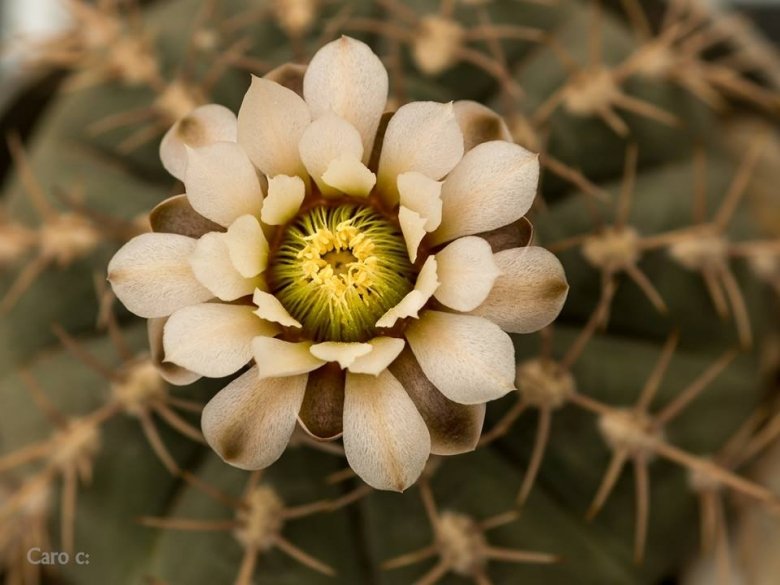
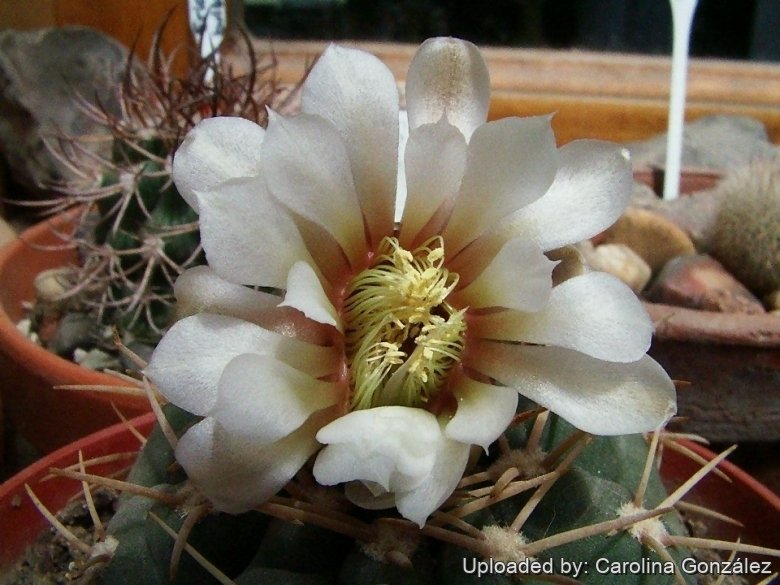
Distinguishing characteristics: It is characterized by a dull grey green epidermis, a dozen of rounded ribs with low tubercles, separated from each other by small furrows, usually 5 needle-like radial spines, mostly 3 to 20 mm in length, and rarely a central spine.
Origin and Habitat
This taxon is endemic to the Sierra de Malanzán near the town of Chepes Viejo, in the province of La Rioja, Argentina,
Altitude range: 600-850 metres above sea level.
Cultivation and Propagation
Summer-growing and pretty easy, water regularly in summer, and keep rather dry in winter. However it can handle excessive water to little water. It grows well in full sun or half sun, too (but in full sun it will form stronger spines).
Propagation: Seeds (it seldom produces offsets). Seed Collecting: Permit fruit to ripen. Fruit must be significantly overripe before harvesting seed; clean and dry seeds.
Bibliography
Major references and further lectures
Gymnocalycium Galerie “Gymnocalycium bozsingianum (Schütz) Piltz” web <http://www.gymnocalycium.fr/bozsingianum/\>