Publication: Kakteen (Berger) 226, 341 (1929) et A. W. Hill 1933
Description
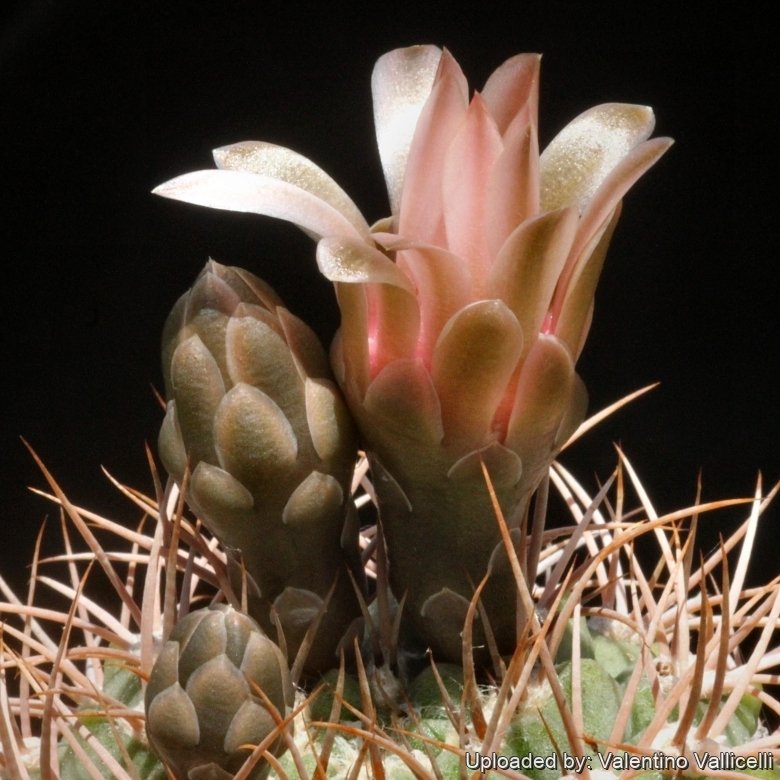
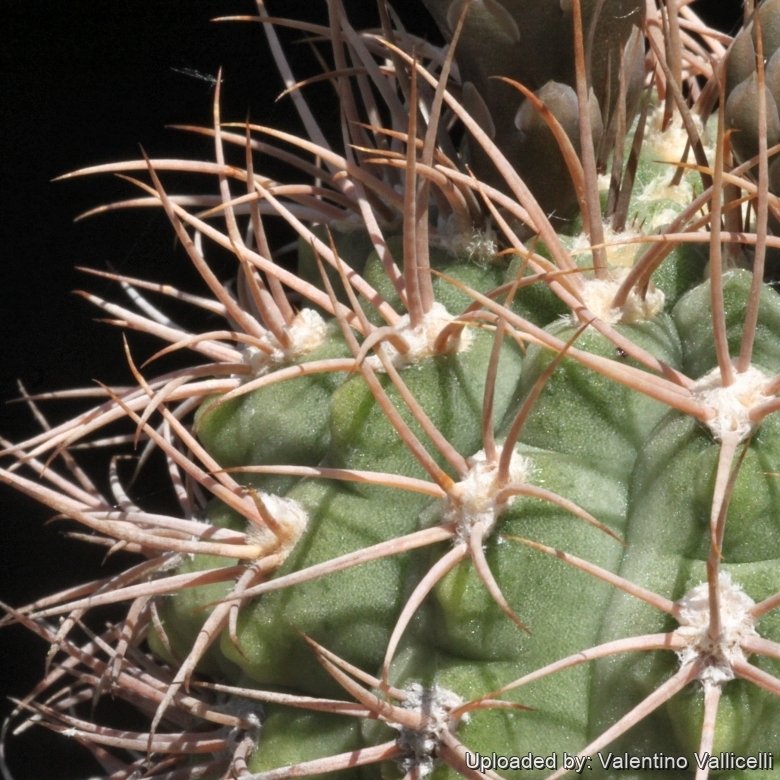
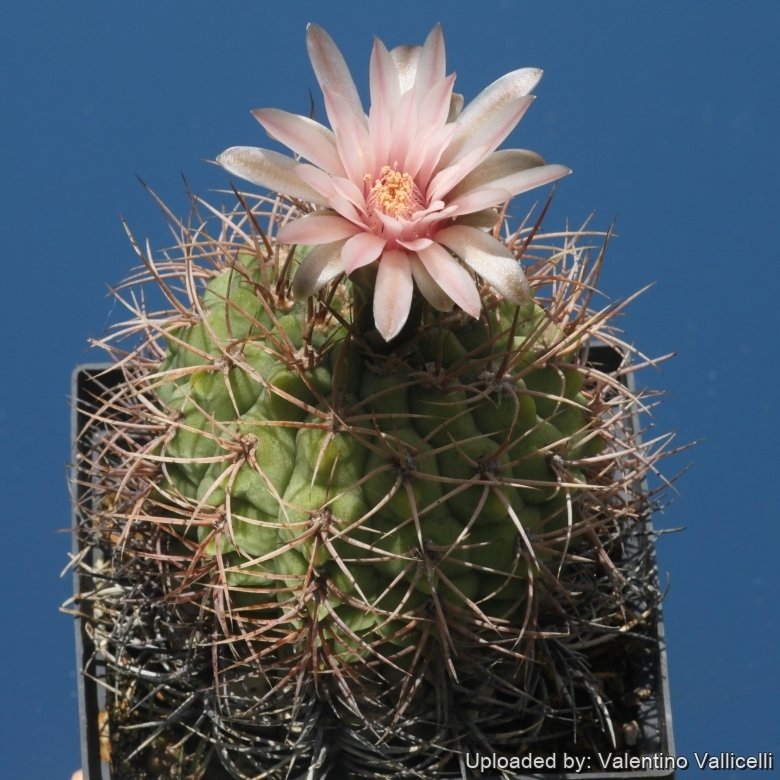
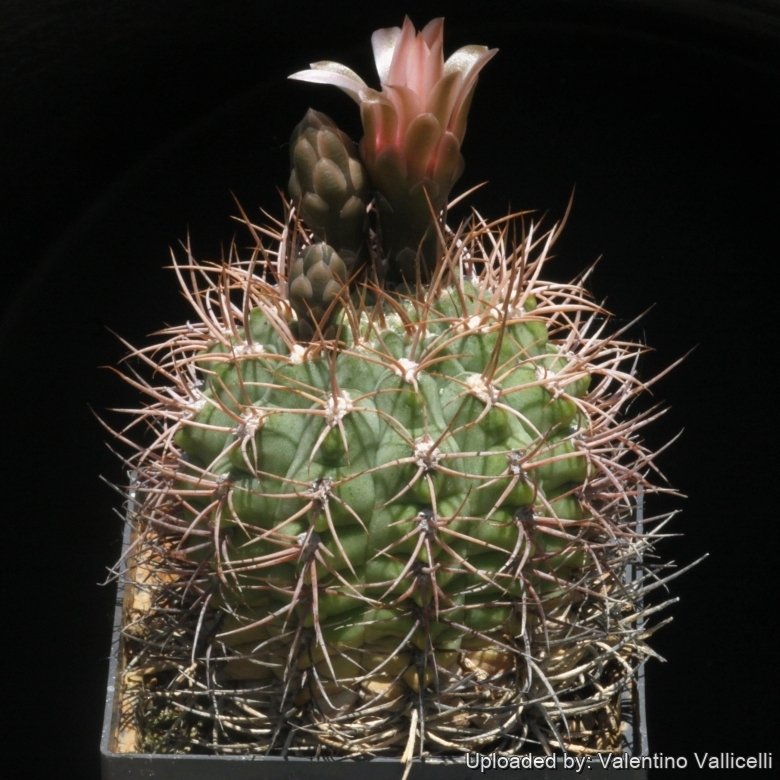
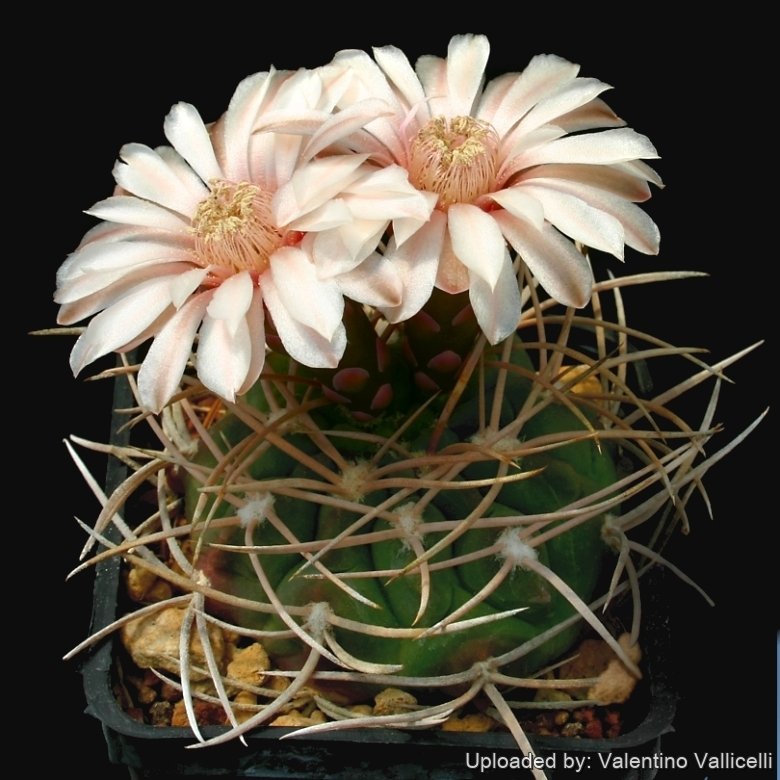
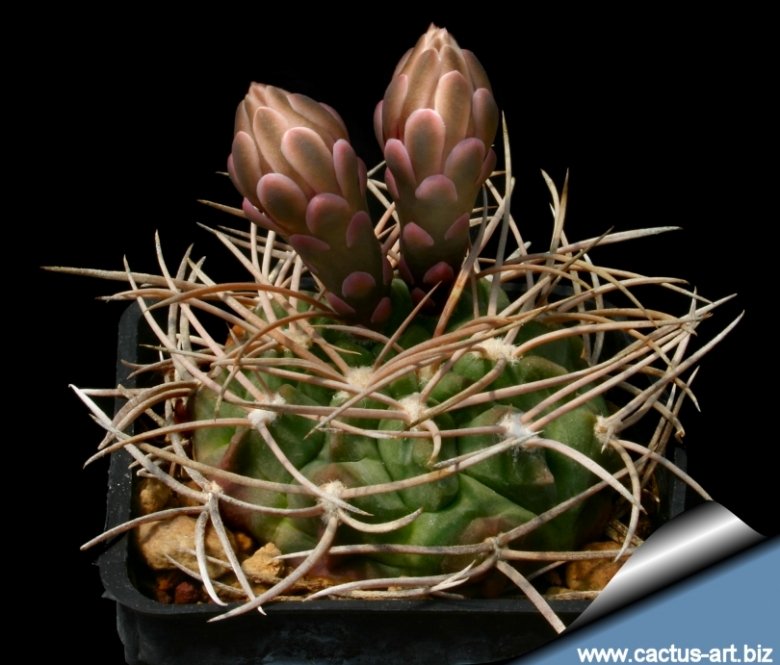
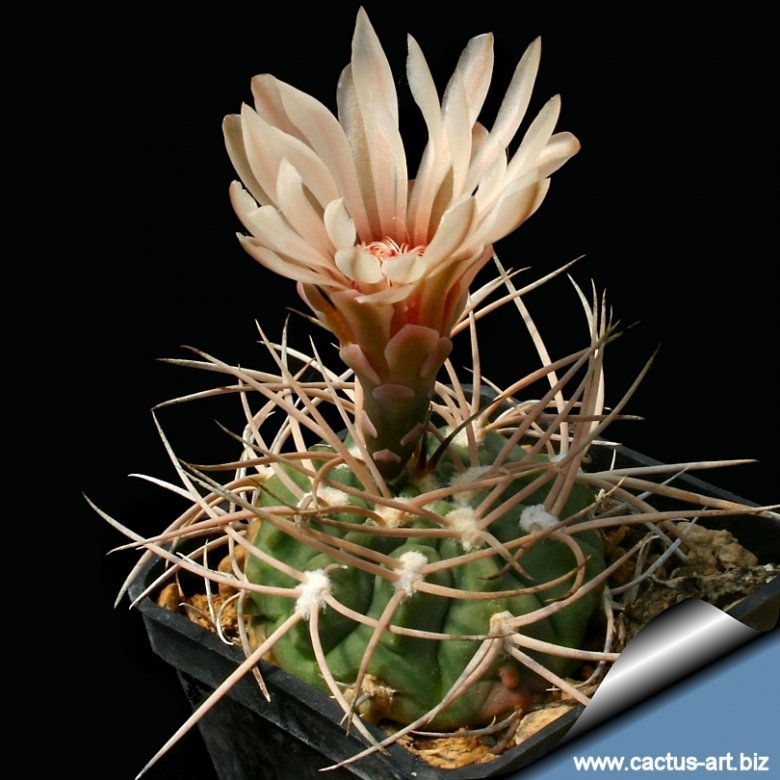
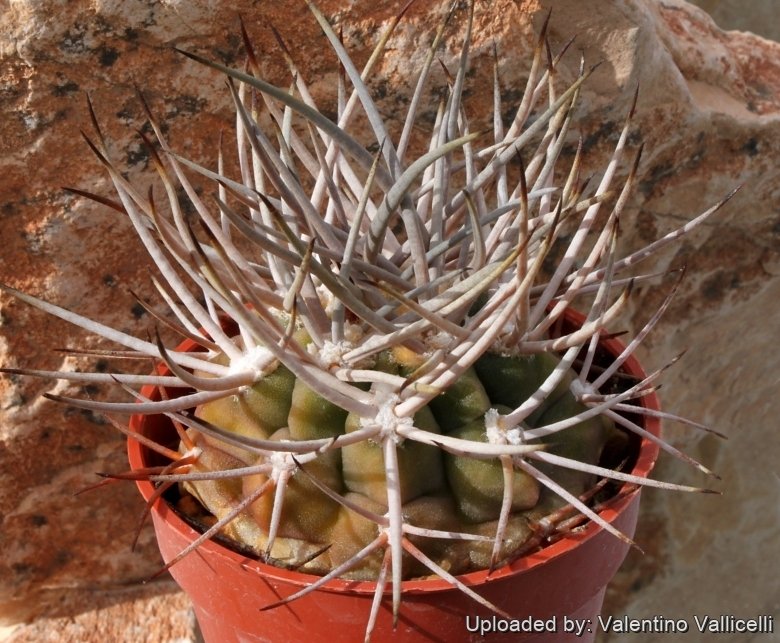
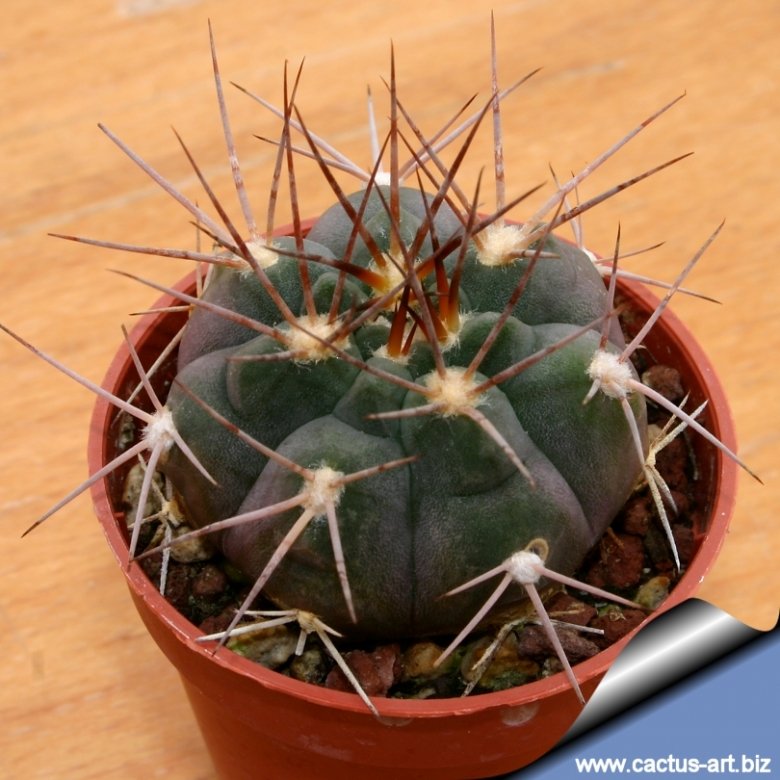
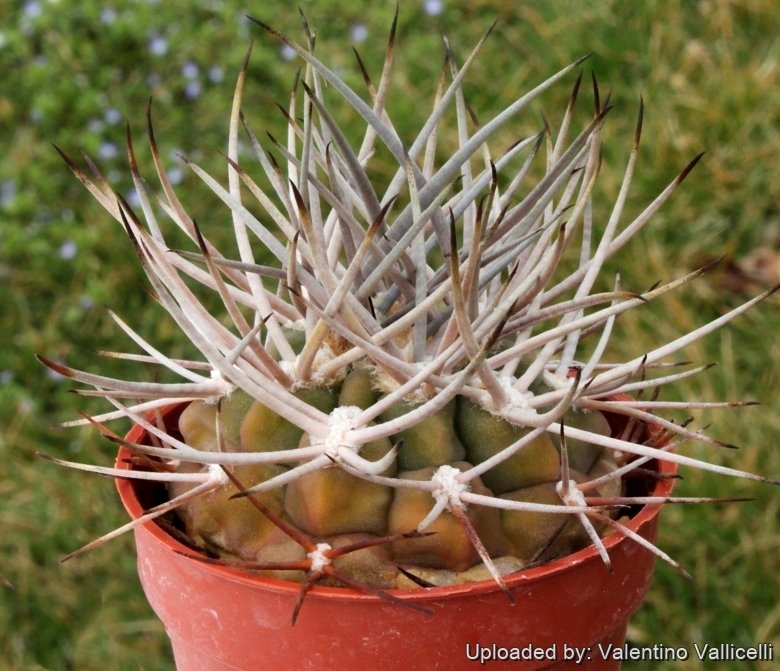
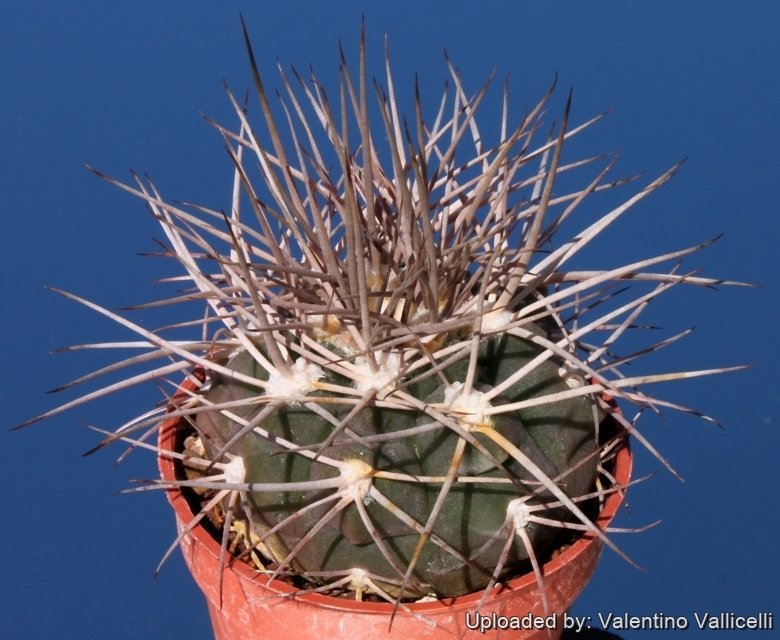
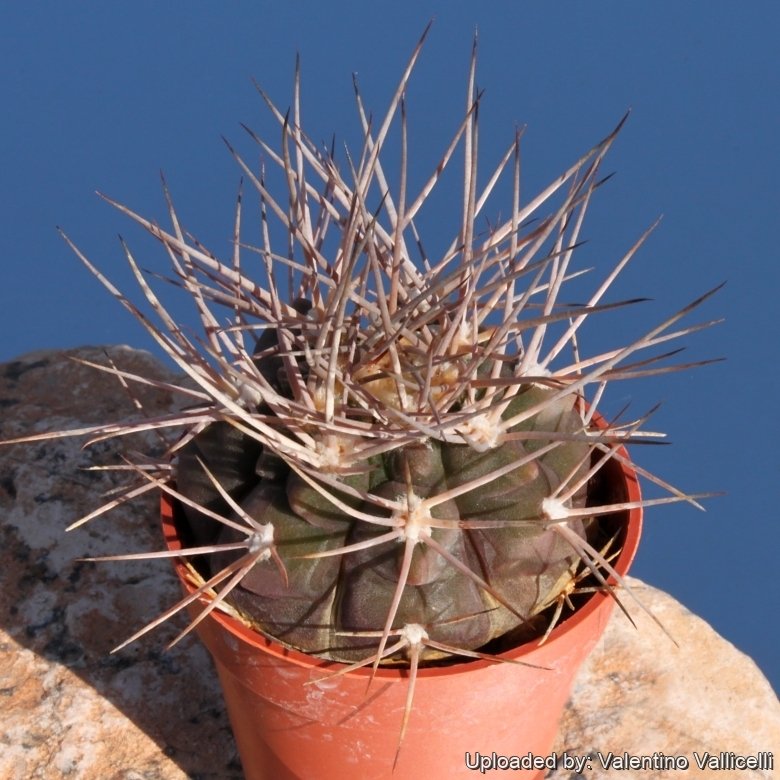
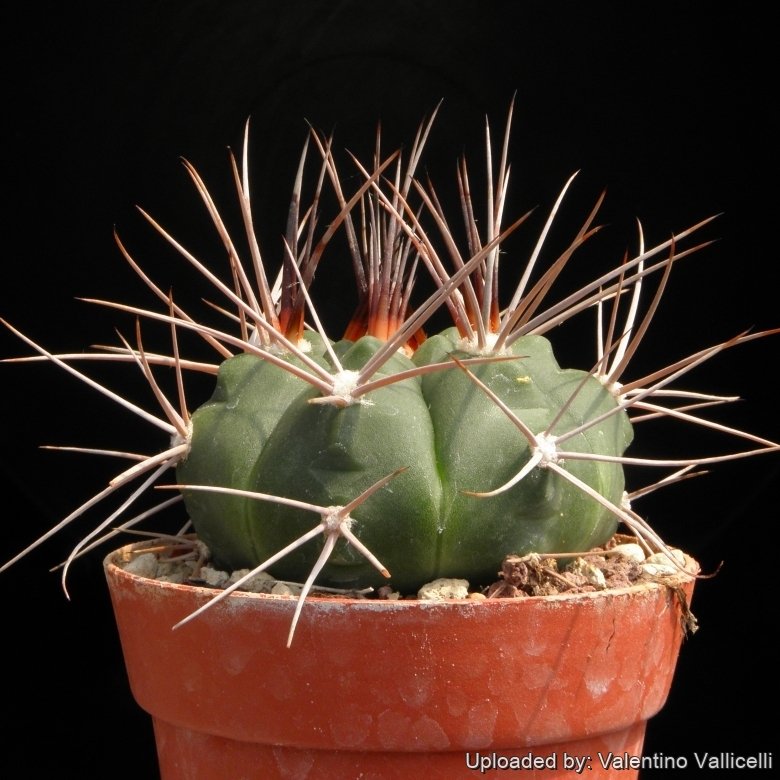
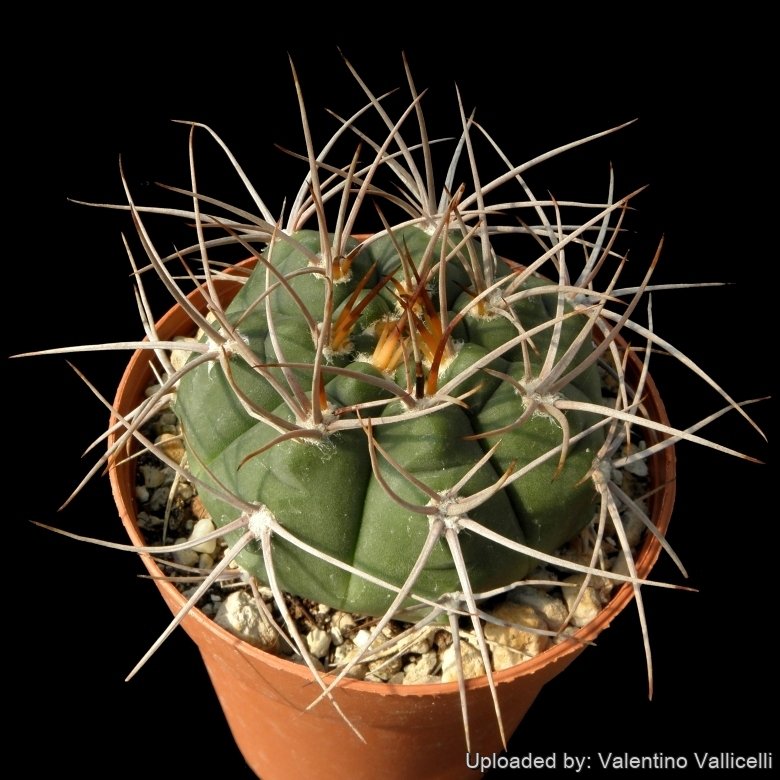
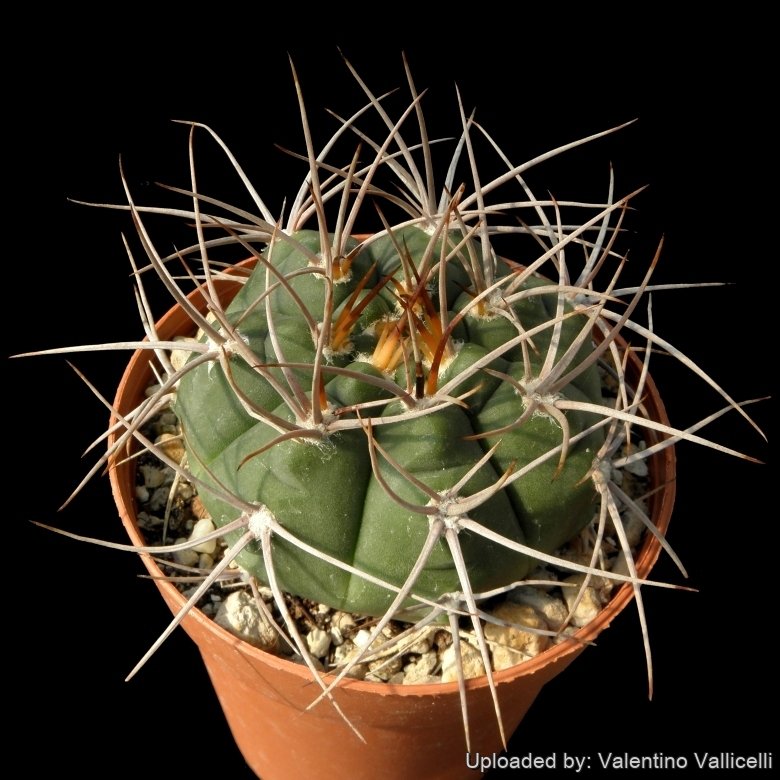
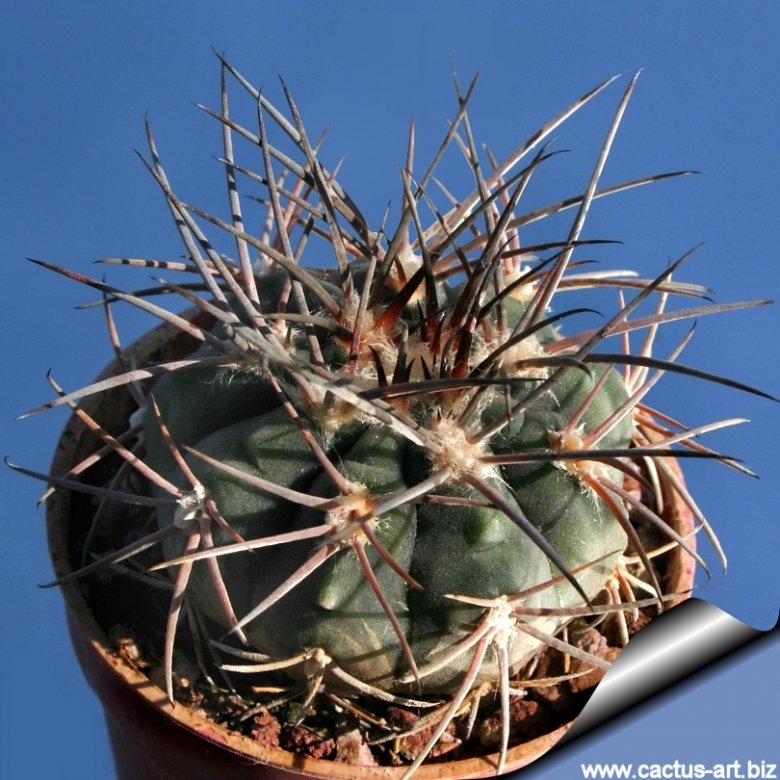
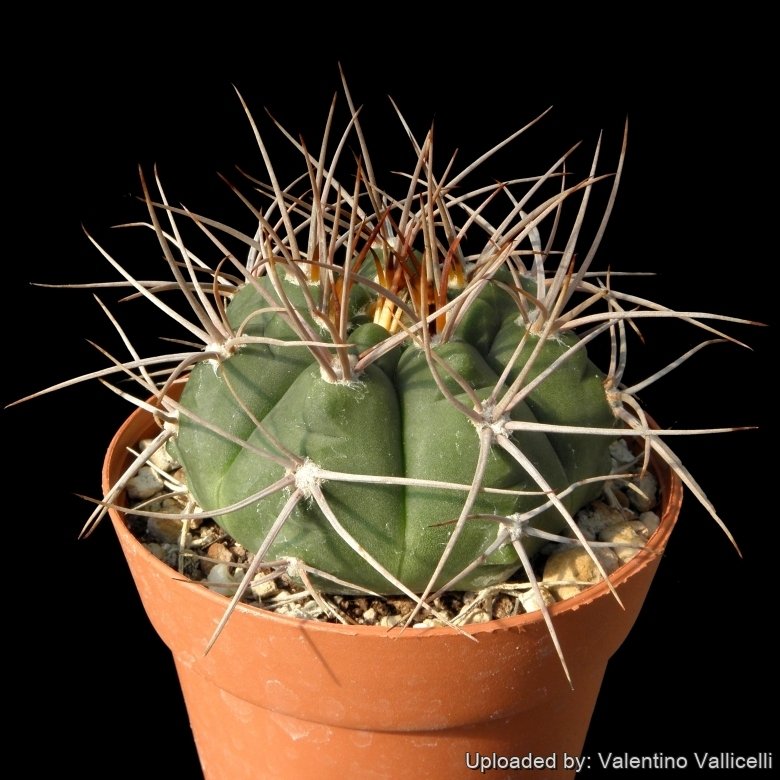
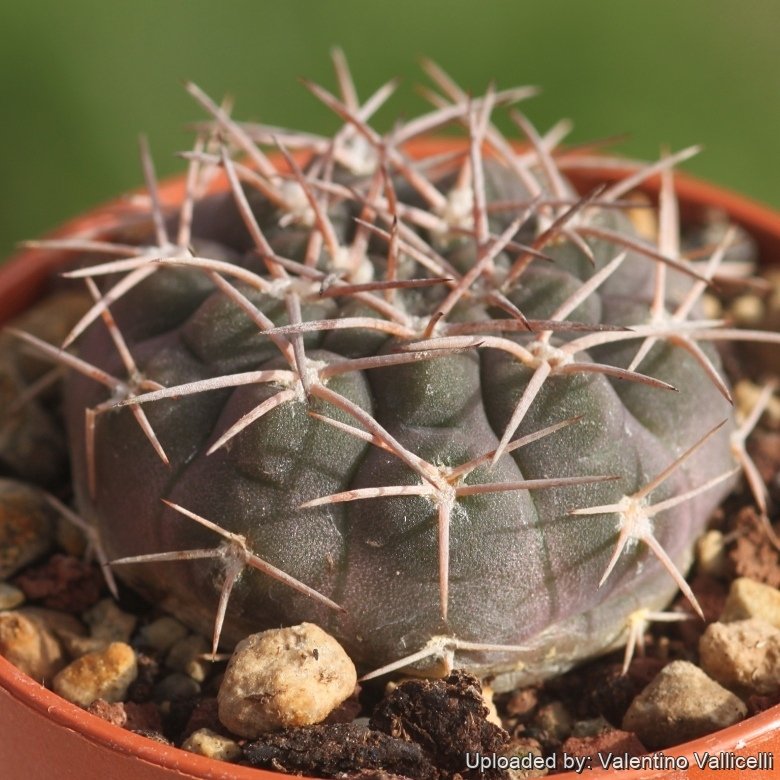
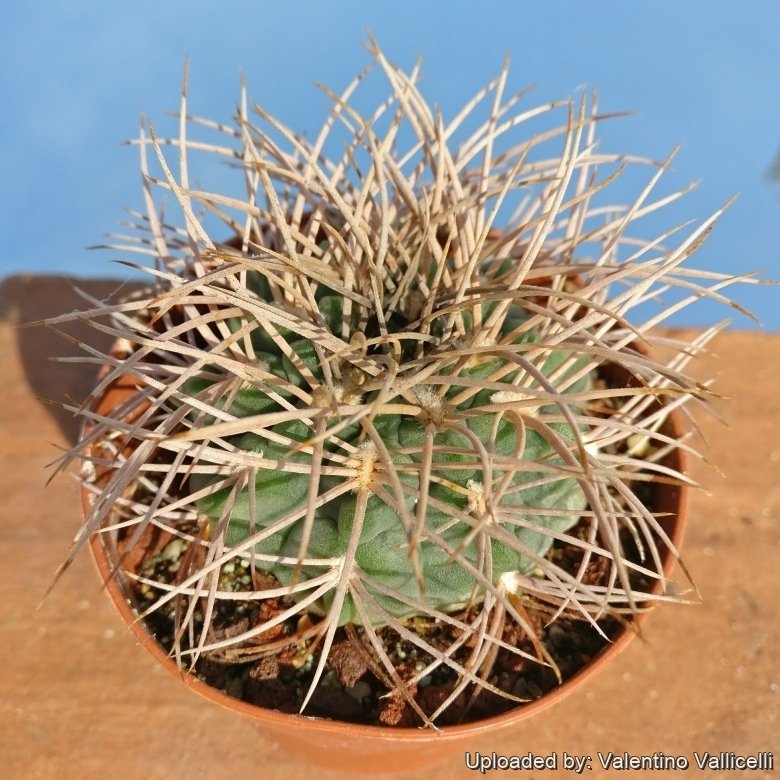
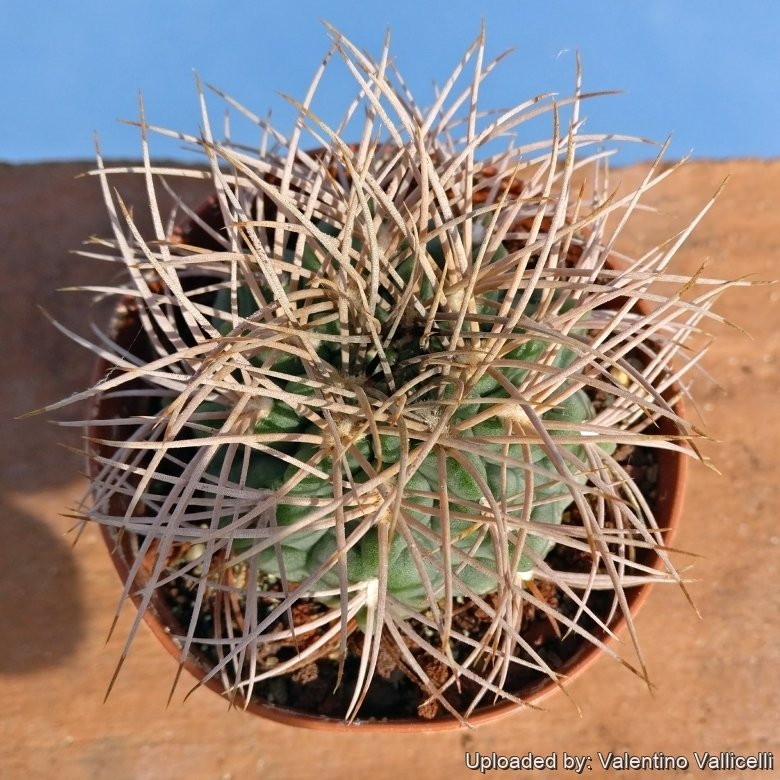
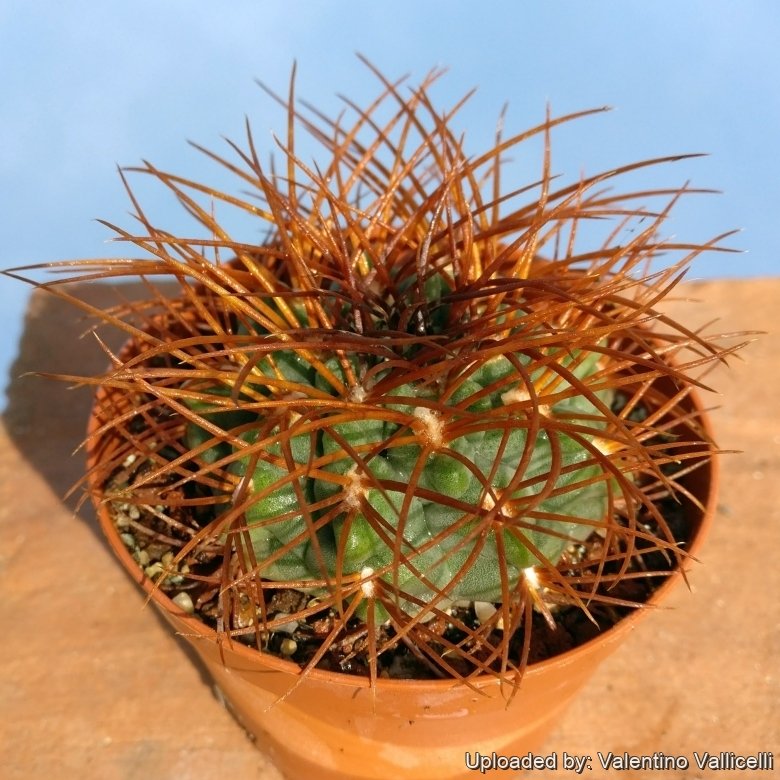
Gymnocalycium hossei is a low-growing, very spiny, cactus species characterized by a marked variability in the length and shape of the spines even in the same population and has received many names. The plants typically got a dark greenish red-violet-brown body colour.
Habit: It is a geophyte stem succulent plant usually solitary and barely rising above ground level with a swollen underground root system.
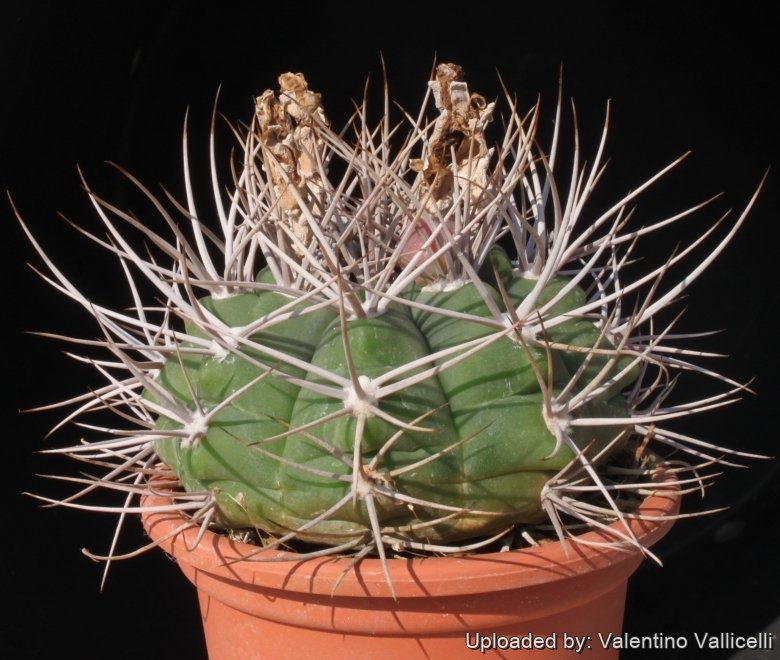
Stem: Globular, somewhat flattened and slightly depressed at the centre (or slightly elongated in cultivation), dark grey-green, olive-green, dark chocolate brown or red-violet, up to 9 cm high and 7-14 cm in diameter, often spineless at the top.
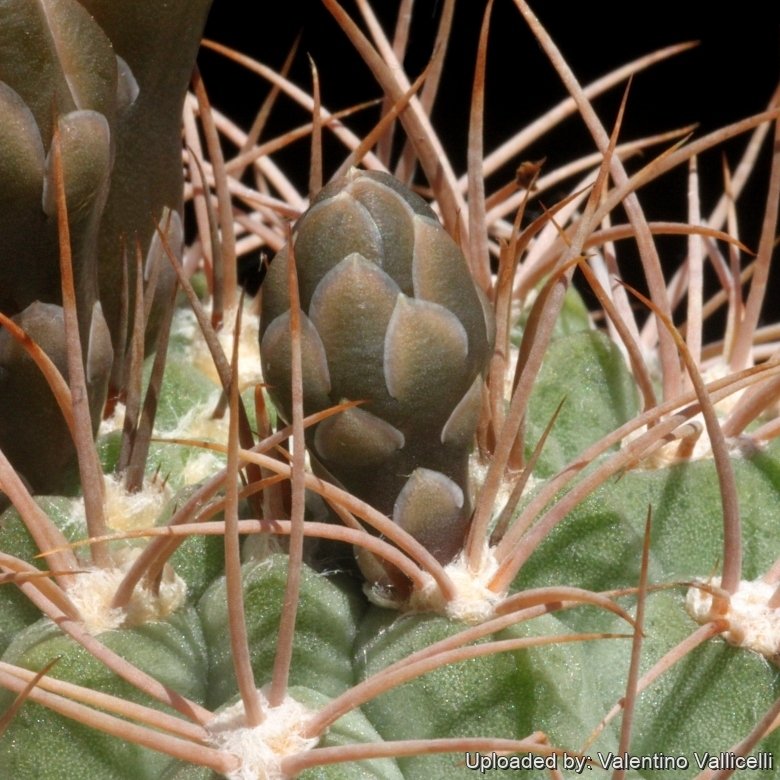
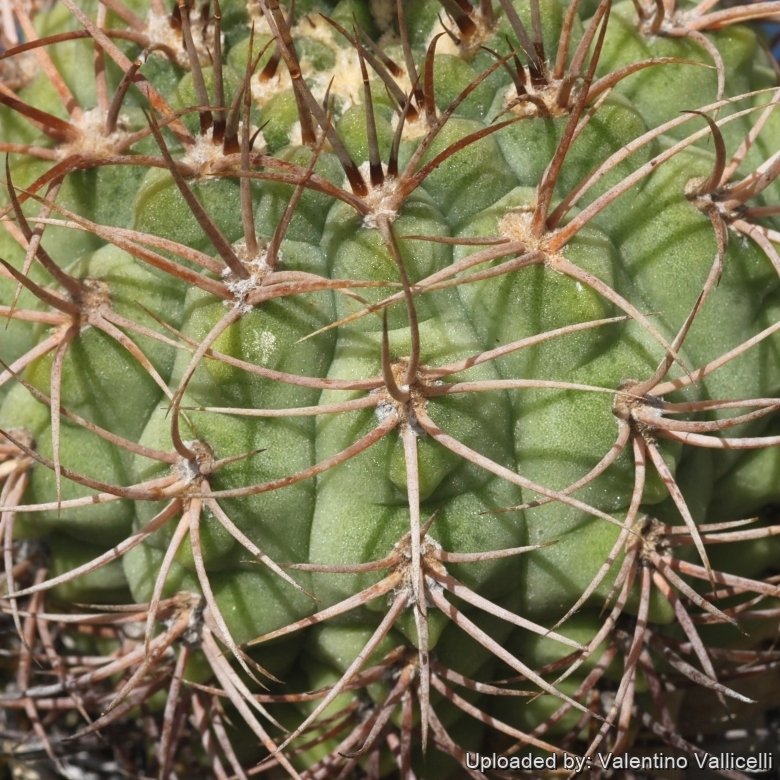
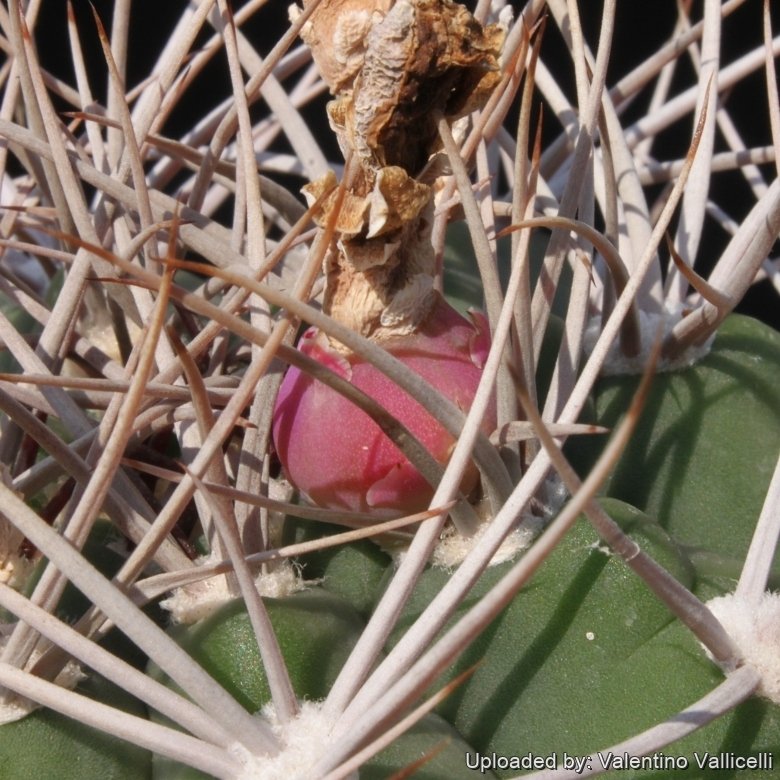
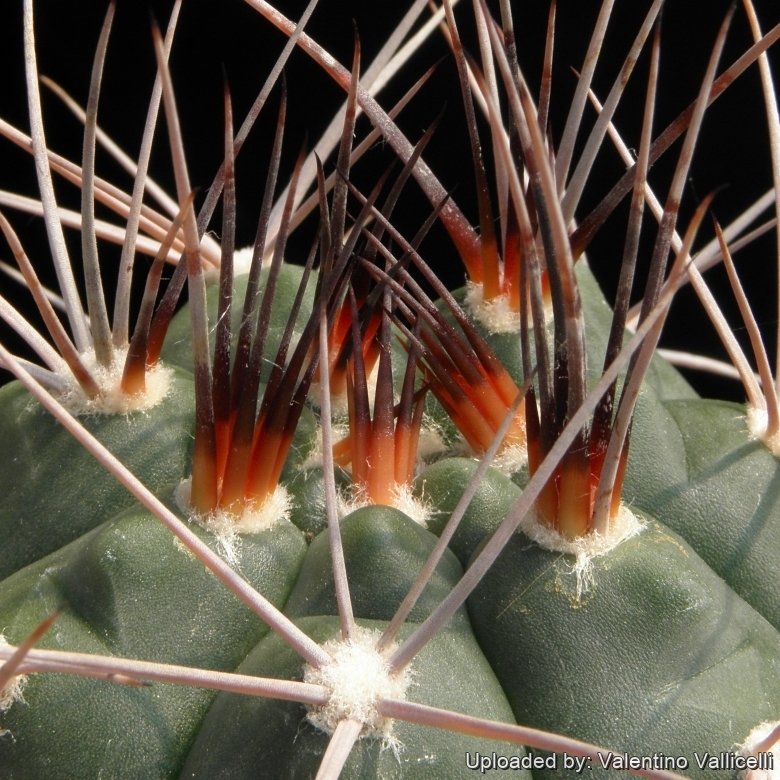
Ribs: 13-19 straight, broad, flat, divided into angular warts with prominent angular chins below the the large woolly areoles , with narrow furrows between them..
Areoles: Oval 10-15 mm apart, slightly furnished with wool.
Central spine: One often absent, brown, becoming grey with age.
Radial spines: 7 to 9, pinkish -brown, turning grey with dark tips spreading, curving backward encasing the brown body, one pointing downward, others to the sides, brown, becoming grey with dark tips, usually up to 15 mm long, but quite variable in length.
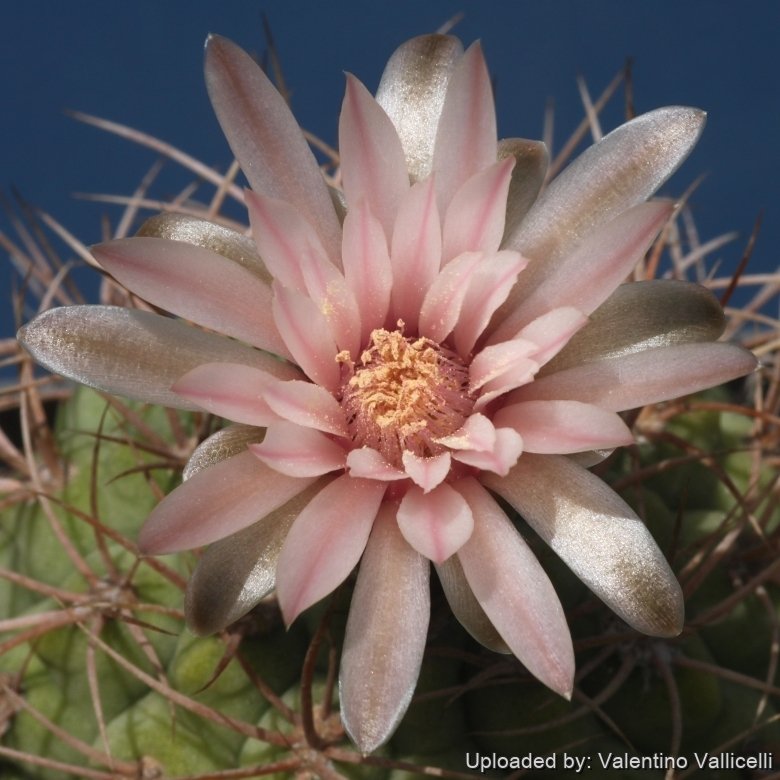
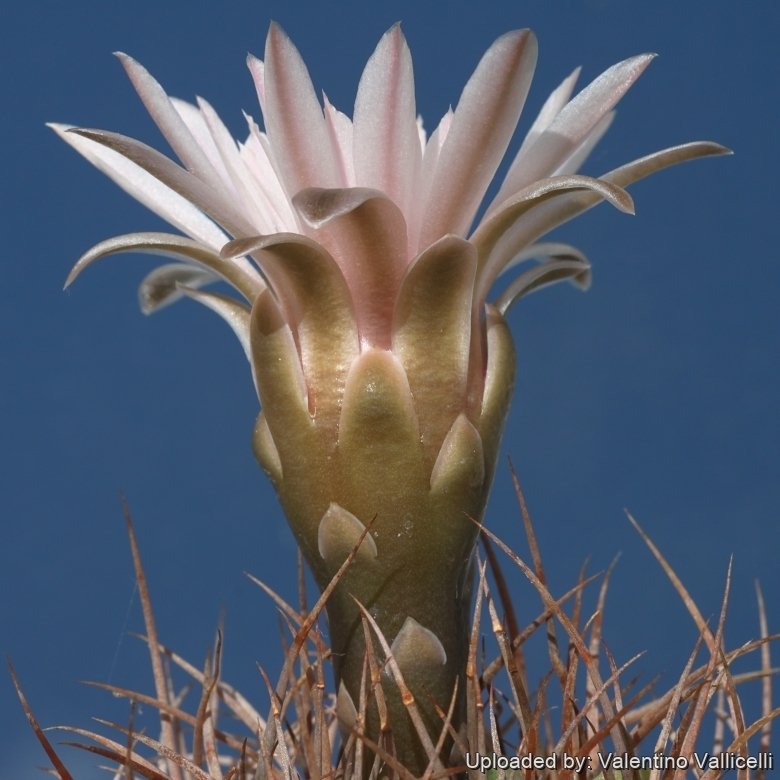
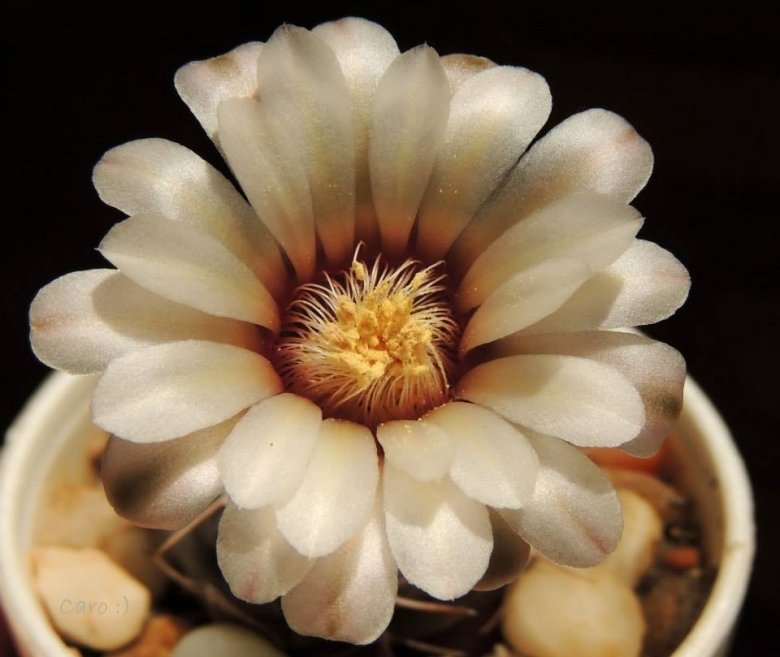
Flowers: Near the apex, 70 mm in length and 60 mm in diameter whitish to reddish pink, sometimes with brownish tint, with short floral tubes.
Flowering time: Blooms appear recurrently from June to autumn.
Origin and Habitat
La Rioja, Córdoba and Catamarca, Argentina.
Altitude: 50-1900 metres above sea level.
Habitat: It grows in various environs and elevations in hilly terrain and steep slopes, among stones, grasses and bushes
Cultivation and Propagation
Gymnocalycium hossei is a summer grower species that is easy to cultivate.
Growth rate: It is a relatively rapidly growing and easily flowering species that will make clumps given the best conditions.
Soils: It likes very porous standard cactus mix soil. Prefer a low pH compost, avoid substrata rich in limestone; otherwise growth will stop altogether.
Repotting: This plant needs plenty of space for its roots, repotting should be done every other year or when the it has outgrown its pot. Use pot with good drainage.
Watering: Needs moderate to copious waterings in summer, but do not overwater (Rot prone), keep dry in winter at a minimum temperature of 0°C.
Fertilization: Feed with a high potassium fertilizer in summer.
Hardiness: Reputedly resistant to frost if kept on the dry side prior to, and during, cold weather (hardy to -12 C ° C, or less for short periods), but for safe cultivation it is best to avoid freezing temperatures.
Exposition: The plant tolerates extremely bright situations but enjoys filtered sunlight or afternoon shade, inside it needs bright light, and some direct sun. Tends to bronze in strong light, which encourages flowering and heavy spine production, but is likely to suffer from sun scorch or stunted growth if over exposed to direct sunlight during the hottest part of the day in summer.
Uses: It is an excellent plant for container growing. It always looks good and stays small. It look fine in a cold greenhouse and frame or outdoor in a rockery.
Pests & diseases: It may be attractive to a variety of insects, but plants in good condition should be nearly pest-free, particularly if they are grown in a mineral potting-mix, with good exposure and ventilation. Nonetheless, there are several pests to watch for:
- Red spiders: Red spiders may be effectively rubbed up by watering the plants from above.
- Mealy bugs: Mealy bugs occasionally develop aerial into the new growth among the wool with disfiguring results, but the worst types develop underground on the roots and are invisible except by their effects.
- Scales: Scales are rarely a problem.
- Rot: This species is particularly easy and accommodating, seldom suffer of cryptogamic diseases. Rot it is only a minor problem with gymnocalyciums if the plants are watered and “aired” correctly. If they are not, fungicides won’t help all that much.
Propagation: Division, direct sow after last frost. Seeds germinate in 7-14 days at 21-27° C in spring, remove gradually the glass cover as soon the plants will be well rooted (ca 1-2 weeks) and keep ventilated, no full sun for young plants! To make a cutting twist off a branch and permit it to dry out a couple of weeks, lay it on the soil and insert the stem end partially into the soil. Try to keep the cutting somewhat upright so that the roots are able to grow downward.
Bibliography
Major references and further lectures
-
Edward Anderson “The Cactus family” Timber Press, Incorporated, 2001
-
James Cullen, Sabina G. Knees, H. Suzanne Cubey “The European Garden Flora Flowering Plants: A Manual for the Identification of Plants Cultivated in Europe, Both Out-of-Doors and Under Glass” Cambridge University Press, 11/Aug/2011
-
David R Hunt; Nigel P Taylor; Graham Charles; International Cactaceae Systematics Group. “The New Cactus Lexicon” dh books, 2006
-
N. L. Britton, J. N. Rose “The Cactaceae. Descriptions and Illustrations of Plants of the Cactus Family.” Volume 4, The Carnegie Institution of Washington, Washington 1923
-
Curt Backeberg “Die Cactaceae: Handbuch der Kakteenkunde” Gustav Fischer Verlag, Stuttgart New York 1982–1985
-
John Borg “Cacti: a gardener’s handbook for their identification and cultivation” Blandford P., 1970
From llifle page Echinocactus mazanensis
Description
Plants very spiny, usually solitary and quite variable even in the same population.
Stem: Flattened globose to globular (or slightly elongated in cultivation), depressed at the top, grey-green, dull-green to brownish green, up to 9 cm high and 7-10(-14) cm across
Ribs: (13-)14-18(-19) straight, fairly broad, rounded , with narrow furrows between them.
Central spine 1 brown, turning grey with age.
Radial spines: About 7 to 9 spreading, curving backward, one pointing downward, others
to the sides, pinkysh-brown, turning grey with dark tips, up to 1,5
cm (or more) long.
Flowers: Whitish with reddish-pink or brownish tint. Tube short.
Origin and Habitat
La Rioja and Catamarca, Argentina.
Type locality: Argentina (near Mazan)
Cultivation and Propagation
Gymnocalycium mazanense is a summer grower species that is easy to cultivate.
Growth rate: It is a relatively rapidly growing and easily flowering species that will make clumps given the best conditions.
Soils: It likes very porous standard cactus mix soil. Prefer a low pH compost, avoid substrata rich in limestone; otherwise growth will stop altogether.
Repotting: This plant needs plenty of space for its roots, repotting should be done every other year or when the it has outgrown its pot. Use pot with good drainage.
Watering: Needs moderate to copious waterings in summer, but do not overwater (Rot prone), keep dry in winter at a minimum temperature of 0°C.
Fertilization: Feed with a high potassium fertilizer in summer.
Hardiness: Reputedly resistant to frost if kept on the dry side prior to, and during, cold weather (hardy to -12 C ° C, or less for short periods), but for safe cultivation it is best to avoid freezing temperatures.
Exposition: The plant tolerates extremely bright situations but enjoys filtered sunlight or afternoon shade, inside it needs bright light, and some direct sun. Tends to bronze in strong light, which encourages flowering and heavy spine production, but is likely to suffer from sun scorch or stunted growth if over exposed to direct sunlight during the hottest part of the day in summer.
Uses: It is an excellent plant for container growing. It always looks good and stays small. It look fine in a cold greenhouse and frame or outdoor in a rockery.
Pests & diseases: It may be attractive to a variety of insects, but plants in good condition should be nearly pest-free, particularly if they are grown in a mineral potting-mix, with good exposure and ventilation. Nonetheless, there are several pests to watch for:
- Red spiders: Red spiders may be effectively rubbed up by watering the plants from above.
- Mealy bugs: Mealy bugs occasionally develop aerial into the new growth among the wool with disfiguring results, but the worst types develop underground on the roots and are invisible except by their effects.
- Scales: Scales are rarely a problem.
- Rot: This species is particularly easy and accommodating, seldom suffer of cryptogamic diseases. Rot it is only a minor problem with gymnocalyciums if the plants are watered and “aired” correctly. If they are not, fungicides won’t help all that much.
Propagation: Division, direct sow after last frost. Seeds germinate in 7-14 days at 21-27° C in spring, remove gradually the glass cover as soon the plants will be well rooted (ca 1-2 weeks) and keep ventilated, no full sun for young plants! To make a cutting twist off a branch and permit it to dry out a couple of weeks, lay it on the soil and insert the stem end partially into the soil. Try to keep the cutting somewhat upright so that the roots are able to grow downward.
Source: Echinocactus mazanensis, LLIFLE - Encyclopedia of living forms, CC-BY-SA, retrieved 2026-10-25.
From llifle page Gymnocalycium guanchinense
Description
This is a solitary geophytes plant with a swollen underground root system. The plant body has significant chin humps below the large woolly and peculiar areoles. The plants typically got a dark greenish red-violet-brown body colour.
Stem: Up to 15 cm in diameter, dark green to brown flattened with wavy ribs.
Spines: The spines are pale brown extremely curved and long.
Flowers: Near the apex, 70mm in length and 60mm in diameter
Flowering time: Blooms appear recurrently from June to autumn.
Origin and Habitat
Argentina (La Rioja)
Cultivation and Propagation
Gymnocalycium guanchinense is a summer grower species that is easy to cultivate.
Growth rate: It is a relatively rapidly growing and easily flowering species that will make clumps given the best conditions.
Soils: It likes very porous standard cactus mix soil. Prefer a low pH compost, avoid substrata rich in limestone; otherwise growth will stop altogether.
Repotting: This plant needs plenty of space for its roots, repotting should be done every other year or when the it has outgrown its pot. Use pot with good drainage.
Watering: Needs moderate to copious waterings in summer, but do not overwater (Rot prone), keep dry in winter at a minimum temperature of 0°C.
Fertilization: Feed with a high potassium fertilizer in summer.
Hardiness: Reputedly resistant to frost if kept on the dry side prior to, and during, cold weather (hardy to -12 C ° C, or less for short periods), but for safe cultivation it is best to avoid freezing temperatures.
Exposition: The plant tolerates extremely bright situations but enjoys filtered sunlight or afternoon shade, inside it needs bright light, and some direct sun. Tends to bronze in strong light, which encourages flowering and heavy spine production, but is likely to suffer from sun scorch or stunted growth if over exposed to direct sunlight during the hottest part of the day in summer.
Uses: It is an excellent plant for container growing. It always looks good and stays small. It look fine in a cold greenhouse and frame or outdoor in a rockery.
Pests & diseases: It may be attractive to a variety of insects, but plants in good condition should be nearly pest-free, particularly if they are grown in a mineral potting-mix, with good exposure and ventilation. Nonetheless, there are several pests to watch for:
- Red spiders: Red spiders may be effectively rubbed up by watering the plants from above.
- Mealy bugs: Mealy bugs occasionally develop aerial into the new growth among the wool with disfiguring results, but the worst types develop underground on the roots and are invisible except by their effects.
- Scales: Scales are rarely a problem.
- Rot: This species is particularly easy and accommodating, seldom suffer of cryptogamic diseases. Rot it is only a minor problem with gymnocalyciums if the plants are watered and “aired” correctly. If they are not, fungicides won’t help all that much.
Propagation: Division, direct sow after last frost. Seeds germinate in 7-14 days at 21-27° C in spring, remove gradually the glass cover as soon the plants will be well rooted (ca 1-2 weeks) and keep ventilated, no full sun for young plants! To make a cutting twist off a branch and permit it to dry out a couple of weeks, lay it on the soil and insert the stem end partially into the soil. Try to keep the cutting somewhat upright so that the roots are able to grow downward.
Source: Gymnocalycium guanchinense, LLIFLE - Encyclopedia of living forms, CC-BY-SA, retrieved 2026-10-25.
From llifle page Gymnocalycium mazanense var. ferox
Description
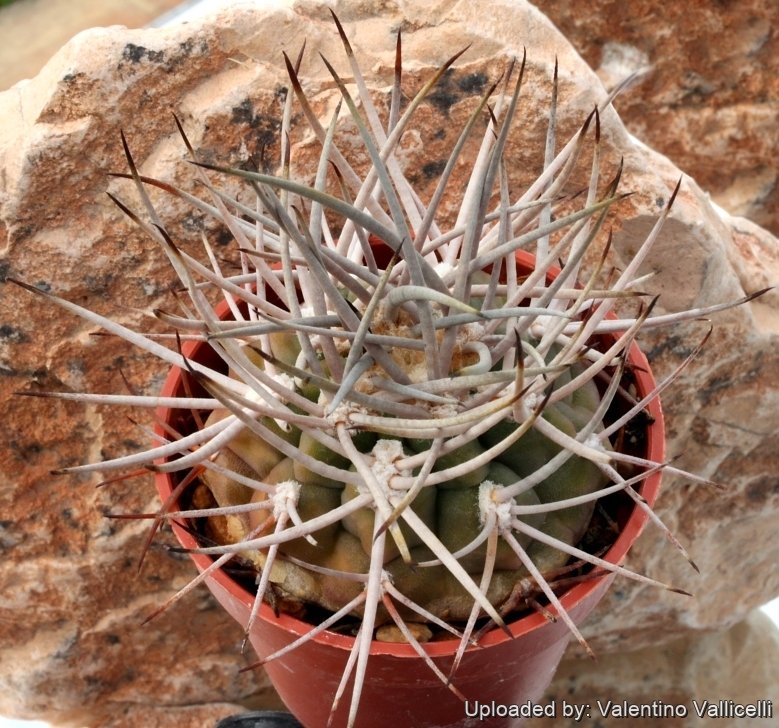
Gymnocalycium mazanense var. ferox is one of the several forms of the very variable Gymnocalycium hossei which form a complex of very closely related taxon. It is still unclear whether this variable complex is one or several species. There is so much variation even in the same population that most authors choose to lump them together. Gymnocalycium mazanense var. ferox is quite variable and distinguishes for the covering of stout greyish interlacing spines. The body is almost concealed by the spines and is one of the most decorative cacti of the genus Gymnocalycium.
Habit: It is a geophyte stem succulent plant, usually solitary and barely rising above ground level with a swollen underground root system.
Stem: Globular, somewhat flattened and slightly depressed at the centre (or slightly elongated in cultivation), dark grey-green, olive-green or red-violet, up to 10 cm in diameter.
Ribs: Gymnocalycium mazanense has about 14-18 ribs, straight, broad, flat, divided into angular warts with prominent angular chins below the the large woolly areoles, with narrow furrows between them.
Areoles: Oval 10-15 mm apart, slightly furnished with yellowish grey wool.
Central spine: Occasionally one central, brown, becoming grey with age up to 4 or more cm long.
Radial spines: 6-8, very stout, subulate, stiff, pinkish-brown when still growing, but turning soon bright, greyish-white with darker tips, spreading, curving backward encasing the brown body, one pointing downward, others to the sides, up to 30 (or more) mm long, but quite variable in length.
Flowers: Near the apex, 70 mm in length and 60 mm in diameter whitish to reddish pink, sometimes with brownish tint, with short floral tubes.
Flowering time: Blooms appear recurrently from June to autumn and flowers well as a young plant.
Origin and Habitat
La Rioja, Argentina.
Altitude: It grows at medium elevations around to 1200 metres above sea level.
Source: Gymnocalycium mazanense var. ferox, LLIFLE - Encyclopedia of living forms, CC-BY-SA, retrieved 2026-10-25.
From llifle page Gymnocalycium nidulans
Description
Gymnocalycium hossei var. nidulans is one of the several forms of the very variable Gymnocalycium hossei which form a complex of related taxon. It is still unclear whether this variable complex is one or several species. There is so much variation even in the same population that most authors choose to lump them together. The variety “nidulans” distingushes for the dense covering of stout grey interlacing spines. The plants typically got a dull brownish-green body colour and is one of the most decorative cacti of the genus Gymnocalycium.
Habit: It is a geophyte, stem succulent plant usually solitary and barely rising above ground level with a swollen underground root system.
Stem: Globular, somewhat flattened and slightly depressed at the centre (or slightly elongated in cultivation), dark grey-green, olive-green, dark chocolate brown or red-violet, up to 10 cm in diameter.
Ribs: About 17 straight, broad, flat, divided into angular warts with prominent angular chins below the the large woolly areoles , with narrow furrows between them..
Areoles: Oval 10-15 mm apart, slightly furnished with yellowish grey wool.
Central spine: Occasionally one central, brown, becoming grey with age up to 4 cm long.
Radial spines: 6-7, pinkish-brown, turning grey with dark tips spreading, curving backward encasing the brown body, one pointing downward, others to the sides, brown, becoming grey with dark tips, usually up to 30 (or more) mm long, but quite variable in length.
Flowers: Near the apex, 70 mm in length and 60 mm in diameter whitish to reddish pink, sometimes with brownish tint, with short floral tubes.
Flowering time: Blooms appear recurrently from June to autumn.
Origin and Habitat
La Rioja, Argentina.
Altitude: 800-2900 metres above sea level.
Habitat: It grows in various environs and elevations in hilly terrain and steep slopes, among stones, grasses and bushes together with Tephrocactus papyracanthus and Pyrrhocactus catamarcensis.
Cultivation and Propagation
Gymnocalycium hossei var. nidulans is a summer grower species that is easy to cultivate.
Growth rate: It is a relatively rapidly growing and easily flowering species that will make clumps given the best conditions.
Soils: It likes very porous standard cactus mix soil. Prefer a low pH compost, avoid substrata rich in limestone; otherwise growth will stop altogether.
Repotting: This plant needs plenty of space for its roots, repotting should be done every other year or when the it has outgrown its pot. Use pot with good drainage.
Watering: Needs moderate to copious waterings in summer, but do not overwater (Rot prone), keep dry in winter at a minimum temperature of 0°C.
Fertilization: Feed with a high potassium fertilizer in summer.
Hardiness: Reputedly resistant to frost if kept on the dry side prior to, and during, cold weather (hardy to -12 C ° C, or less for short periods), but for safe cultivation it is best to avoid freezing temperatures.
Exposition: The plant tolerates extremely bright situations but enjoys filtered sunlight or afternoon shade, inside it needs bright light, and some direct sun. Tends to bronze in strong light, which encourages flowering and heavy spine production, but is likely to suffer from sun scorch or stunted growth if over exposed to direct sunlight during the hottest part of the day in summer.
Uses: It is an excellent plant for container growing. It always looks good and stays small. It look fine in a cold greenhouse and frame or outdoor in a rockery.
Pests & diseases: It may be attractive to a variety of insects, but plants in good condition should be nearly pest-free, particularly if they are grown in a mineral potting-mix, with good exposure and ventilation. Nonetheless, there are several pests to watch for:
- Red spiders: Red spiders may be effectively rubbed up by watering the plants from above.
- Mealy bugs: Mealy bugs occasionally develop aerial into the new growth among the wool with disfiguring results, but the worst types develop underground on the roots and are invisible except by their effects.
- Scales: Scales are rarely a problem.
- Rot: This species is particularly easy and accommodating, seldom suffer of cryptogamic diseases. Rot it is only a minor problem with gymnocalyciums if the plants are watered and “aired” correctly. If they are not, fungicides won’t help all that much.
Propagation: Division, direct sow after last frost. Seeds germinate in 7-14 days at 21-27° C in spring, remove gradually the glass cover as soon the plants will be well rooted (ca 1-2 weeks) and keep ventilated, no full sun for young plants! To make a cutting twist off a branch and permit it to dry out a couple of weeks, lay it on the soil and insert the stem end partially into the soil. Try to keep the cutting somewhat upright so that the roots are able to grow downward.
Bibliography
Major references and further lectures
-
Edward Anderson “The Cactus family” Timber Press, Incorporated, 2001
-
James Cullen, Sabina G. Knees, H. Suzanne Cubey “The European Garden Flora Flowering Plants: A Manual for the Identification of Plants Cultivated in Europe, Both Out-of-Doors and Under Glass” Cambridge University Press, 11/Aug/2011
-
David R Hunt; Nigel P Taylor; Graham Charles; International Cactaceae Systematics Group. “The New Cactus Lexicon” dh books, 2006
-
N. L. Britton, J. N. Rose “The Cactaceae. Descriptions and Illustrations of Plants of the Cactus Family.” Volume 4, The Carnegie Institution of Washington, Washington 1923
-
Curt Backeberg “Die Cactaceae: Handbuch der Kakteenkunde” Gustav Fischer Verlag, Stuttgart New York 1982–1985
-
John Borg “Cacti: a gardener’s handbook for their identification and cultivation” Blandford P., 1970
-
Clive Innes, Charles Glass “Cacti” Portland House, 01/May/1991
-
Gordon D. Rowley “The illustrated encyclopedia of succulents” Crown Publishers, 01/Aug/1978
Source: Gymnocalycium nidulans, LLIFLE - Encyclopedia of living forms, CC-BY-SA, retrieved 2026-10-25.
From llifle page Gymnocalycium rhodantherum var. cinerascens
Origin and Habitat
La Rioja (Argentina Northwest, Southern South America, Southern America)
Type Locality: prope Carrizal, 1800m
Source: Gymnocalycium rhodantherum var. cinerascens, LLIFLE - Encyclopedia of living forms, CC-BY-SA, retrieved 2026-10-25.
From llifle page Gymnocalycium rhodantherum subs. recii
Origin and Habitat
Salta (Argentina Northwest, Southern South America, Southern America)
Type Locality: Aimogasta, 1500m
Source: Gymnocalycium rhodantherum subs. recii, LLIFLE - Encyclopedia of living forms, CC-BY-SA, retrieved 2026-10-25.
From llifle page Gymnocalycium weissianum
Description
Gymnocalycium weissianum is one of the several forms of the very variable Gymnocalycium hossei which form a complex of very closely related taxon. It is still unclear whether this variable complex is one or several species. There is so much variation even in the same population that most authors choose to lump them together. Gymnocalycium weissianum is quite variable and distinguishes for the covering of stout bright greyish-white interlacing spines.
Habit: It is a geophyte, stem succulent plant usually solitary and barely rising above ground level with a swollen underground root system.
Stem: Globular, somewhat flattened and slightly depressed at the centre (or slightly elongated in cultivation), dark grey-green, olive-green, dark chocolate brown or red-violet, up to 10 cm in diameter.
Ribs: Gymnocalycium weissianum has about 19 ribs, straight, broad, flat, divided into angular warts with prominent angular chins below the the large woolly areoles , with narrow furrows between them.
Areoles: Oval 10-15 mm apart, slightly furnished with yellowish grey wool.
Central spine: Occasionally one central, brown, becoming grey with age up to 4 cm long.
Radial spines: 6-8, pinkish-brown when still growing, but turning soon bright, greyish-white ,spreading, curving backward encasing the brown body, one pointing downward, others to the sides, up to 20 (or more) mm long, but quite variable in length.
Flowers: Near the apex, 70 mm in length and 60 mm in diameter whitish to reddish pink, sometimes with brownish tint, with short floral tubes.
Flowering time: Blooms appear recurrently from June to autumn and flowers well as a young plant.
Origin and Habitat
La Rioja and Catamarca, Argentina
Altitude: 1200-2000 metres above sea level.
Habitat: It grows in various environs and elevations in hilly terrain and steep slopes, among stones, grasses and bushes.
Cultivation and Propagation
Gymnocalycium weissianum is a summer grower species that is easy to cultivate.
Growth rate: It is a relatively rapidly growing and easily flowering species that will make clumps given the best conditions.
Soils: It likes very porous standard cactus mix soil. Prefer a low pH compost, avoid substrata rich in limestone; otherwise growth will stop altogether.
Repotting: This plant needs plenty of space for its roots, repotting should be done every other year or when the it has outgrown its pot. Use pot with good drainage.
Watering: Needs moderate to copious waterings in summer, but do not overwater (Rot prone), keep dry in winter at a minimum temperature of 0°C.
Fertilization: Feed with a high potassium fertilizer in summer.
Hardiness: Reputedly resistant to frost if kept on the dry side prior to, and during, cold weather (hardy to -12 C ° C, or less for short periods), but for safe cultivation it is best to avoid freezing temperatures.
Exposition: The plant tolerates extremely bright situations but enjoys filtered sunlight or afternoon shade, inside it needs bright light, and some direct sun. Tends to bronze in strong light, which encourages flowering and heavy spine production, but is likely to suffer from sun scorch or stunted growth if over exposed to direct sunlight during the hottest part of the day in summer.
Uses: It is an excellent plant for container growing. It always looks good and stays small. It look fine in a cold greenhouse and frame or outdoor in a rockery.
Pests & diseases: It may be attractive to a variety of insects, but plants in good condition should be nearly pest-free, particularly if they are grown in a mineral potting-mix, with good exposure and ventilation. Nonetheless, there are several pests to watch for:
- Red spiders: Red spiders may be effectively rubbed up by watering the plants from above.
- Mealy bugs: Mealy bugs occasionally develop aerial into the new growth among the wool with disfiguring results, but the worst types develop underground on the roots and are invisible except by their effects.
- Scales: Scales are rarely a problem.
- Rot: This species is particularly easy and accommodating, seldom suffer of cryptogamic diseases. Rot it is only a minor problem with gymnocalyciums if the plants are watered and “aired” correctly. If they are not, fungicides won’t help all that much.
Propagation: Division, direct sow after last frost. Seeds germinate in 7-14 days at 21-27° C in spring, remove gradually the glass cover as soon the plants will be well rooted (ca 1-2 weeks) and keep ventilated, no full sun for young plants! To make a cutting twist off a branch and permit it to dry out a couple of weeks, lay it on the soil and insert the stem end partially into the soil. Try to keep the cutting somewhat upright so that the roots are able to grow downward.
Bibliography
Major references and further lectures
-
Edward Anderson “The Cactus family” Timber Press, Incorporated, 2001
-
James Cullen, Sabina G. Knees, H. Suzanne Cubey “The European Garden Flora Flowering Plants: A Manual for the Identification of Plants Cultivated in Europe, Both Out-of-Doors and Under Glass” Cambridge University Press, 11/Aug/2011
-
David R Hunt; Nigel P Taylor; Graham Charles; International Cactaceae Systematics Group. “The New Cactus Lexicon” dh books, 2006
-
N. L. Britton, J. N. Rose “The Cactaceae. Descriptions and Illustrations of Plants of the Cactus Family.” Volume 4, The Carnegie Institution of Washington, Washington 1923
-
Curt Backeberg “Die Cactaceae: Handbuch der Kakteenkunde” Gustav Fischer Verlag, Stuttgart New York 1982–1985
-
John Borg “Cacti: a gardener’s handbook for their identification and cultivation” Blandford P., 1970
-
Clive Innes, Charles Glass “Cacti” Portland House, 01/May/1991
Source: Gymnocalycium weissianum, LLIFLE - Encyclopedia of living forms, CC-BY-SA, retrieved 2026-10-25.
Cultivars and forms (1)
Varieties (1)
Gallery