Publication: Kaktus-ABC [Backeb. & Knuth] 289. 1936 [12 Feb 1936]
Description
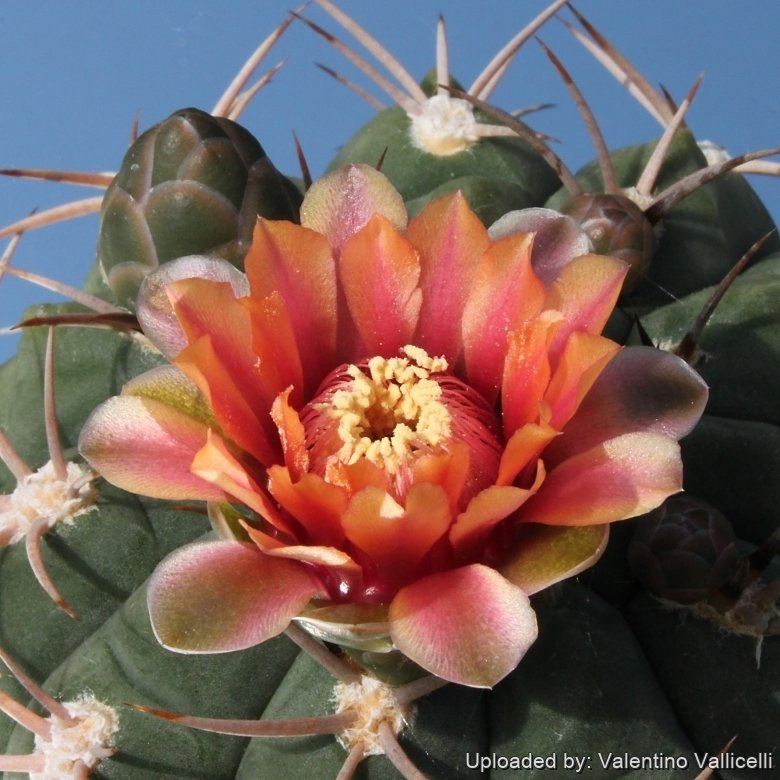
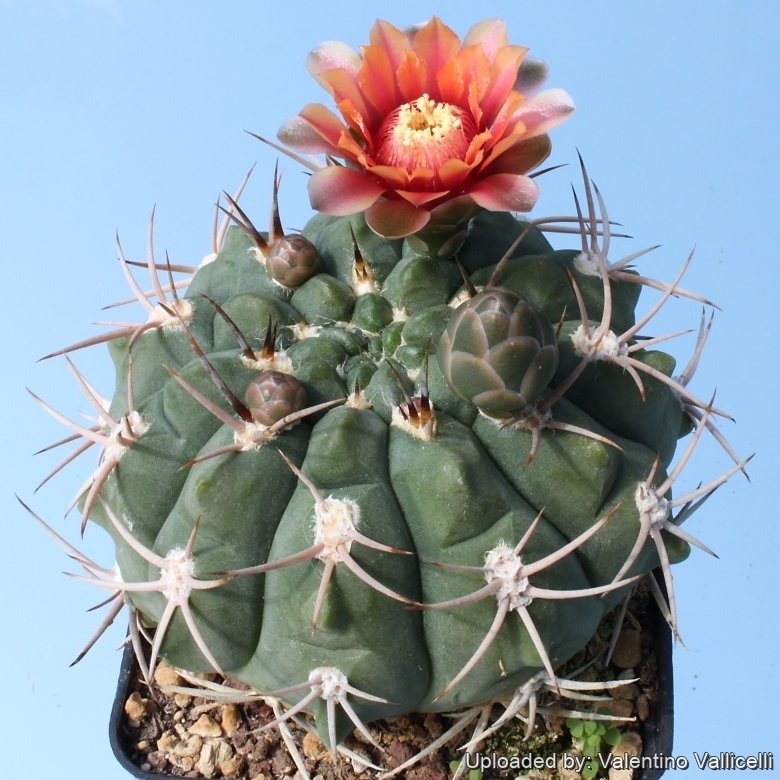
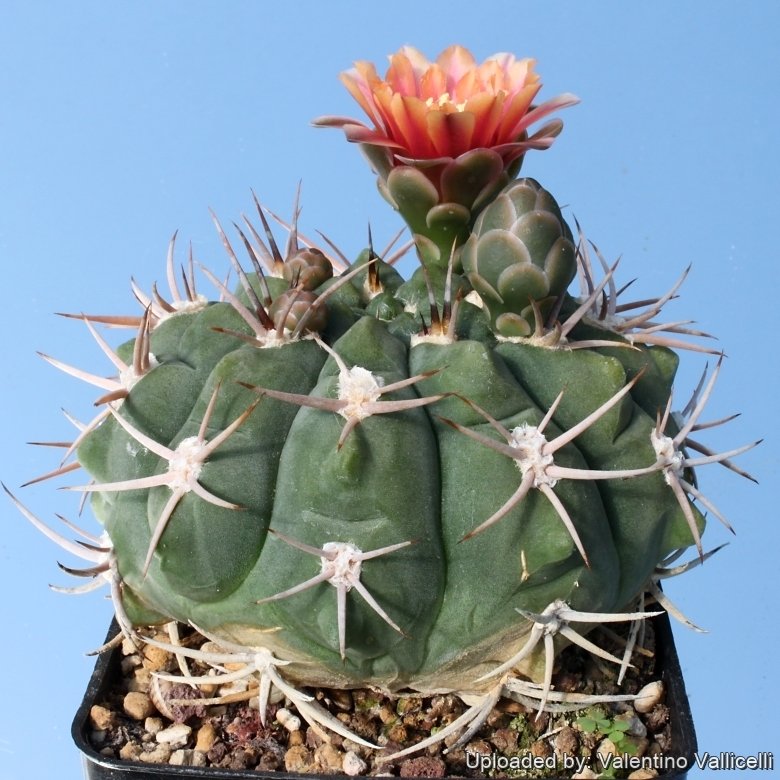
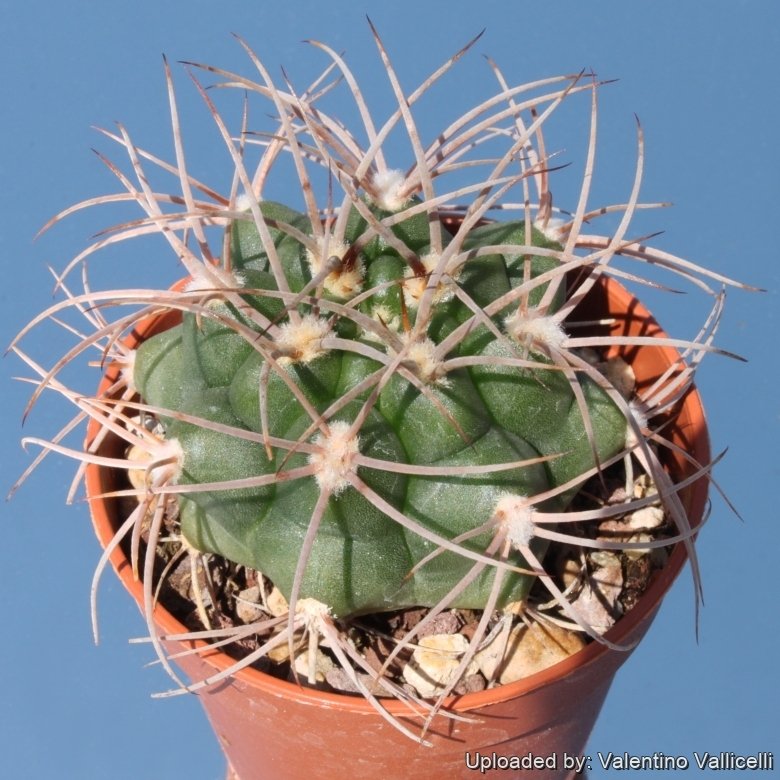
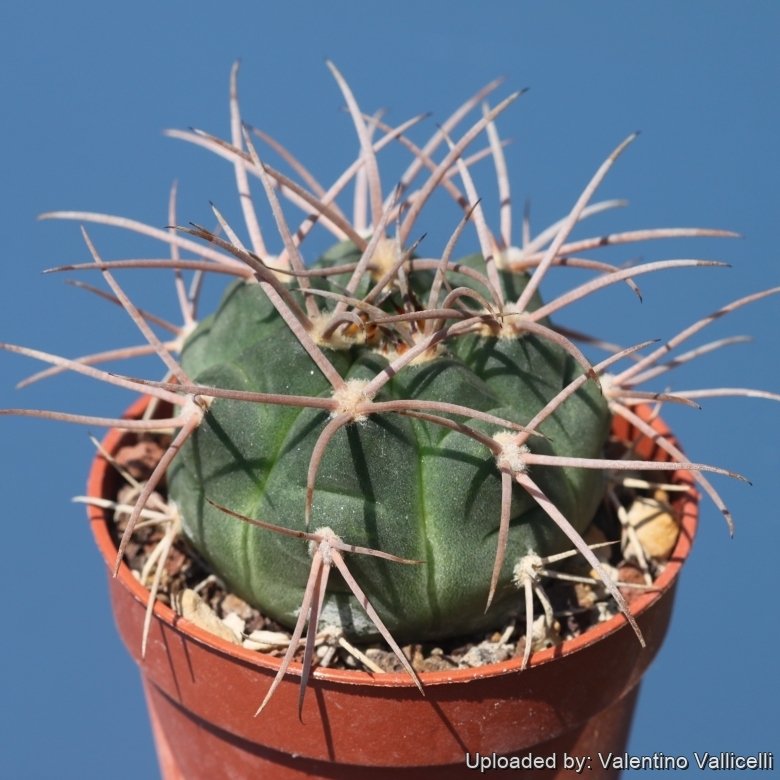
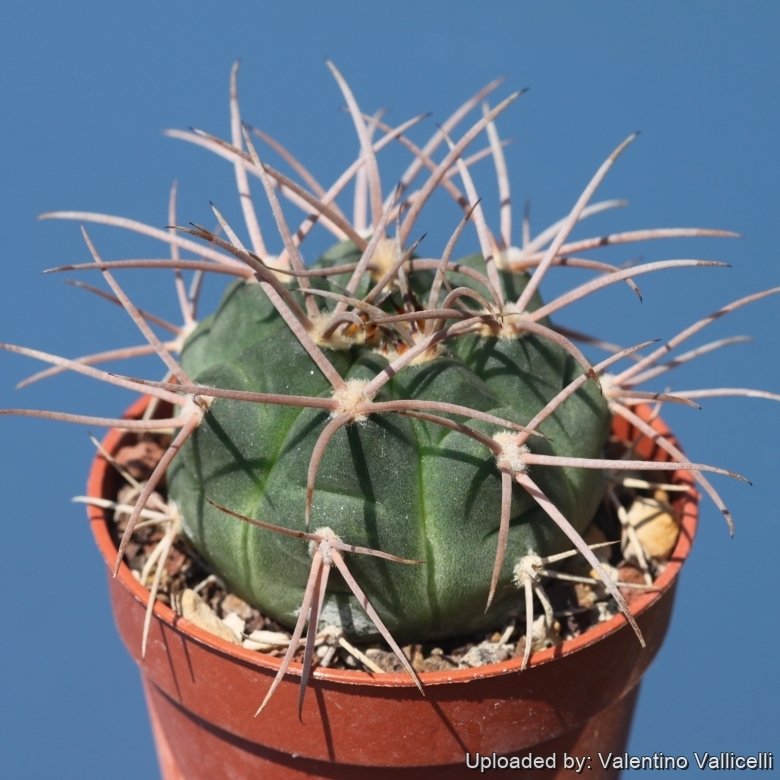
Gymnocalycium hybopleurum is a strongly-spined and variable species related to Gymnocalycium multiflorum, usually solitary in habitat, but occasianally branching basally in cultivation. This species is characterized by a marked variability in the length and shape of the spines and has received many names.
Stem: Hemispherical to globular in shape up to 15 cm tall and in diameter dark-green or blue-green.
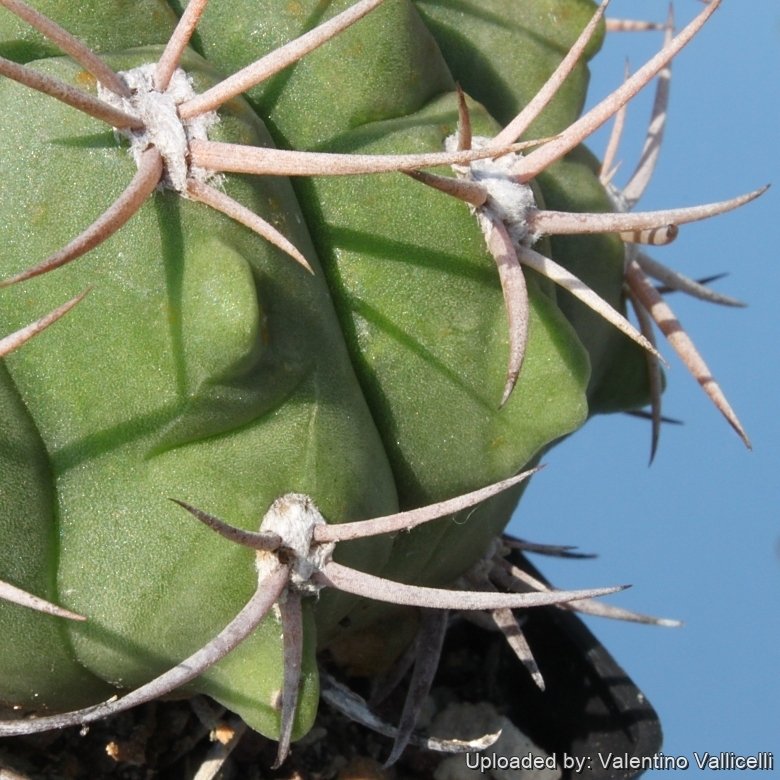
Ribs: About 10-13, rounded or acute, with small chinlike protrusions.
Central spine: Absent or one, with darker tip.
Radial spines: 7-8, straight or slightly curved, thick and flattened, interwoven around the body up to to 3 cm long, dull creamy or pinkish coloured, later grey.
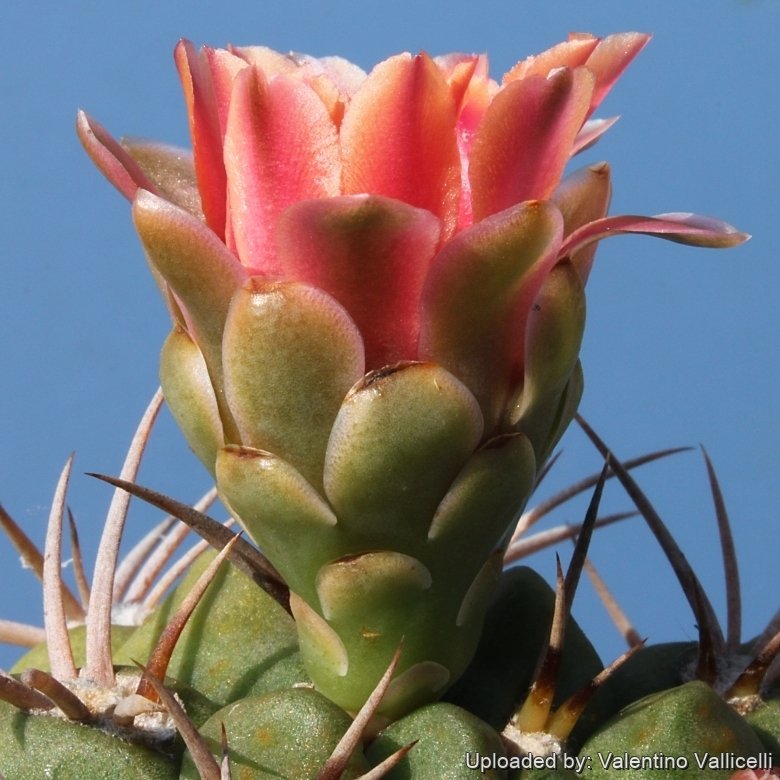
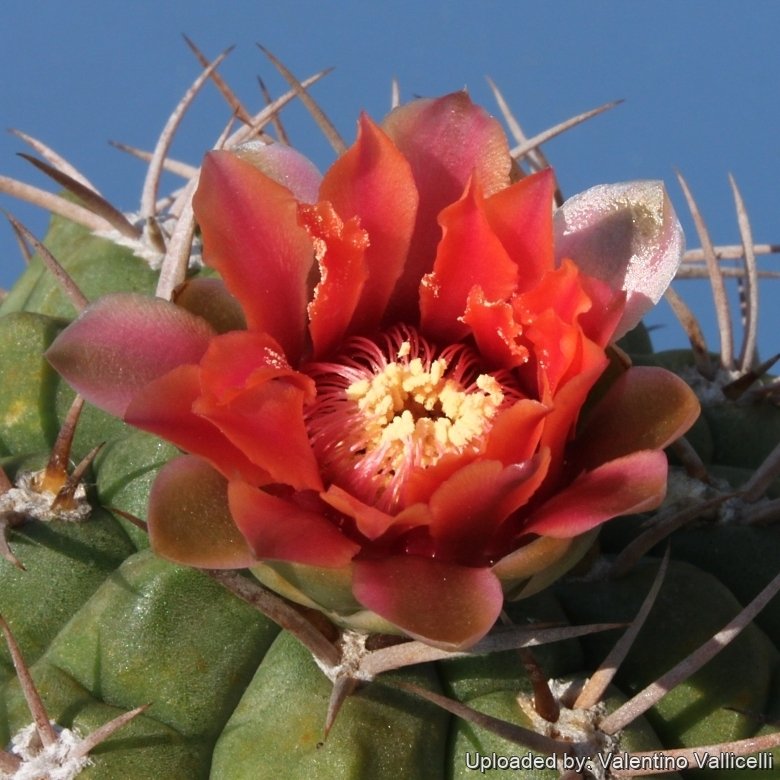
Flowers: Short-tubed, ivory white (occasionally pinkish) with a red throat.
Blooming season: Flowers are borne in early summer. It flowers quite readily as a young seedling.
Fruits: Globose to cylindrical, blue-green.
Origin and Habitat
Catamarca and Cordoba, Argentina.
Altitude:400-2600
Habitat: It grows in various environs and elevations, among stones and bushes, often in association with Lobivia mazanensis and Tephrocactus sp.
Cultivation and Propagation
Gymnocalycium hybopleurum is a summer grower species that is easy to cultivate.
Growth rate: It is a relatively rapidly growing and easily flowering species that will make clumps given the best conditions.
Soils: It likes very porous standard cactus mix soil. Prefer a low pH compost, avoid substrata rich in limestone; otherwise growth will stop altogether.
Repotting: This plant needs plenty of space for its roots, repotting should be done every other year or when the it has outgrown its pot. Use pot with good drainage.
Watering: Needs moderate to copious waterings in summer, but do not overwater (Rot prone), keep dry in winter at a minimum temperature of 0°C.
Fertilization: Feed with a high potassium fertilizer in summer.
Hardiness: Reputedly resistant to frost if kept on the dry side prior to, and during, cold weather (hardy to -5 C ° C, or less for short periods).
Exposition: The plant tolerates extremely bright situations but enjoys filtered sunlight or afternoon shade, inside it needs bright light, and some direct sun. Tends to bronze in strong light, which encourages flowering and heavy spine production, but is likely to suffer from sun scorch or stunted growth if over exposed to direct sunlight during the hottest part of the day in summer.
Uses: It is an excellent plant for container growing. It always looks good and stays small. It look fine in a cold greenhouse and frame or outdoor in a rockery.
Pests & diseases: It may be attractive to a variety of insects, but plants in good condition should be nearly pest-free, particularly if they are grown in a mineral potting-mix, with good exposure and ventilation. Nonetheless, there are several pests to watch for:
- Red spiders: Red spiders may be effectively rubbed up by watering the plants from above.
- Mealy bugs: Mealy bugs occasionally develop aerial into the new growth among the wool with disfiguring results, but the worst types develop underground on the roots and are invisible except by their effects.
- Scales: Scales are rarely a problem.
- Rot: This species is particularly easy and accommodating, seldom suffer of cryptogamic diseases. Rot it is only a minor problem with gymnocalyciums if the plants are watered and “aired” correctly. If they are not, fungicides won’t help all that much.
Propagation: Division, direct sow after last frost. Seeds germinate in 7-14 days at 21-27° C in spring, remove gradually the glass cover as soon the plants will be well rooted (ca 1-2 weeks) and keep ventilated, no full sun for young plants! To make a cutting twist off a branch and permit it to dry out a couple of weeks, lay it on the soil and insert the stem end partially into the soil. Try to keep the cutting somewhat upright so that the roots are able to grow downward.
Bibliography
Major references and further lectures
-
Edward Anderson “The Cactus family” Timber Press, Incorporated, 2001
-
James Cullen, Sabina G. Knees, H. Suzanne Cubey “The European Garden Flora Flowering Plants: A Manual for the Identification of Plants Cultivated in Europe, Both Out-of-Doors and Under Glass” Cambridge University Press, 11/Aug/2011
-
David R Hunt; Nigel P Taylor; Graham Charles; International Cactaceae Systematics Group. “The New Cactus Lexicon” dh books, 2006
-
N. L. Britton, J. N. Rose “The Cactaceae. Descriptions and Illustrations of Plants of the Cactus Family.” Volume 4, The Carnegie Institution of Washington, Washington 1923, page. 41
-
Curt Backeberg “Die Cactaceae: Handbuch der Kakteenkunde” Gustav Fischer Verlag, Stuttgart New York 1982–1985
-
Clive Innes, Charles Glass “Cacti” Portland House, 01/mag/1991
From llifle page Gymnocalycium curvispinum var. acuticostatum
Description
Gymnocalycium curvispinus var. acuticostatum is one of the several forms of the very variable Gymnocalycium hybopleurum which form a complex of related taxon. Gymnocalycium curvispinus var. acuticostatum is a cultivated form that distinguish for the strong curved spines and the very prominent acute chinlike protrusions on the ribs, and also for the colourful flowers that are often pink or orangish. It It is still unclear whether this variable complex is one or several species. There is so much variation in spination that most authors choose to lump them together until further studies are done.
Habit: Gymnocalycium hybopleurum is usually solitary in habitat, but occasionally branching basally in cultivation It is characterized by a marked variability in the length and shape of the spines and has received many names.
Stem: Hemispherical to globular in shape up to 15 cm tall and in width dark-green or blue-green
Ribs: About 10-13, acute, with small chinlike protrusions.
Central spine: Absent or one, with darker tip.
Radial spines: 7-8, more or less curved, thick and flattened, interwoven around the body up to to 3 cm long, dull creamy or pinkish coloured, later grey.
Flowers: Short-tubed, ivory white (occasionally pinkish) with a red throat.
Blooming season: Flowers are borne in early summer. It flowers quite readily as a young
seedling.
Fruits: Globose to cylindrical, blue-green
Origin and Habitat
Catamarca, Argentina
Cultivation and Propagation
Gymnocalycium curvispinus var. acuticostatum (=ambatoense) is a summer grower species that is easy to cultivate.
Growth rate: It is a relatively rapidly growing and easily flowering species that will make clumps given the best conditions.
Soils: It likes very porous standard cactus mix soil. Prefer a low pH compost, avoid substrata rich in limestone; otherwise growth will stop altogether.
Repotting: This plant needs plenty of space for its roots, repotting should be done every other year or when the it has outgrown its pot. Use pot with good drainage.
Watering: Needs moderate to copious waterings in summer, but do not overwater (Rot prone), keep dry in winter at a minimum temperature of 0°C.
Fertilization: Feed with a high potassium fertilizer in summer.
Hardiness: Reputedly resistant to frost if kept on the dry side prior to, and during, cold weather (hardy to -5 C ° C, or less for short periods).
Exposition: The plant tolerates extremely bright situations but enjoys filtered sunlight or afternoon shade, inside it needs bright light, and some direct sun. Tends to bronze in strong light, which encourages flowering and heavy spine production, but is likely to suffer from sun scorch or stunted growth if over exposed to direct sunlight during the hottest part of the day in summer.
Uses: It is an excellent plant for container growing. It always looks good and stays small. It look fine in a cold greenhouse and frame or outdoor in a rockery.
Pests & diseases: It may be attractive to a variety of insects, but plants in good condition should be nearly pest-free, particularly if they are grown in a mineral potting-mix, with good exposure and ventilation. Nonetheless, there are several pests to watch for:
- Red spiders: Red spiders may be effectively rubbed up by watering the plants from above.
- Mealy bugs: Mealy bugs occasionally develop aerial into the new growth among the wool with disfiguring results, but the worst types develop underground on the roots and are invisible except by their effects.
- Scales: Scales are rarely a problem.
- Rot: This species is particularly easy and accommodating, seldom suffer of cryptogamic diseases. Rot it is only a minor problem with gymnocalyciums if the plants are watered and “aired” correctly. If they are not, fungicides won’t help all that much.
Propagation: Division, direct sow after last frost. Seeds germinate in 7-14 days at 21-27° C in spring, remove gradually the glass cover as soon the plants will be well rooted (ca 1-2 weeks) and keep ventilated, no full sun for young plants! To make a cutting twist off a branch and permit it to dry out a couple of weeks, lay it on the soil and insert the stem end partially into the soil. Try to keep the cutting somewhat upright so that the roots are able to grow downward.
Bibliography
Major references and further lectures
-
Edward Anderson “The Cactus family” Timber Press, Incorporated, 2001
-
James Cullen, Sabina G. Knees, H. Suzanne Cubey “The European Garden Flora Flowering Plants: A Manual for the Identification of Plants Cultivated in Europe, Both Out-of-Doors and Under Glass” Cambridge University Press, 11/Aug/2011
-
David R Hunt; Nigel P Taylor; Graham Charles; International Cactaceae Systematics Group. “The New Cactus Lexicon” dh books, 2006
-
N. L. Britton, J. N. Rose “The Cactaceae. Descriptions and Illustrations of Plants of the Cactus Family.” Volume 4, The Carnegie Institution of Washington, Washington 1923, page. 41
-
Curt Backeberg “Die Cactaceae: Handbuch der Kakteenkunde” Gustav Fischer Verlag, Stuttgart New York 1982–1985
Source: Gymnocalycium curvispinum var. acuticostatum, LLIFLE - Encyclopedia of living forms, CC-BY-SA, retrieved 2026-10-25.
From llifle page Gymnocalycium nigriareolatum
Description
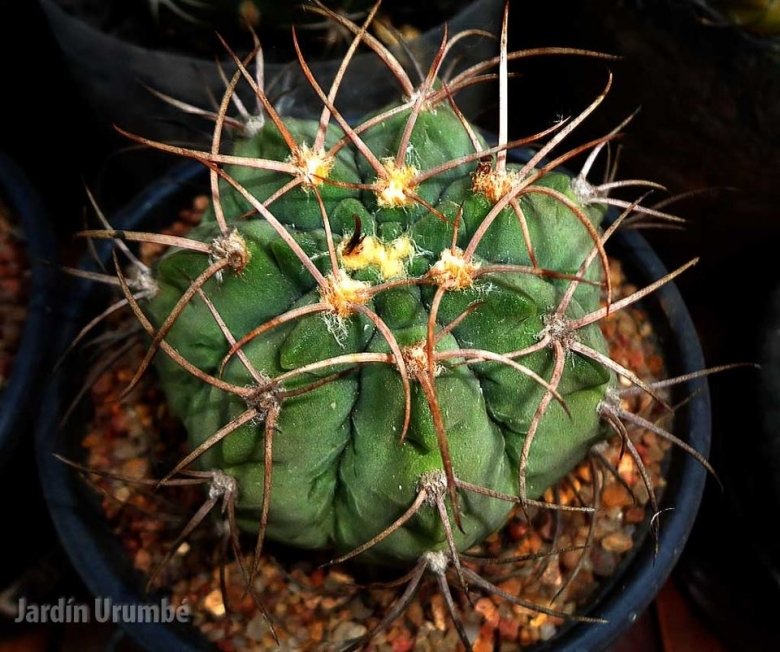
Gymnocalycium nigriareolatum has rather strong spines set on darkish areoles, white flowers and bluish fruits. In most of the bibliography it is considered as synonymous of Gymnocalycium hibopleurum, but it has a single bluish-green stem with distinctive black areoles, and dark bluish fruits, unlike of G. hibopleurum, that usually has a clustering habit, clearer areoles and green fruits. Moreover G. nigriareolatum is easily distinguished by the yellow colour of the anthers, which makes it close to Gymnocalycium glaucum. The fruit is bluish. The aspect of the plants (length of the spines, shape of the ribs, colour of stems etc..) can vary considerably depending to the local circumstances and in the environment of Cuesta del Portezuelo and Palo Labrado, there are plants intermediate with G. hibopleurum, with green fruits and solitary (not clustering) habit. It could be an intraspecific variation, which seems to be very common in the genus Gymnocalycium. In nature the plants are often attacked by a mould fungus and the areoles develop a characteristic black colouring (hence the species name).
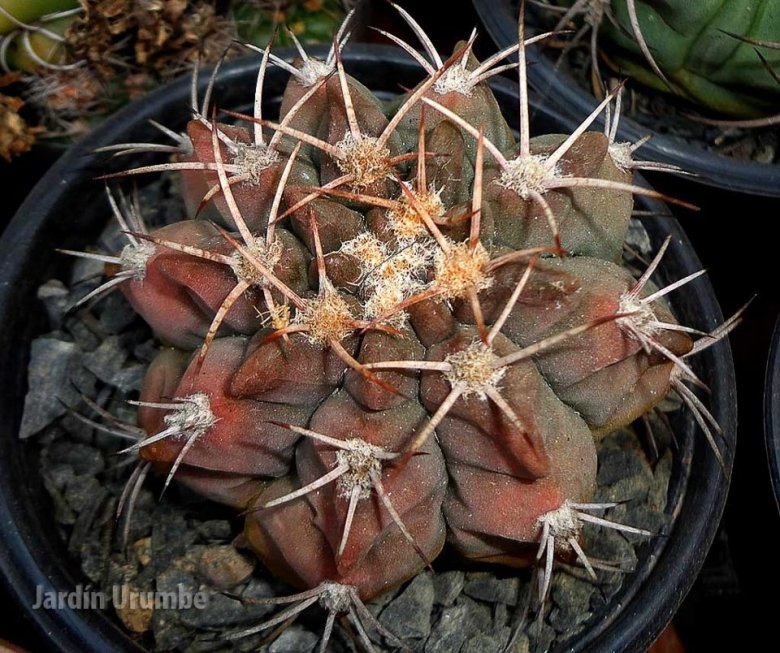
Stem: Solitary rarely with basal shoots ( “var. densispinum”), initially flattened spherical, then sub-spherical, 10-20 cm in diameter, 10-15 cm tall. Glaucous-green to velvety light to dark green reddening in full sun. Apex depressed, woolly, spineless or with young spines.
Root: Napiform, short, strong, often highly branched.
Ribs: 8 to 16(-20), regular, straight, divided by transverse furrows into into angular tubercles up to 3cm wide. The tubercles are rather flat and rounded to distinctly pronounced and sharp-edged, with very prominent conical to angular chins below the areoles.
Areoles: Round to oblong, 7 × 8 mm, at first with white to yellowish brown wool that turns grey or black with time in the wild, whilst new areoles developed in culture remain yellowish-white.
Radial spines: 5-7-(9), radiating, straight to curved toward the body, whitish-grey or pinkish-grey with a brown to black tip, spreading (more comb-shaped in “var. simoi”) measuring up to 30 mm long. Young spines black with an orange-brown base.
Central spine: None or one, similar to radials but somewhat longer, with a darker tip and upwards bent when it is present.
Flowers: Near the apex usually white, with a greenish to reddish throat, but sometimes reddish-pink with a darker throat ( “fa. Carmineum”), broadly funnel-shaped, 45-50 mm long, 35-45 mm in diameter Pericarpel short (12 mm), leaf-green, with rounded scales with a white edge and pink point. The scales pass gradually to the external tepals, while elongating and becoming lighter green. External tepals lanceolate, more or less bent towards the outside, white with a median green stripe and a pink top, the median stripe terminates in a brownish spot. Internal tepals are ivory-white, lanceolate. The throat is carmine. Filaments pink. Anthers yellow. Style greenish-white. Stigma yellowish-white, with 10-12 lobes, under the stamens.
Fruits: Light to dark (bluish-) green spherical, vertical, up to 1.5 cm in diameter. The scales have a thin white edge and pink point.
Seeds: Shiny brownish-black, spherical up to 1.1 mm in diameter, the surface covered with minute, wartlike tubercles. Hilum oval, flat, with a spongy edge more or less developed according to the populations.
Origin and Habitat
Gymnocalycium nigriareolatum occupies a vast area all around the town of Catamarca, known in the Cuesta de los Angeles in the South-West, the Sierra of Graciana in the North, and Cuesta de Portezuelo in the South-east. (typical populations are localized in the zone of the slope of Bethlehem and proximities of the Cuesta de Zapata in Belén)
Habitat and ecology: This species is notably found amongst rocks in clearings and bushes. It is never found growing in places deprived of stones.
Altitude range: 500-1500 metres above sea level.
Cultivation and Propagation
Gymnocalycium nigriareolatum is a summer grower species that is easy to cultivate, but it grows rather slowly.
Growth rate: It is a relatively rapidly growing and easily flowering species that will make clumps given the best conditions.
Soils: It likes very porous standard cactus mix soil. Prefer a low pH compost, avoid substrata rich in limestone; otherwise growth will stop altogether.
Repotting: This plant needs plenty of space for its roots, repotting should be done every other year or when the it has outgrown its pot. Use pot with good drainage.
Watering: Needs moderate to copious waterings in summer, but do not overwater (Rot prone), keep dry in winter at a minimum temperature of 0°C.
Fertilization: Feed with a high potassium fertilizer in summer.
Hardiness: Reputedly resistant to frost if kept on the dry side prior to, and during, cold weather (hardy to -5° C, or less for short periods).
Exposition: The plant tolerates extremely bright situations but enjoys filtered sunlight or afternoon shade, inside it needs bright light, and some direct sun. Tends to bronze in strong light, which encourages flowering and heavy spine production, but is likely to suffer from sun scorch or stunted growth if over exposed to direct sunlight during the hottest part of the day in summer.
Uses: It is an excellent plant for container growing. It always looks good and stays small. It look fine in a cold greenhouse and frame or outdoor in a rockery.
Propagation: Division, direct sow after last frost. Seeds germinate in 7-14 days at 21-27° C in spring, remove gradually the glass cover as soon the plants will be well rooted (ca 1-2 weeks) and keep ventilated, no full sun for young plants! To make a cutting twist off a branch and permit it to dry out a couple of weeks, lay it on the soil and insert the stem end partially into the soil. Try to keep the cutting somewhat upright so that the roots are able to grow downward.
Bibliography
Major references and further lectures
-
J.G. Lambert “Cacti of Argentina” 2nd edition Revised and supplemented 1997 <https://www.cactuspro.com/biblio\_fichiers/pdf/Lambert/LambertEN.pdf\>
-
Gymnocalycium nigriareolatum Backeb. <http://www.atlas.catamarca.gob.ar/PDF/unidades%20tematicas/territorio%20y%20medio%20ambiente/eco%20regiones/Publicaciones/Cactus/nombre/gymnnigr.htm\>
-
“Notes on the 1967 Seed List W.F.M.” The Cactus and Succulent Journal of Great Britain Vol. 29, No. 1 (FEBRUARY, 1967), pp. 16-18
-
Edward Anderson “The Cactus family” Timber Press, Incorporated, 2001
-
David R Hunt; Nigel P Taylor; Graham Charles; International Cactaceae Systematics Group. “The New Cactus Lexicon” dh books, 2006
-
Charles, G. 2009. “Gymnocalycium in Habitat and Culture.” Graham Charles, Stamford.
-
Pilbeam, John. “Gymnocalycium: A Collector’s Guide.” A. A. BALKEMA / ROTTERDAM / BROOKFIELD / 1995
-
Preston-Mafham Rod Preston-Mafham Ken “Cacti: The Illustrated Dictionary” 1995
-
Detlef Metzing “Nacktdistel und Spinnenkaktus Die Gattung Gymnocalycium.” Sonderausgabe der Deutsche Kakteen-Gesellschaft e.V., 2012, S. 99.
-
KuaS 2/2001, S. 37 f.
-
KuaS 4/2012.
-
Karteikarte 2012/07.
Source: Gymnocalycium nigriareolatum, LLIFLE - Encyclopedia of living forms, CC-BY-SA, retrieved 2026-10-25.
From llifle page Gymnocalycium nigriareolatum f. carmineum
Description
Gymnocalycium nigriareolatum f. carmineum is an interesting pink flowering form of Gymnocalycium nigriareolatum that, in turn, is one of the several species of the very variable Gymnocalycium hybopleurum which form a complex of related taxon. It is still unclear whether this variable complex is one or several species. There is so much variation that most authors choose to lump them together until further studies are done.
Taxonomy note: G. Charles (2009) speculated that Gymnocalycium nigriareolatum f. carmineum might be a form of Gymnocalycium oenanthemum, but part for the pink flowers it does not differ from the standard Gymnocalycium nigriareolatum. However it is not clear if it is simply a pink-flowering form of the species, or whether it is a natural hybrid with Gymnocalycium oenanthemum. (Perhaps the deviant flower colour was created by “introgression”, i.e. by the back-crossing of a natural hybrid from Gymnocalycium nigriareolatum and Gymnocalycium oenanthemum with Gymnocalycium nigriareolatum - but this is only a vague presumption.) It could also be interpreted as a transitional form between the two species.
Origin and Habitat
Argentina Northwest (Catamarca).
Type Locality: Sierra de Ancasti, 600-700m
Cultivation and Propagation
Gymnocalycium nigriareolatum f. carmineum is a summer grower species that is easy to cultivate, but it grows rather slowly.
Growth rate: It is a relatively rapidly growing and easily flowering species that will make clumps given the best conditions.
Soils: It likes very porous standard cactus mix soil. Prefer a low pH compost, avoid substrata rich in limestone; otherwise growth will stop altogether.
Repotting: This plant needs plenty of space for its roots, repotting should be done every other year or when the it has outgrown its pot. Use pot with good drainage.
Watering: Needs moderate to copious waterings in summer, but do not overwater (Rot prone), keep dry in winter at a minimum temperature of 0°C.
Fertilization: Feed with a high potassium fertilizer in summer.
Hardiness: Reputedly resistant to frost if kept on the dry side prior to, and during, cold weather (hardy to -5° C, or less for short periods).
Exposition: The plant tolerates extremely bright situations but enjoys filtered sunlight or afternoon shade, inside it needs bright light, and some direct sun. Tends to bronze in strong light, which encourages flowering and heavy spine production, but is likely to suffer from sun scorch or stunted growth if over exposed to direct sunlight during the hottest part of the day in summer.
Uses: It is an excellent plant for container growing. It always looks good and stays small. It look fine in a cold greenhouse and frame or outdoor in a rockery.
Propagation: Division, direct sow after last frost. Seeds germinate in 7-14 days at 21-27° C in spring, remove gradually the glass cover as soon the plants will be well rooted (ca 1-2 weeks) and keep ventilated, no full sun for young plants! To make a cutting twist off a branch and permit it to dry out a couple of weeks, lay it on the soil and insert the stem end partially into the soil. Try to keep the cutting somewhat upright so that the roots are able to grow downward.
Source: Gymnocalycium nigriareolatum f. carmineum, LLIFLE - Encyclopedia of living forms, CC-BY-SA, retrieved 2026-10-25.
From llifle page Gymnocalycium nigriareolatum var. densispinum
Notes
Remarks: Gymnocalycium nigriareolatum var. densispinum: Backeberg (Cactaceae 3: 1759. 1959) published this name invalidly. The type collection, originally collected by H. Fechser in 1963, flowered in cultivation. (Locality: sine loco exacto, coll. H. Fechser s.n., 1963, cult. in coll. H. Till)
Source: Gymnocalycium nigriareolatum var. densispinum, LLIFLE - Encyclopedia of living forms, CC-BY-SA, retrieved 2026-10-25.
From llifle page Gymnocalycium nigriareolatum var. simoi
Origin and Habitat
Argentina Northwest (Catamarca).
Type Locality: Palo Labrado [inter Portezuelo et La Merced]
Source: Gymnocalycium nigriareolatum var. simoi, LLIFLE - Encyclopedia of living forms, CC-BY-SA, retrieved 2026-10-25.
From llifle page Gymnocalycium ambatoense
Description
Gymnocalycium ambatoense is a densely spined specie that grow individually around 900-1100 m asl on the Sierra Ambato. It is often considered as a transitional form intermediate between the strongly spined and red flowering Gymnocalycium oenanthemum (growing in the same area from 800 to 1800 m asl), and the widespread Gymnocalycium hossei.
Stem: Flattened or ball-shaped, dark green, 7-12 cm. in diameter, 5-7 cm. tall.
Roots: Fibrous roots.
Ribs: Usually 10 but varying from 9 to17 with distinct chin-like projections.
Spines: Yellowish brown turning pinkish-grey as they age.
Central spine: 1(-to 3), sometimes missing, straight or slightly curved inward, upstanding 5 cm long.
Radial spines: 9-11 slightly curved or protruding up to 2,5 cm. long.
Flower: Bell-shaped, silky white with a bright pink mid-strip 2,5 to 4,5 cm. long and 3 to 4 cm. in diameter.
Fruit: Dark green, flattened spherical and up to 4 cm long.
Origin and Habitat
Sierra Ambato, Catamarca, Argentina.
Altitude range. Around 900-1100 metres above sea level.
Cultivation and Propagation
Gymnocalycium ambatoense is a summer grower species that is easy to cultivate.
Growth rate: It is a relatively rapidly growing and easily flowering species that will make clumps given the best conditions.
Soils: It likes very porous standard cactus mix soil. Prefer a low pH compost, avoid substrata rich in limestone; otherwise growth will stop altogether.
Repotting: This plant needs plenty of space for its roots, repotting should be done every other year or when the it has outgrown its pot. Use pot with good drainage.
Watering: Needs moderate to copious waterings in summer, but do not overwater (Rot prone), keep dry in winter at a minimum temperature of 0°C.
Fertilization: Feed with a high potassium fertilizer in summer.
Hardiness: Reputedly resistant to frost if kept on the dry side prior to, and during, cold weather (hardy to -5 C ° C, or less for short periods).
Exposition: The plant tolerates extremely bright situations but enjoys filtered sunlight or afternoon shade, inside it needs bright light, and some direct sun. Tends to bronze in strong light, which encourages flowering and heavy spine production, but is likely to suffer from sun scorch or stunted growth if over exposed to direct sunlight during the hottest part of the day in summer.
Uses: It is an excellent plant for container growing. It always looks good and stays small. It look fine in a cold greenhouse and frame or outdoor in a rockery.
Pests & diseases: It may be attractive to a variety of insects, but plants in good condition should be nearly pest-free, particularly if they are grown in a mineral potting-mix, with good exposure and ventilation. Nonetheless, there are several pests to watch for:
- Red spiders: Red spiders may be effectively rubbed up by watering the plants from above.
- Mealy bugs: Mealy bugs occasionally develop aerial into the new growth among the wool with disfiguring results, but the worst types develop underground on the roots and are invisible except by their effects.
- Scales: Scales are rarely a problem.
- Rot: This species is particularly easy and accommodating, seldom suffer of cryptogamic diseases. Rot it is only a minor problem with gymnocalyciums if the plants are watered and “aired” correctly. If they are not, fungicides won’t help all that much.
Propagation: Division, direct sow after last frost. Seeds germinate in 7-14 days at 21-27° C in spring, remove gradually the glass cover as soon the plants will be well rooted (ca 1-2 weeks) and keep ventilated, no full sun for young plants! To make a cutting twist off a branch and permit it to dry out a couple of weeks, lay it on the soil and insert the stem end partially into the soil. Try to keep the cutting somewhat upright so that the roots are able to grow downward.
Source: Gymnocalycium ambatoense, LLIFLE - Encyclopedia of living forms, CC-BY-SA, retrieved 2026-10-25.
From llifle page Gymnocalycium ambatoense subs. plesnikii
Origin and Habitat
Catamarca (Argentina Northwest, Southern South America, Southern America)
Type Locality: Near Campo, 800m.
Source: Gymnocalycium ambatoense subs. plesnikii, LLIFLE - Encyclopedia of living forms, CC-BY-SA, retrieved 2026-10-25.
Gallery