Publication: Explan. Diagr. Austroechinocactinae 293 (1957)
Description
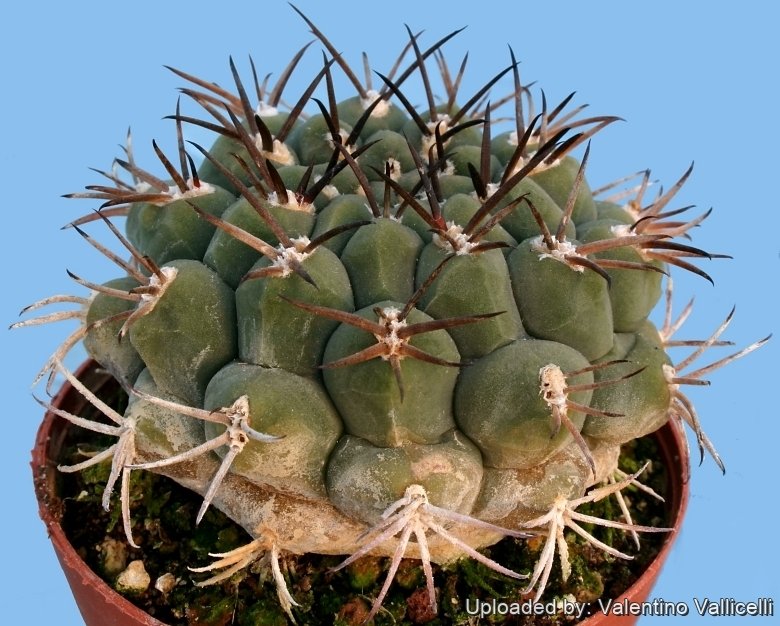
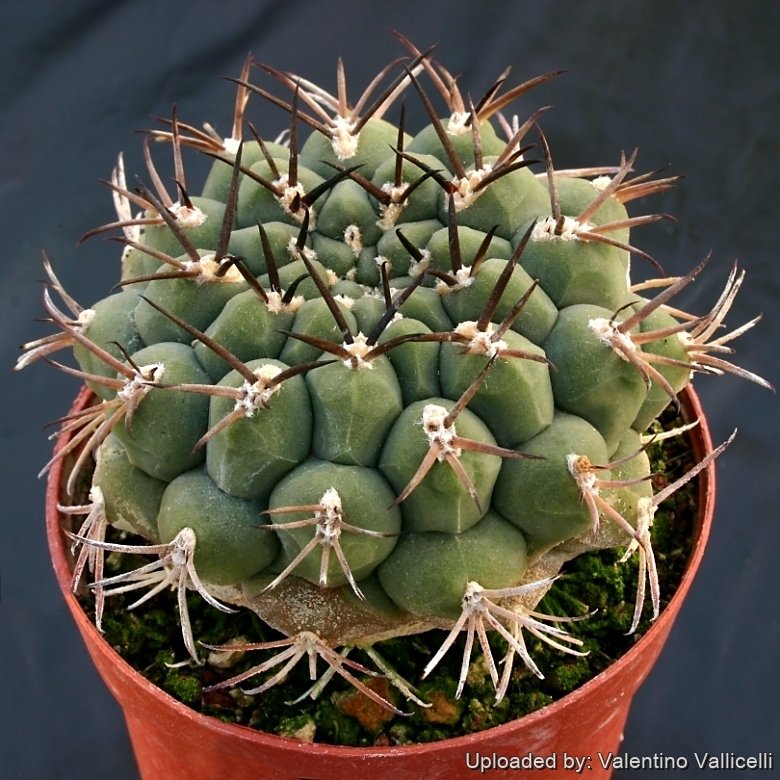
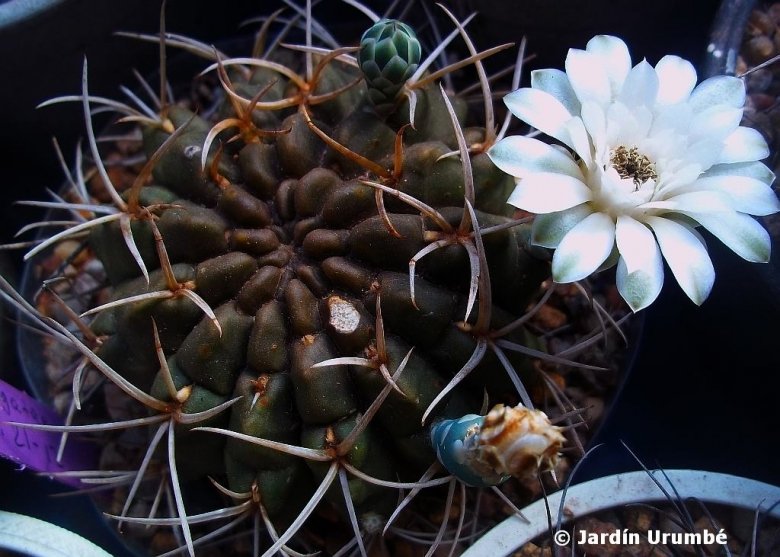
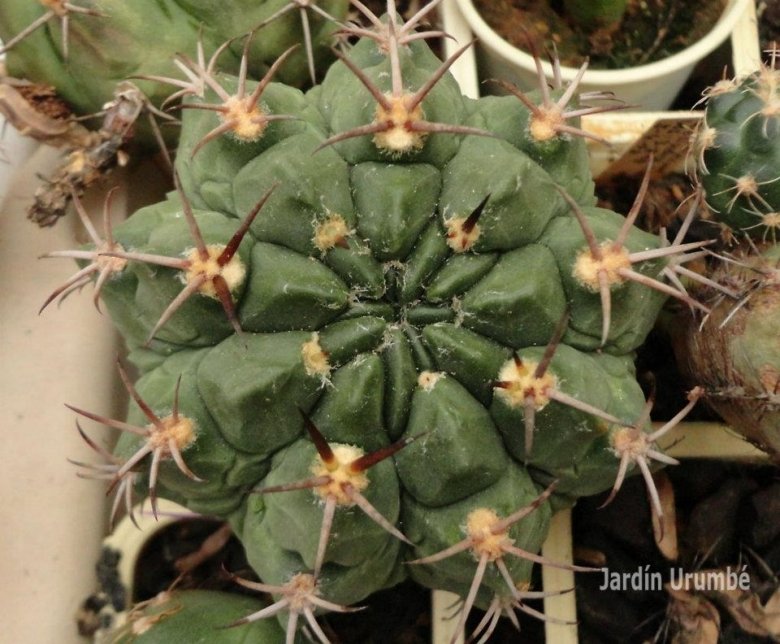
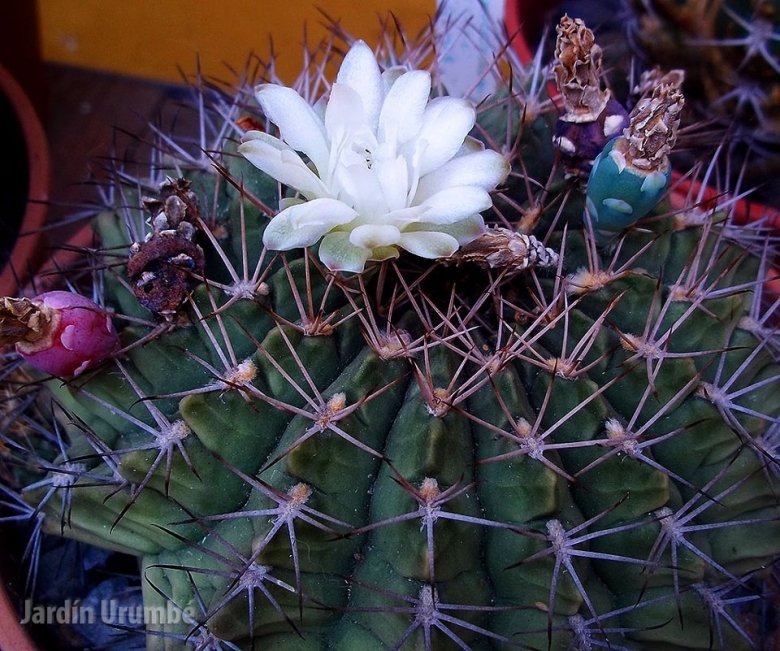
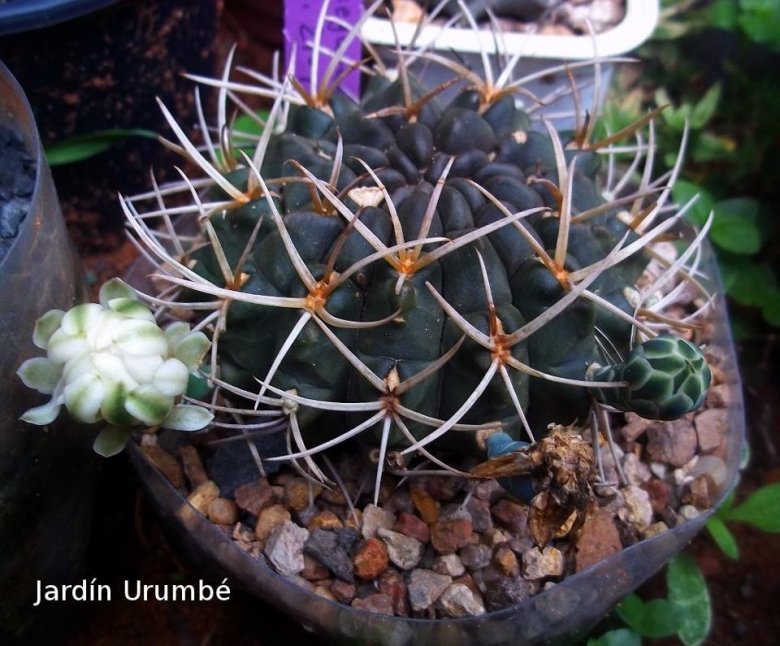
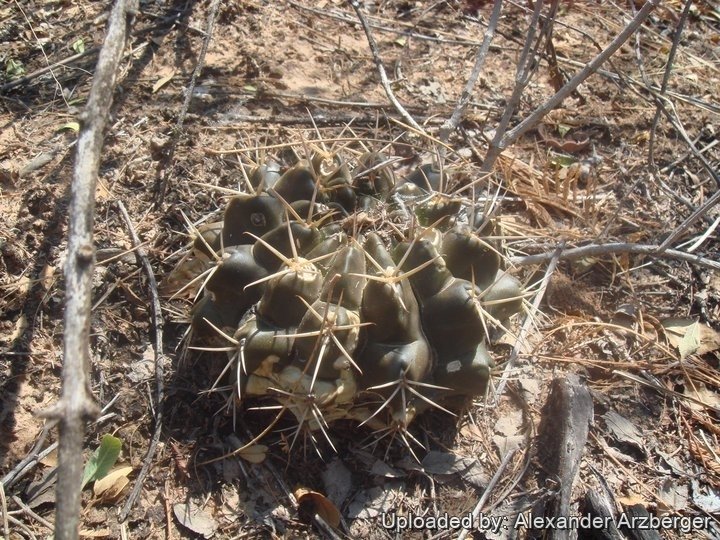
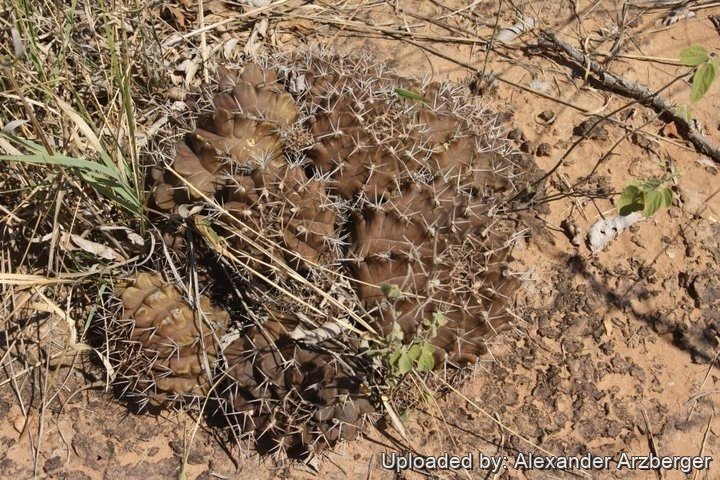
Gymnocalycium marsoneri is a globular cactus, rather flattened, with spreading and sometimes recurved spines. They are a rich brown and form a pleasing contrast against the bronze-green body.
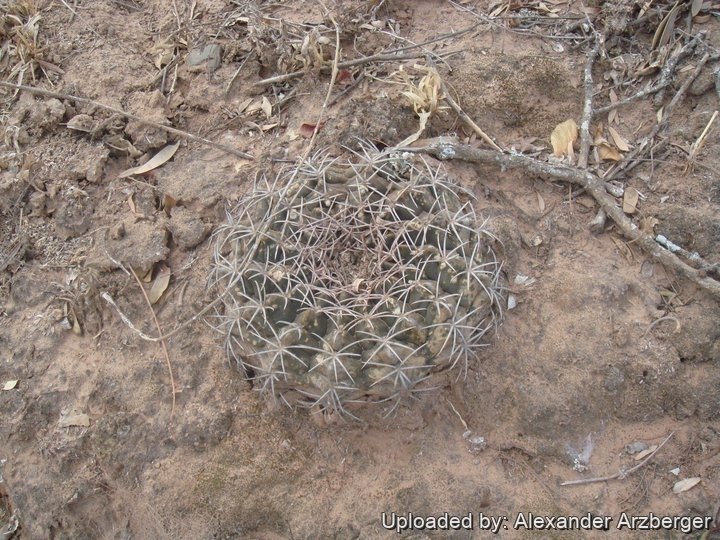
Habit: Solitary, barely rising above ground level, but often branching basally in cultivation to form clusters.
Stem Depressed-spherical, up to 7 cm tall (often more in cultivation) and up to 14 centimetres in diameter, dull greyish green, olive-green or dark-coppery red in full sun.
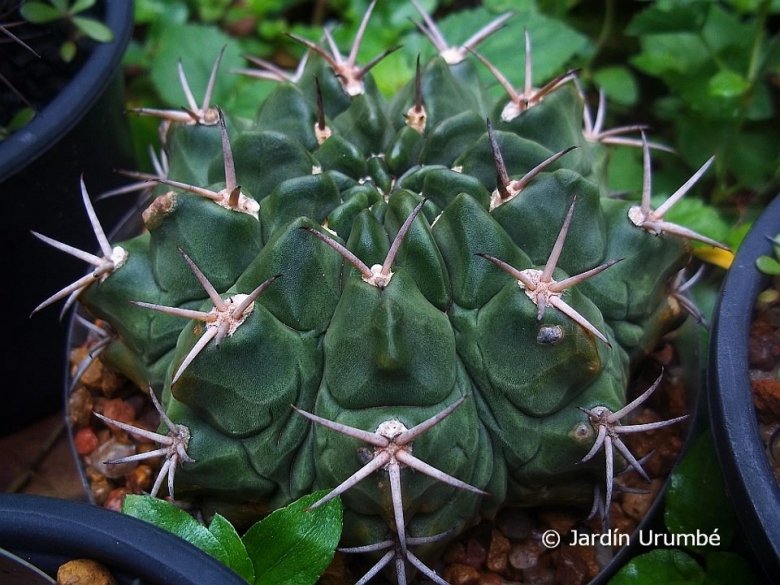
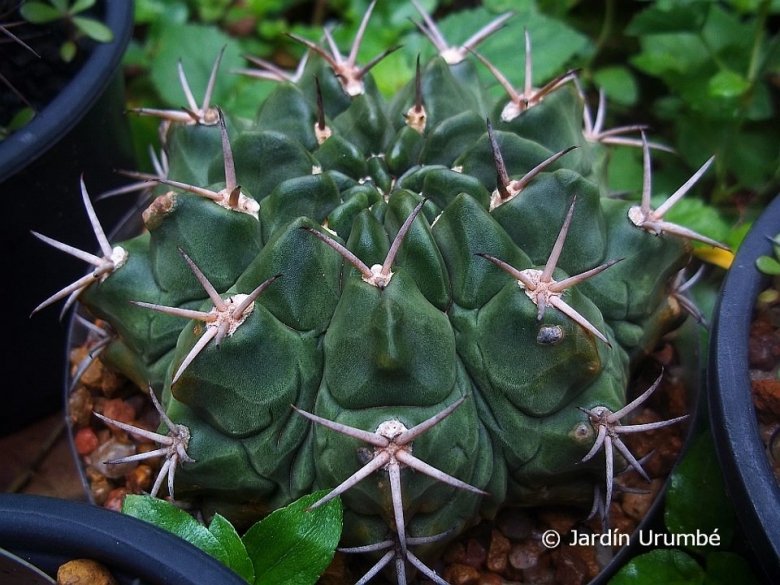
Ribs: 9-21, divided into tubercles
Tubercles: Large, prominent, rounded and spirally arranged.
Central spines: Usually absent.
Radial spines: 5-7 straight to slightly recurved, 2-3 cm long brownish above, lighter below at first, becoming darker with age.
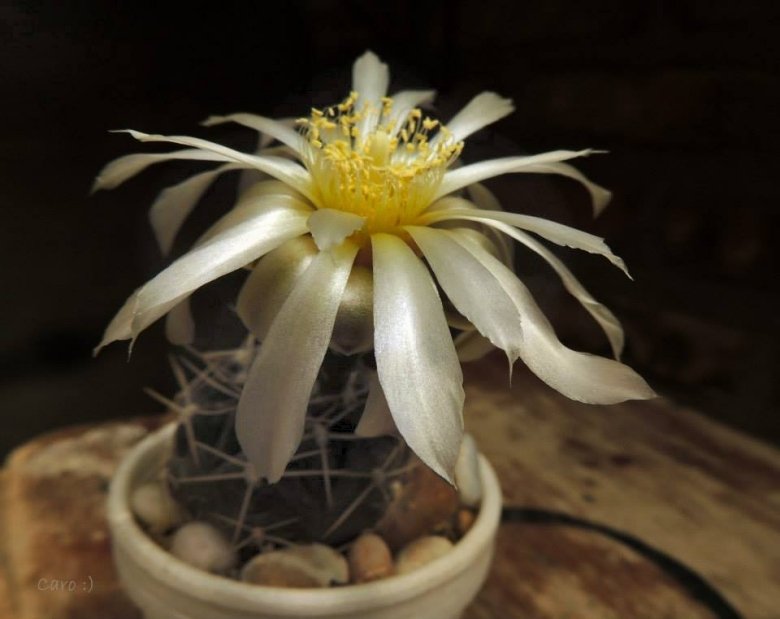
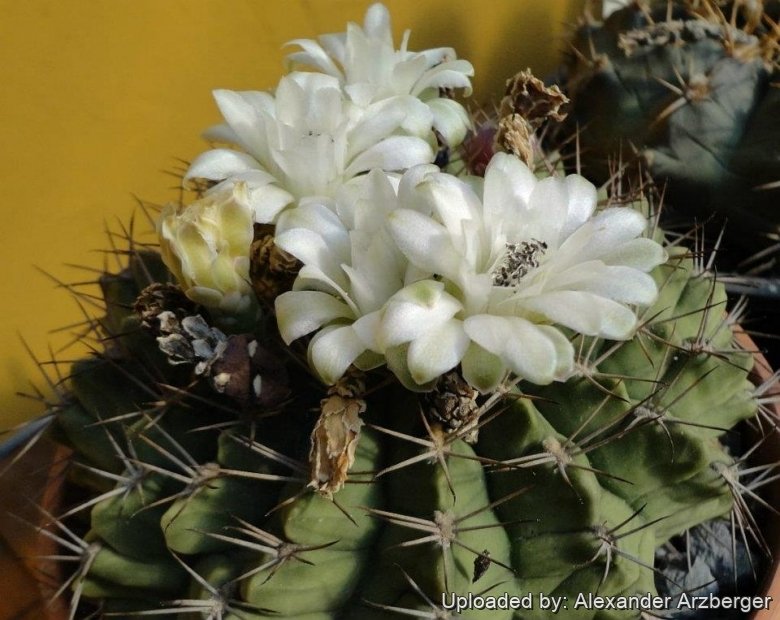
Flowers: Campanulate to infundibuliform, 3-3,5 cm long and 3-4,5 cm in diameter, pale greenish white to white.
Fruit: Spherical to slightly ovoid, red, purple or bluish green.
Seeds: Nearly spherical pale brown. About 1 mm in diameter including the inconspicuous hilum.
Origin and Habitat
Widespread in Paraguay, south-western Brazil, southern Bolivia and northern Argentina.
Altitude: 700-1600 metres above sea level.
Cultivation and Propagation
Gymnocalycium marsoneri is a summer grower species that is easy to cultivate.
Growth rate: It is a relatively rapidly growing and easily flowering species that will make clumps given the best conditions.
Soils: It likes very porous standard cactus mix soil. Prefer a low pH compost, avoid substrata rich in limestone; otherwise growth will stop altogether.
Repotting: This plant needs plenty of space for its roots, repotting should be done every other year or when the it has outgrown its pot. Use pot with good drainage.
Watering: Needs moderate to copious waterings in summer, but do not overwater (Rot prone), keep dry in winter at a minimum temperature of 0°C.
Fertilization: Feed with a high potassium fertilizer in summer.
Hardiness: Reputedly resistant to frost if kept on the dry side prior to, and during, cold weather (hardy to -5 C ° C, or less for short periods).
Exposition: The plant tolerates extremely bright situations but enjoys filtered sunlight or afternoon shade, inside it needs bright light, and some direct sun. Tends to bronze in strong light, which encourages flowering and heavy spine production, but is likely to suffer from sun scorch or stunted growth if over exposed to direct sunlight during the hottest part of the day in summer.
Uses: It is an excellent plant for container growing. It always looks good and stays small. It look fine in a cold greenhouse and frame or outdoor in a rockery.
Pests & diseases: It may be attractive to a variety of insects, but plants in good condition should be nearly pest-free, particularly if they are grown in a mineral potting-mix, with good exposure and ventilation. Nonetheless, there are several pests to watch for:
- Red spiders: Red spiders may be effectively rubbed up by watering the plants from above.
- Mealy bugs: Mealy bugs occasionally develop aerial into the new growth among the wool with disfiguring results, but the worst types develop underground on the roots and are invisible except by their effects.
- Scales: Scales are rarely a problem.
- Rot: This species is particularly easy and accommodating, seldom suffer of cryptogamic diseases. Rot it is only a minor problem with gymnocalyciums if the plants are watered and “aired” correctly. If they are not, fungicides won’t help all that much.
Propagation: Division, direct sow after last frost. Seeds germinate in 7-14 days at 21-27° C in spring, remove gradually the glass cover as soon the plants will be well rooted (ca 1-2 weeks) and keep ventilated, no full sun for young plants! To make a cutting twist off a branch and permit it to dry out a couple of weeks, lay it on the soil and insert the stem end partially into the soil. Try to keep the cutting somewhat upright so that the roots are able to grow downward.
Bibliography
Major references and further lectures
-
Edward Anderson “The Cactus family” Timber Press, Incorporated, 2001
-
James Cullen, Sabina G. Knees, H. Suzanne Cubey “The European Garden Flora Flowering Plants: A Manual for the Identification of Plants Cultivated in Europe, Both Out-of-Doors and Under Glass” Cambridge University Press, 11/Aug/2011
-
David R Hunt; Nigel P Taylor; Graham Charles; International Cactaceae Systematics Group. “The New Cactus Lexicon” dh books, 2006
-
Ito, Yoshi “Explanatory Diagram of Austroechinocactinae” 1957
-
Curt Backeberg “Die Cactaceae: Handbuch der Kakteenkunde” Gustav Fischer Verlag, Stuttgart New York 1982–1985
From llifle page Gymnocalycium anisitsii var. pseudomalacocarpus
Description
This variety differ from var. anisitsii and var. griseopallidum with flatly globular, with disc-like body in dry season (which is similar to malacocarpus), however, it was said they are hardly any differences in flower, fruit and seeds.
Source: Gymnocalycium anisitsii var. pseudomalacocarpus, LLIFLE - Encyclopedia of living forms, CC-BY-SA, retrieved 2026-10-25.
From llifle page Gymnocalycium hamatum
Description
Gymnocalycium hamatum (firstly described as by Friedrich Ritter in in “Kakteen in Südamerika” vol 2, 663-664, 1980) is a local or morphological form of Gymnocalycium marsoneri. It has an olive green, tuberculate body. The pale coloured spines are all radial, standing out from the body, straight but slightly hooked at the tip. However the distinguishing characteristics of Gymnocalycium hamatum, appear to fall within the natural variation of Gymnocalycium marsoneri and it should be synonymized with the latter.
Note: Gymnocalycium hamatum has been made synonymous to Gymnocalycium marsoneri subs. megatae by G. Charles without specifically justify that choice.
Stem: Usually solitary (not clustering), globular flattened, 6-18 cm in diameter grey-green, olive green to coppery brown.
Ribs: 9-16 with blunt tubercles.
Areoles: 5-8 mm long, 3 mm wide, 10-18 mm apart, with a cream to white wool.
Spines: All radial, 5 to 9, 15-20 (or more) mm long mostly creamy-white or light yellowish brown, some-times reddish-brown, stiff, straight but slightly hooked at the tip, hence the specific name (Latin adjective “hamatus”, “hamata”, “hamatum” = hooked).
Flowers:Produced around the stems side, away from the apex. Large, about 5 cm long, white with a pink middle stripe
Fruits Red, with a blue bloom, fusiform, 25-30 mm long , 15-20 mm wide. Pulp pinkish.
Origin and Habitat
Gymnocalycium hamatum was discovered by Friedrich Ritter near Palos Blancos, Tarija, Bolivia in 1958. Up to now this species has only been found near its type habitat at Palos Blancos.
Altitude range: 730-870 metres above seal level.
Cultivation and Propagation
Gymnocalycium hamatum is a summer grower species that is easy to cultivate.
Growth rate: It is a relatively rapidly growing and easily flowering species that will make clumps given the best conditions.
Soils: It likes very porous standard cactus mix soil. Prefer a low pH compost, avoid substrata rich in limestone; otherwise growth will stop altogether.
Repotting: This plant needs plenty of space for its roots, repotting should be done every other year or when the it has outgrown its pot. Use pot with good drainage.
Watering: Needs moderate to copious waterings in summer, but do not overwater (Rot prone), keep dry in winter at a minimum temperature of 0°C.
Fertilization: Feed with a high potassium fertilizer in summer.
Hardiness: Reputedly resistant to frost if kept on the dry side prior to, and during, cold weather (hardy to -5 C ° C, or less for short periods).
Exposition: The plant tolerates extremely bright situations but enjoys filtered sunlight or afternoon shade, inside it needs bright light, and some direct sun. Tends to bronze in strong light, which encourages flowering and heavy spine production, but is likely to suffer from sun scorch or stunted growth if over exposed to direct sunlight during the hottest part of the day in summer.
Uses: It is an excellent plant for container growing. It always looks good and stays small. It look fine in a cold greenhouse and frame or outdoor in a rockery.
Pests & diseases: It may be attractive to a variety of insects, but plants in good condition should be nearly pest-free, particularly if they are grown in a mineral potting-mix, with good exposure and ventilation. Nonetheless, there are several pests to watch for:
- Red spiders: Red spiders may be effectively rubbed up by watering the plants from above.
- Mealy bugs: Mealy bugs occasionally develop aerial into the new growth among the wool with disfiguring results, but the worst types develop underground on the roots and are invisible except by their effects.
- Scales: Scales are rarely a problem.
- Rot: This species is particularly easy and accommodating, seldom suffer of cryptogamic diseases. Rot it is only a minor problem with gymnocalyciums if the plants are watered and “aired” correctly. If they are not, fungicides won’t help all that much.
Propagation: Division, direct sow after last frost. Seeds germinate in 7-14 days at 21-27° C in spring, remove gradually the glass cover as soon the plants will be well rooted (ca 1-2 weeks) and keep ventilated, no full sun for young plants! To make a cutting twist off a branch and permit it to dry out a couple of weeks, lay it on the soil and insert the stem end partially into the soil. Try to keep the cutting somewhat upright so that the roots are able to grow downward.
Bibliography
Major references and further lectures
-
Terry Smale, Cactus and Succulent Society of Great Britain “Notes on the 1977 seed distribution” Cactus and Succulent Journal of Great Britain”, Volumes 39-43 page 17, 1977.
-
Gymnocalycium hamatum F. Ritter <http://www.richtstatt.de\> Web. 9 May. 2015.
-
Demaio, P. H., M. H. J. Barfuss, W. Till & J. O. Chiapella. 2010. “Phylogenetic relationships and infrageneric classification of the genus Gymnocalycium: insights from molecular data. Gymnocalycium” 2010: 925–946.
-
Navarro Sánchez, G. 1996. “Catálago ecológico preliminar de las cactáceas de Bolivia.” Lazaroa 17: 33–84.
-
Jørgensen, P. M., M. H. Nee & S. G. Beck. (eds.) 2014. “Cat. Pl. Vasc. Bolivia”, Monogr. Syst. Bot. Missouri Bot. Gard. 127(1–2): i–viii, 1–1744. Missouri Botanical Garden Press, St. Louis.
-
Friedrich Ritter “Kakteen in Südamerika: Ergebnisse meiner 20jährigen Feldforschungen” volume 2, 1980
Source: Gymnocalycium hamatum, LLIFLE - Encyclopedia of living forms, CC-BY-SA, retrieved 2026-10-25.
From llifle page Gymnocalycium megatae
Description
Doubtfully distinct from Gymnocalycium marsoneri, Gymnocalycium megatae (syn: Gymnocalycium marsoneri subs. megatae) is a member of a complex group of species, that may include Gymnocalycium tudae and Gymnocalycium onychacanthum which inhabit the Gran Chaco of Paraguay and neighbouring areas, and are now considered as mere synonyms. Gymnocalycium eytianum and Gymnocalycium pseudomalacocarpus are also considered close to this species. Unlike to G. marsoneri that has large rounded tubercles, G. megatae has a large flattened body with acute ribs (characteristic that relate it to Gymnocalycium matoense that grows at the edge of the area to the east of the populations of G. megatae).
G. megatae has 5 thin spines spreading from the body, while G. marsoneri has stouter spines enlarged at the base which are bent toward the body of the plants. However, G. megatae and G. marsoneri are quite different and easily told apart at a glance, and perhaps it may be worth to consider them as two separated species. Gymnocalycium megatae freely-produces white flowers.
Stems: Flattened to globular (occasionally up to 30 tall), depressed at the apex 16-20 cm in diameter. Solitary or few branched in age, dull grey-green, often reddish-brown.
Ribs: Acute, strongly marked, divided into polygonal-chinned tubercles, separated by furrows.
Spines: 5 (occasionally up to 9), thin, slightly recurved, pale to dull brown.
Flowers: White to dirty white.
Origin and Habitat
Gymnocalycium megatae (Gymnocalycium marsoneri subs. megatae) inhabits a belt of territory, extending between Charagua-Boyuibe-Palos Blancos in the Bolivian Chaco, and crossing the Chaco Boreal (i.e. the departments of Boquerón and Alto Paraguay in Paraguay, where there are still populations of the taxon), it arrived in the area of Porto Murtinho, Mato Grosso do Sul (Brazil) where the Chaco becomes Pantanal.
Habitat and ecology: Gymnocalycium megatae forms large colonies in dry areas near salt lakes, but is also found in moister conditions in step cliff faces and is adapted to grow in deep shade. The soil must rapidly crumble away, but these cacti are able to germinate and grow to flowering size before their home falls out from under them. Abundant mosses, normally good indicators of a habitat unsuitable to cacti, least of all healthy cacti, are growing alongside specimens of G. megatae.
Cultivation and Propagation
Gymnocalycium megatae is a summer grower species that is easy to cultivate.
Growth rate: It is a relatively rapidly growing and easily flowering species that will make clumps given the best conditions.
Soils: It likes very porous standard cactus mix soil. Prefer a low pH compost, avoid substrata rich in limestone; otherwise growth will stop altogether.
Repotting: This plant needs plenty of space for its roots, repotting should be done every other year or when the it has outgrown its pot. Use pot with good drainage.
Watering: Needs moderate to copious waterings in summer, but do not overwater (Rot prone), keep dry in winter at a minimum temperature of 0°C.
Fertilization: Feed with a high potassium fertilizer in summer.
Hardiness: Reputedly resistant to frost if kept on the dry side prior to, and during, cold weather (hardy to -5 C ° C, or less for short periods).
Exposition: The plant tolerates extremely bright situations but enjoys filtered sunlight or afternoon shade, inside it needs bright light, and some direct sun. Tends to bronze in strong light, which encourages flowering and heavy spine production, but is likely to suffer from sun scorch or stunted growth if over exposed to direct sunlight during the hottest part of the day in summer.
Uses: It is an excellent plant for container growing. It always looks good and stays small. It look fine in a cold greenhouse and frame or outdoor in a rockery.
Pests & diseases: It may be attractive to a variety of insects, but plants in good condition should be nearly pest-free, particularly if they are grown in a mineral potting-mix, with good exposure and ventilation. Nonetheless, there are several pests to watch for:
- Red spiders: Red spiders may be effectively rubbed up by watering the plants from above.
- Mealy bugs: Mealy bugs occasionally develop aerial into the new growth among the wool with disfiguring results, but the worst types develop underground on the roots and are invisible except by their effects.
- Scales: Scales are rarely a problem.
- Rot: This species is particularly easy and accommodating, seldom suffer of cryptogamic diseases. Rot it is only a minor problem with gymnocalyciums if the plants are watered and “aired” correctly. If they are not, fungicides won’t help all that much.
Propagation: Division, direct sow after last frost. Seeds germinate in 7-14 days at 21-27° C in spring, remove gradually the glass cover as soon the plants will be well rooted (ca 1-2 weeks) and keep ventilated, no full sun for young plants! To make a cutting twist off a branch and permit it to dry out a couple of weeks, lay it on the soil and insert the stem end partially into the soil. Try to keep the cutting somewhat upright so that the roots are able to grow downward.
Bibliography
Major references and further lectures
-
Gymnocalycium megatae in: The Cactus and Succulent Journal of Great Britain, Cactus and Succulent Society of Great Britain, 1977
-
Gymnocalycium megatae in: The Cactus and Succulent Journal of Great Britain, Cactus and Succulent Society of Great Britain, 1982
-
Pilbeam “Gymnocalycium - A collector’s guide”. 1995
-
Charles, G. “Gymnocalycium in habitat and culture”. Stamford, England: published by the author. 2009.
-
Braun, P. J. & Esteves Pereira, E. “Kakteen und andere Sukkulenten in Brasilien.” Schumannia 3: 1-235. 2001.
-
Anceschi, G. & Magli, A. “South America 2005/2010.” Bologna. MODO infoshop.2010.
-
James D. Mauseth, Roberto Kiesling, and Carlos Ostolaza “A cactus odyssey: journeys in the wilds of Bolivia, Peru, and Argentina” Timber Press, 2002
-
Joël Lodé. “Cactacées Gymnocalycium megatae Y.Ito” Collections: Herman Schwatzz, USA. Edisud. Aix. Série 5 <https://www.cactuspro.com/biblio\_fichiers/pdf/Lode/LodeC-Floribunda-Myrtillocactus\_O.pdf\>
Source: Gymnocalycium megatae, LLIFLE - Encyclopedia of living forms, CC-BY-SA, retrieved 2026-10-25.
Cultivars and forms (3)
Gallery