Publication: Kaktusář 1934, August; cf. Backeb. Blatter Kakteenforsch. 1934, Pr. 9, [p.2].
Description
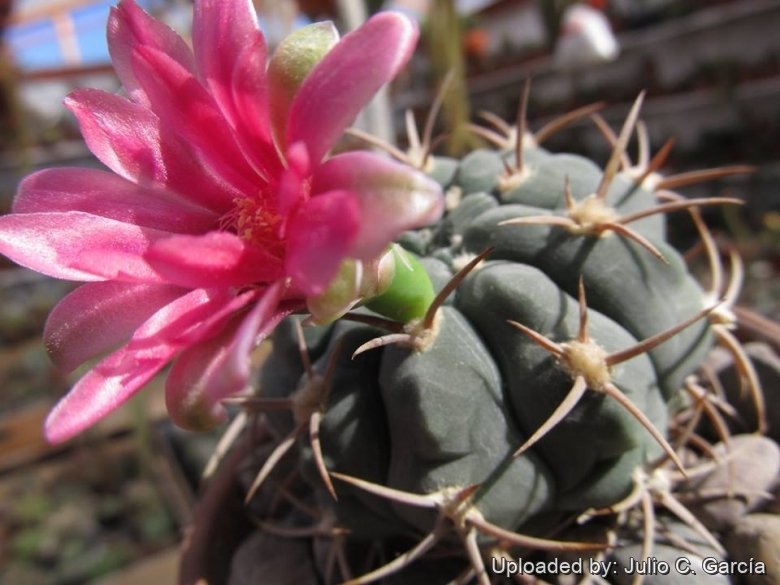
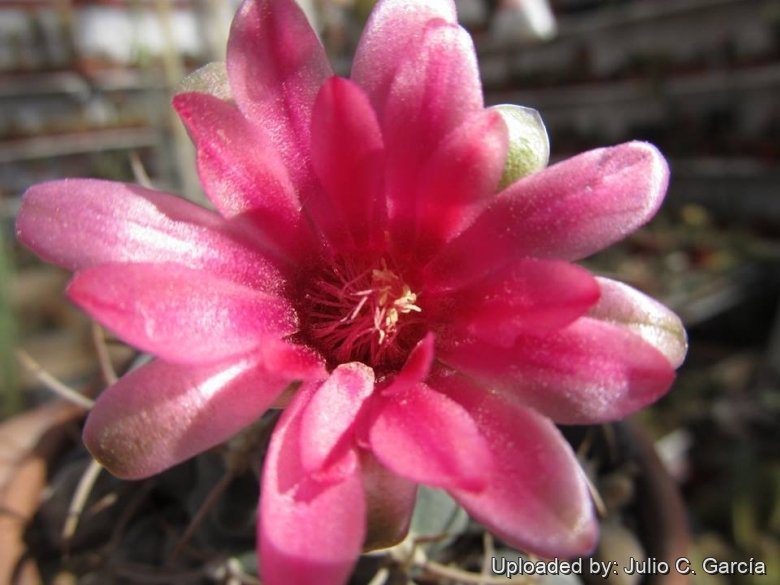
Gymnocalycium oenanthemum is a beautiful solitary stemmed species, of modest size, with stout spines slightly curved inward and particularly attractive for its beautiful wine-red or deep salmon-pink flowers.
Taxonomy: In the past the name G. oenanthemum was reserved to the plants found in the south-east slope of Sierra Ambato while those on the west slope of the valley was classified as Gymnocalycium tillianum, at the same time the carmine red flowering form growing from 1300 to 1800 m was named Gymnocalycium carminanthum, but apart little differences in seeds morphology this three plants are the same and not readily distinguishable. The white flowering Gymnocalycium ambatoense may also be referred to the same species. The absence of the central spine is a good clue of G. oenanthemum (but not always true)
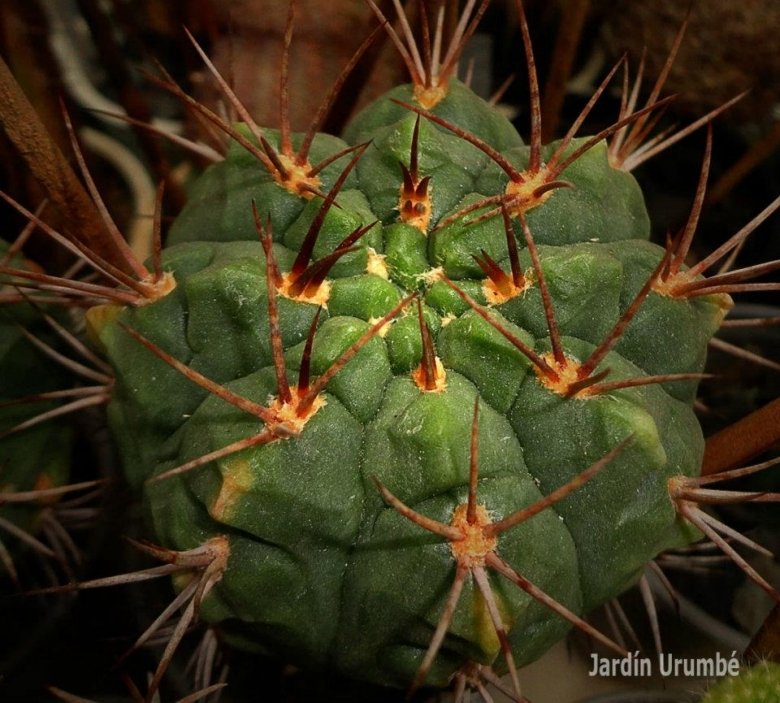
Stem: flattened globose, dull grey-green to to bluish green, 6-8(-10) cm high and 7-9(-12) cm in diameter.
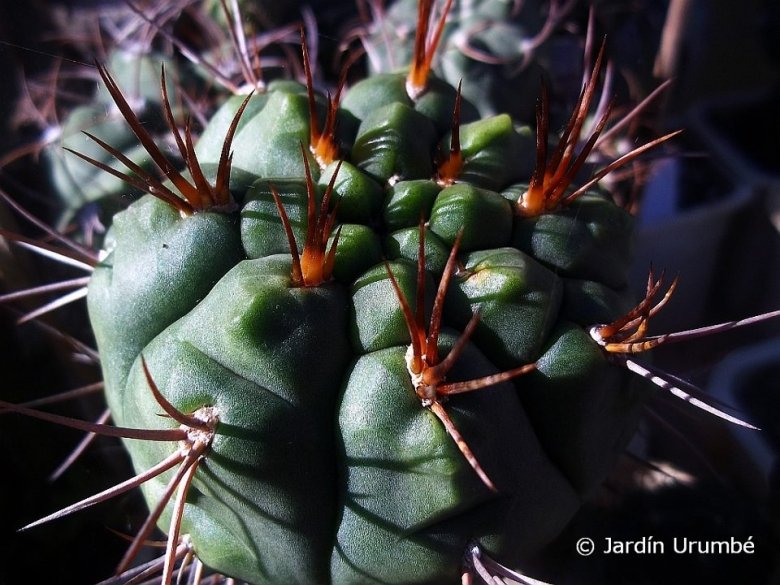
Ribs: (6-)11-13, broad. obtuse, sharply angled.
Central spine: Usually absent, sometimes one erect.
Radial spines: Usually 5(-7), reddish grey with dark tips, stout, straight to slightly curved inward, to 1.5-2 cm long, pinkish at first, later grey.
Flowers: Wine red or deep salmon-pink, shiny, to 5 cm long and 4-4.5 cm in diameter lasting approx 4 days..
Fruits: Ovoid, green.
Seeds: 0.8 mm in diameter, dark brown to black, tuberculate, with small pale hilum.
Origin and Habitat
Sierra Ambato, Catamarca (and La Rioja?), Argentina. This species has a very small range (extent of occurrence is 1,500 km2) and occurs in only two locations however there might be more subpopulations in the area.
Altitude range: It occurs at elevations of 800-1800 metres above sea level.
Habitat and Ecology: The species grows in high altitude grasslands. The major threat is intentional fires in the grasslands. The species is threatened in part of its range by collectors.
Cultivation and Propagation
Gymnocalycium oenanthemum is an easy to grow succulent, more cold tolerant than most and less fussy regarding soil conditions.
Growth rate: It is a relatively rapidly growing and easily flowering species that will make clumps given the best conditions.
Soils: It likes very porous standard cactus mix soil.
Repotting: Use pot with good drainage.
Watering: Water regularly in summer, but do not overwater (Rot prone), keep dry in winter.
Fertilization: Feed with a high potassium fertilizer in summer.
Hardiness: Reputedly somewhat resistant to frost if kept on the dry side prior to, and during, cold weather (hardy to -12 C ° C, or less for short periods).
Exposition: Outside bright but filtered sunlight or afternoon shade, inside it needs bright light, and some direct sun. Tends to bronze in strong light, which encourages flowering and heavy spine production.
Uses: It is an excellent plant for container growing. It always looks good and stays small. It look fine in a cold greenhouse and frame or outdoor in a rockery.
Pests & diseases: It may be attractive to a variety of insects, but plants in good condition should be nearly pest-free, particularly if they are grown in a mineral potting-mix, with good exposure and ventilation. Nonetheless, there are several pests to watch for:
- Red spiders: Red spiders may be effectively rubbed up by watering the plants from above.
- Mealy bugs: Mealy bugs occasionally develop aerial into the new growth among the wool with disfiguring results, but the worst types develop underground on the roots and are invisible except by their effects.
- Sciara Flies: Sciara flies are one of the major problems for seedlings. It is a good practice to mulch your seedlings with a layer of grit, which will strongly discourage the flies.
- Scales: Scales are rarely a problem.
- Rot: Rot it is only a minor problem with cacti if the plants are watered and “aired” correctly. If they are not, fungicides won’t help all that much.
Propagation: Division, direct sow after last frost. Seeds germinate in 7-14 days at 21-27° C in spring, remove gradually the glass cover as soon the plants will be well rooted (ca 1-2 weeks) and keep ventilated, no full sun for young plants! To make a cutting twist off a branch and permit it to dry out a couple of weeks, lay it on the soil and insert the stem end partially into the soil. Try to keep the cutting somewhat upright so that the roots are able to grow downward.
Bibliography
Major references and further lectures
-
Edward Anderson “The Cactus family” Timber Press, Incorporated, 2001
-
David R Hunt; Nigel P Taylor; Graham Charles; International Cactaceae Systematics Group. “The New Cactus Lexicon” dh books, 2006
-
Roberto Kiesling, Omar E. Ferrari “Cien cactus argentinos” Editorial Albatros, 2005
-
James Cullen, Sabina G. Knees, H. Suzanne Cubey “The European Garden Flora Flowering Plants: A Manual for the Identification of Plants Cultivated in Europe, Both Out-of-Doors and Under Glass” Cambridge University Press, 11/Aug/2011
-
Hans Krainz “Die Kakteen: eine Gesamtdarstellung der eingeführten Arten nebst Anzucht- und Pflege-Anweisung” Franckh’sche Verlagshandlung” Lfg. 59. 1974
-
Demaio, P., Perea, M. & Trevisson, M. 2013. Gymnocalycium oenanthemum. The IUCN Red List of Threatened Species. Version 2014.2. <www.iucnredlist.org>. Downloaded on 08 August 2014.
-
Blätter für Kakteenforschung 1934. Nummer 9, S. [2], 1934, Genus 74, Species 4.
-
Zuloaga, F. O., O. N. Morrone, M. J. Belgrano, C. Marticorena & E. Marchesi. (eds.) 2008. Monogr. Syst. Bot. Missouri Bot. Gard. 107: 3 Vols., 3348 p.
From llifle page Gymnocalycium carminanthum
Description
Gymnocalycium oenanthemum subs. carminanthum best known in cultivation as Gymnocalycium carminanthum is a solitary stemmed species, of modest size, with stout spines slightly curved inward which is particularly attractive for its beautiful bright carmine-red flowers. It grows at around 1300 to 1800 m asl, but apart the colouration of flowers it is the same as Gymnocalycium oenanthemum and not readily distinguishable.
Stem: flattened globose, dull grey-green to to bluish green, 6-8(-10) cm high and 7-9(-12) cm in diameter.
Ribs: (6-)11-13, broad. obtuse, sharply angled.
Central spine: Usually absent, sometimes one erect.
Radial spines: Usually 5(-7), reddish grey with dark tips, stout, straight to slightly curved inward, to 1.5-2 cm long, pinkish at first, later grey.
Flowers: Wine red, carmine-red or deep salmon-pink, shiny, to 5 cm long and 4-4.5 cm in diameter lasting approx 4 days..
Fruits: Ovoid, green.
Seeds: 0.8 mm in diameter, dark brown to black, tuberculate, with small pale hilum.
Origin and Habitat
Sierra Ambato, Catamarca, Argentina.
Altitude range: It occurs at elevations of 130-1800 metres above sea level.
Habitat and Ecology: Gymnocalycium oenanthemum subs. carminanthum grows in high altitude grasslands on rich mineral soil among the grasses or in rock crevices. The major threat is intentional fires in the grasslands. The species is threatened in part of its range by collectors.
Cultivation and Propagation
Gymnocalycium oenanthemum subs. carminanthum is a summer grower species that is easy to cultivate.
Growth rate: It is a relatively rapidly growing and easily flowering species that will make clumps given the best conditions.
Soils: It likes very porous standard cactus mix soil. Prefer a low pH compost, avoid substrata rich in limestone; otherwise growth will stop altogether.
Repotting: This plant needs plenty of space for its roots, repotting should be done every other year or when the it has outgrown its pot. Use pot with good drainage.
Watering: Needs moderate to copious waterings in summer, but do not overwater (Rot prone), keep dry in winter at a minimum temperature of 0°C.
Fertilization: Feed with a high potassium fertilizer in summer.
Hardiness: Reputedly resistant to frost if kept on the dry side prior to, and during, cold weather (hardy to -5 C ° C, or less for short periods).
Exposition: The plant tolerates extremely bright situations but enjoys filtered sunlight or afternoon shade, inside it needs bright light, and some direct sun. Tends to bronze in strong light, which encourages flowering and heavy spine production, but is likely to suffer from sun scorch or stunted growth if over exposed to direct sunlight during the hottest part of the day in summer.
Uses: It is an excellent plant for container growing. It always looks good and stays small. It look fine in a cold greenhouse and frame or outdoor in a rockery.
Pests & diseases: It may be attractive to a variety of insects, but plants in good condition should be nearly pest-free, particularly if they are grown in a mineral potting-mix, with good exposure and ventilation. Nonetheless, there are several pests to watch for:
- Red spiders: Red spiders may be effectively rubbed up by watering the plants from above.
- Mealy bugs: Mealy bugs occasionally develop aerial into the new growth among the wool with disfiguring results, but the worst types develop underground on the roots and are invisible except by their effects.
- Scales: Scales are rarely a problem.
- Rot: This species is particularly easy and accommodating, seldom suffer of cryptogamic diseases. Rot it is only a minor problem with gymnocalyciums if the plants are watered and “aired” correctly. If they are not, fungicides won’t help all that much.
Propagation: Division, direct sow after last frost. Seeds germinate in 7-14 days at 21-27° C in spring, remove gradually the glass cover as soon the plants will be well rooted (ca 1-2 weeks) and keep ventilated, no full sun for young plants! To make a cutting twist off a branch and permit it to dry out a couple of weeks, lay it on the soil and insert the stem end partially into the soil. Try to keep the cutting somewhat upright so that the roots are able to grow downward.
Source: Gymnocalycium carminanthum, LLIFLE - Encyclopedia of living forms, CC-BY-SA, retrieved 2026-10-25.
From llifle page Gymnocalycium tillianum
Description
Gymnocalycium tillianum is a short, squat Argentinian cactus, with shining green stems that grow 10 cm tall and 15 cm wide. It has long, black-brown, curving spines and relatively large pale pink, carmine red or wine-red flowers in spring that stand out. The richness of the red always provides an inner glow of satisfaction. Spherical fruit follow in summer. Gymnocalycium tillianum is almost identical to the standard Gymnocalycium oenanthemum and it is hard to tell apart one from the others, if not for the geographical provenance and a few little differences in seeds morphology and they are not considered distinct.
Stem: Solitary, flattened globose, leaf-green, grey-green or bluish-green; up to 12-15 cm in diameter, and 8-10 cm tall. Apex depressed, woolly, covered by the spines from neighbouring areoles.
Roots: Fibrous.
Ribs: 11 to 13 (12 to 18 according to Ritter), sinuous, acute or somewhat rounded, separated by deep vertical furrows. Tubercles rounded, with prominent chins separates by straight transverse furrows, occupying the whole width of the ribs.
Areoles: Oblong, 8 × 5 mm, initially yellow then white.
Radial spines: 5 (3 to 8, Ritter), stout, stiff, erect, , straight to slightly curved, 25-30 mm long one pointing downward, others in pairs curving sideways. .
Central spines: absent (occasionally one is present, similar to the radial, Ritter), erect and slightly bent upwards. Young spines translucent, grey-brown with dark tip to blackish, becoming grey with brownish points.
Flowers: Apical, 30-35 mm long, 25-35(-40) mm in diameter. Pericarpel short (15 mm), green, with rounded olive-green scales, initially edged with white and a pink point, then bordered with pink. Outer perianth segments spatulate, cherry-red with an olive-green wide median band. Inner perianth segments spatulate, but narrower, with a small mucro, carmine red. Throat carmine. Filaments carmine pink. Anthers light yellow. Style carmine to orange-red. Stigma white to yellowish, with 9-11 lobes, under the stamens.
Fruits: Flattened globose to spherical, light green to brownish green with lighter scales.
Seeds: ca. 1 mm. Testa matt blackish-brown, finely granulous. Hilum large basal, circled with a strong prominent white ring.
Origin and Habitat
Sierra de Ambato; province of Catamarca, Argentina.
Altitude range. 1000-3500 metres above sea level.
Habitat and ecology: Gymnocalycium tillianum grows among rocks on steep, grassy slopes , and in fairly dense dry scrubby woodland. The closely related Gymnocalycium carminanthum, grows in the same area, and differs mainly by the rather particular type of seed.
Cultivation and Propagation
Gymnocalycium tillianum is a summer grower species that is easy to cultivate.
Growth rate: It is a relatively slowly growing but easily flowering species.
Soils: It likes very porous standard cactus mix soil. Prefer a low pH compost, avoid substrata rich in limestone; otherwise growth will stop altogether.
Repotting: This plant needs plenty of space for its roots, repotting should be done every other year or when the it has outgrown its pot. Use pot with good drainage.
Watering: Needs moderate to copious waterings in summer, but do not overwater (Rot prone), keep dry in winter at a minimum temperature of 0°C.
Fertilization: Feed with a high potassium fertilizer in summer.
Hardiness: Reputedly resistant to frost if kept on the dry side prior to, and during, cold weather (hardy to -5 C ° C, or less for short periods).
Exposition: The plant tolerates extremely bright situations but enjoys filtered sunlight or afternoon shade, inside it needs bright light, and some direct sun. Tends to bronze in strong light, which encourages flowering and heavy spine production, but is likely to suffer from sun scorch or stunted growth if over exposed to direct sunlight during the hottest part of the day in summer. In full sun turns an uneven brownish red colour.
Uses: It is an excellent plant for container growing. It always looks good and stays small. It look fine in a cold greenhouse and frame or outdoor in a rockery.
Pests & diseases: It may be attractive to a variety of insects, but plants in good condition should be nearly pest-free, particularly if they are grown in a mineral potting-mix, with good exposure and ventilation. Nonetheless, there are several pests to watch for:
- Red spiders: Red spiders may be effectively rubbed up by watering the plants from above.
- Mealy bugs: Mealy bugs occasionally develop aerial into the new growth among the wool with disfiguring results, but the worst types develop underground on the roots and are invisible except by their effects.
- Scales: Scales are rarely a problem.
- Rot: This species is particularly easy and accommodating, seldom suffer of cryptogamic diseases. Rot it is only a minor problem with gymnocalyciums if the plants are watered and “aired” correctly. If they are not, fungicides won’t help all that much.
Propagation: Direct sow after last frost. Seeds germinate in 7-14 days at 21-27° C in spring, remove gradually the glass cover as soon the plants will be well rooted (ca 1-2 weeks) and keep ventilated, no full sun for young plants!
Bibliography
Major references and further lectures
-
J.G. Lambert “Cacti of Argentina” 2nd edition Revised and supplemented 1997 <https://www.cactuspro.com/biblio\_fichiers/pdf/Lambert/LambertEN.pdf\>
-
“Botanica: The Illustrated A-Z of Over 10,000 Garden Plants and how to Cultivate Them” Mynah, 1997
-
John Pilbeam “Cacti for the Connoisseur: A Guide for Growers & Collectors” Timber Press, 01 Jule 1987
-
Edward Anderson “The Cactus family” Timber Press, Incorporated, 2001
Source: Gymnocalycium tillianum, LLIFLE - Encyclopedia of living forms, CC-BY-SA, retrieved 2026-10-25.
Cultivars and forms (1)
Subspecies (1)
Gallery