Publication: Cactaceae (Britton & Rose) 3: 164. 1922 [12 Oct 1922]
Description
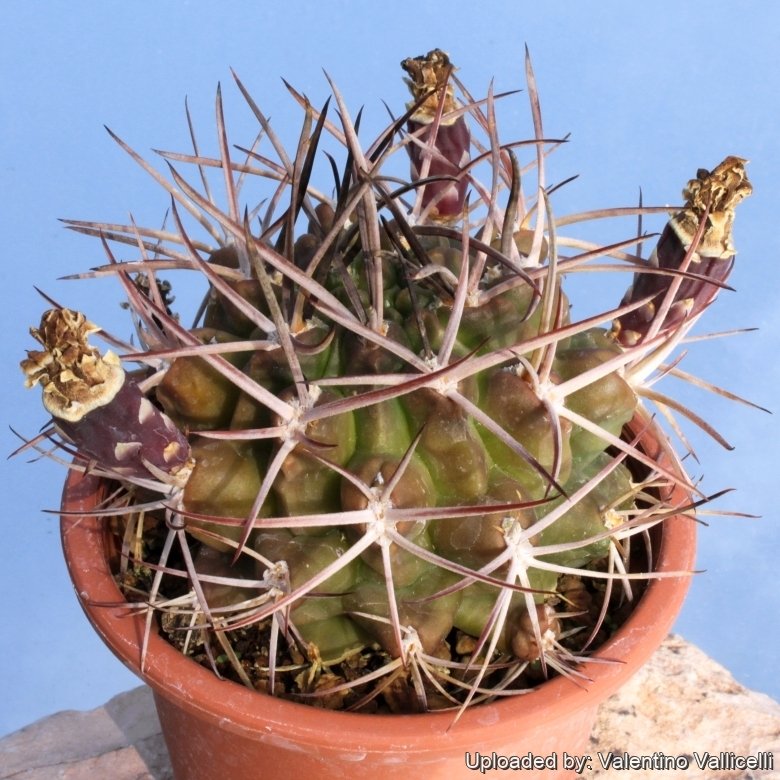
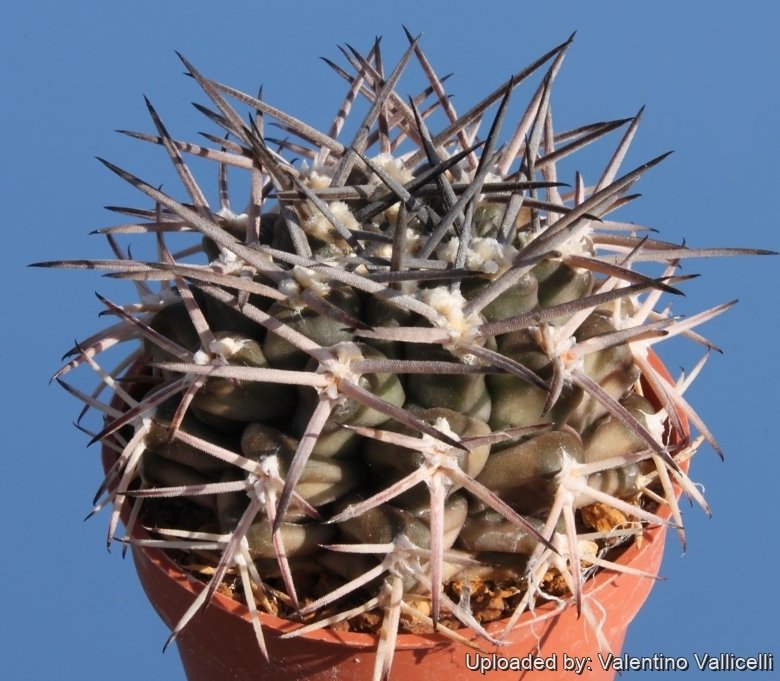
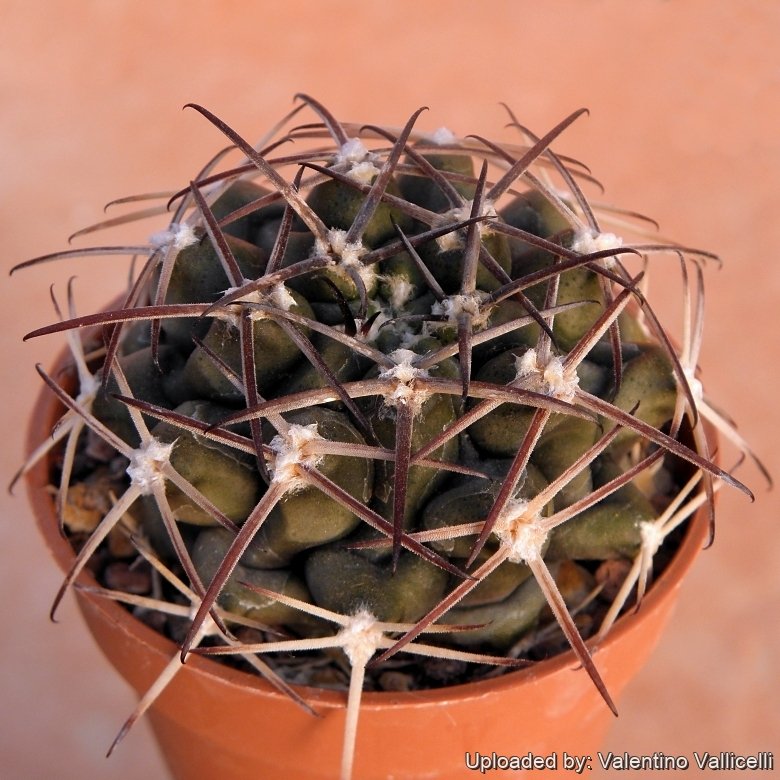
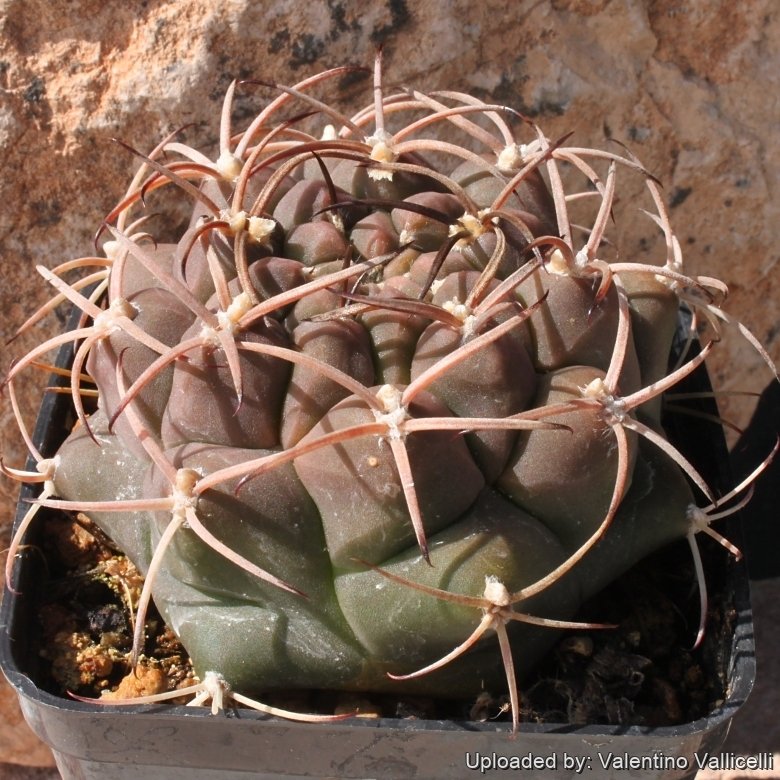
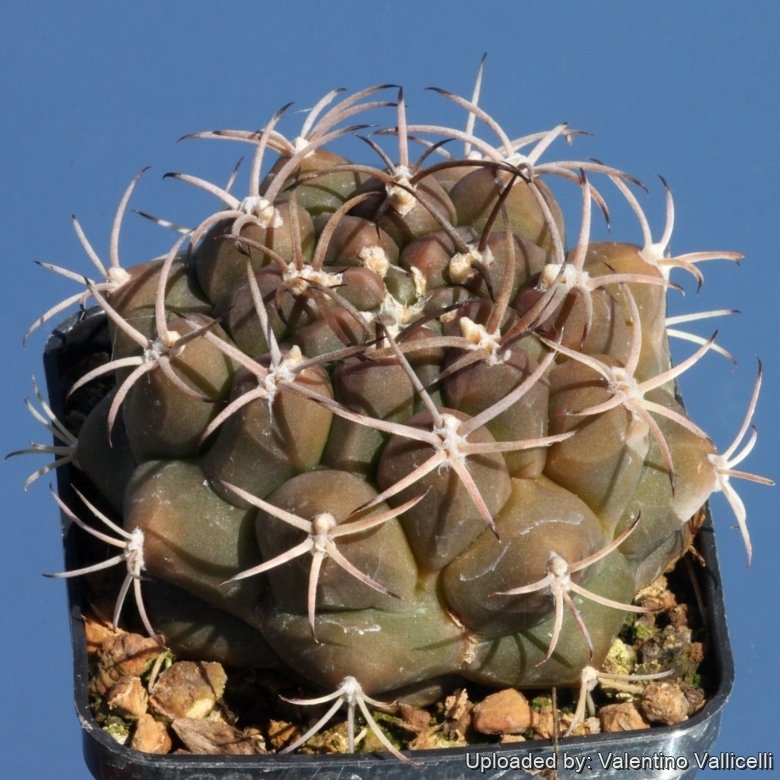
Gymnocalycium schickendantzii is a nice looking broadly globular, somewhat flattened cactus similar to Gymnocalycium saglionis, but with quite varied spination, some with beautiful long interlacing spines. Two subspecies are recognized, the nominate form and subsp. delaetii (K.Schum.) G.J.Charles.
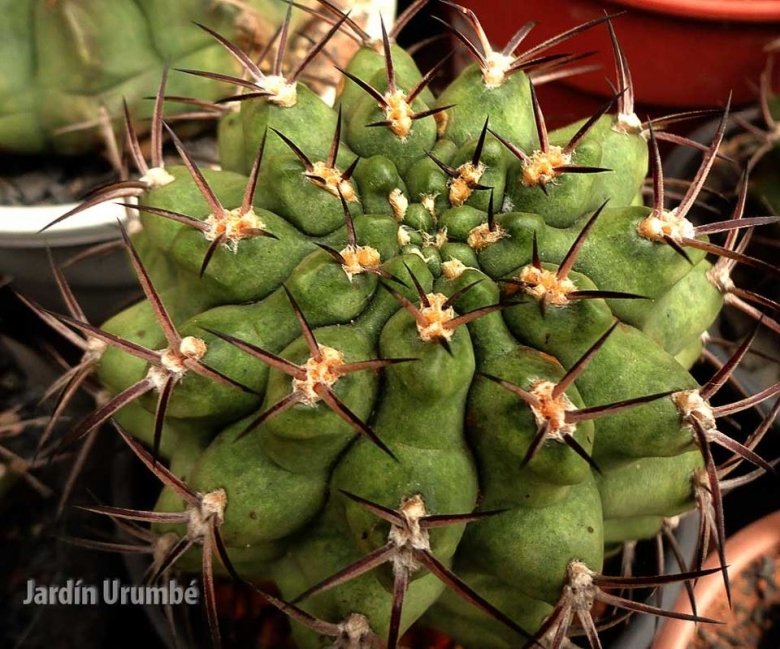
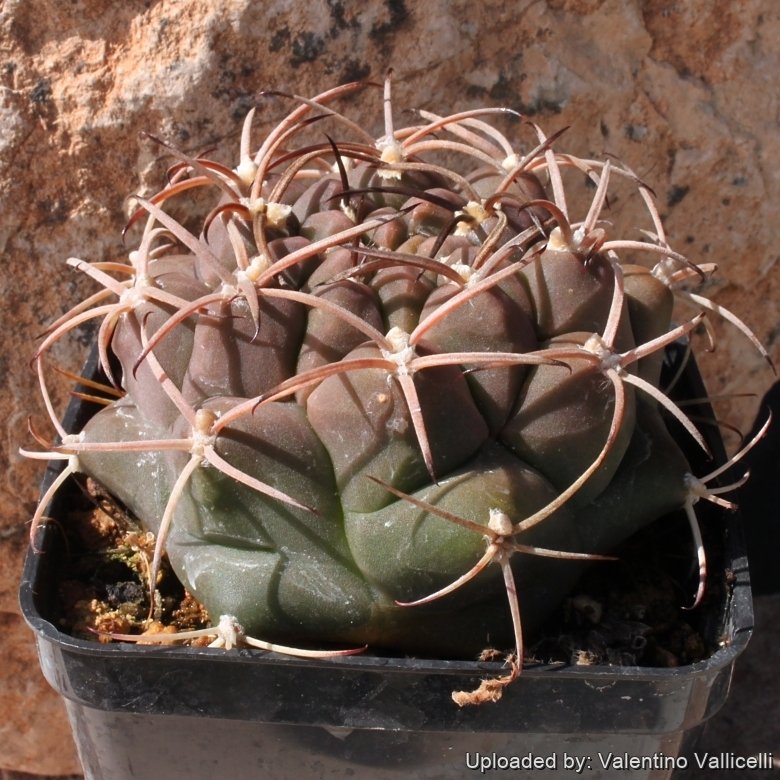
Stem: About 10 cm in diameter, dark olive green to brownish green. Young plants have broadly orbicular plant bodies which, when mature, become about as tall as they are broad.
Ribs: Ribs 7-16, distinctly tuberculate, with transverse furrows.
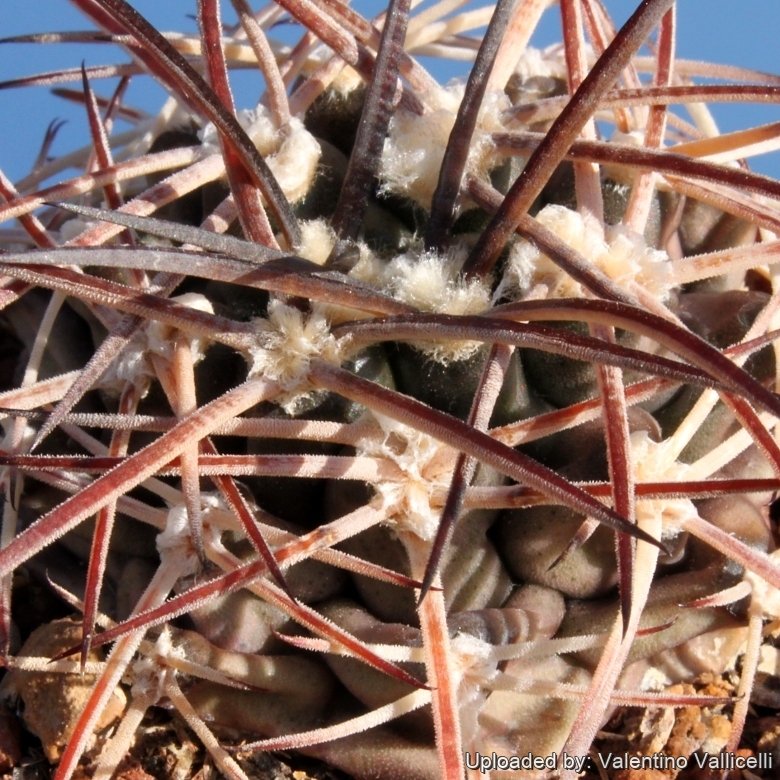
Areoles: Elongated, fuzzy white.
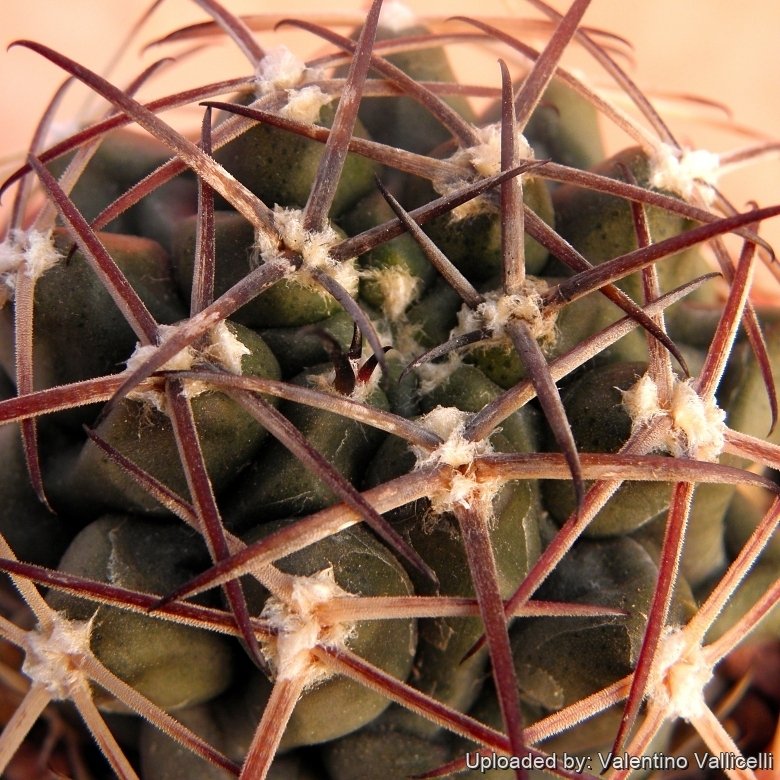
Spines: 6-7 radial only spines, strong, somewhat flattened, curved outward or downward, reddish-grey to yellowish
brown turning to ash colour as they age., to 3 (or more) cm long.
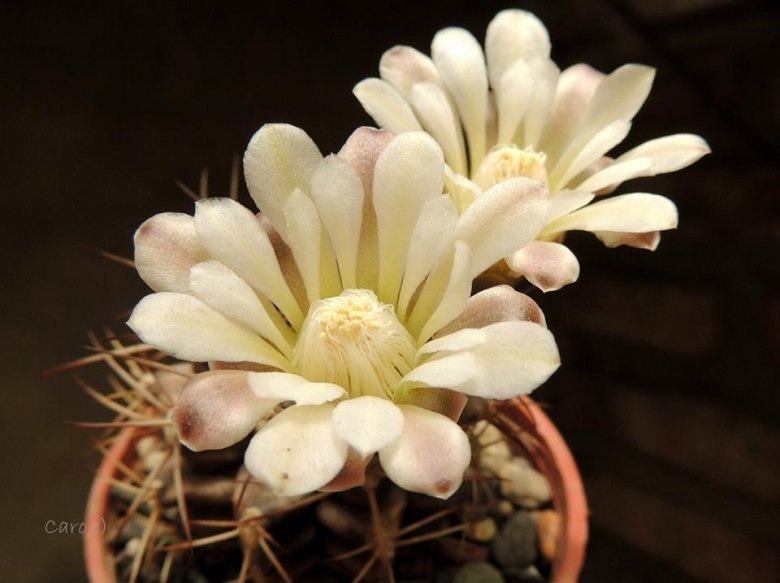
Flowers: G. schickendantzii commonly flowers from lateral areoles as well as from the crown. Flowers funnel shaped with long floral tubes, white to reddish, to 5 cm long. The stigma has 12 yellowish lobes.
Fruits: Ovoid, green to bluish.
Origin and Habitat
This species is endemic to northwestern Argentina, where it occurs in the provinces of Catamarca, Córdoba, La Rioja, Mendoza, Salta, Santiago del Estero, San Juan, San Luis and Tucumán.
Altitude range: 100 to 1,200 metres above sea level.
Habitat and Ecology: This cactus grows in flat, sandy or silty areas away from rocks and steep slopes, but often in the shade of shrubs. It has a wide distribution and is often locally common. In the northeastern part of its range Gymnocalycium schickendantzii may be affected by agricultural activities.
Cultivation and Propagation
Keep this plant almost dry in winter at a minimum temperature of 0°C, prefer a low pH compost otherwise growth will stop altogether. The plant tolerate extremely bright situations but are likely to suffer from sun scorch or stunted growth if over exposed to direct sunlight during the hottest part of the day in summer. Repotting should be done every other year or when the plant has outgrown its pot.
Propagation: Seeds (It don’t produces offsets).
Seed Collecting: Permit fruit to ripen, fruit must be significantly overripe before harvesting seed; clean and dry seeds.
Notes
The spines are very peculiar somehow flattened dark brown in the upper face and grey below.
Bibliography
Major references and further lectures
-
Edward Anderson “The Cactus family” Timber Press, Incorporated, 2001
-
James Cullen, Sabina G. Knees, H. Suzanne Cubey “The European Garden Flora Flowering Plants: A Manual for the Identification of Plants Cultivated in Europe, Both Out-of-Doors and Under Glass” Cambridge University Press, 11/Aug/2011
-
David R Hunt; Nigel P Taylor; Graham Charles; International Cactaceae Systematics Group. “The New Cactus Lexicon” dh books, 2006
-
Urs Eggli, Leonard E. Newton: “Etymological Dictionary of Succulent Plant Names” Springer, Berlin/Heidelberg 2010
-
Ortega-Baes, P., Méndez, E. & Kiesling, R. 2013. Gymnocalycium schickendantzii. The IUCN Red List of Threatened Species. Version 2014.3. <www.iucnredlist.org>. Downloaded on 26 April 2015.
From llifle page Gymnocalycium lumbrerasense
Description
Up till now G. lumberasense is an undescribed plant collected by Ritter (FR962) that appear to be a form of Gymnocalycium schickendantzii.
Origin and Habitat
Lumbreras and Juramento, Salta, Argentina
Cultivation and Propagation
Gymnocalyciums are very gratifying plants, their culture is easy and their flowering is abundant if we give them a well drained relatively rich substrate (if possible not limestone) Water regularly in summer (but do not overwater ) keep rather dry in winter, need frequent repottings and a very luminous exposure but avoid direct exposure to the sun rays. This species is particularly easy and accommodating, seldom suffer of cryptogamic diseases. Feed with a high potassium fertilizer in summer. Hardy as low as -5° C (or less) if kept dry.
Propagation: Direct sow after last frost or offsets. The grafting is useless (excluded the cultivars deprived of chlorophyll), it does not bring anything concrete
Source: Gymnocalycium lumbrerasense, LLIFLE - Encyclopedia of living forms, CC-BY-SA, retrieved 2026-10-25.
Cultivars and forms (5)
Gallery