Publication: Cactaceae (Britton & Rose) 3: 155. 1922 [12 Oct 1922] Remarks: nom. nov. for Echinocactus loricatus Speg. 1905 (later¹homonym, non Poselger 1853).
Description
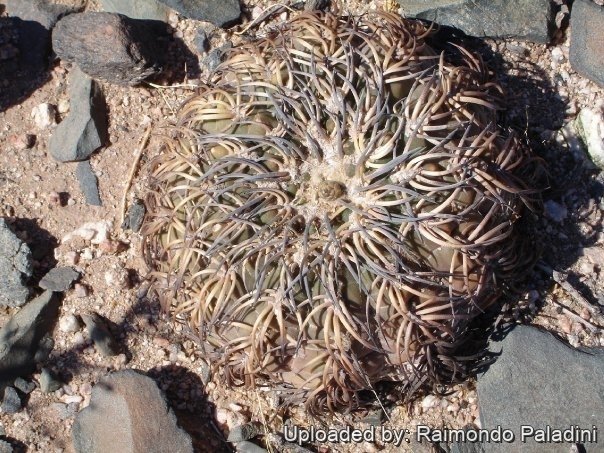
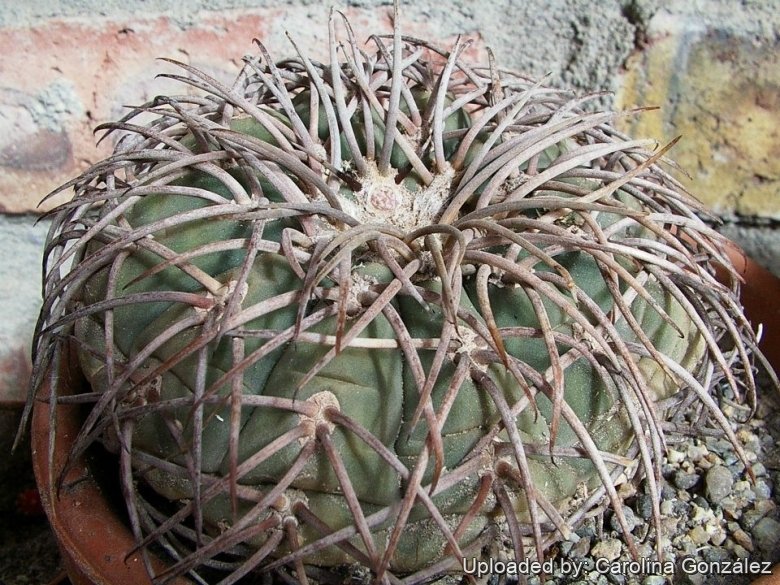
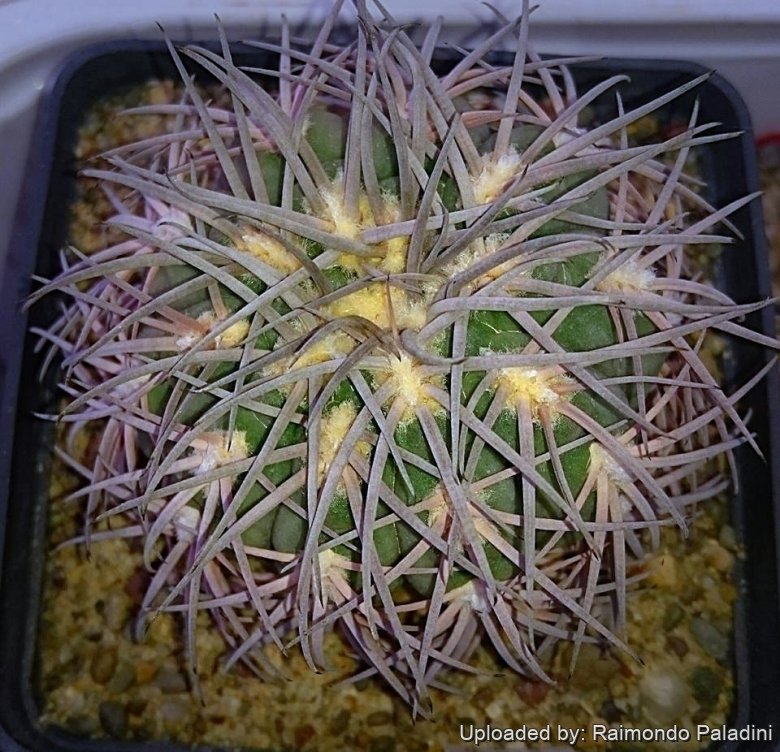
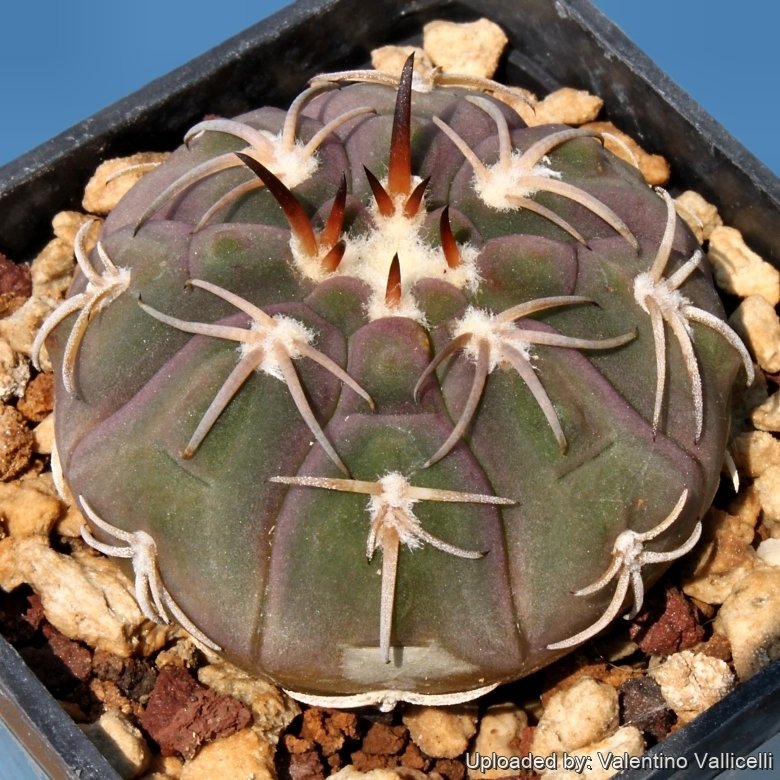
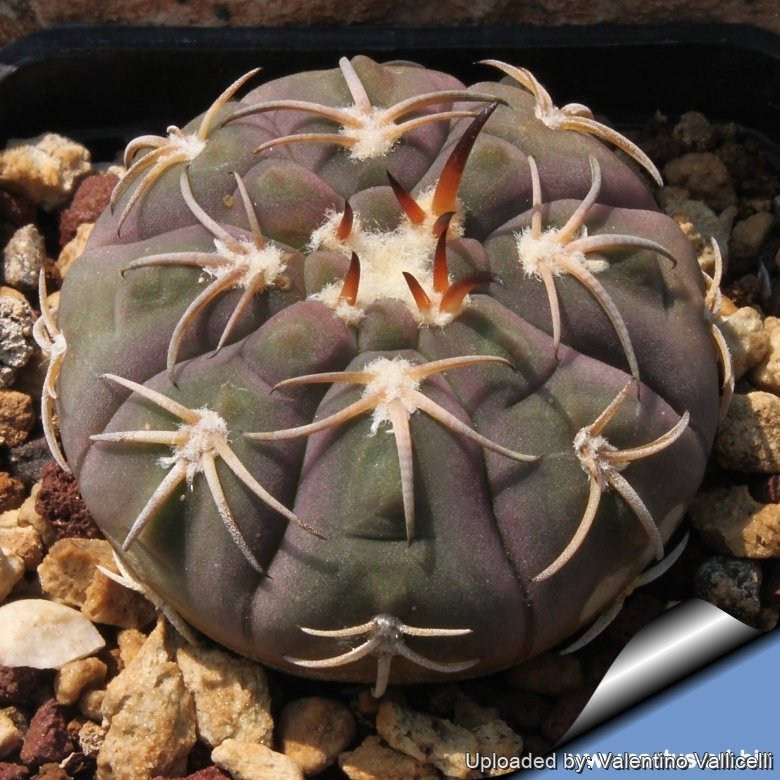
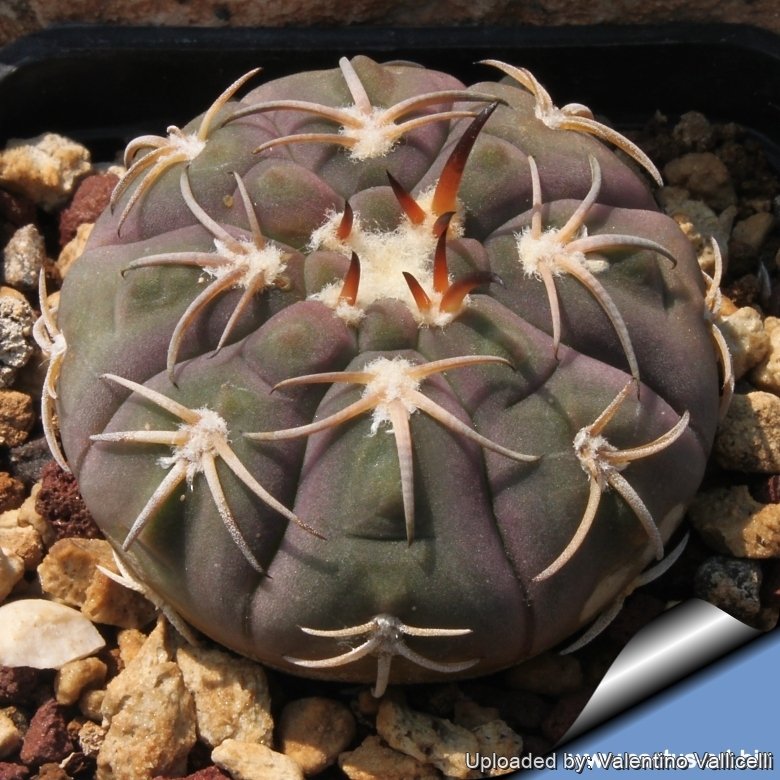
Gymnocalycium spegazzinii is a flattened solitary cactus with very characteristic spines pointing sideways or downward. Two subspecies are recognized, the nominate form and subsp. cardenasianum (F.Ritter) R.Kiesling & Metzing.
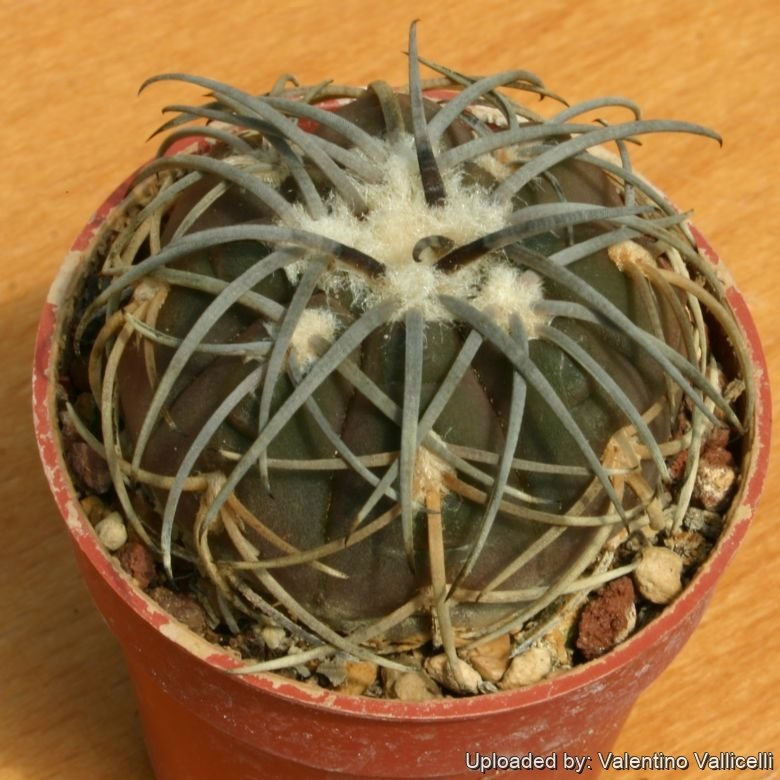
Stem: Noticeably flatten, in nature it is partially underground, greyish-green, brownish-grey to almost black up to 18 cm (or more) in diameter, 6 cm tall (up to 10 cm tall in cultivation). Apex depressed an woolly. Will not offset.
Ribs: 10-33 (usually about 13-15) broad an low, evenly subdivided in confluent rounded tubercle, not chinned. Transversal grooves rudimentary or absent.
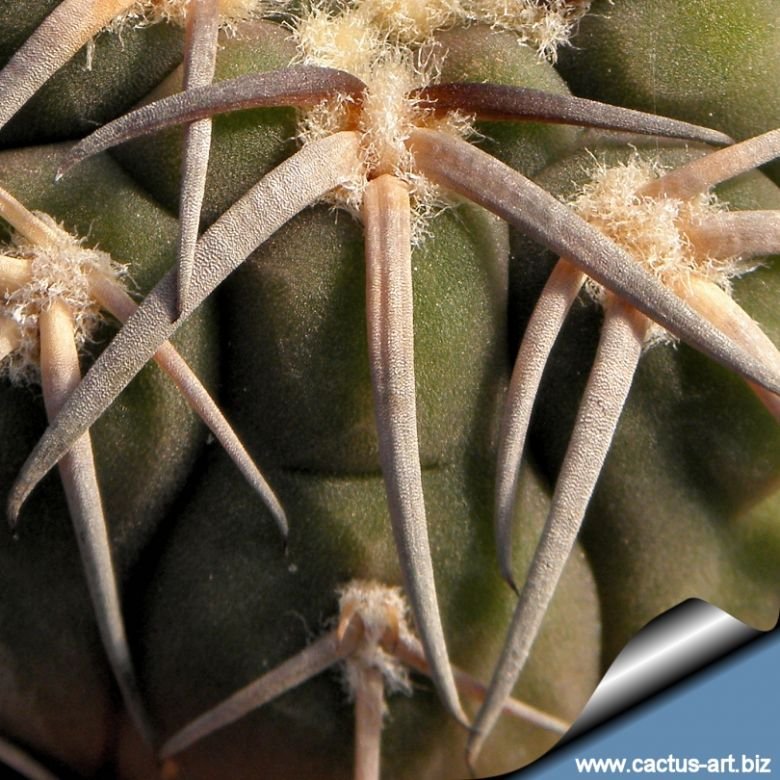
Areoles: Elongate 8-10 x 4-6 mm yellowish or greyish.
Central spine: Absent.
Radial spines: 5-7(-9) strong, subulate, +/- flattened, 25-55 mm long, typically recurved, and add-pressed against the body and most attractive, the young spines are yellowish or blackish and become brownish-grey as they ages.
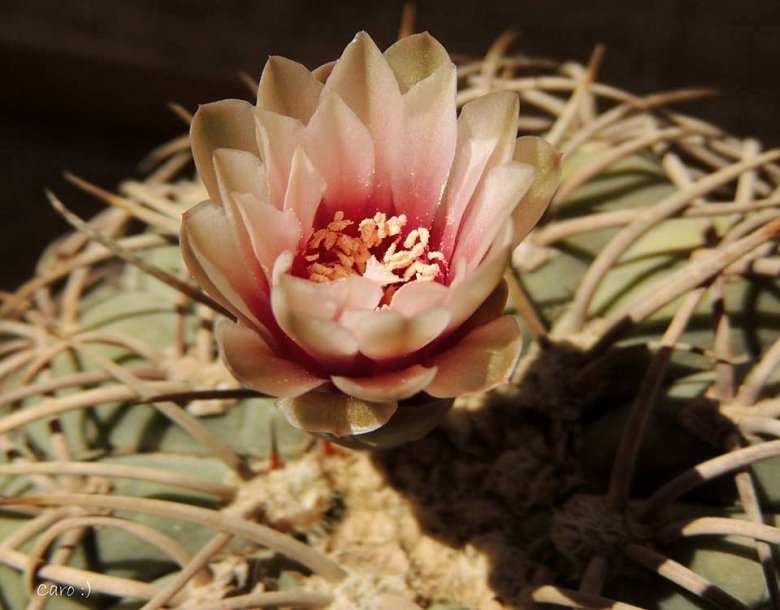
Flowers: Infundibuliform on the plant apex 70 mm long, 50 mm in diameter. Outer tepals spatulated whitish or pinkish with a glaucous green midrib. Inner tepals smaller, lanceolated white with a pink midrib and basally crimson coloured (red throated). Filament crimson or violet, anthers pale-yellow, style white to violet-pink, stigma with 10-16 white to rose-coloured lobes. Scales on the ovary few and broad.
Blooming season: Flowers are produced in late spring and remain open for up to twelve days.
Fruits: Elonged up to 35 mm long, green covered with bluish pruine.
Seeds: Of the microsemineum type +/- 0.9 mm.
Origin and Habitat
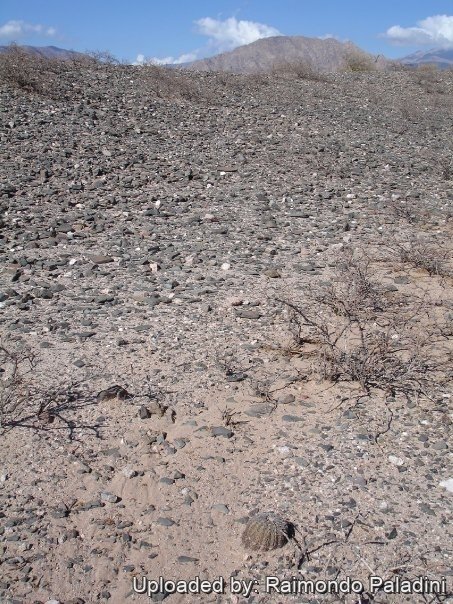
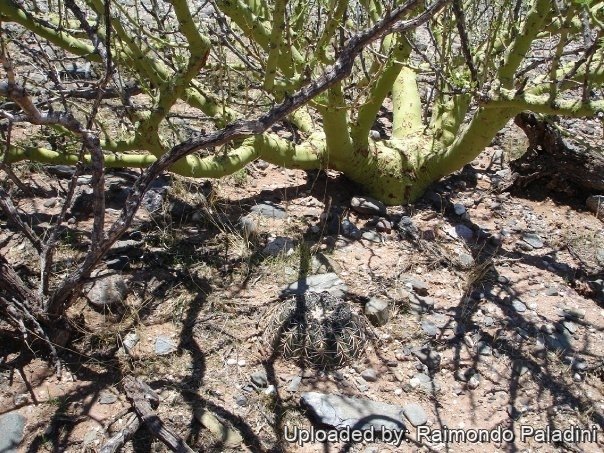
North Argentina on hight altitude (from south-west of Salta to North-east of Catamarca, north-west of Tucuman and Cordoba) and in Bolivia.
Altitude: 1300 to 3600 metres above sea level.
Habitat: This cactus grows on rather rich and water-absorbing sandy, gravelly and rocky terrains among scrubs of Trichocereus terschekii and sometimes of Cleistocactus sp. predominantly on plain ‘meadows’ rather than slopes, though without a trace of grass. In the same area it is possible to find other cactus and succulent species like: Parodia rubellihamata, Acanthocalycium thionanthum, Parodia spanisa, Trichocereus pasacana and bromeliads. This species is scarce in several locations, but in others it is abundant. The major threat is the expansion of agricultural land and cattle ranching, the animals eat and trample on the plants. Illegal collection poses a threat to a lesser extent.
Cultivation and Propagation
Gymnocalycium spegazzinii is a summer grower species that is easy to cultivate.
Growth rate: It is a slow growing and easily flowering species.
Soils: It likes very porous standard cactus mix soil. Prefer a low pH compost, avoid substrata rich in limestone; otherwise growth will stop altogether.
Repotting: This plant needs plenty of space for its roots, repotting should be done every other year or when the it has outgrown its pot. Use pot with good drainage.
Watering: Needs moderate to copious waterings in summer, but do not overwater (Rot prone), keep dry in winter at a minimum temperature of 0°C.
Fertilization: Feed with a high potassium fertilizer in summer.
Hardiness: Reputedly resistant to frost if kept on the dry side prior to, and during, cold weather (hardy to -12 C ° C, or less for short periods), but for safe cultivation it is best to avoid freezing temperatures.
Exposition: The plant tolerates extremely bright situations but enjoys filtered sunlight or afternoon shade, inside it needs bright light, and some direct sun. Tends to bronze in strong light, which encourages flowering and heavy spine production, but is likely to suffer from sun scorch or stunted growth if over exposed to direct sunlight during the hottest part of the day in summer.
Uses: It is an excellent plant for container growing. It always looks good and stays small. It look fine in a cold greenhouse and frame or outdoor in a rockery.
Pests & diseases: It may be attractive to a variety of insects, but plants in good condition should be nearly pest-free, particularly if they are grown in a mineral potting-mix, with good exposure and ventilation. Nonetheless, there are several pests to watch for:
- Red spiders: Red spiders may be effectively rubbed up by watering the plants from above.
- Mealy bugs: Mealy bugs occasionally develop aerial into the new growth among the wool with disfiguring results, but the worst types develop underground on the roots and are invisible except by their effects.
- Scales: Scales are rarely a problem.
- Rot: This species is particularly easy and accommodating, seldom suffer of cryptogamic diseases. Rot it is only a minor problem with gymnocalyciums if the plants are watered and “aired” correctly. If they are not, fungicides won’t help all that much.
Propagation: Division, direct sow after last frost. Seeds germinate in 7-14 days at 21-27° C in spring, remove gradually the glass cover as soon the plants will be well rooted (ca 1-2 weeks) and keep ventilated, no full sun for young plants! To make a cutting twist off a branch and permit it to dry out a couple of weeks, lay it on the soil and insert the stem end partially into the soil. Try to keep the cutting somewhat upright so that the roots are able to grow downward.
Bibliography
Major references and further lectures
-
Edward Anderson “The Cactus family” Timber Press, Incorporated, 2001
-
James Cullen, Sabina G. Knees, H. Suzanne Cubey “The European Garden Flora Flowering Plants: A Manual for the Identification of Plants Cultivated in Europe, Both Out-of-Doors and Under Glass” Cambridge University Press, 11/Aug/2011
-
David R Hunt; Nigel P Taylor; Graham Charles; International Cactaceae Systematics Group. “The New Cactus Lexicon” dh books, 2006
-
N. L. Britton, J. N. Rose “The Cactaceae. Descriptions and Illustrations of Plants of the Cactus Family.” Volume 4, The Carnegie Institution of Washington, Washington 1923
-
Curt Backeberg “Die Cactaceae: Handbuch der Kakteenkunde” Gustav Fischer Verlag, Stuttgart New York 1982–1985
-
John Borg “Cacti: a gardener’s handbook for their identification and cultivation” Blandford P., 1970
-
Méndez, E., Kiesling, R. & Ortega-Baes, P. 2013. Gymnocalycium spegazzinii. In: IUCN 2013. “IUCN Red List of Threatened Species.” Version 2013.2. <www.iucnredlist.org>. Downloaded on 15 January 2014.
From llifle page Gymnocalycium horizonthalonium
Description
Gymnocalycium spegazzinii var. horizonthalonium is a former synonym of Gymnocalycium spegazzinii which is characterized by a variability in the length and shape of the spines and has received many names. It is really difficult to tell var. horizonthalonium apart from the standard species and most authors choose to lump them together. It is not difficult to see how a naming error could have arisen here, leading to confusion with the not entirely dissimilar Echinocactus horizonthalonius.
Habit: Gymnocalycium spegazzinii is a geophyte cactus usually solitary and barely rising above ground level with a swollen root system.
Stem: Noticeably flatten, in nature it is partially underground, greyish-green, brownish-grey to almost black up to 18 cm (or more) in diameter, 6 cm tall (up to 10 cm tall in cultivation). Apex depressed an woolly. Will not offset.
Ribs: 10-33 (usually about 13-15) broad an low, evenly subdivided in confluent rounded tubercle, not chinned. Transversal grooves rudimentary or absent.
Areoles: Elongate 8-10 x 4-6 mm yellowish or greyish.
Central spine: Absent.
Radial spines: 5-7(-9) strong, subulate, +/- flattened, 25-55 mm long, typically recurved, and add-pressed against the body and most attractive, the young spines are yellowish or blackish and become brownish-grey as they ages.
Flowers: Infundibuliform on the plant apex 70 mm long, 50 mm in diameter. Outer tepals spatulated whitish or pinkish with a glaucous green midrib. Inner tepals smaller, lanceolated white with a pink midrib and basally crimson coloured (red throated). Filament crimson or violet, anthers pale-yellow, style white to violet-pink, stigma with 10-16 white to rose-coloured lobes. Scales on the ovary few and broad.
Blooming season: Flowers are produced in late spring and remain open for up to twelve days.
Fruits: Elongate up to 35 mm long, green covered with bluish pruine.
Seeds: Of the microsemineum type +/- 0.9 mm.
Origin and Habitat
Salta, Argentina
Altitude: 3000-3600m
Bibliography
Major references and further lectures
-
Edward Anderson “The Cactus family” Timber Press, Incorporated, 2001
-
James Cullen, Sabina G. Knees, H. Suzanne Cubey “The European Garden Flora Flowering Plants: A Manual for the Identification of Plants Cultivated in Europe, Both Out-of-Doors and Under Glass” Cambridge University Press, 11/Aug/2011
-
David R Hunt; Nigel P Taylor; Graham Charles; International Cactaceae Systematics Group. “The New Cactus Lexicon” dh books, 2006
-
N. L. Britton, J. N. Rose “The Cactaceae. Descriptions and Illustrations of Plants of the Cactus Family.” Volume 4, The Carnegie Institution of Washington, Washington 1923
-
Curt Backeberg “Die Cactaceae: Handbuch der Kakteenkunde” Gustav Fischer Verlag, Stuttgart New York 1982–1985
-
John Borg “Cacti: a gardener’s handbook for their identification and cultivation” Blandford P., 1970
-
The National Cactus and Succulent Journal: The Official Journal of the National Cactus & Succulent Society, Volumes 35-37 - Page 111, 1980
Source: Gymnocalycium horizonthalonium, LLIFLE - Encyclopedia of living forms, CC-BY-SA, retrieved 2026-10-25.
Cultivars and forms (7)
Varieties (4)
Gallery