Publication: Kakteen Südamerika 1: 265 (266), figs. 1979
Description
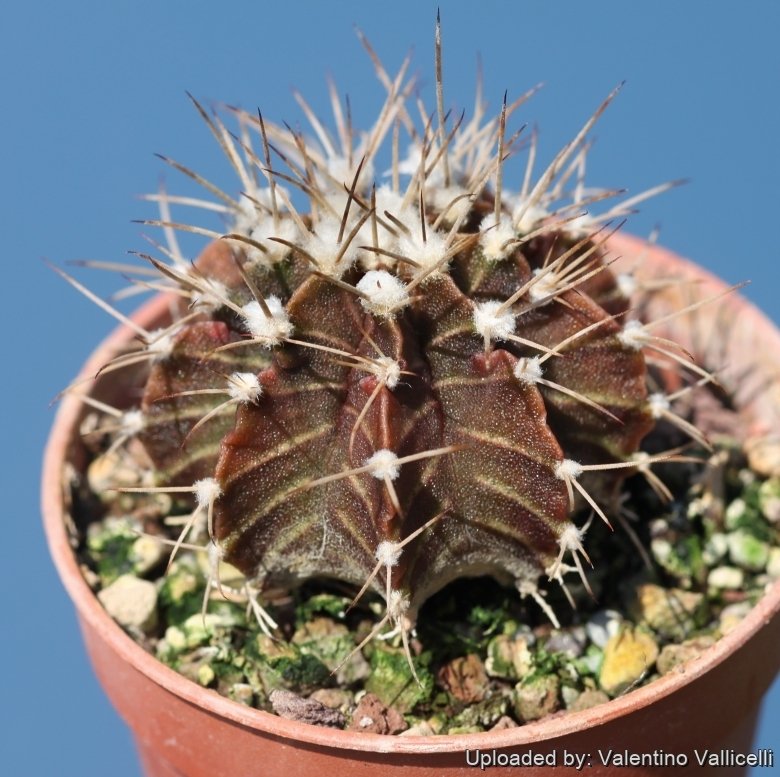
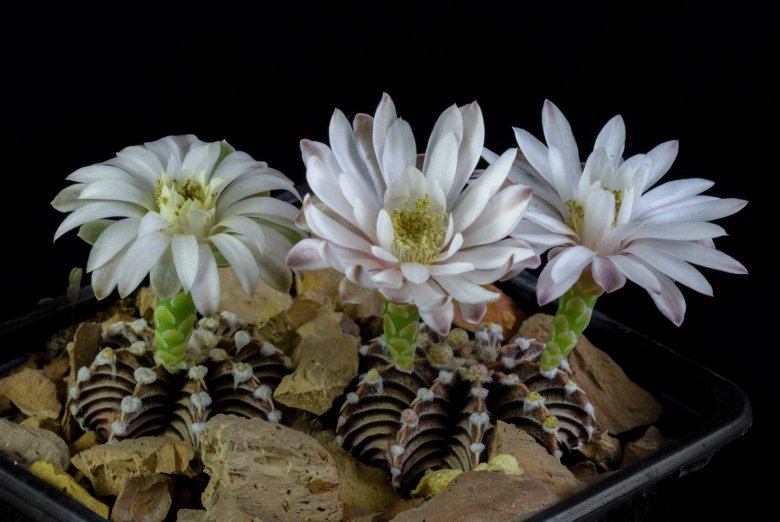
Gymnocalycium stenopleurum is a small solitary cactus with with grey-green and brownish-red banded body that typically has white, fully opening flowers.
Stem: Flattened globose to globose, grey-green, to 12 cm or more high, 6-12 cm in diameter.
Ribs: 8-14, rounded.
Spines: Needle-like to awl shaped, light to dark brown, somewhat twisted.
Central spines: Usually absent.
Radial spines: 3-6, 7-40 mm long.
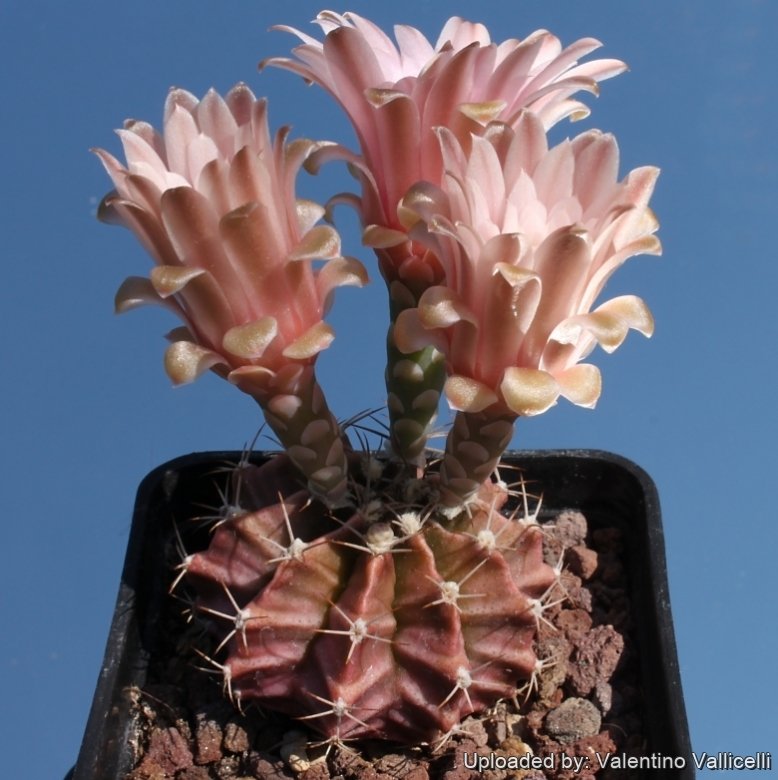
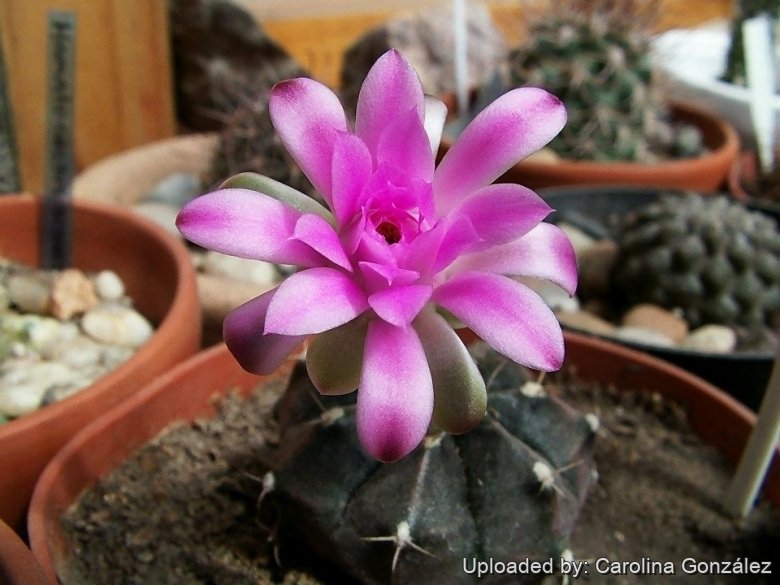
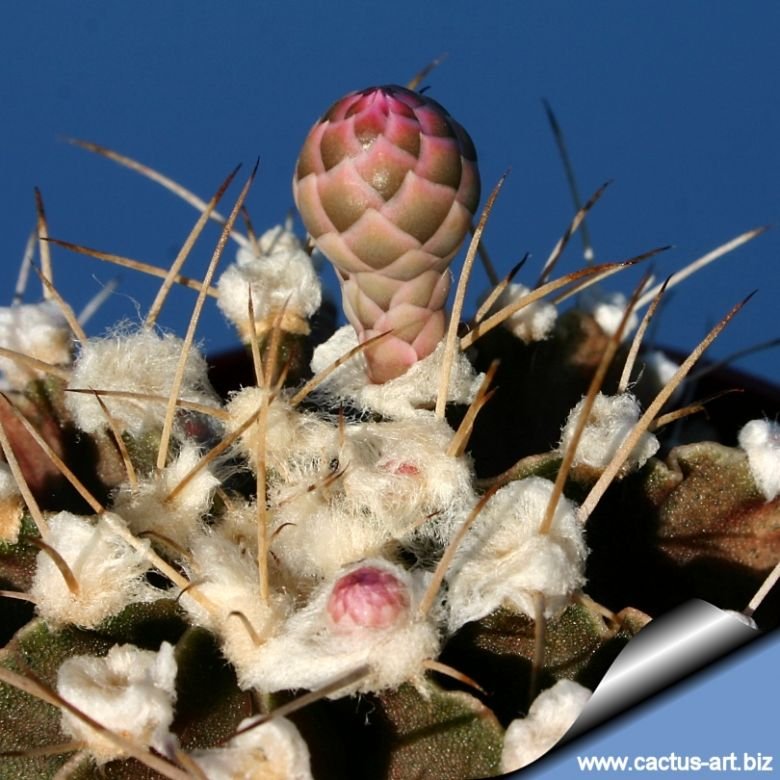
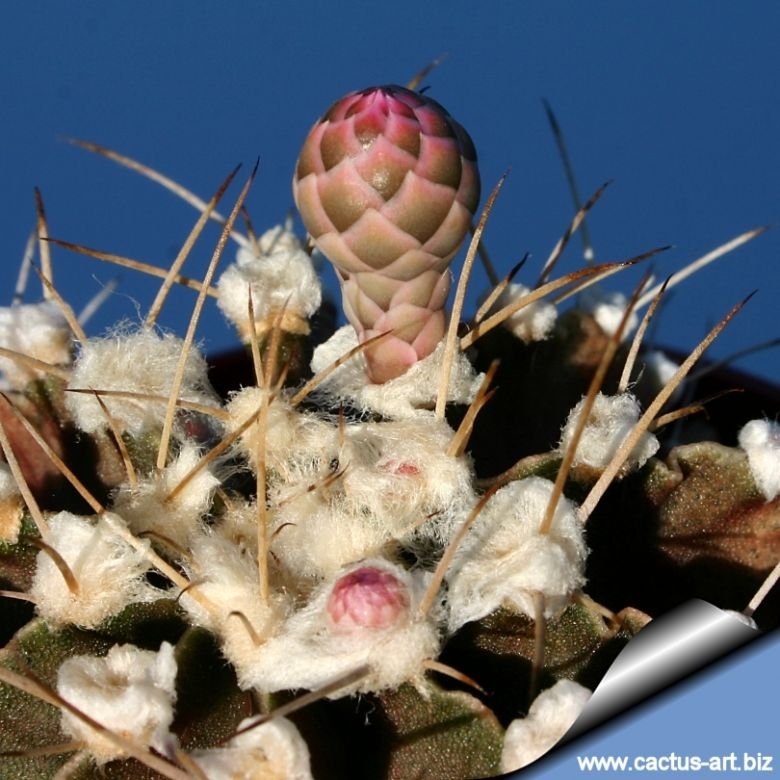
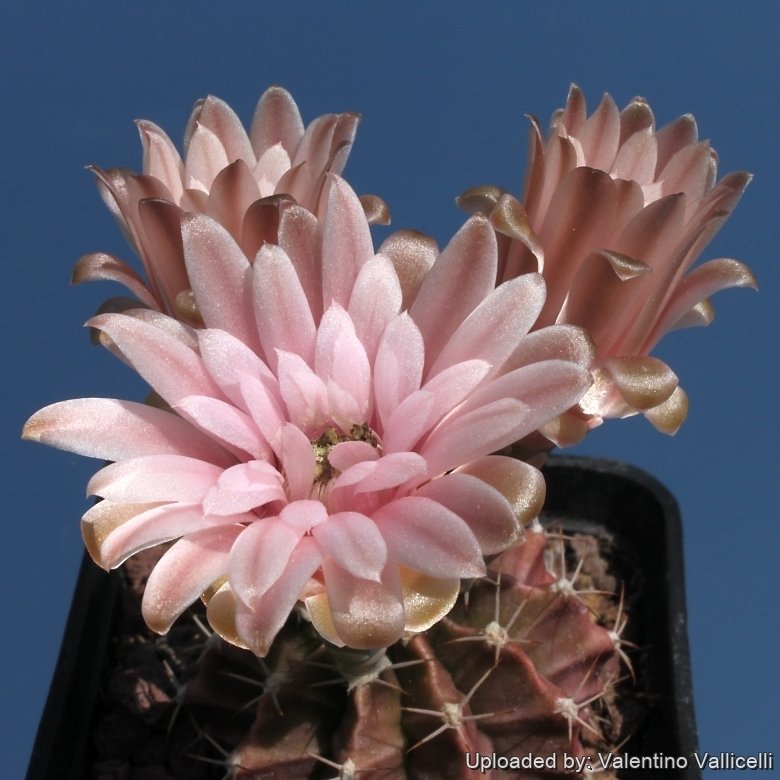
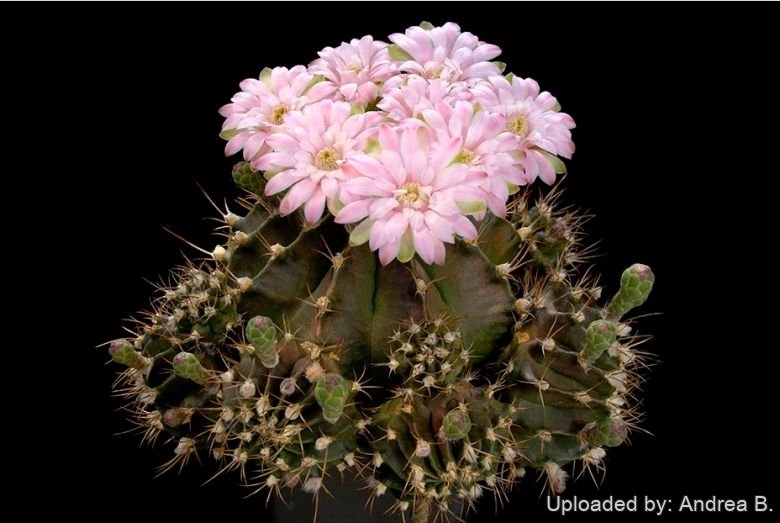
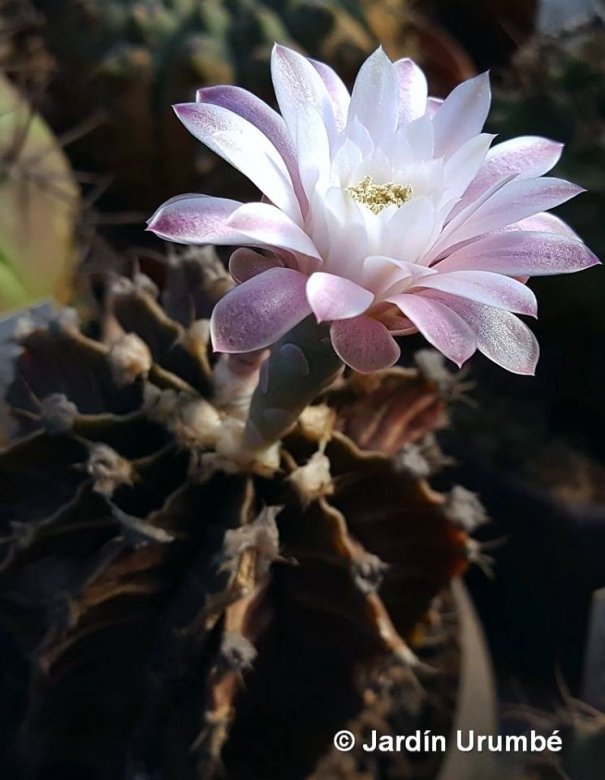
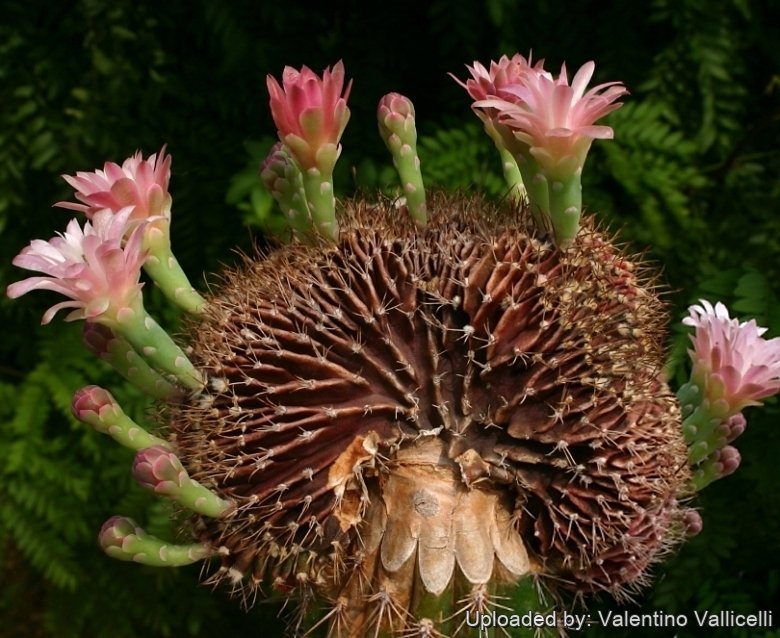
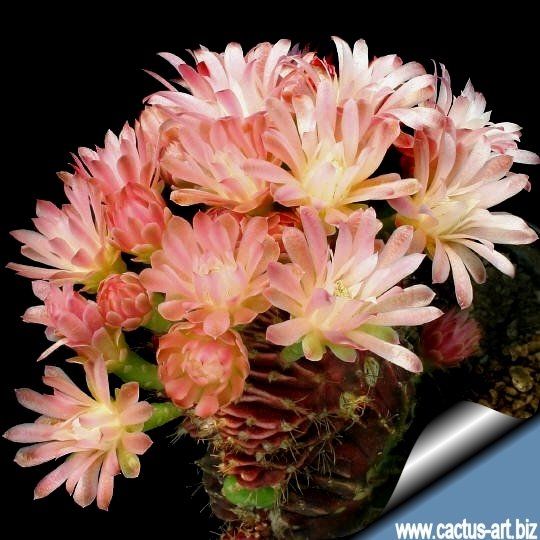
Flowers: White, 5-7 cm long, but also pale to dark pink.
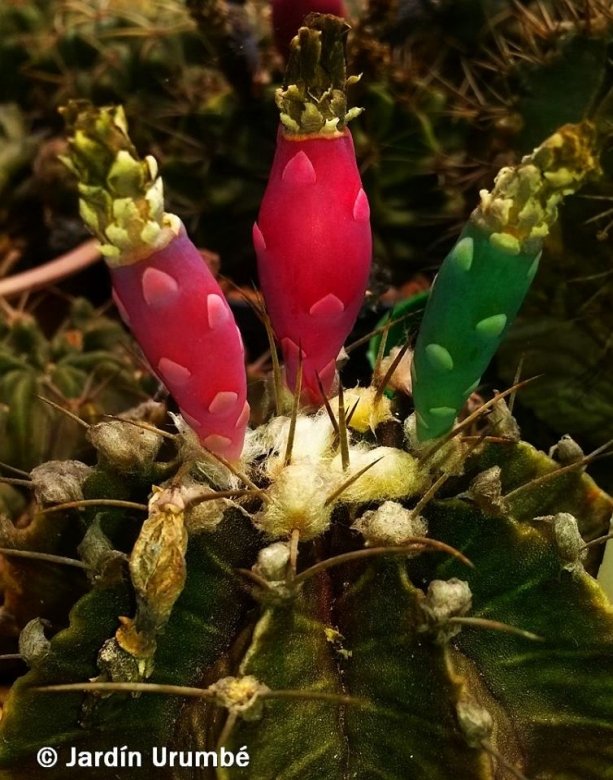
Fruits: Grey-green, to 4 cm long and 1 cm in diameter.
Similar species: Gymnocalycium mihanovichii, Gymnocalycium anisitsii.
Origin and Habitat
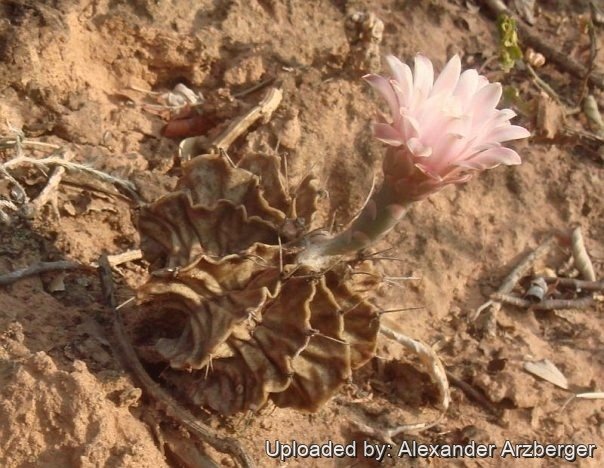
Gymnocalycium stenopleurum occurs in the Cerro León, Boquerón department of Paraguay in the in the C “Chaco seco” and possibly also in adjacent Bolivia.
Altitude range: It has been reported at elevations between 10 and 500 metres above sea level.
Habitat and Ecology: This cactus occurs in xerophilous Chacoan forest, on clayey soil. This species is relatively common but not abundant. The area where it occurs is not used for human activities. There are no known threats to this species.
Cultivation and Propagation
Gymnocalycium stenopleurum is a summer grower species that is easy to cultivate.
Growth rate: It is a relatively rapidly growing and easily flowering species.
Soils: It likes very porous standard cactus mix soil. Prefer a low pH compost, avoid substrata rich in limestone; otherwise growth will stop altogether.
Repotting: This plant needs plenty of space for its roots, repotting should be done every other year or when the it has outgrown its pot. Use pot with good drainage.
Watering: Needs moderate to copious waterings in summer, but do not overwater (Rot prone), keep dry in winter at a minimum temperature of 0°C.
Fertilization: Feed with a high potassium fertilizer in summer.
Hardiness: Quite frost resistant if kept dry -10° C (Temperature Zone USDA 8-10), but for safe cultivation it is best to avoid freezing temperatures.
Exposition: The plant tolerates extremely bright situations but enjoys filtered sunlight or afternoon shade, inside it needs bright light, and some direct sun. Tends to bronze in strong light, which encourages flowering and heavy spine production, but is likely to suffer from sun scorch or stunted growth if over exposed to direct sunlight during the hottest part of the day in summer.
Uses: It is an excellent plant for container growing. It always looks good and stays small. It look fine in a cold greenhouse and frame or outdoor in a rockery.
Pests & diseases: It may be attractive to a variety of insects, but plants in good condition should be nearly pest-free, particularly if they are grown in a mineral potting-mix, with good exposure and ventilation. Nonetheless, there are several pests to watch for:
- Red spiders: Red spiders may be effectively rubbed up by watering the plants from above.
- Mealy bugs: Mealy bugs occasionally develop aerial into the new growth among the wool with disfiguring results, but the worst types develop underground on the roots and are invisible except by their effects.
- Scales: Scales are rarely a problem.
- Rot: This species is particularly easy and accommodating, seldom suffer of cryptogamic diseases. Rot it is only a minor problem with gymnocalyciums if the plants are watered and “aired” correctly. If they are not, fungicides won’t help all that much.
Propagation: Seeds (seldom produces offsets). Seeds germinate in 7-14 days at 21-27° C in spring, remove gradually the glass cover as soon the plants will be well rooted (ca 1-2 weeks) and keep ventilated, no full sun for young plants!
Bibliography
Major references and further lectures
-
Edward Anderson “The Cactus family” Timber Press, Incorporated, 2001
-
David R Hunt; Nigel P Taylor; Graham Charles; International Cactaceae Systematics Group. “The New Cactus Lexicon” dh books, 2006
-
Pin, A. & Oakley, L. 2013. “Gymnocalycium stenopleurum”. The IUCN Red List of Threatened Species. Version 2014.3. <www.iucnredlist.org>. Downloaded on 29 April 2015.
-
James Cullen, Sabina G. Knees, H. Suzanne Cubey “The European Garden Flora Flowering Plants: A Manual for the Identification of Plants Cultivated in Europe, Both Out-of-Doors and Under Glass” Cambridge University Press, 11/Aug/2011
-
Dmitriy Rogatskin “Controversial point” Cultivar e-magazin ISSUE 3 (25): 4 <http://www.lapshin.org/cultivar/N25/index-e.htm\>
From llifle page Gymnocalycium friedrichii
Description
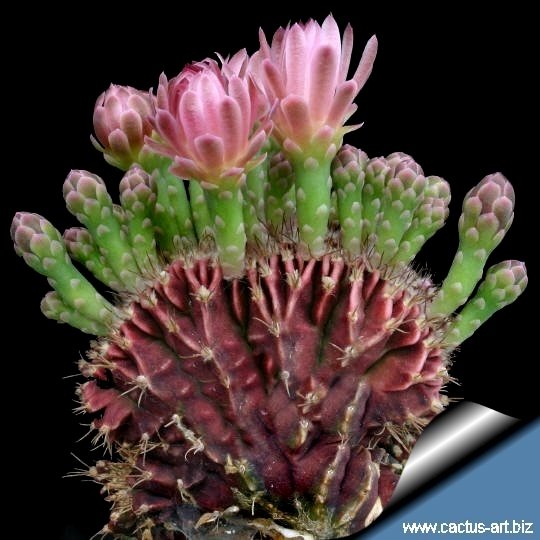
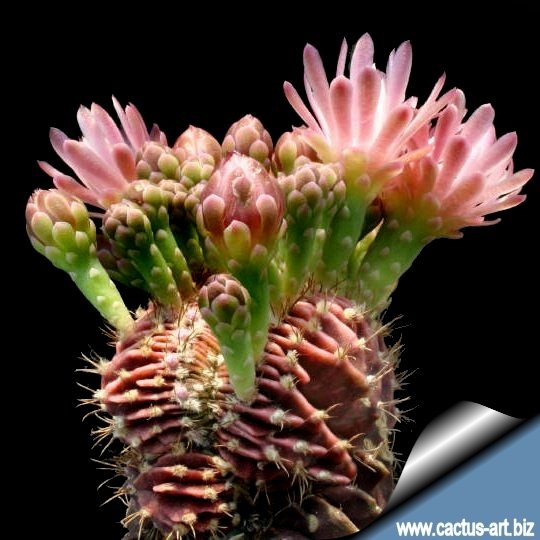
Gymnocalycium friedrichii is a an invalid name used to indicate the pink flowered form of Gymnocalycium stenopleurum. It is a small solitary cactus with banded body that has perianth-segments pinkish-red with white margins (but also pale pink or almost pure white). This species is sometimes combined with Gymnocalycium mihanovichii, and sometimes kept as a separate species.
Stem: Flattened globose to elongated globose, grey green, olive green, greenish-purple, reddish brown to a dark grape colour 10-12 cm tall (or more), 6-12 cm in diameter.
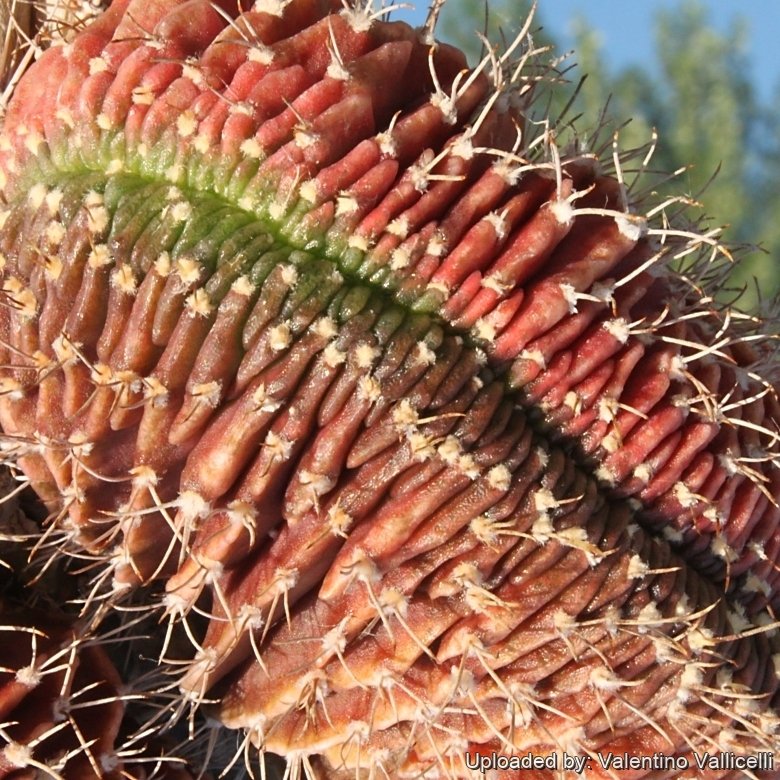
Ribs: 8-14, very prominent, and sharp banded whit strong dark brown markings especially when young, and these sometimes have crossbands of lighter colors.
Radial spines: 3-6, acicular, to awl shaped, light to dark brown, somewhat twisted, 0,7-4 cm long.
Central spines: Usually absent.
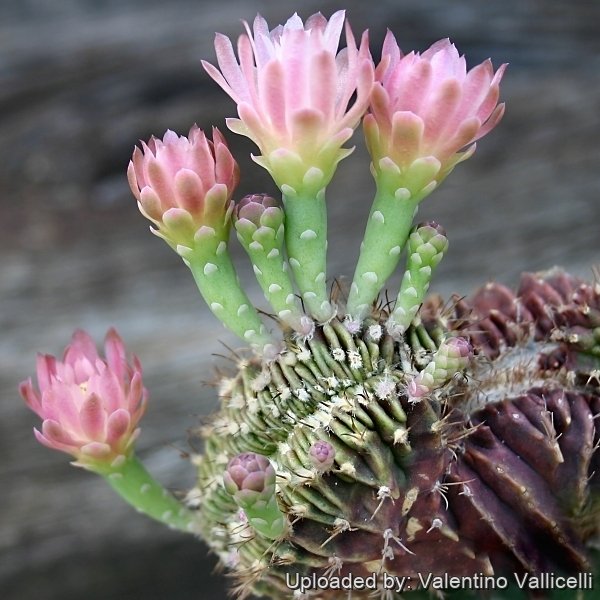
Flowers: Pale-pink to purplish-pink, 6-7 cm long.
Fruit: Gray-green up to 4 cm long, diameter 1 cm.
Remaks: Gymnocalycium friedrichii and Gymnocalycium stenopleurum are sometimes combined with Gymnocalycium mihanovichii, and sometimes kept as separate species. Gymnocalycium friedrichii and Gymnocalycium stenopleurum are quite distinct from Gymnocalycium mihanovichii, but many intermediate forms are also known and nowadays it is suggested that all should be combined into only one variable species.
Origin and Habitat
From south to North-Western Paraguay (Chaco -Department Boquerón)
Habitat: Grows among scrubs in high-savannah.
Cultivation and Propagation
Gymnocalycium friedrichii is a summer grower species that is easy to cultivate.
Growth rate: It is a relatively rapidly growing and easily flowering species.
Soils: It likes very porous standard cactus mix soil. Prefer a low pH compost, avoid substrata rich in limestone; otherwise growth will stop altogether.
Repotting: This plant needs plenty of space for its roots, repotting should be done every other year or when the it has outgrown its pot. Use pot with good drainage.
Watering: Needs moderate to copious waterings in summer, but do not overwater (Rot prone), keep dry in winter at a minimum temperature of 0°C.
Fertilization: Feed with a high potassium fertilizer in summer.
Hardiness: Quite frost resistant if kept dry -10° C (Temperature Zone USDA 8-10), but for safe cultivation it is best to avoid freezing temperatures.
Exposition: The plant tolerates extremely bright situations but enjoys filtered sunlight or afternoon shade, inside it needs bright light, and some direct sun. Tends to bronze in strong light, which encourages flowering and heavy spine production, but is likely to suffer from sun scorch or stunted growth if over exposed to direct sunlight during the hottest part of the day in summer.
Uses: It is an excellent plant for container growing. It always looks good and stays small. It look fine in a cold greenhouse and frame or outdoor in a rockery.
Pests & diseases: It may be attractive to a variety of insects, but plants in good condition should be nearly pest-free, particularly if they are grown in a mineral potting-mix, with good exposure and ventilation. Nonetheless, there are several pests to watch for:
- Red spiders: Red spiders may be effectively rubbed up by watering the plants from above.
- Mealy bugs: Mealy bugs occasionally develop aerial into the new growth among the wool with disfiguring results, but the worst types develop underground on the roots and are invisible except by their effects.
- Scales: Scales are rarely a problem.
- Rot: This species is particularly easy and accommodating, seldom suffer of cryptogamic diseases. Rot it is only a minor problem with gymnocalyciums if the plants are watered and “aired” correctly. If they are not, fungicides won’t help all that much.
Propagation: Seeds (seldom produces offsets). Seeds germinate in 7-14 days at 21-27° C in spring, remove gradually the glass cover as soon the plants will be well rooted (ca 1-2 weeks) and keep ventilated, no full sun for young plants!
Notes
The “HIBOTAN”
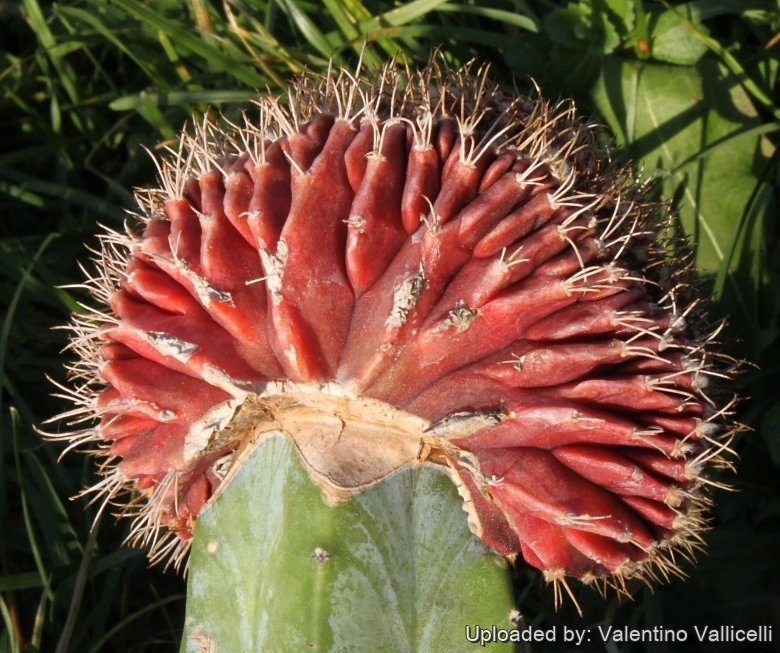
Gymnocalycium mihanovichii friedrichii “Rubra” (cv. Hibotan) are popular mutant, red or orange bodied cactus often known as the “Red Cap Cactus”, or “Ruby Ball”. There are also pure yellow or pink-white forms, “Blondie” or “Moon Cactus”. They are red, orange, yellow or even white because they contains no chlorophyll, much like the red we see in the fall foliage of trees when their chlorophyll breaks down and disappears. Without chlorophyll the mutant gymnocalyciums can not produce sugar and without sugar they will die. The only way to keep them alive is to graft them onto another cactus which has chlorophyll and which will provide sugar to the mutant scion. The chlorophyll containing bottom part of the graft, called the stock, can be any number of different cactus species. In the case of the gymnoclyciums it is usually Hylocereus, a tropical cactus.
Story: The first two red plants were produced by E. Watanabe in Japan. Sowing of some thousands of seeds of G. friedrichii yielded two bright red freak seedlings which would have died quickly had they not been grafted at once. From these have been produced literally millions of plants, distributed all over the world, by repeated grafting and cutting.” Furthermore a number of readily distinguished multicoloured and variegated cultivars (only partially de-coloured) are now available. Some of this plants can be grown on their own roots and are very beautiful.
Bibliography
Major references and further lectures
-
Edward Anderson “The Cactus family” Timber Press, Incorporated, 2001
-
James Cullen, Sabina G. Knees, H. Suzanne Cubey “The European Garden Flora Flowering Plants: A Manual for the Identification of Plants Cultivated in Europe, Both Out-of-Doors and Under Glass” Cambridge University Press, 11/Aug/2011
-
David R Hunt; Nigel P Taylor; Graham Charles; International Cactaceae Systematics Group. “The New Cactus Lexicon” dh books, 2006
-
N. L. Britton, J. N. Rose “The Cactaceae. Descriptions and Illustrations of Plants of the Cactus Family.” Volume 4, The Carnegie Institution of Washington, Washington 1923
-
Curt Backeberg “Die Cactaceae: Handbuch der Kakteenkunde” Gustav Fischer Verlag, Stuttgart New York 1982–1985
-
Dmitriy Rogatskin “Controversial point” Cultivar e-magazin ISSUE 3 (25): 4 <http://www.lapshin.org/cultivar/N25/index-e.htm\>
Source: Gymnocalycium friedrichii, LLIFLE - Encyclopedia of living forms, CC-BY-SA, retrieved 2026-10-25.
From llifle page Gymnocalycium friedrichii var. moserianum
Description
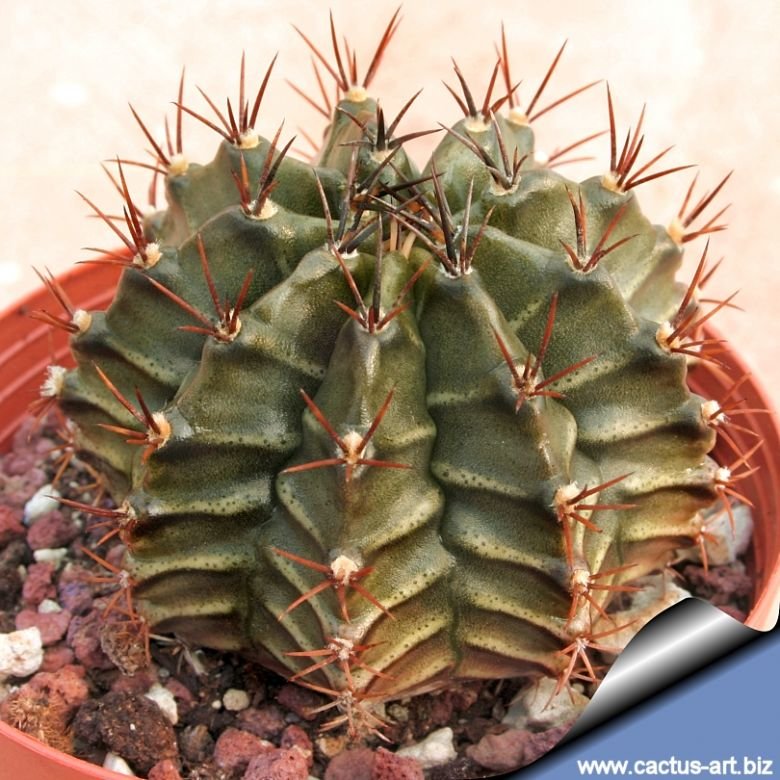
Gymnocalycium friedrichii v moserianum is a controversial variety that, broadly speaking, belongs to the G. mihanovichii/stenopleurum group. It differs from Gymnocalycium friedrichii by the size of the stem 2 times larger. It is an attractive plant with a reddish brown body with pointed ribs striped with white cross at the areoles. The areoles are very wooly and (usually) with only 3 spines. The spines are weak and fall over time. The flowers are pale pink (or white), appear freely and open up entirely.
Derivation of specific name: It is named for Gunther Moser, the well-known Austrian Gymnocalycium specialist.
Remarks: This plant is sometimes confused with Gymnocalycium moserianum, a member of the Gymnocalycium quehlianum complex of species which shows a good deal of similarity to Gymnocalycium triacanthum.
Origin and Habitat
Gymnocalycium friedrichii var. moserianum was described from cultivated plants supposedly growing in Yrebdaque - north-west of Nueva Asunción, Boquerón department, Paraguay.
Altitude range: 150-750.
Cultivation and Propagation
Gymnocalycium friedrichii var. moserianum is a summer grower species that is easy to cultivate.
Growth rate: It is a slow growing but easily flowering species.
Soils: It likes very porous standard cactus mix soil. Prefer a low pH compost, avoid substrata rich in limestone; otherwise growth will stop altogether.
Repotting: This plant needs plenty of space for its roots, repotting should be done every other year or when the it has outgrown its pot. Use pot with good drainage.
Watering: Needs moderate to copious waterings in summer, but do not overwater (Rot prone), keep dry in winter at a minimum temperature of 0°C.
Fertilization: Feed with a high potassium fertilizer in summer.
Hardiness: Reputedly resistant to frost if kept on the dry side prior to, and during, cold weather (hardy to -5 C ° C, or less for short periods).
Exposition: The plant tolerates extremely bright situations but enjoys filtered sunlight or afternoon shade, inside it needs bright light, and some direct sun. Tends to bronze in strong light, which encourages flowering and heavy spine production, but is likely to suffer from sun scorch or stunted growth if over exposed to direct sunlight during the hottest part of the day in summer.
Propagation: Division, direct sow after last frost. Seeds germinate in 7-14 days at 21-27° C in spring, remove gradually the glass cover as soon the plants will be well rooted (ca 1-2 weeks) and keep ventilated, no full sun for young plants! To make a cutting twist off a branch and permit it to dry out a couple of weeks, lay it on the soil and insert the stem end partially into the soil. Try to keep the cutting somewhat upright so that the roots are able to grow downward.
Bibliography
Major references and further lectures
-
“Cactus and Succulent Journal of Great Britain” 1973
-
“Gymnocalycium friedrichii var. moserianum Pazout” <http://www.gymnocalycium.fr/gymnocalycium-friedrichii/gymnocalycium-friedrichii-v-moserianum/\>
-
“Gymnocalycium friedrichii” <http://www.gymnocalycium.org/gatunki/friedrichii.html\>
-
E. W Putnam “GYMNOCALYCIUMS” Handbook No. 5. Published by the National Cactus & Succulent Society. 1978.
Source: Gymnocalycium friedrichii var. moserianum, LLIFLE - Encyclopedia of living forms, CC-BY-SA, retrieved 2026-10-25.
From llifle page Gymnocalycium friedrichii f. cristatum
Description
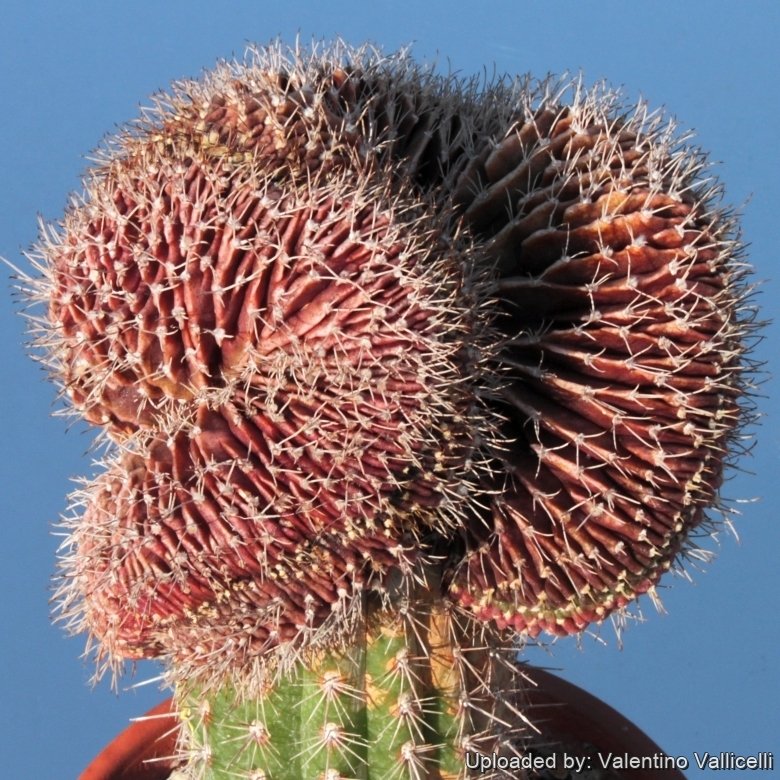
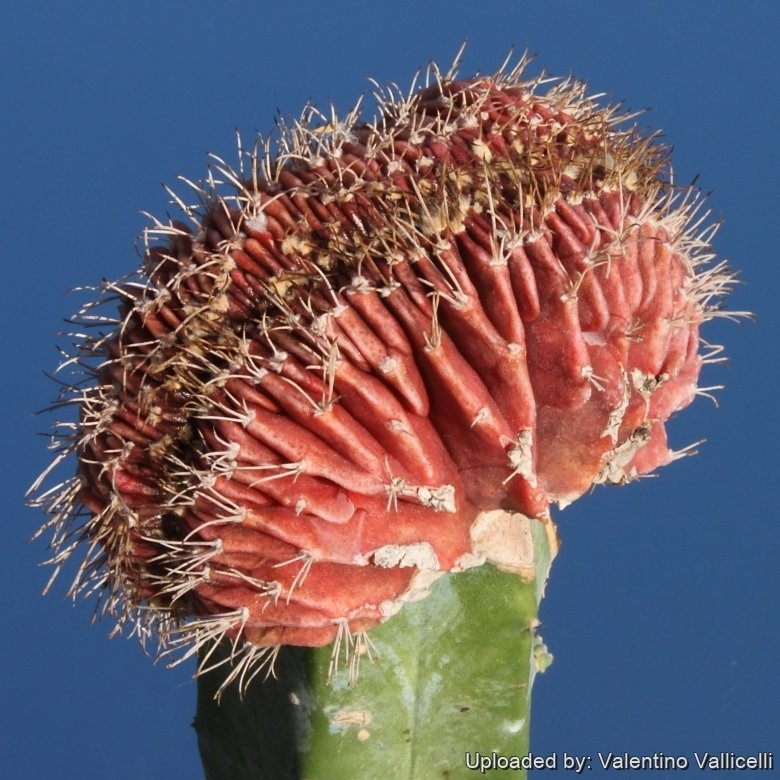
Gymnocalycium friedrichii f. cristatum (crested form), deviate from the standard species for the stem which is fan shaped up to 30 cm (or more) long with age.
The typical Gymnocalycium friedrichii is among the most famous of all cacti for is unique shaped stem and pink flowers.
Habit: Gymnocalycium friedrichii (Gymnocalycium stenopleurum) is a small solitary cacti with banded body sometimes combined with Gymnocalycium mihanovichii, and sometimes kept as a separate species.
Stem: Flattened globose to elongated globose, grey green, olive green, greenish-purple, reddish brown to a dark grape colour 10-12 cm tall (or more), 6-12 cm in diameter.
Ribs: 8-14, very prominent, and sharp banded whit strong dark brown markings especially when young, and these sometimes have crossbands of lighter colors.
Radial spines: 3-6, acicular, to awl shaped, light to dark brown, somewhat twisted, 0,7-4 cm long.
Central spines: Usually absent.
Flowers: Pale-pink to purplish-pink, 6-7 cm long.
Fruit: Gray-green up to 4 cm long, diameter 1 cm.
Remarks: Gymnocalycium friedrichii and Gymnocalycium stenopleurum are sometimes combined with Gymnocalycium mihanovichii, and sometimes kept as separate species. Gymnocalycium friedrichii and Gymnocalycium stenopleurum are quite distinct from Gymnocalycium mihanovichii, but many intermediate forms are also known and nowadays it is suggested that all should be combined into only one variable species.
Origin and Habitat
Garden origin (Nursery produced cultivar)
Cultivation and Propagation
Although regarded as a choice and difficult plant is not too difficult in a greenhouse, although grows quite slowly. It is sometime seen as a grafted plant but grows very well on its own roots too.
Soil: Use mineral well permeable mineral soil with little organic matter (peat, humus).
Exposure: Light shade to half shade. Full sun helps to keep the plants healthy, although slow growth.
Watering: Water sparingly from March till October (weekly during summertime, if the weather is sunny enough), with a little fertilizer added. Less or no water during cold winter months, or when night temperatures remain below 10° to prevent root loss. It is sensitive to overwatering (rot prone).
Fertilization: Feeding may not be necessary at all if the compost is fresh then, feed in summer only if the plant hasn’t been repotted recently. Do not feed the plants from September onwards as this can cause lush growth which can be fatal during the darker cold months.
Hardiness: Keep perfectly dry in winter at temperatures from 5 to 15 degrees centigrade. (but it is relatively cold resistant and hardy to -5° C, or possibly colder for short periods) In the rest period no high atmospheric humidity!! (Temperature Zone: USDA 9-11)
Crested growth: Unlike ‘monstrose’ varieties of plants, where the variation from normal growth is due to genetic mutation, crested growth can occur on normal plants. Sometimes it’s due to variances in light intensity, or damage, but generally the causes are unknown. A crested plant may have some areas growing normally, and a cresting plant that looks like a brain, may revert to normal growth for no apparent reason. If you have any of the crested part left you need to remove the normal growth and leave the crested part behind this will need to be done regularly.
Propagation: Crested and variegates cultivars are propagated by graft. Plants are usually grafted onto column-shaped cacti but proved to be able to produce their own roots if degrafted. Cuttings will take root in a minimum temperature of 20° C (but better in hot weather). Cuttings of healthy shoots can be taken in the spring and summer. Cut the stem with a sharp, sterile knife, leave the cutting in a warm, dry place for a week or weeks (depending on how thick the cutting is) until a callus forms over the wound. Once the callus forms, the cutting may be inserted in a container filled with firmed cactus potting mix topped with a surface layer of coarse grit. They should be placed in the coarse grit only; this prevents the cut end from becoming too wet and allows the roots to penetrate the rich compost underneath. Large crested piece must be placed on the soil surface without burying the plant base down in the soil. The application of both a rooting hormone as well as fungicide on the cut surfaces helps prevent infection and accelerate rooting.
Source: Gymnocalycium friedrichii f. cristatum, LLIFLE - Encyclopedia of living forms, CC-BY-SA, retrieved 2026-10-25.
Gallery