Publication: Kakteen Südamerika 4: 1421 (fig.). 1981
Description
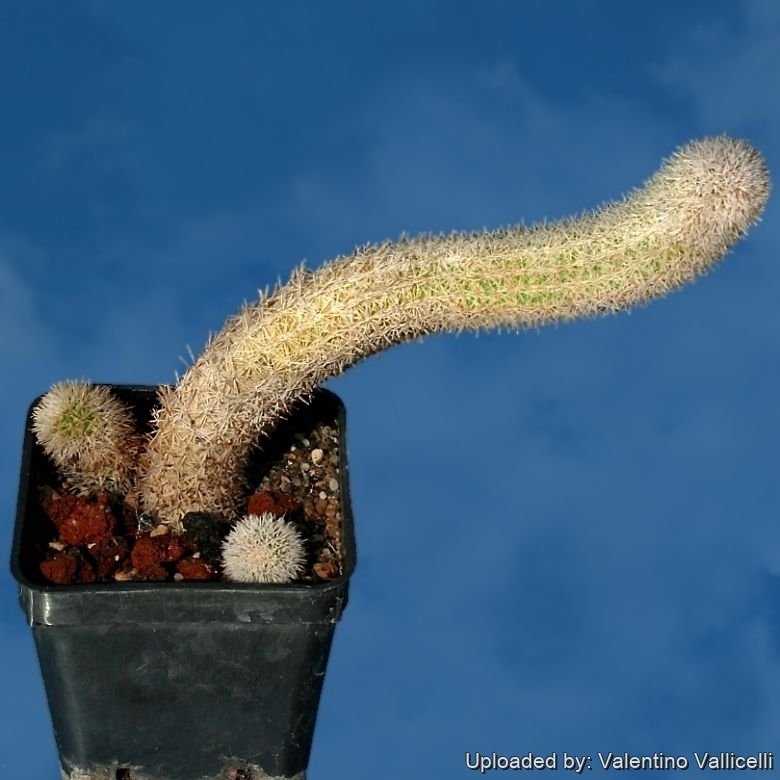
Haageocereus tenuis is a prostrate and creeping cactus densely covered by greyish spines with microscopic hairs that survives in extreme conditions in northern Peru. It grows on its side, branches splayed forlornly, its base decaying in the loose sand. The sides of the stems produce roots that store water, which is rarely available.
Derivation of specific name: Lat. tenuis’, thin, slender, presumably refers to appearance of the stems.
Stems: Cylindrical, thin, slender, grey to bluish green, 1.5-3 cm in diameter. These stems develops adventitious roots in contact with the ground and later detach from the mother plant.
Ribs: 12-15 with wavy margins.
Areoles: Silver-gray, close set.
Spines. Minute, greyish with microscopic hairs helping in the capture of humidity from fog.
Central spines: 7-10, stout, brownish to black, to 20 mm long.
Radial spines: About 30, white to brownish, 2-3 mm long.
Flowers: Rarely and never profusely produced, nocturnal, white, funnelform, white, to 10 cm long and 4.3 cm in diameter. Pericarpels and floral tubes with long white hairs in areoles.
Fruits: Oblong, pinkish red, to 2.5 cm long and 1.7 cm in
diameter; perianth parts persistent.
Remarks: Haageocereus tenuis is triploid (an organism that has three copies of every chromosome in the cell nucleus instead of the normal) and propagates asexually through stem fragmentation. It can also propagate via agamospermy (production of seeds without the occurrence of fertilization). Adventitious embryony (production of embryos from normal tissues and not from a fertilised ovule) has also been referred. Asexually produced seeds are viable. All existing individuals from the only existing population are genetically identical and the population likely represents a single clone. H. tenuis is probably of hybrid origin. The tetraploids Haageocereus chalaensis and Haageocereus multicolorispinus and the diploids Haageocereus pseudomelanostele and Haageocereus decumbens, also with a prostrate habit, are the possible parental species. However H. tenuis is distinct from other congeners and should perhaps be considered a microspecies.
Origin and Habitat
Haageocereus tenuis grows between Chancay and Huacho (Parque de las Leyendas), north of Lima, Peru. Haageocereus tenuis has an extremely restricted range. In 2004 the population consisted of 504 individuals spread over 3 square kilometers.
Altitude range. 200 to 250 metres above sea level.
Habitat and Ecology: This species grows on shifting sand dunes in a very arid coastal habitats (lomas costeras). The prostrate creeping stems are usually covered by wind-blown sand and pieces of shells. It may experience moisture when a fog rolls off the ocean, or when it rains only every two years. It is close to the Pan-American Highway and therefore threatened by both collectors and development. Haageocereus tenuis grows in an area being taken over increasingly for poultry farming. Surveys have shown that the population is now only 30% of the figure ten years ago, and this impact has not ceased and is not reversible. The species thus qualifies for listing as Critically Endangered.
Cultivation and Propagation
Haageocereus tenuis necessitate deep pots and a well drained mineral potting mix.
It needs a sufficient amount of air and is susceptible to overwatering, but needs enough water during vegetation.
Frost Tolerance: It tolerate light frost -5 °C and needs to be kept in a cool place during winter rest this is important for the flowers as well as for its health. Without this cool winter period they normally wont get many buds.
Sun Exposure: This species needs a good amount of sun.
Propagation: Usually it is propagated by cuttings and grafting. Grafted plants in culture are most common and sprout strongly. But it is also feasible to root them but they grow much slower on their own roots and takes various years prior to they bloom.
Bibliography
Major references and further lectures
-
Edward Anderson “The Cactus family” Timber Press, Incorporated, 2001
-
Ritter F. 1981. “Kakteen in Südamerika” volume IV (Peru). Spangenberg
(Germany): Friedrich Ritter.
-
David R Hunt; Nigel P Taylor; Graham Charles; International Cactaceae Systematics Group. “The New Cactus Lexicon” dh books, 2006
-
Håkan Sönnermo “Peru: land of deserts, ice, cacti” Acta Succulenta 2(3) [257-362] 2014-10-20
-
Arakaki, M., Ostolaza, C., Cáceres, F. and Roque, J. 2006. “Cactaceae endémicas del Perú.” Revista Peruana de Biología 13(2): 193s-291s.
-
Novoa, S., Ostolaza, C., Ceroni, A. and Castro, V. 2010. “Estatus poblacional de Haageocereus tenuis (Cactaceae).” Quepo 24: 42-47.
-
Ostalaza, C. & Roque, J. 2013. Haageocereus tenuis. The IUCN Red List of Threatened Species 2013: e.T152883A690499. http://dx.doi.org/10.2305/IUCN.UK.2013-1.RLTS.T152883A690499.en. Downloaded on 10 September 2016.
-
The Plantsman, Royal Horticultural Society, 2002
-
“Issues in Genetic Research: 2013” Edition Scholarly Editions, 01 May 2013
-
George Gafner “Therapy with Tough Clients: Exploring the Use of Indirect and Unconscious Techniques” Crown House Publishing, 01 November 2013
-
Urs Eggli, Leonard E. Newton “Etymological Dictionary of Succulent Plant Names” Springer Science & Business Media, 29 June 2013
-
Ostolaza C, Rauh W. 1990. “Bemerkungen zur Kakteenvegetation der peruanischen Küstenwüste, insbesondere zu Haageocereus tenuis Ritter, einer wenig
bekannten Art.” Kakteen und Andere Sukkulenten 41:40–44
- Mónica Arakaki, Pablo Speranza, Pamela S. Soltis, and Douglas E. Soltis “Genetic Variability of an Unusual Apomictic Triploid Cactus Haageocereus tenuis Ritter from the Coast of Central Peru” Journal of Heredity 2013:104(1):127–133 Advance Access publication October 1, 2012 <http://jhered.oxfordjournals.org/content/104/1/127.full.pdf
From llifle page Arthrocereus densiaculeatus
Description
Haageocereus lanugispinus is a very rare and poorly known cactus that produces finger sized, sprawling stems offsetting from the base. The peculiarity of this plant is the nice fine spination. It seems that there is only ONE clone propagated in collections worldwide!
Taxonomy note: According to the “The New Cactus Lexicon” Haageocereus lanugispinus is a synonym of Haageocereus tenuis. In effect the seeds of tenuis are very similar to those of lanugispinus, but in culture, there are a lot of differences, in particular the spination in tenuis is much less dense. Both are beautiful anyway.
Habit: It is a low growing cylindrical cactus species sprawling and spreading from its base and half-lying on the ground.
Stem: Cylindrical, 10-20 cm long, 1.2 2 cm in diameter, either upright or prostrate, eventually clumping near the base of the plant, green, somewhat hidden under a dense cover of glassy white spines.
Ribs: 13-14, 1.5-2 mm high.
Spines: 30-40, most unusual dense, short, unequal, needle-like, glassy white, 3-5 mm long, which detach very easily. As in Haageocereus tenuis the spines are minutely plumose.
Flower: White, 5 cm long.
Remarks: This plant seems to be very rarely seen in its “normal” form, as it is almost always seen the cristate form. However the crested form sometimes throws off normal stems, but they proved to be particularly difficult to root, for this reason the few plants found in specialized cactus collections are - usually – grafted.
Origin and Habitat
North of Pativilca, boundary between Lima and Ancash, Peru (South America)
Habitat and ecology:
Habitat: Haageocereus lanugispinus grows in the hills near the coast (lomas de la costa.), but it has never been observed after Ritter discovery in 1957.
Cultivation and Propagation
This mountain cactus necessitate deep pots and a well drained mineral potting mix.
Need a sufficient amount of air. They are susceptible to overwatering, but need enough water during vegetation.
Frost Tolerance: They tolerate light frost -5 °C and need to be kept in a cool place during winter rest this is important for the flowers as well as for their health. Without this cool winter period they normally wont get many buds.
Sun Exposure: This species needs a good amount of sun.
Propagation: Usually it is propagated by cuttings and grafting. Grafted plants in culture are most common and sprout strongly. But it is also feasible to root them but they grow much slower on their own roots and takes various years prior to they bloom.
Notes
This plant, according to Fr. Ritter’s description and pictures in his 4 volume book ‘Kakteen in Südamerika’, certainly Haageocereus lanugispinus. For a long time this taxon erroneously had been called Pygmaeocereus densiaculeatus due to Backeberg’s generic misplacement in 1966.
Ritter found this taxon already in 1957 in a tiny area north of Pativilca in the flat coastal zone near or at the boarder line of Depto. Lima and Ancash. In his book he finally described it by the name which had been used before as nomen nudum in the nursery of his sister H. Winter.
Bibliography
Major references and further lectures
-
Edward Anderson “The Cactus family” Timber Press, Incorporated, 2001
-
David R Hunt; Nigel P Taylor; Graham Charles; International Cactaceae Systematics Group. “The New Cactus Lexicon” dh books, 2006
-
Tropicos.org. Missouri Botanical Garden. 12 Aug 2015 <http://www.tropicos.org/Name/5101809\>
-
M. Arakaki, C. Ostolaza, F. Cáceres & J. Roque. “Cactaceae endémicas del Perú (Cactaceae endemic of Peru)” Revista Peruana de Biología v.13 n.2 Lima Dec. 2006
-
C. Ostolaza. “Todos los cactus del Perú” pag. 298. Lima, Ministerio del Ambiente, Dec. 2014. http://www.minam.gob.pe/diversidadbiologica/wp-content/uploads/sites/21/2014/02/document.pdf
-
Håkan Sönnermo “Peru: land of deserts, ice, cacti” Acta Succulenta 2(3) [257-362] 2014-10-20 <http://acta-succulenta.eu/dwn/en/ActaSucculenta\_2\_3\_2014\_EN.pdf\>
Source: Arthrocereus densiaculeatus, LLIFLE - Encyclopedia of living forms, CC-BY-SA, retrieved 2026-10-25.
From llifle page Haageocereus lanugispinus f. cristatus
Description
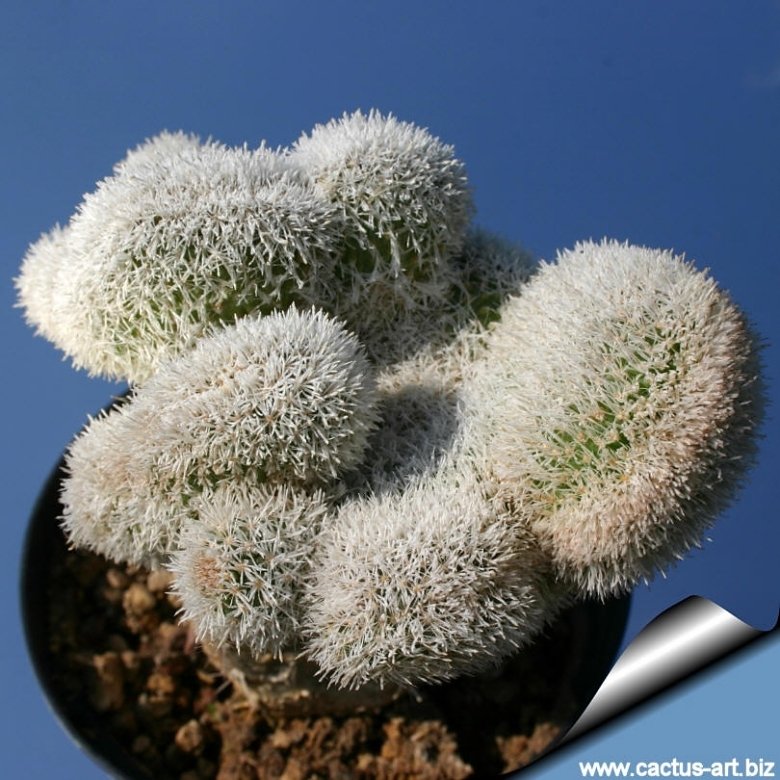
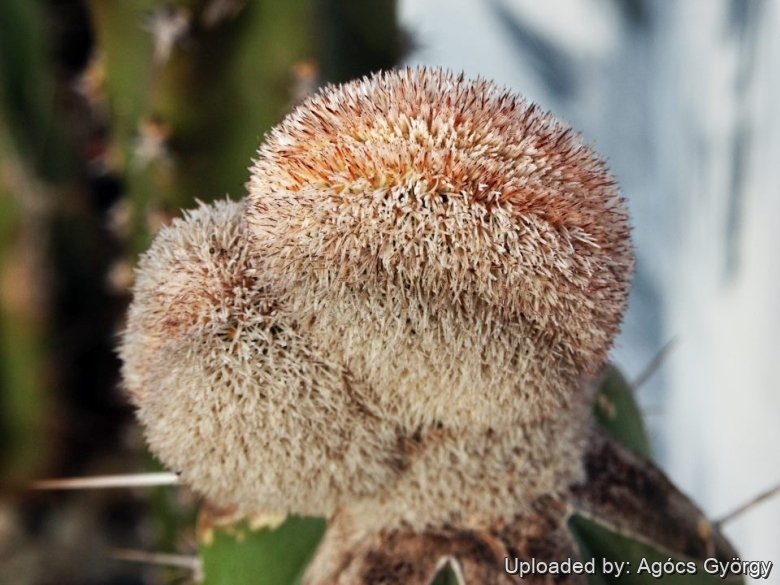
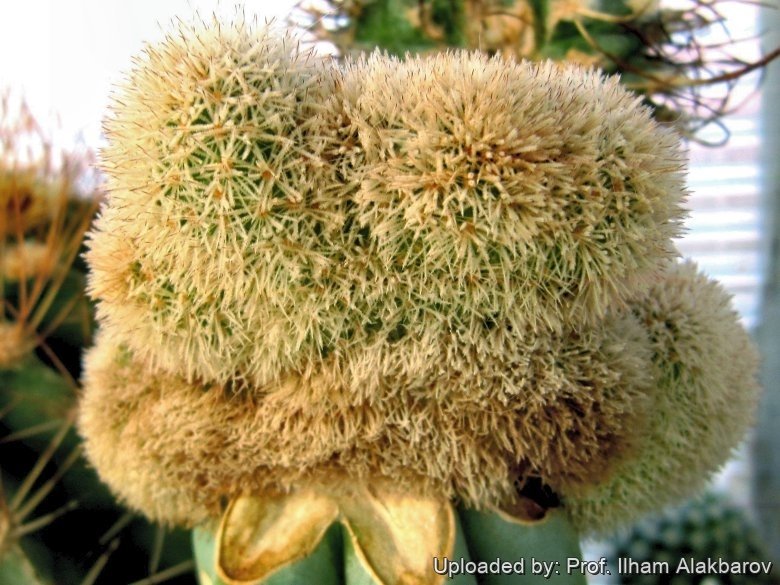
Haageocereus lanugispinus is a very rare and poorly known small finger sized cactus. It seems that there is only ONE clone propagated in collections worldwide! The crested form Haageocereus lanugispinus f. cristatus is very rare and sought after by collectors, for its unique dense cover of glassy white spines.
Root: Has a large tap root below the surface of the compost.
Stem: Fan shaped, narrow, slowly forming tangled brain-like stems up to 15 (or more) cm across, almost completely hidden under a dense cover of glassy white spines.
Spines: Most unusual dense, plumose, short, glassy white, which detach very easily.
Flower: White.
Remarks: This plant seems to be very rarely seen in its “normal” form, as it is almost always seen the cristate form. However the crested form sometimes throws off normal stems, but they proved to be particularly difficult to root, for this reason the few plants found in specialized cactus collections are - usually - grafted.
Origin and Habitat
Garden origin (Nursery produced cultivar).
Cultivation and Propagation
It is regarded as a choice and difficult plant and grows quite slowly. It is almost always seen as a grafted plant but may grows on its own roots too.
Soil: Use mineral well permeable mineral soil with little organic matter (peat, humus).
Exposure: They need a good amount of light shade to full sun this help to keep the plants healthy, although slow growth.
Watering: Water sparingly from March till October (weekly during summertime, if the weather is sunny enough), with a little fertilizer added. Less or no water during cold winter months, or when night temperatures remain below 10° to prevent root loss. It is very sensitive to overwatering (rot prone).
Fertilization: Feeding may not be necessary at all if the compost is fresh then, feed in summer only if the plant hasn’t been repotted recently. Do not feed the plants from September onwards as this can cause lush growth which can be fatal during the darker cold months.
Hardiness: Keep perfectly dry in winter at temperatures from 5 to 15 degrees centigrade. (but it is relatively cold resistant and hardy to -5° C, or possibly colder for short periods) In the rest period no high atmospheric humidity!! (Temperature Zone: USDA 9-11)
Crested growth: Unlike ‘monstrose’ varieties of plants, where the variation from normal growth is due to genetic mutation, crested growth can occur on normal plants. Sometimes it’s due to variances in light intensity, or damage, but generally the causes are unknown. A crested plant may have some areas growing normally, and a cresting plant that looks like a brain, may revert to normal growth for no apparent reason. If you have any of the crested part left you need to remove the normal growth and leave the crested part behind this will need to be done regularly.
Propagation: Grafting or cuttings. Plants are usually grafted onto column-shaped cacti but proved to be able to produce their own roots if degrafted. Cuttings will take root in a minimum temperature of 20° C (but better in hot weather). Cuttings of healthy shoots can be taken in the spring and summer. Cut the stem with a sharp, sterile knife, leave the cutting in a warm, dry place for a week or weeks (depending on how thick the cutting is) until a callus forms over the wound. Once the callus forms, the cutting may be inserted in a container filled with firmed cactus potting mix topped with a surface layer of coarse grit. They should be placed in the coarse grit only; this prevents the cut end from becoming too wet and allows the roots to penetrate the rich compost underneath. The cuttings should root in 2 to 6 weeks. Large crested piece must be placed on the soil surface without burying the plant base down in the soil.
Source: Haageocereus lanugispinus f. cristatus, LLIFLE - Encyclopedia of living forms, CC-BY-SA, retrieved 2026-10-25.
Gallery