Publication: Cactaceae (Britton & Rose) 2: 155, fig. 225. 1920 [9 Sep 1920]
Description
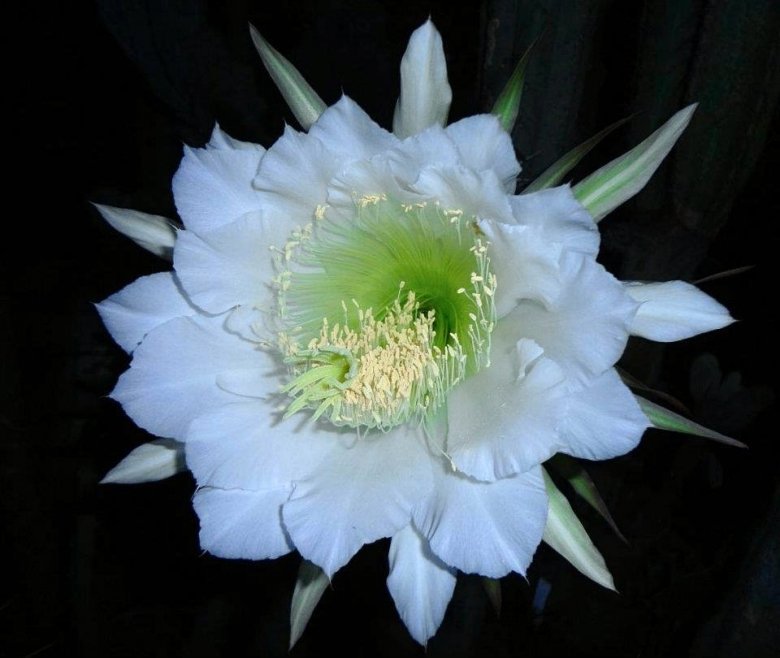
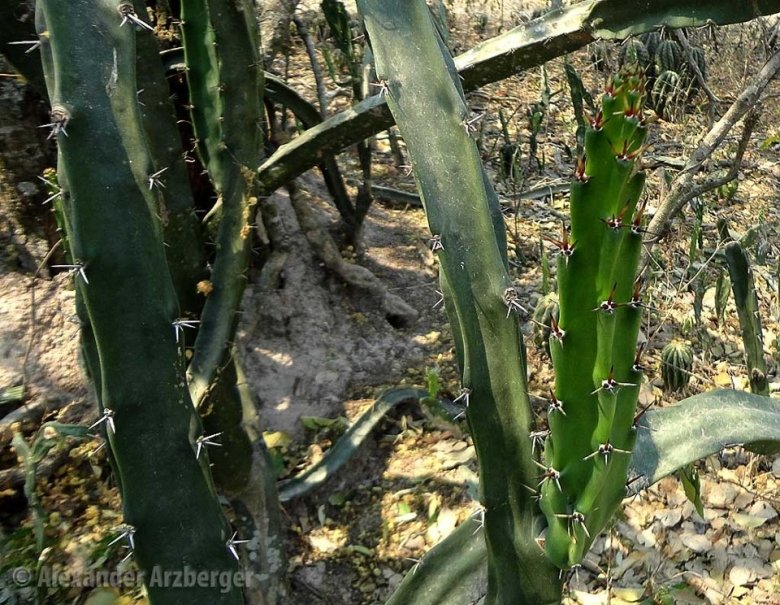
Harrisia pomanensis (Eriocereus pomanensis) is a sprawling or clambering cactus to 3 m or more long, sometimes somewhat shrubby, it has arching, bluish-green, rhizome-like stems with four to six blunt, rounded ribs. Growth habit permitting this cactus to explore and asexually reproduce in its immediate habitat. The spine clusters have each one central up to 2 cm long and five to seven shorter radials. Up to 15 cm in length, the flowers are white. Harrisia pomanensis is wide-ranging and quite variable. Subspecies regelii tends to be more shrubby, with smaller stems having fewer spines; it occurs only in Argentina.
Stem: Erect at first, then arching or even prostrate, sprawling or clambering, bluish-green, or grey-green, glaucous, nearly round in cross section, jointed to 3 m (or more) long and 2-4-(rarely to 8) cm in diameter.
Ribs: 4-7(-rarely to 7) blunt, rounded, not tuberculate.
Areoles: 1.2-1.4 cm apart.
Spines: Rigid, all subulate, needle-like, white rose-coloured or red when young, later whitish or greyish, tipped blackish.
Central spine: Solitary, 10-20(-25) mm long.
Radial spines: 5 to 8 about 1 cm long.
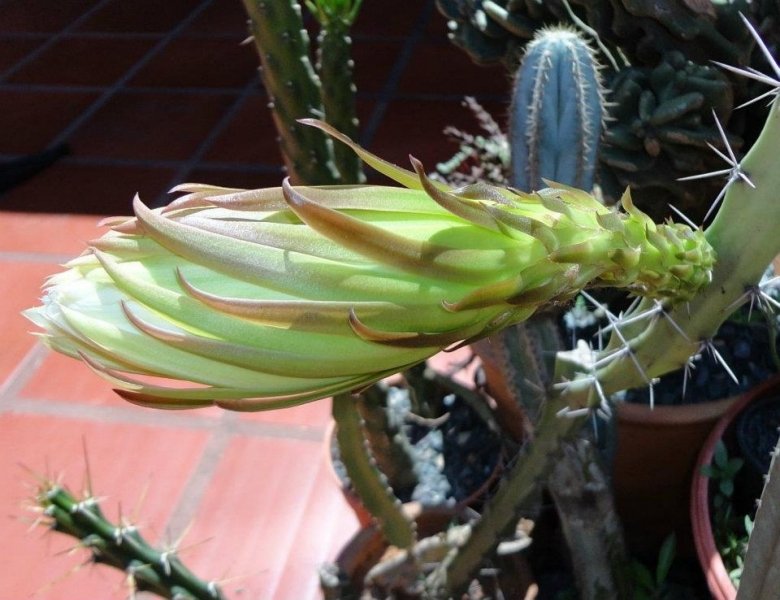
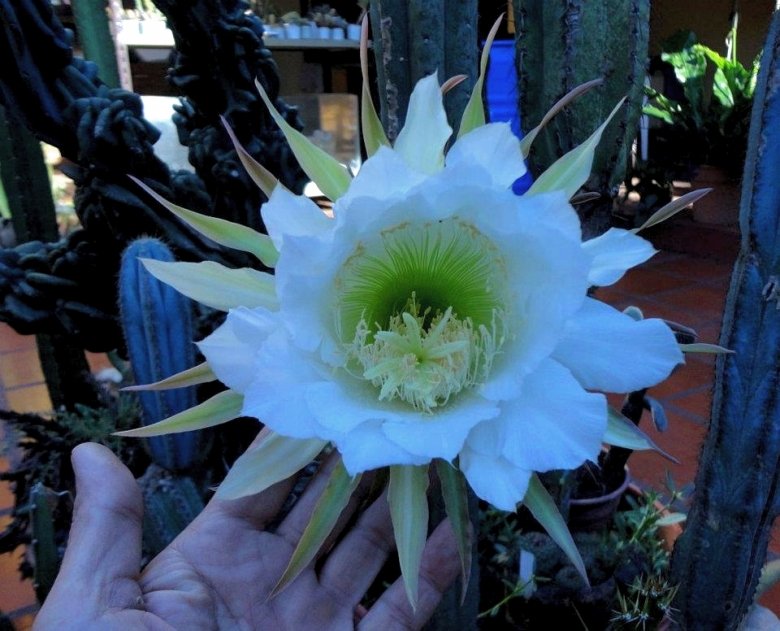
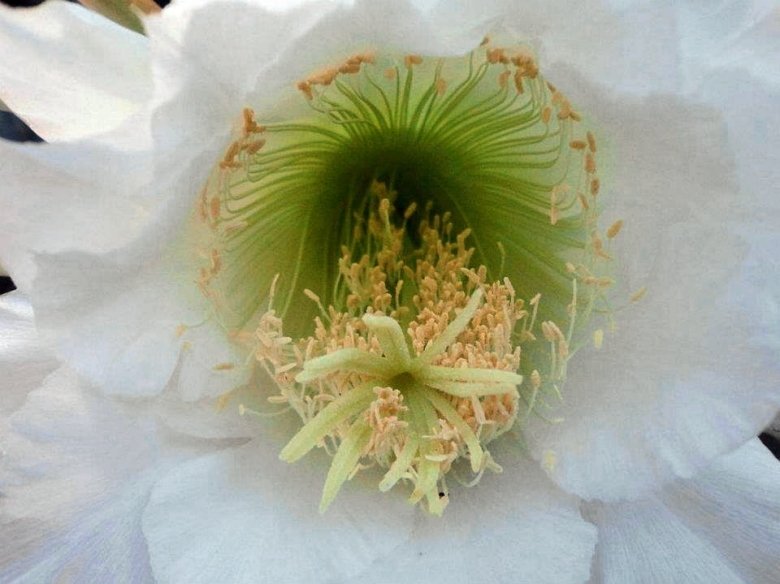
Flowers: About 15 cm long. Flower-tube with ovate, acute scales 1 cm or more long, hairy in the axils. Outer perianth-segments linear, acute; inner perianth segments oblong, acutish, white. Stigma-lobes numerous, linear.
Blooming season: Summer.
Fruit: Spherical, slightly tuberculate, spineless, with a few scales3-5 cm in diameter red, splitting laterally to expose the spongy white funicles and black seeds.
Origin and Habitat
Harrisia pomanensis occurs in Argentina, Bolivia, Uruguay and in Paraguay in the Alto Paraguay, Boquerón, Central, Cordillera, Paraguarí, and Presidente Hayes departments. It is naturalised in Australia and elsewhere in the tropics and subtropics.
Type locality: Poman, Catamarca, Argentina.
Altitude range: It grows at elevations between 10 and 1,000 metres above sea level.
Habitat and Ecology: This cactus occurs in the Chaco Region of Argentina, Paraguay, and Bolivia. It also occurs in Uruguay. It grows low lying in the borders, as well as inside the Dry Chaco forest of the western region. It grows in clearings within the Chacoan province, and below shrubs, mostly “jarillas” (Larrea spp.), in the Monte province. Harrisia pomanensis is widely distributed and locally abundant throughout its range, and there are no major threats affecting it. It is favored by livestock grazing and is consumed by the Chacoan Peccary (Catagonus wagneri) in the dry season. Also Harrisia pomanensis you will find most of the night flowers are white and very fragrant to attract night flying moths for pollination.
Cultivation and Propagation
Harrisia pomanensis (Eriocereus pomanensis) presents no problems in cultivation and will do well in a sunny spot in a cactus house.
Soil: Grow them in rich, porous, sandy soil and let their soil dry out between waterings. If potted, repot in the spring if their roots become cramped. Generally, they should be repotted every other year in order to provide fresh soil. However, this doesn’t necessarily mean they’ll need larger containers. Fill about a quarter of the pot with broken crocks, gravel, etc. to promote good drainage. After repotting, do not water for a week or more.
Hardiness: These plants will not tolerate extended periods of frost; they can survive to a minimum temperature of -4°C.
Traditional uses: The Lengua-Maskoy natives eat the raw fruits, as well as boiled or roasted roots of this species.
Propagation: It can be increased by seeds or cuttings. Cuttings of healthy shoots can be taken in the spring and summer, Cut the stem with a sharp, sterile knife just above a bud or shoot (a 7-10cm long tip or branch is most suitable for propagation) Leave the cutting in a warm, dry place for a week or weeks (depending on how thick the cutting is) until a callus forms over the wound. Once the callus forms, the cutting may be inserted into a container filled with firmed cactus potting mix topped with a surface layer of coarse grit. They should be placed in the coarse grit only; this prevents the cut end from becoming too wet and allows the roots to penetrate the rich compost underneath. The cuttings should root in 2 to 6 weeks.
Garden uses: Harrisia pomanensis forms long columns that are great for grafting valuable species of cacti and - differently from other common grafting stock - don’t induces plants to elongate out of character and produce weak spination. The scions on Harrisia don’t grow as fast as the ones grafted on other tender and stronger stock, but they prosper very easy and can be kept in dark and cold places in winter. It can easily endure some light frost, too.
Notes
Harrisia jusbertii is considered by some to possibly be a natural intergenic hybrid betwee Harrisia pomanensis, and Echinopsis eyriesii rather than a pure species.
Bibliography
Major references and further lectures
-
Edward Anderson “The Cactus family” Timber Press, Incorporated, 2001
-
David R Hunt; Nigel P Taylor; Graham Charles; International Cactaceae Systematics Group. “The New Cactus Lexicon” dh books, 2006
-
James Cullen, Sabina G. Knees, H. Suzanne Cubey “The European Garden Flora Flowering Plants: A Manual for the Identification of Plants Cultivated in Europe, Both Out-of-Doors and Under Glass” Cambridge University Press, 11/Aug/2011
-
Oakley, L., Pin, A. & Duarte, W. 2013. “Harrisia pomanensis.” The IUCN Red List of Threatened Species. Version 2014.3. <www.iucnredlist.org>. Downloaded on 27 December 2014.
-
Karl J. Niklas “The Evolutionary Biology of Plants” University of Chicago Press, 08 giu 1997
-
N. L. Britton, J. N. Rose “The Cactaceae. Descriptions and Illustrations of Plants of the Cactus Family” volume 2 The Carnegie Institution of Washington, Washington f. 225 1920
-
Thomas H. Everett “The New York Botanical Garden Illustrated Encyclopedia of Horticulture” Volume 4 Courier Corporation, 01 January 1981
-
“Carnegie Institution of Washington Publication” Volume 248, Part 2 Carnegie Institution of Washington, 1920
-
Haustein, Erik “Der Kosmos-Kakteenführer” Franckh-Kosmos 1983
From llifle page Cereus bonplandii
Description
The Midnight Lady (Harrisia pomanensis subs. bonplandii), is generally included within (as a synonym of) Harrisia pomanensis, suggesting that there is not really a fundamental difference between the two and there remains a considerable confusion surrounding the true identity of this this plant. Up to 22 cm in length, the flowers are white with scales of the perianth-tube copiously woolly in the axils. The plant remains often unnoticed in the forest, but can not be overseen when it blossoms only in the night and where its Spanish name, Reina de la Noche (Queen of the Night) originates. This species is widely cultivated, but under different names, one of which is Cereus acutangulus. Fruits and roots are edible and well known to the native nations of the Gran Chaco.
Derivation of specific name. The name bonplandii honors the French scientific Aimé Bonpland.
Stems: Slender and weak, some erect or clambering and reaching 1–1.5 m, the other procumbent, arching or trailing on the ground up to 2.5-3 meters long, or, 3 to 8 cm in diameter, strongly (3-)4-angled. The margins are sharp and wavy.
Areoles: 2 cm apart.
Spines: 4-6 (or rarely more), acicular, the longest 0.5–2(-4) cm long, when young red and often black-tipped, in age grey. The single strong central spine (if present) is up to 2.5-3 centimetres long.
Flowers: White, nocturnal, funnelform,15 to 22(-25) cm long, closing soon after sunrise. Outer perianth segments green, pink-tipped. Pericarpel and corolla tube filled with large persistent scales copiously woolly in the axils. Filaments numerous, borne almost to the base of the tube. Style included; stigma-lobes numerous.
Fruit: Edible, globular, and strongly tuberculate, 4 to 6 cm in diameter, red, bearing large scales with hairs in their axils, spineless, splitting on the side and exposing the white flesh and black seeds.
Similar species: Harrisia bonplandii differs from Harrisia martinii by its areoles with 4–6 (not 1–3), much longer radial spines 5–20 mm long, and scales of the perianth tube woolly in the axils.
Note: It has been argued that this name should be rejected in favour of Harrisia balansae, but no formal proposal has been has been made, Hunt & al. (2006). Leuenberger (2001) wrote a detailed history of the name and recommended to maintain the use of H. bonplandii. Its modern application appears to be consistent and widely accepted.
Origin and Habitat
Harrisia pomanensis subs. bonplandii grows in the Gran Chaco (Paraguay, north of Argentina, Bolivia, and southwest of Brazil).
Habitat and ecology: Harrisia pomanensis subs. bonplandii is present in the understory at edges of dry forests, or associated with tropical plants. This terrestrial night-blooming cactus has escaped from cultivation and become naturalized in dry secondary thicket in many tropical countries.
Cultivation and Propagation
Harrisia pomanensis subs. bonplandii (Harrisia bonplandii) presents no problems in cultivation and will do well in a sunny spot in a cactus house.
Soil: Grow them in rich, porous, sandy soil and let their soil dry out between waterings. If potted, repot in the spring if their roots become cramped. Generally, they should be repotted every other year in order to provide fresh soil. However, this doesn’t necessarily mean they’ll need larger containers. Fill about a quarter of the pot with broken crocks, gravel, etc. to promote good drainage. After repotting, do not water for a week or more.
Hardiness: These plants will not tolerate extended periods of frost; they can survive to a minimum temperature of -4°C.
Traditional uses: Fruits and roots are edible and well known to the native nations of the Gran Chaco. The fresh mature fruits and the boiled flowers are edible. The Maka natives also ate boiled or roasted roots. The Maka use the thorns to make tatoos.
Propagation: It can be increased by seeds or cuttings. Cuttings of healthy shoots can be taken in the spring and summer, Cut the stem with a sharp, sterile knife just above a bud or shoot (a 7-10cm long tip or branch is most suitable for propagation) Leave the cutting in a warm, dry place for a week or weeks (depending on how thick the cutting is) until a callus forms over the wound. Once the callus forms, the cutting may be inserted into a container filled with firmed cactus potting mix topped with a surface layer of coarse grit. They should be placed in the coarse grit only; this prevents the cut end from becoming too wet and allows the roots to penetrate the rich compost underneath. The cuttings should root in 2 to 6 weeks.
Garden uses: This species forms long columns that are great for grafting valuable species of cacti and - differently from other common grafting stock - don’t induces plants to elongate out of character and produce weak spination. The scions on Harrisia don’t grow as fast as the ones grafted on other tender and stronger stock, but they prosper very easy and can be kept in dark and cold places in winter. It can easily endure some light frost, too.
Notes
The widely grown Harrisia jusbertii is considered by some to possibly be a natural intergenic hybrid betwee Harrisia pomanensis, and Echinopsis eyriesii rather than a pure species.
Bibliography
Major references and further lectures
-
Edward Anderson “The Cactus family” Timber Press, Incorporated, 2001
-
David R Hunt; Nigel P Taylor; Graham Charles; International Cactaceae Systematics Group. “The New Cactus Lexicon” dh books, 2006
-
James Cullen, Sabina G. Knees, H. Suzanne Cubey “The European Garden Flora Flowering Plants: A Manual for the Identification of Plants Cultivated in Europe, Both Out-of-Doors and Under Glass” Cambridge University Press, 11/Aug/2011
-
Oakley, L., Pin, A. & Duarte, W. 2013. “Harrisia pomanensis.” The IUCN Red List of Threatened Species. Version 2014.3. <www.iucnredlist.org>. Downloaded on 27 December 2014.
-
Karl J. Niklas “The Evolutionary Biology of Plants” University of Chicago Press, 08 giu 1997
-
N. L. Britton, J. N. Rose “The Cactaceae. Descriptions and Illustrations of Plants of the Cactus Family” volume 2 The Carnegie Institution of Washington, Washington f. 225 1920
-
Urs Eggli, Leonard E. Newton “Etymological Dictionary of Succulent Plant Names”. Springer, Berlin/Heidelberg 2010
-
Friesen Ratzlaff, Verena “Urunde´y - Schlorrekaktus - Pehen, Una guia para plantas leñosas del Chaco, Ein Feldführer für Chacogehölze” 2004.
-
Hunt, D.R., Taylor, N.P. & Charles, G. (eds.). “The New Cactus Lexicon”. Milborne Port, England: dh Books. 2006.
-
Kiesling, R. “El genero Harrisia (Cactaceae) en La Argentina”. Darwiniana 34: 389–398. 1996.
-
Leuenberger, B.E. “Harrisia bonplandii, case history of a controversial name in Cactaceae from South America.” Bot. Jahrb. Syst. 123: 145–178. 2001.
-
Taylor, N.P. & Zappi “Cactaceae Consensus Initiatives”, 3: 7, as H. balansae.1997.
-
“Harrisia bonplandii.” Wikispecies, . 11 Mar 2016, 07:06 UTC. 3 Jul 2016, 10:07 <https://species.wikimedia.org/w/index.php?title=Harrisia\_bonplandii&oldid=2520208\>.
-
Wikipedia contributors. “Harrisia bonplandii.” Wikipedia, The Free Encyclopedia. Wikipedia, The Free Encyclopedia, 13 Feb. 2015. Web. 3 Jul. 2016.
-
David H. Lorence, Timothy W. Flynn, Warren L. Wagner “Contributions to the Flora of Hawai‘i. III New Additions, Range Extensions, and Rediscoveries of Flowering Plants” Harrisia bonplandii in: “Occasional Papers of Bernice Pauahi Bishop Museum: RECORDS OF THE HAWAII BIOLOGICAL SURVEY FOR 1994” Bishop Museum Press, 1984 NO. 41, p.28, 1995
Source: Cereus bonplandii, LLIFLE - Encyclopedia of living forms, CC-BY-SA, retrieved 2026-10-25.
Cultivars and forms (1)
Subspecies (1)
Gallery