Description
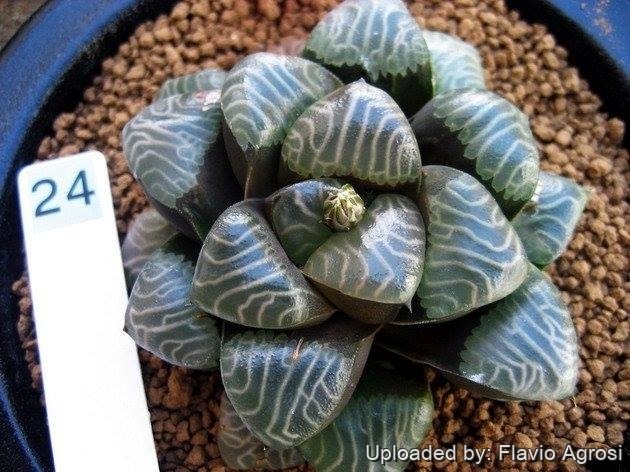
Haworthia bayeri is one of the most spectacular retuse-leaved species highly sought-after for its beautiful leaf markings, but is slow growing and still very rare in cultivation. The random fine white white strips across the olive-green to red leaf surfaces is extremely variable and a number of nicely marked clones has been selected by growers, especially in Japan.
Cv. Kelikete: This is one of the best clones whit beautiful reticulate patterning or and extra shiny almost glassy surface.
Habit: Rosettes mostly solitary, stemless, 8-10 cm in diameter, but occasionally may form a small mound over time.
Leaves: 15-20 triangular, retuse, lime green, dark brownish-green, blackish-green, or reddish, slightly scabrid, glassy, keels and margins with minute spines or smooth, tip rounded and not pointed, the end-area opaque, cloudy-transparent, conspicuous longitudinal white or pink lines.
Inflorescence: Raceme lax (bearing 15-25 flowers), up to 30 cm tall, single, unbranched, erect and wiry.
Flowers: Whitish. The flower’s Structure, colour and fruits are typical of the genus.
Origin and Habitat
Garden origin, Japan?
Bibliography
Major references and further lectures
-
M. B. Bayer “The new Haworthia handbook” National Botanic Gardens of South Africa, 1982
-
John Pilbeam “Haworthia and Astroloba: A Collector’s Guide” 1983
-
Stuart Max Walters, James Cullen “The European Garden Flora: Pteridophyta, Gymnospermae, Angiospermae” Cambridge University Press, 1986
-
Gibbs Russell, G. E., W. G. Welman, E. Reitief, K. L. Immelman, G. Germishuizen, B. J. Pienaar, M. v. Wyk & A. Nicholas. “List of species of southern African plants.” Mem. Bot. Surv. S. Africa 1987
-
Ernst Van Jaarsveld, Ben-Erik Van Wyk, Gideon Smith “Succulents of South Africa: A Guide to the Regional Diversity” Tafelberg Publishers, Limited, 01/lug/2000
Gallery