Publication: Philos. Mag. Ann. Chem. 66: 301 1824.
Description
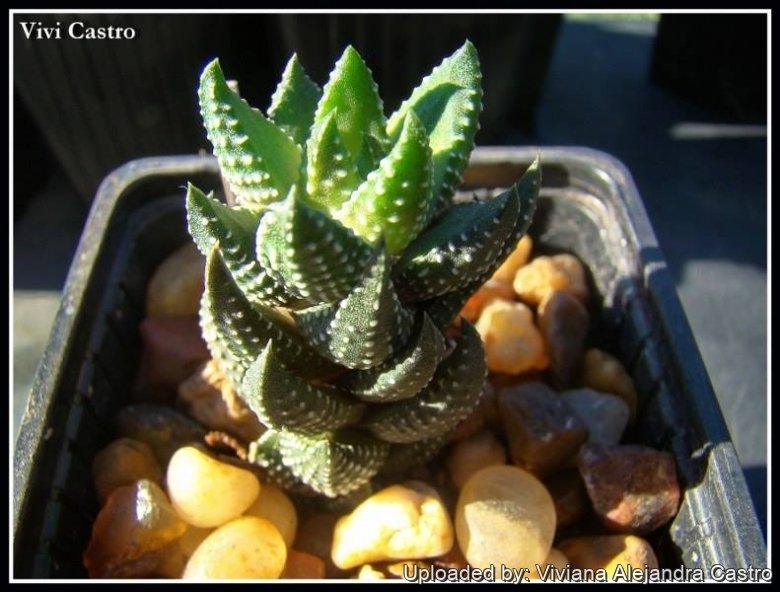
Haworthia coarctata is a medium-sized, stem forming, species that consist of columnar rosettes dotted with white, slightly raised, tubercles (protuberances on the leaves); the plant blush bronze when grown in bright light (but if they turn orange red they are getting too much). It is well known and instantly recognisable and it is also one of the least variable of the haworthias. This leafy stemmed Haworthia is well known, being somewhat easy to grow and standing considerable abuse.
Habit: This is a small evergreen tall rosette-succulent and forms dense clusters.
Rosette: Columnar, tight, 5-20 cm tall, offsetting from the base. The leaves are seemingly arranged in many spiral rows around the stem.
Leaves:* 4-6 cm long, triangular-lanceolate, tips incurved, shining green, turning red in full-sun with greenish white slightly raised, rounded tubercles in longitudinal or sometimes transverse rows; density of tubercles very variable.
Inflorescence (racemes): Up to 30 cm tall, usually unbranched, few-flowered. The flowers are white tubular.
Blooming season: Spring to summer.
Similar species: Haworthia coarctata has been very often confused with Haworthia reinwardtii in the past. The leaves of H. coarctata are fatter, smaller and more smoothly rounded and tends to form less and more open spirals. H. reinwardtii the laves are densely packed, clasping, and thinner in transversal section. If a straight line is drawn across the H. reinwardtii stem and the leaves that lie opposite the line counted, the result is often 10. If repeated with H. coarctata the answer is often 5. Both species have white tubercles on the outer (abaxial) leaf surface, usually smaller, more smoothly rounded and diffused in H. coarctata, more prominent, whiter and often in cross bands in H. reinwardtii. However, at least in some part of its range, populations with intermediate characteristics are found, and it is often difficult to distinguish what is H. coarctata and what is already H. reinwardtii.
Origin and Habitat
Eastern Cape, South Africa. It is concentrated in the Grahamstown area but extending to Addo in the west and near the Fish River in the east.
Habitat: It grows usually on rocky terrain, rather than on open grass-lands. It forms dense clusters and often grows in full exposed situations and, possibly because of vegetative reproduction, populations tend to be very uniform. In the eastern part of the range blends with Haworthia fasciata. In the area of Grahamstown / Port Alfred / Great Fish River its distribution range meets with Haworthia reinwardtii.
Cultivation and Propagation
Haworthia coarctata is a proliferous species of easy cultivation and relatively low maintenance, forming clumps in nature. Its interest lies in its ability to change colour: in cooler weather the plant blush bronze-red. It is also a good houseplant, and can be an excellent subject for the beginning succulentophile (they can grow easily on window sills, verandas and in miniature succulent gardens where they are happy to share their habitat with other smaller succulent plants, or in outdoor rockeries). It is a winter grower and is dormant in the hottest summer months. In cultivation it needs more sunny position to show its beauty.
Growth rate: Haworthia coarctata are relatively slow-growing plants that offsets freely to form small clusters whit time.
Soil: They are tolerant of a wide range of soils and habitats, but prefer a very porous potting mix to increase drainage. A non-acid soil is ideal. You can grow a plant in a 10-15 cm pot for years and have perfectly happy plants. For best results, use a shallow pot.
Exposition: The plant needs little bit more exposed situation to let plants grow compactly. With some sun exposure the leaf develops a nice reddish tint and remains compact.
Watering: During the hot summer months, the soil should be kept moist but not overly wet. During the winter months, water only when the soil becomes completely dry. Wet soil quickly causes root and stem rot, especially during chilly winter months. No water should ever be allowed to stand around the roots. Low ambient humidity is always needed.
Fertilization: The plants are fertilized only once during the growing season with a balanced fertilizer diluted to ½ the recommended strength.
Hardiness: Although the plant will survive mild frost if kept dry (hardy as low as -5° C) it should be protected from severe cold and prolonged frost conditions.
Rot: Rot is only a minor problem with Haworthia if the plants are watered and “aired” correctly. If they are not, fungicides won’t help all that much. Care must be given in watering, keeping them warm and wet while growing, and cooler and dry when dormant.
Remarks: Haworthias are best planted in a shaded and airy part of the greenhouse, and not too close to the glass roof or sides of the house as the plants can overheat during hot spells.
Propagation: Haworthia are easily propagated by the removal of offshoots in spring or summer. They can also be grown from seed.
Notes
Haworthia are predominantly rosette-shaped species but Haworthia coarctata is one of the few plants in the genus to form clumps of tough leafy columns.
Bibliography
Major references and further lectures
-
Debra Lee Baldwin “Succulent Container Gardens: Design Eye-Catching Displays with 350 Easy-Care Plants” Timber Press, 20/gen/2010
-
John Robert Brown “Unusual Plants: 110 Spectacular Photographs of Succulents” Abbey Garden Press, 1954
-
Rudolf Marloth “The flora of South Africa: with synopical tables of the genera of the higher plants” Volume 4 Darter bros. & co., 1915
-
Gordon D. Rowley “The illustrated encyclopedia of succulents” Crown Publishers, 01/Aug/1978
-
Urs Eggli “Illustrated Handbook of Succulent Plants: Monocotyledons” Springer, 2001
-
- Charles L. Scott “The genus Haworthia (Liliaceae): a taxonomic revision” Aloe Books, 1985
-
Stuart Max Walters “The European Garden Flora: Pteridophyta, Gymbospermae, Angiospermae-Monocotyledons” Cambridge University Press, 1984
-
M. B. Bayer “The new Haworthia handbook” National Botanic Gardens of South Africa, 1982
-
John Pilbeam “Haworthia and Astroloba: A Collector’s Guide” B. T. Batsford Limited, 1983
-
Bruce Bayer “Haworthia revisited: a revision of the genus” Umdaus Press, 1999
-
Bayer, M.B and van Jaarsveld, E. ”Haworthia. in Illustrated Handbook of Succulent Plants: Monocotyledons.” Springer, Berlin. 2001
-
“Haworthia coarctata Haw.” <http://haworthia-gasteria.blogspot.it\>. Downloaded on 09 March 2014.
From llifle page Haworthia baccata
Description
The name Haworthia baccata is no longer accepted and should be fully synonymized with Haworthia coarctata var. coarctata, but the plant has been in the trade for many years and the name is still in use. It is a bright shade loving succulent plant with thick, densely packed, dark green triangular leaves which can turn a reddish brown with more sun exposure. The leaves are covered by beautiful pearl-like little tubercle forming a white bumpy pattern. This leafy stemmed Haworthia is well known, being somewhat easy to grow.
Habit: This is a medium-sized stem forming species that consist of columnar rosette and forms dense clusters.
Rosette: Columnar, tight, about 15 cm tall, offsetting from the base. The leaves are seemingly arranged in many spiral rows around the stem.
Leaves:* 4-6 cm long, triangular-lanceolate, tips incurved. shining green, that blush bronze when grown in bright light (but if they turn orange red they are getting too much). They are dotted with greenish white slightly raised, rounded tubercles in longitudinal or sometimes transverse rows; density of tubercles very variable.
Inflorescence (racemes): Up to 30 cm tall, usually unbranched, few-flowered. The flowers are white tubular.
Blooming season: Spring tu summer.
Origin and Habitat
Southwest of Stutterheim, Cape Province, South Africa.
Habitat: It grows usually on rocky terrain, rather than on open grass-lands. It forms dense clusters and often grows in full exposed situations and, possibly because of vegetative reproduction, populations tend to be very uniform.
Cultivation and Propagation
Haworthia baccata (=Haworthia coarctata) is a proliferous species of easy cultivation and relatively low maintenance, forming clumps in nature. Its interest lies in its ability to change colour: in cooler weather the plant blush bronze-red. It is also a good houseplant, and can be an excellent subject for the beginning succulentophile (they can grow easily on window sills, verandas and in miniature succulent gardens where they are happy to share their habitat with other smaller succulent plants, or in outdoor rockeries). It is a winter grower and is dormant in the hottest summer months. In cultivation it needs more sunny position to show its beauty.
Growth rate: Haworthia baccata are relatively slow-growing plants that offsets freely to form small clusters whit time.
Soil: They are tolerant of a wide range of soils and habitats, but prefer a very porous potting mix to increase drainage. A non-acid soil is ideal. You can grow a plant in a 10-15 cm pot for years and have perfectly happy plants. For best results, use a shallow pot.
Exposition: The plant needs little bit more exposed situation to let plants grow compactly. With some sun exposure the leaf develops a nice reddish tint and remains compact.
Watering: During the hot summer months, the soil should be kept moist but not overly wet. During the winter months, water only when the soil becomes completely dry. Wet soil quickly causes root and stem rot, especially during chilly winter months. No water should ever be allowed to stand around the roots. Low ambient humidity is always needed.
Fertilization: The plants are fertilized only once during the growing season with a balanced fertilizer diluted to ½ the recommended strength.
Hardiness: Although the plant will survive mild frost if kept dry (hardy as low as -5° C) it should be protected from severe cold and prolonged frost conditions.
Rot: Rot is only a minor problem with Haworthia if the plants are watered and “aired” correctly. If they are not, fungicides won’t help all that much. Care must be given in watering, keeping them warm and wet while growing, and cooler and dry when dormant.
Remarks: Haworthias are best planted in a shaded and airy part of the greenhouse, and not too close to the glass roof or sides of the house as the plants can overheat during hot spells.
Propagation: Haworthia are easily propagated by the removal of offshoots in spring or summer. They can also be grown from seed.
Notes
Haworthia are predominantly rosette-shaped species but this is one of the few plants in the genus to form clumps of tough leafy columns.
Bibliography
Major references and further lectures
-
Debra Lee Baldwin “Succulent Container Gardens: Design Eye-Catching Displays with 350 Easy-Care Plants” Timber Press, 20/gen/2010
-
John Robert Brown “Unusual Plants: 110 Spectacular Photographs of Succulents” Abbey Garden Press, 1954
-
Rudolf Marloth “The flora of South Africa: with synopical tables of the genera of the higher plants” Volume 4 Darter bros. & co., 1915
-
Gordon D. Rowley “The illustrated encyclopedia of succulents” Crown Publishers, 01/Aug/1978
-
Urs Eggli “Illustrated Handbook of Succulent Plants: Monocotyledons” Springer, 2001
-
- Charles L. Scott “The genus Haworthia (Liliaceae): a taxonomic revision” Aloe Books, 1985
-
Stuart Max Walters “The European Garden Flora: Pteridophyta, Gymbospermae, Angiospermae-Monocotyledons” Cambridge University Press, 1984
-
M. B. Bayer “The new Haworthia handbook” National Botanic Gardens of South Africa, 1982
-
John Pilbeam “Haworthia and Astroloba: A Collector’s Guide” B. T. Batsford Limited, 1983
-
Bruce Bayer “Haworthia revisited: a revision of the genus” Umdaus Press, 1999
-
Bayer, M.B and van Jaarsveld, E. ”Haworthia. in Illustrated Handbook of Succulent Plants: Monocotyledons.” Springer, Berlin. 2001
-
“Haworthia coarctata Haw.” <http://haworthia-gasteria.blogspot.it\>. Downloaded on 09 March 2014.
-
Hans Hecht “Cacti & succulents” Sterling Pub. Co., 1997
Source: Haworthia baccata, LLIFLE - Encyclopedia of living forms, CC-BY-SA, retrieved 2026-10-25.
From llifle page Haworthia chalwinii
Description
Haworthia coarctata v chalwinii is one of the morphological or geographical form of the coarctata group. It is a small plant which grows many upright leaf-clad stems radiating from an offsetting base, rather than flattened rosettes. It is not readily distinguishable from Haworthia coarctata var. coarctata, if not for the provenance and, may be, for the firmer leaves, each about 12-25 mm long and 5-20 mm broad at the base. The leaves are dotted with white, slightly raised, tubercles. Its leaf colour can vary from green to reddish brown dependant upon the amount of light it receives.
Habit: This is a small evergreen tall rosette-succulent and forms dense clusters.
Rosette: Columnar, tight, 5-20 cm tall, and about 4 cm in diameter, offsetting from the base. The leaves are seemingly arranged in many spiral rows around the stem.
Leaves: About 25 mm long cm long, triangular-lanceolate, tips incurved, shining green, turning red in full-sun with greenish white slightly raised, rounded tubercles in longitudinal or sometimes transverse rows; density of tubercles very variable.
Inflorescence (racemes): Up to 30 cm tall, usually unbranched, few-flowered. The flowers are white tubular.
Blooming season: Spring to summer.
Chromosome number: 2n=28 (It is also known an aneuploid variant with 2n=26.)
Origin and Habitat
Graaff-Reinet in the vicinity of the Kowie River, Eastern Cape, South Africa
Cultivation and Propagation
Haworthia coarctata f. chalwinii is a proliferous species of easy cultivation and relatively low maintenance, forming clumps in nature. Its interest lies in its ability to change colour: in cooler weather the plant blush bronze-red. It is also a good houseplant, and can be an excellent subject for the beginning succulentophile (they can grow easily on window sills, verandas and in miniature succulent gardens where they are happy to share their habitat with other smaller succulent plants, or in outdoor rockeries). It is a winter grower and is dormant in the hottest summer months. In cultivation it needs more sunny position to show its beauty.
Growth rate: Haworthia coarctata are relatively slow-growing plants that offsets freely to form small clusters whit time.
Soil: They are tolerant of a wide range of soils and habitats, but prefer a very porous potting mix to increase drainage. A non-acid soil is ideal. You can grow a plant in a 10-15 cm pot for years and have perfectly happy plants. For best results, use a shallow pot.
Exposition: The plant needs little bit more exposed situation to let plants grow compactly. With some sun exposure the leaf develops a nice reddish tint and remains compact.
Watering: During the hot summer months, the soil should be kept moist but not overly wet. During the winter months, water only when the soil becomes completely dry. Wet soil quickly causes root and stem rot, especially during chilly winter months. No water should ever be allowed to stand around the roots. Low ambient humidity is always needed.
Fertilization: The plants are fertilized only once during the growing season with a balanced fertilizer diluted to ½ the recommended strength.
Hardiness: Although the plant will survive mild frost if kept dry (hardy as low as -5° C) it should be protected from severe cold and prolonged frost conditions.
Rot: Rot is only a minor problem with Haworthia if the plants are watered and “aired” correctly. If they are not, fungicides won’t help all that much. Care must be given in watering, keeping them warm and wet while growing, and cooler and dry when dormant.
Remarks: Haworthias are best planted in a shaded and airy part of the greenhouse, and not too close to the glass roof or sides of the house as the plants can overheat during hot spells.
Propagation: Haworthia are easily propagated by the removal of offshoots in spring or summer. They can also be grown from seed.
Bibliography
Major references and further lectures
-
Debra Lee Baldwin “Succulent Container Gardens: Design Eye-Catching Displays with 350 Easy-Care Plants” Timber Press, 20/gen/2010
-
John Robert Brown “Unusual Plants: 110 Spectacular Photographs of Succulents” Abbey Garden Press, 1954
-
Rudolf Marloth “The flora of South Africa: with synopical tables of the genera of the higher plants” Volume 4 Darter bros. & co., 1915
-
Gordon D. Rowley “The illustrated encyclopedia of succulents” Crown Publishers, 01/Aug/1978
-
Urs Eggli “Illustrated Handbook of Succulent Plants: Monocotyledons” Springer, 2001
-
Charles L. Scott “The genus Haworthia (Liliaceae): a taxonomic revision” Aloe Books, 1985
-
Stuart Max Walters “The European Garden Flora: Pteridophyta, Gymbospermae, Angiospermae-Monocotyledons” Cambridge University Press, 1984
-
M. B. Bayer “The new Haworthia handbook” National Botanic Gardens of South Africa, 1982
-
John Pilbeam “Haworthia and Astroloba: A Collector’s Guide” B. T. Batsford Limited, 1983
-
Bruce Bayer “Haworthia revisited: a revision of the genus” Umdaus Press, 1999
-
Bayer, M.B and van Jaarsveld, E. ”Haworthia. in Illustrated Handbook of Succulent Plants: Monocotyledons.” Springer, Berlin. 2001
-
- Doreen Court “Succulent Flora of Southern Africa” CRC Press, 01/Jun/2000
Source: Haworthia chalwinii, LLIFLE - Encyclopedia of living forms, CC-BY-SA, retrieved 2026-10-25.
Cultivars and forms (2)
Varieties (1)
Forms (1)
Gallery