Description
Haworthia cooperi is a low growing densely clustered succulent which rosettes are usually withdrawn in the soil. Its short stem is located several centimetres underground, and produces many cylindrical leaves that are just long enough to reach the soil surface, the transparent tips allowing light into the factory below. In transverse section the leaf is so transparent you can read through it. It is excellent for transmitting light to parts of the leaf that are underground. It was introduced into cultivation by Cooper in 1860.
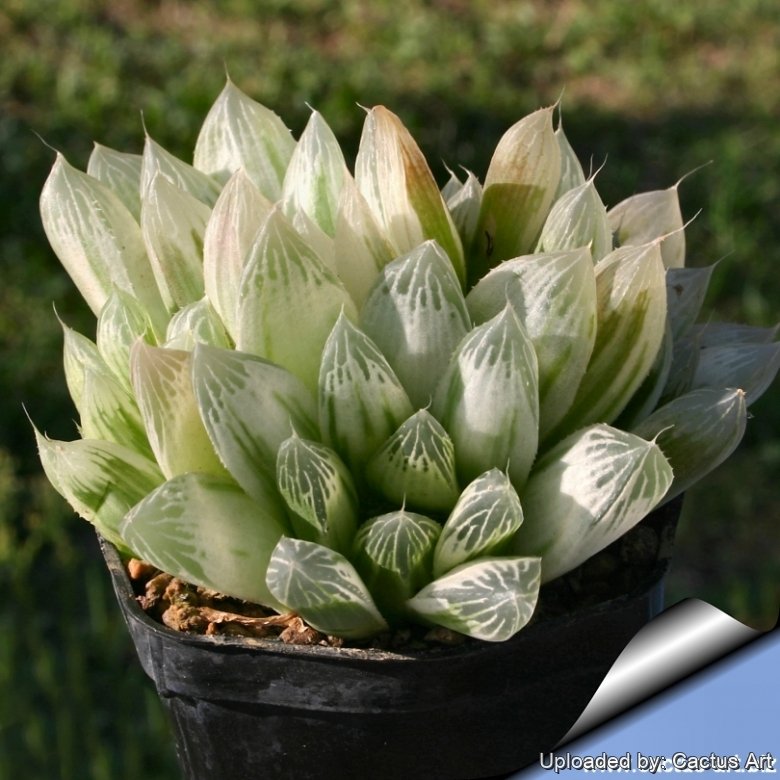
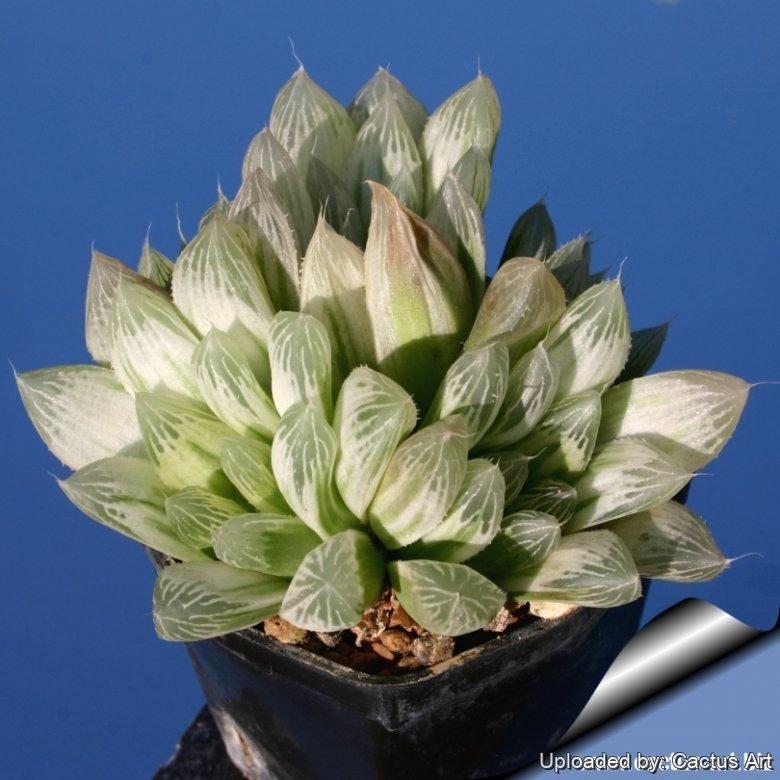
Variegated form(s): The pale foliage is distinctively patterned with a consistent, whitish-grey, variegation. It slowly forms offsets, becoming an attractive clump in time. Individual plants can vary a lot depending on the care they’ve received, especially the amount of light.
Rosettes: 35-90(-120) mm across each with 20 to 40 leaves .
Leaves: Up to 20-25(-50) cm long, c. 6mm thick, turgid, multifarious, oblong-lanceolate, half buried in the ground except for the translucent tips, often round and ending abruptly or acuminate with a large pellucid terminal awn to 6 mm long, flat on the face, convex on the back and keeled upwards or with both surfaces convex, pale green, grey-green or bluish-green with dark longitudinal lines becoming reddish with too much sun or not enough water. Margins and keel with pellucid deltoid-cuspidate teeth 2-4 mm long or smooth. The tips of the leaves have transparent epidermis with marks radiating from the awned leaf-tip, and the mesophyll is also transparent because it has no intercellular spaces. Consequently, light enters through the window-like tip and then passes deep into the rest of the under-ground leaf, where cells with chloroplasts are located: photosynthesis actually occurs underground. Because most of each leaf is subterranean, they stay cooler in summer, they are less visible to animals, and the air in the soil is richer in carbon dioxide than is air above ground.
Inflorescence: Peduncle simple, about a 30 cm long; raceme simple, 15 cm long consisting of 20 to 30 closely set flowers; pedicels very short; bracts deltoid, 3-6 mm long narrowly elongate, whitish.
Flowers: Narrowly elongate, whitish. The flower’s Structure, colour and fruits are typical of the genus. Perianth c.2 cm long; segments half as long as the tube.
Blooming season:Spring to summer (in habitat November to January)
Origin and Habitat
Garden origin (Nursery produced cultivar). The original natural habitat of this species is Eastern Cape.
Bibliography
Major references and further lectures
-
Gordon D. Rowley “The illustrated encyclopedia of succulents” Crown Publishers, 01/Aug/1978
-
Doreen Court “Succulent Flora of Southern Africa” CRC Press, 01/Jun/2000
-
Urs Eggli “Illustrated Handbook of Succulent Plants: Monocotyledons” Springer, 2001
-
Charles L. Scott “The genus Haworthia (Liliaceae): a taxonomic revision” Aloe Books, 1985
-
Stuart Max Walters “The European Garden Flora: Pteridophyta, Gymbospermae, Angiospermae-Monocotyledons” Cambridge University Press, 1984
-
M. B. Bayer “The new Haworthia handbook” National Botanic Gardens of South Africa, 1982
-
John Pilbeam “Haworthia and Astroloba: A Collector’s Guide” B. T. Batsford Limited, 1983
-
Bruce Bayer “Haworthia revisited: a revision of the genus” Umdaus Press, 1999
-
Ernst Van Jaarsveld, Ben-Erik Van Wyk, Gideon Smith “Succulents of South Africa: A Guide to the Regional Diversity” Tafelberg Publishers, Limited, 01/Jul/2000
-
ames D. Mauseth “Botany: An Introduction to Plant Biology” Jones & Bartlett Publishers, 2014
-
Charles L. Scott “The Genus Haworthia (Liliaceae): A Taxonomic Revision” Aloe Books, 1985
-
Noel Urton “Plants of the Swartkops valley bushveld” Zwartkops Trust, 1993
-
W. Wilson Saunders: “Refugium Botanicum; or, Figures and Descriptions from Living Specimens of Little Known of New Plants of Botanical Interest” volume 4, London 1871
-
Cactus and Succulent Journal (US) 53: 70-71 1981
-
J. G. Baker “Flora Capensis” page 253 1897
-
Bayer, M.B and van Jaarsveld, E. 2001. “Haworthia. in Illustrated Handbook of Succulent Plants: Monocotyledons.” Springer, Berlin.
-
Bayer, M.B. 1999. “Haworthia Revisited: A revision of the genus.” Umdaus Press, Hatfield.
-
Bayer, M.B. and Manning, J.C. “The Haworthia nomenclator: A list of accepted species with some guidelines for infraspecific names.” Haworthia Update 7(4):30-40.2012
-
Manning, J.C., Boatwright, J.S., Daru, B.H., Maurin, O. and Van der Bank, M. “A molecular phylogeny and generic classification of Asphodelaceae subfamily Alooideae: A final resolution of the prickly issue of polyphyly in the Alooids?” Systematic Botany 39(1):55-74. 2014
-
von Staden, L., Klopper, R. & Manning, J.C. 2014. Haworthia cooperi Baker. “National Assessment: Red List of South African Plants” version 2014.1. Accessed on 2014/06/10