Publication: Haworthia Revisited 55 (1999)
Description
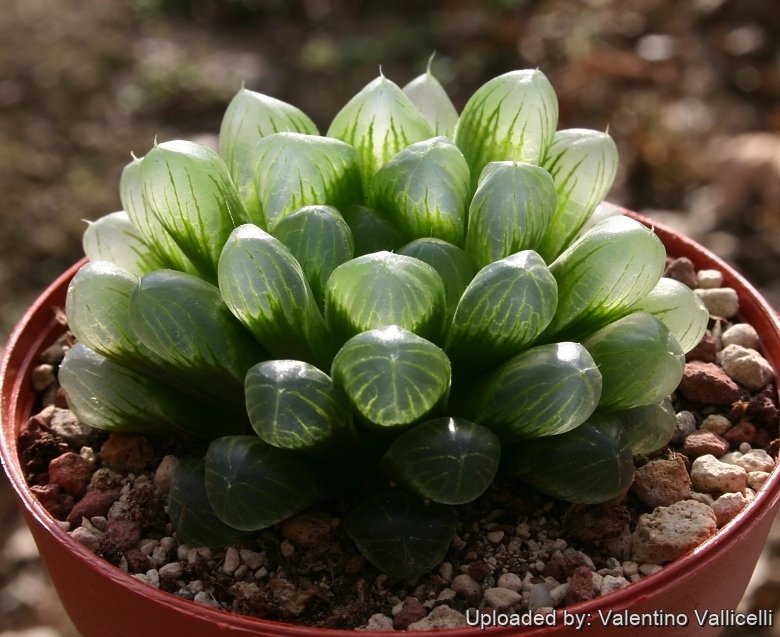
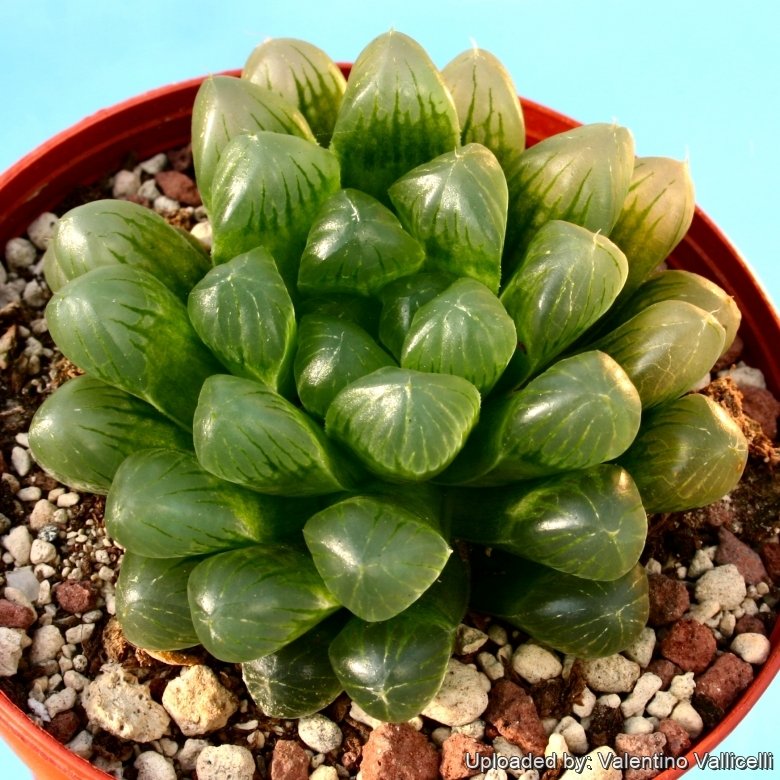
Strange spreading stemless plant that looks like a small grape cluster and makes fat little colonies, up to 7,5 cm in diameter.
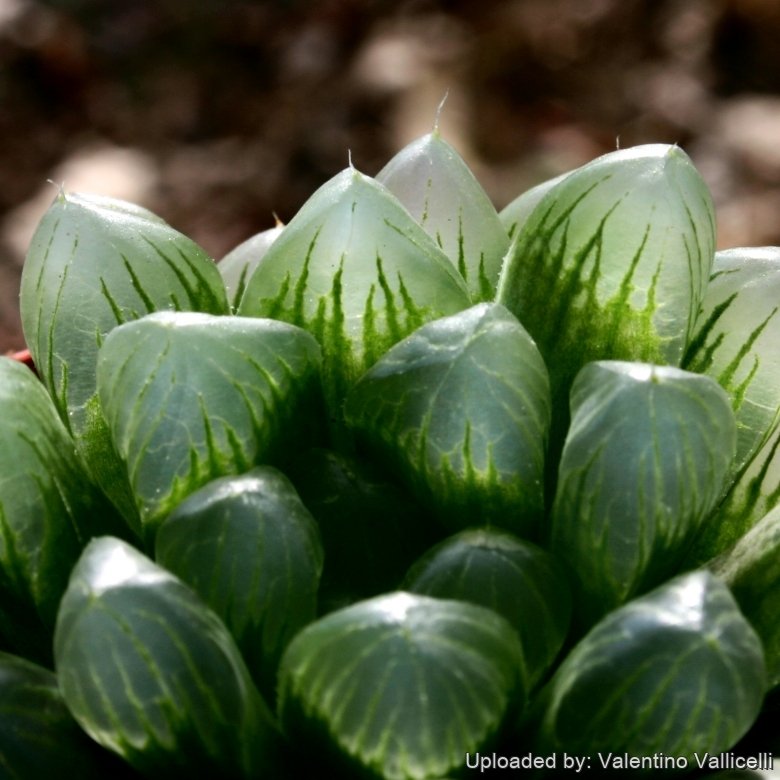
Leaves: 20 to 25 per rosette, succulent soft and glassy (almost transparent) round-tipped somewhat spherical with lovely blue-green translucent-patterns, leaves become reddish with too much sun or not enough water.
Origin and Habitat
South Africa (Eastern Cape Province, north of East London)
Cultivation and Propagation
There’s no difference in cultivation from usual plants of this type. Though it grows more slowly.
Exposure: Needs light shade to shade.
Watering needs: Regular water (They enjoy a little water during winter period too) but do not overwater as they will most likely wind up with root rot, and do not water again until dry!
Hardiness: Hardy to to -5°C (or less if dry).
Propagation: Offsets (New plants are freely produced basally between the leaves)
Notes
Fenestrate leaves: This plant is a choice example of the window-leaf ( fenestrate leaf) adaptation found in many Haworthias, Mesembreanthemums and Peperomias, the translucent ‘glassy’ windowed apices allow light into the internal plant body rich in chlorophyll-bearing layers of cells, thereby providing a much larger assimilation area.
The windows greatly increase the photosynthesizing area by allowing light into the centres of leaves and at the same time avoiding water loss.
Bibliography
Major references and further lectures
-
Gordon D. Rowley “The illustrated encyclopedia of succulents” Crown Publishers, 01/Aug/1978
-
Doreen Court “Succulent Flora of Southern Africa” CRC Press, 01/Jun/2000
-
Urs Eggli “Illustrated Handbook of Succulent Plants: Monocotyledons” Springer, 2001
-
Charles L. Scott “The genus Haworthia (Liliaceae): a taxonomic revision” Aloe Books, 1985
-
Stuart Max Walters “The European Garden Flora: Pteridophyta, Gymbospermae, Angiospermae-Monocotyledons” Cambridge University Press, 1984
-
M. B. Bayer “The new Haworthia handbook” National Botanic Gardens of South Africa, 1982
-
John Pilbeam “Haworthia and Astroloba: A Collector’s Guide” B. T. Batsford Limited, 1983
-
Bruce Bayer “Haworthia revisited: a revision of the genus” Umdaus Press, 1999
-
Ernst Van Jaarsveld, Ben-Erik Van Wyk, Gideon Smith “Succulents of South Africa: A Guide to the Regional Diversity” Tafelberg Publishers, Limited, 01/Jul/2000
-
ames D. Mauseth “Botany: An Introduction to Plant Biology” Jones & Bartlett Publishers, 2014
-
Charles L. Scott “The Genus Haworthia (Liliaceae): A Taxonomic Revision” Aloe Books, 1985
-
Noel Urton “Plants of the Swartkops valley bushveld” Zwartkops Trust, 1993
-
Manning, J.C., Boatwright, J.S., Daru, B.H., Maurin, O. and Van der Bank, M. “A molecular phylogeny and generic classification of Asphodelaceae subfamily Alooideae: A final resolution of the prickly issue of polyphyly in the Alooids?” Systematic Botany 39(1):55-74. 2014
-
von Staden, L., Klopper, R. & Manning, J.C. 2014. Haworthia cooperi Baker. “National Assessment: Red List of South African Plants” version 2014.1. Accessed on 2014/06/10
-
J. G. Baker “Flora Capensis” page 253 1897
-
Bayer, M.B and van Jaarsveld, E. 2001. “Haworthia. in Illustrated Handbook of Succulent Plants: Monocotyledons.” Springer, Berlin.
-
Bayer, M.B. 1999. “Haworthia Revisited: A revision of the genus.” Umdaus Press, Hatfield.
-
Bayer, M.B. and Manning, J.C. “The Haworthia nomenclator: A list of accepted species with some guidelines for infraspecific names.” Haworthia Update 7(4):30-40.2012