Publication: 61 (1983)
Description
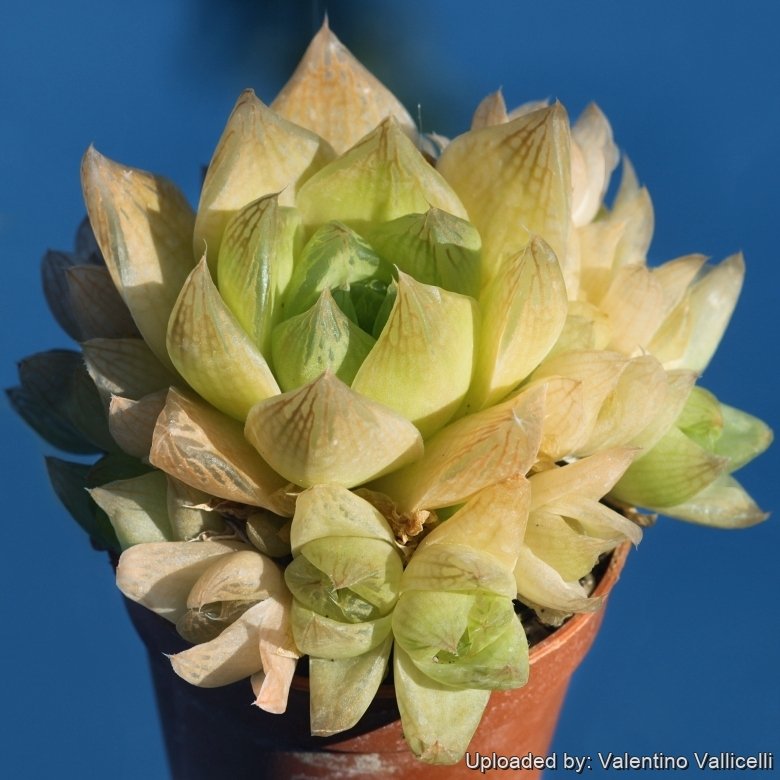
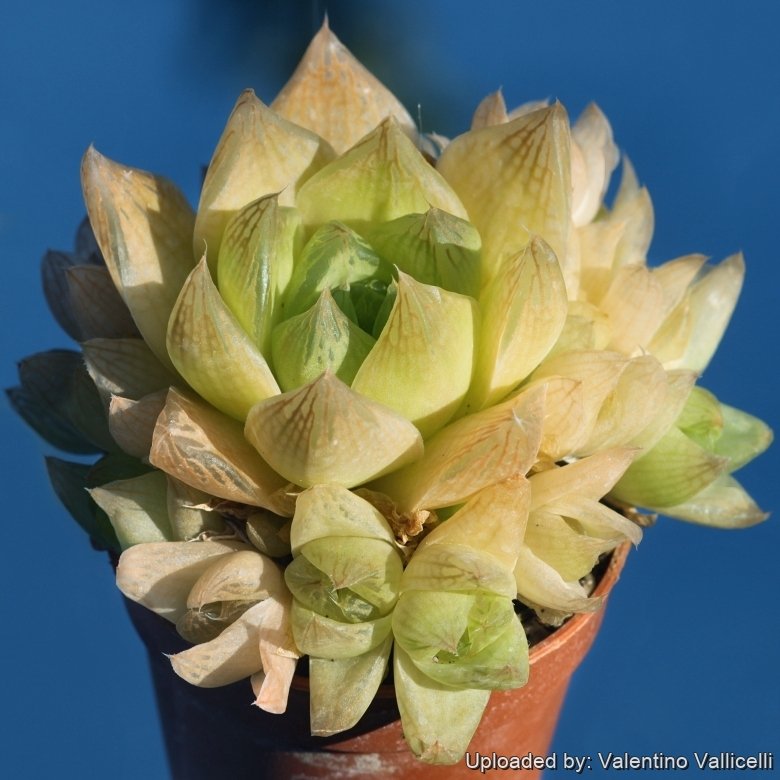
Haworthia cymbiformis f. pallida is on of the innumerable morphological forms of the very variable Haworthia cymbiformis. The “pallida” form is characterized by pale yellowish-green leaves.
Habit: It is a spreading ground cover succulent forming dense mats up to 15 cm (or more) in diameter.
Roots: Superficial.
Stem: Stemless or shortly caulescent
Rosette: Dense, 20–25 leafed, 7-10 cm diam
Leaves: Succulent, soft, very juicy, obovate, acute, 2,5-4(-5) cm long, up to 2 cm broad, 4-5 mm thick, slightly concave, rounded on the back, keeled upwards, not distinctly aristate, sometime slightly serrated near the tips, pale yellowhis-green, marked especially in the upper half with indistinct anastomosing vertical achlorophyllous lines forming a translucent surface with ample irregular areas free of pigmentation known as windows.
Flowers: Relatively inconspicuous whitish/greenish with a light pinkish-brown keel, peduncle simple, 15 cm long; raceme lax, 15 long; lower pedicels 4-6 mm long; bracts small, ovate; perianth 2 cm long; segments nearly as long as the tube.
Blooming season: Spring to summer.
Origin and Habitat
Nursery selected form.
Cultivation and Propagation
They are amongst the easiest Haworthias to grow. On account of their easy cultivation these plants are fairly common in collections and are more tolerant of injudicious watering than the others. They must be repotted frequently, because every year a part of their roots die and then rots in the pot. They are very responsive to differing cultural conditions both as regards colour, length and shape of leaves, rate of growth and size of plant.
Watering Needs: Water regularly in the growing season, but avoid water-logging and let dry between watering, they should never dry out completely during the rest period.
Frost Tolerance: Hardy to -1 (-5)°C.
Propagation: Seeds or (usually) offsett.
Sun Exposure: It prefers locations with diffuse sunlight or light shade, it can tolerate shade. It proliferates rapidly and should be exposed to at least some direct sunlight to prevent bloating and excessive softening of the plants, but shelter from direct sun during the hottest hours! Plants can have more remarkable colour under stress and if more exposed to direct sunlight.
Bibliography
Major references and further lectures
-
Urs Eggli “Illustrated Handbook of Succulent Plants: Monocotyledons” Springer, 2001
-
Charles L. Scott “The genus Haworthia (Liliaceae): a taxonomic revision” Aloe Books, 1985
-
Stuart Max Walters “The European Garden Flora: Pteridophyta, Gymbospermae, Angiospermae-Monocotyledons” Cambridge University Press, 1984
-
M. B. Bayer “The new Haworthia handbook” National Botanic Gardens of South Africa, 1982
-
John Pilbeam “Haworthia and Astroloba: A Collector’s Guide” B. T. Batsford Limited, 1983
-
Gordon D. Rowley “The illustrated encyclopedia of succulents” Crown Publishers, 01/Aug/1978
-
Linda R. Berg “Introductory Botany: Plants, People, and the Environment” Cengage Learning, 02/Mar/2007
-
Dieter J. Von Willert “Life strategies of succulents in deserts: with special reference to the Namib desert” CUP Archive, 1992
-
A. J. van Laren “Succulents other than cacti” Abbey San Encino Press, 1934
-
Walther Haage “Cacti and succulents: a practical handbook” Dutton, 1963
-
Adrian Hardy Haworth “A new Arrangement of the Genus Aloe, with a chronological Sketch of the progressive Knowledge of that Genus, and of other succulent Genera.” In: Transactions of the Linnean Society of London. Band 7, Nummer 1, London 1804
Gallery