Publication: Cact. Succ. J. Gr. Brit. 7: 40 1938.
Description
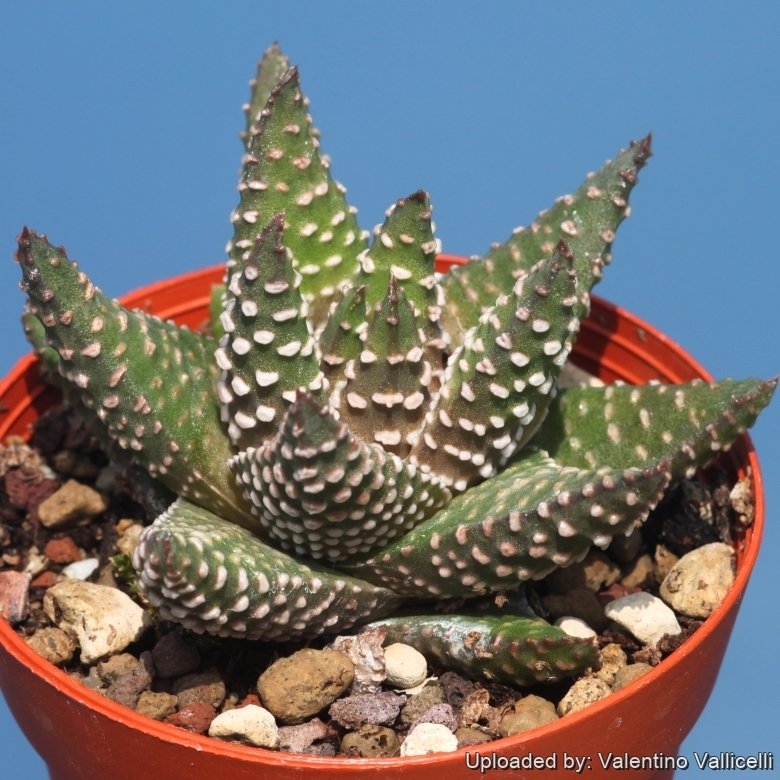
Haworthia herbacea is a small, low growing succulent that forms crowded clusters varying in size from 35 mm to 80 mm in diameter, but this plant will never take much space in a collection. It grows deeply sunken in the ground and is has characteristic hairy but firm glassy spines with some striping and spotting on the leaves… barely has that transluscent look when very small.
Stem: Leafy stem very short almost invisible.
Rosettes: Up to 8 cm in diameter proliferating.
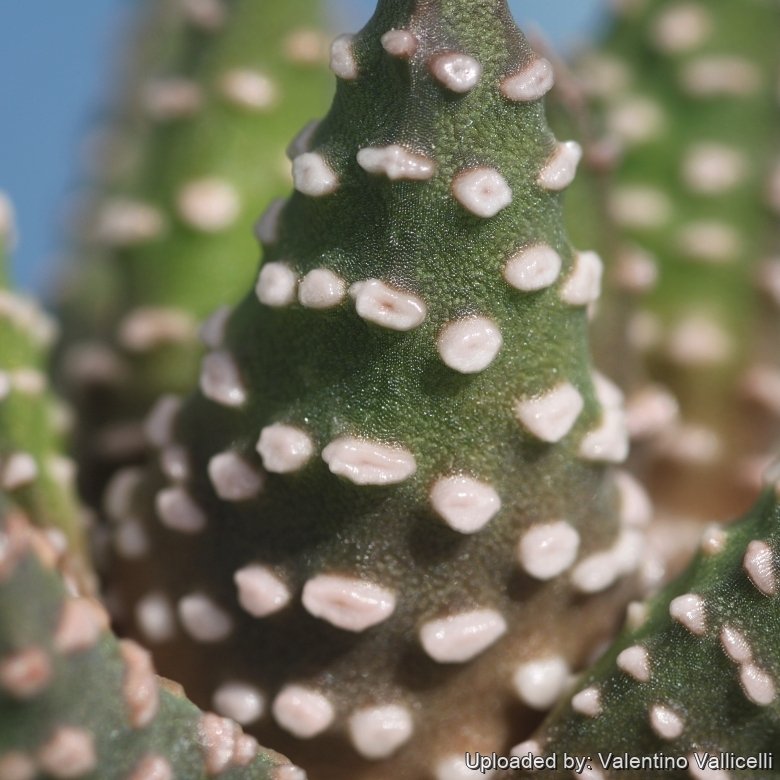
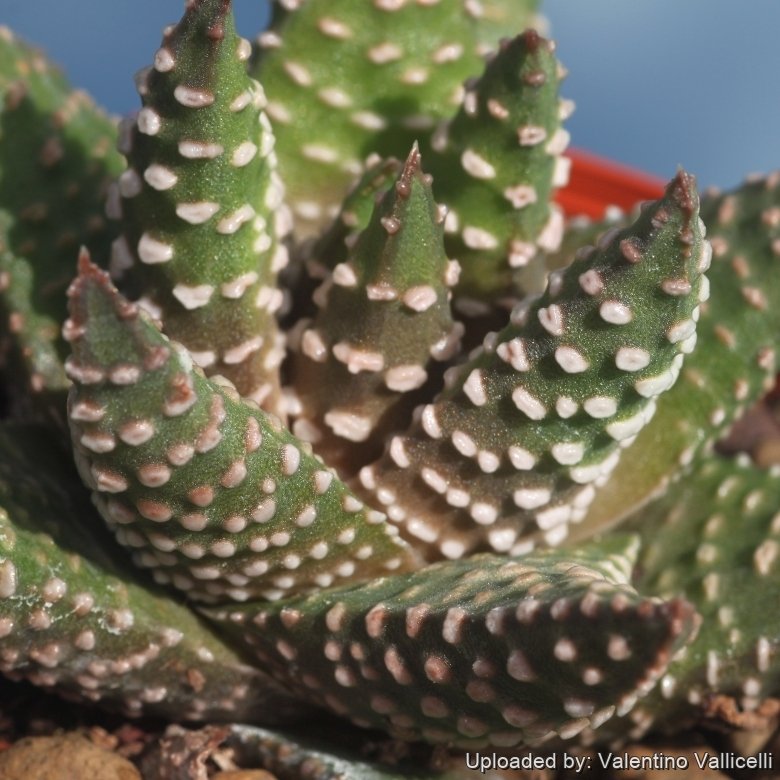
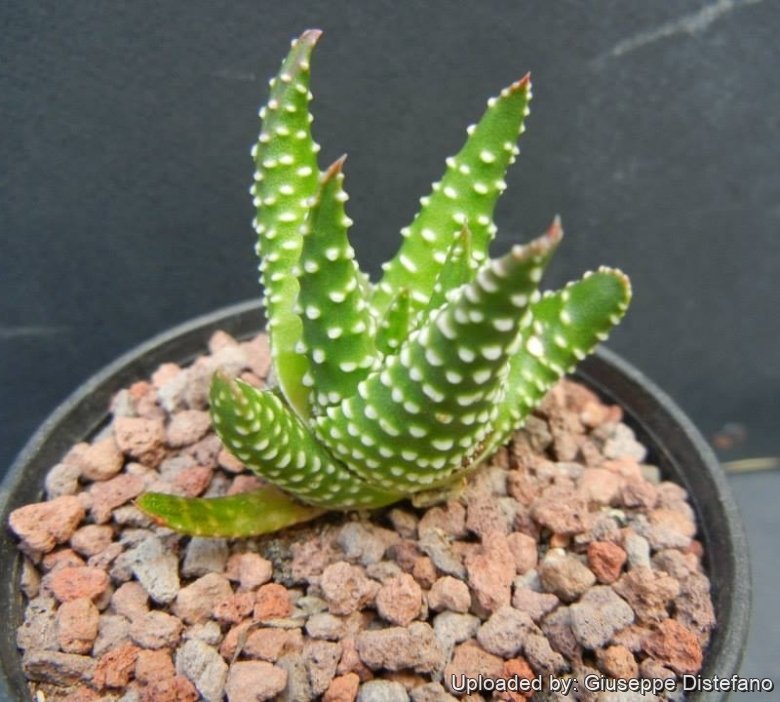
Leaves: Erect, incurved, ovate-lanceolate or triangular, up to 6 cm long and about 1 cm broad at the base, pointed and quite stiff, rough-textured, greenish-yellow, with reticulate pattern with translucent areas between the veins. Margins and keel fringed with firm glassy white spines. As matures the leaves tends to become a dark waxy green and spots are more raised, pure white and randomly speckled on both sides of the leaves. Leaves may be quite variable looking in different clones.
Inflorescence: Simple or occasionally forked 30-40-flowered racemes, up to 30 cm tall.
Flowers: Large, creamy-white or beige with pinkish tips.
Blooming season: Late winter to spring.
Origin and Habitat
Western Cape (Worcester area in the south-east to east of McGregor, south into the mountains at Villiersdorp to just north-west of Worcester itself.)
Habitat: It grows amongst stones, in stony soil and in spaces in grassy areas.
Cultivation and Propagation
Haworthia are of easy cultivation and relatively low maintenance (they can grow easily on window sills, verandas and in miniature succulent gardens where they are happy to share their habitat with other smaller succulent plants, or in outdoor rockeries). Haworthias are winter growers and are dormant in the hottest summer months.
Growth rate: They are relatively fast-growing plants that offsets freely to form small clusters quickly.
Soil: They are tolerant of a wide range of soils and habitats, but prefer a very porous potting mix to increase drainage. A non-acid soil is ideal. You can grow a plant in a 10-15 cm pot for years and have perfectly happy plants. For best results, use a shallow pot.
Exposition: The plant needs light shade to shade, but will take full sun part of the day. (with some sun exposure the leaf develops a nice reddish tint and remains compact)
Watering: During the hot summer months, the soil should be kept moist but not overly wet. During the winter months, water only when the soil becomes completely dry. Wet soil quickly causes root and stem rot, especially during chilly winter months. . No water should ever be allowed to stand around the roots. Low ambient humidity is always needed.
Fertilization: The plants are fertilized only once during the growing season with a balanced fertilizer diluted to ½ the recommended strength.
Hardiness: Although the plant will survive mild frost if kept dry (hardy as low as -5° C) it should be protected from severe cold and prolonged frost conditions.
Rot: Rot is only a minor problem with Haworthia if the plants are watered and “aired” correctly. If they are not, fungicides won’t help all that much. Care must be given in watering, keeping them warm and wet while growing, and cooler and dry when dormant.
Remarks: Haworthias are best planted in a shaded and airy part of the greenhouse, and not too close to the glass roof or sides of the house as the plants can overheat during hot spells.
Propagation: Haworthia are easily propagated by the removal of offshoots or by leaf cuttings in spring or summer. To propagate by leaf cuttings, remove a leaf and let it lie for about one month, giving the wound time to heal. Then lay the leaf on its side with the basal part buried in the soil. This leaf should root within a month or two, and small plants will form at the leaf base. They can also be grown from seed.
Notes
The name herbacea is quite “problematic”, it has been applied in past to many different forms (previously considered independent species) with one form intergrading into another, creating a taxonomig nightmare. (See the long list of synonyms). It is one of the Haworthia with the prettiest foliage. It is very close to Haworthia reticulata which has different yellowish flowers.
Bibliography
Major references and further lectures
-
Urs Eggli “Illustrated Handbook of Succulent Plants: Monocotyledons” Springer, 2001
-
Charles L. Scott “The genus Haworthia (Liliaceae): a taxonomic revision” Aloe Books, 1985
-
James Cullen, Sabina G. Knees, H. Suzanne Cubey “The European Garden Flora Flowering Plants: A Manual for the Identification of Plants Cultivated in Europe, Both Out-of-Doors and Under Glass” Cambridge University Press, 11/Aug/2011
-
M. B. Bayer “The new Haworthia handbook” National Botanic Gardens of South Africa, 1982
-
John Pilbeam “Haworthia and Astroloba: A Collector’s Guide” B. T. Batsford Limited, 1983
-
Gordon D. Rowley “The illustrated encyclopedia of succulents” Crown Publishers, 01/Aug/1978
From llifle page Catevala papillosa
Description
Haworthia papillosa is a small, low growing succulent that forms crowded clusters of rosettes with characteristic raised dots on both sides of the leaves. It is one of the Haworthia with the prettiest foliage. It was introduced into cultivation about 1750.
Leaves: Erect, incurved, ovate-lanceolate or triangular, multifarious, thick, pointed and quite stiff, up to 6(-10) cm long and about 1-3 cm broad at the base, glaucous green or dull-green often reddish-brown in strong light and under stress, rather convex on the face, rounded on the back, obscurely keeled towards the apex, covered with raised pearly bosses 2 mm in diameter randomly speckled on both sides of the leaves.
Inflorescence: Flowering stalk simple or branched 30-40 cm tall wit the racemes 15-22 cm long. Pedicels short, erecto-patent; bracts minute, deltoid; perianth about 2 cm long; limb half as long as the tube.
Flowers: Large, creamy-white or beige with pinkish (or greenish) tips.
Blooming season: It flowers mainly in late spring to summer.
Origin and Habitat
Without locality, cultivated plants.
Bibliography
Major references and further lectures
-
J.G. Backer “Flora Capensis” page 253 (1897)
-
Haworth, Adrian Hardy. 1819. Original description of Haworthia papillosa.
-
Urs Eggli “Illustrated Handbook of Succulent Plants: Monocotyledons” Springer, 2001
-
Charles L. Scott “The genus Haworthia (Liliaceae): a taxonomic revision” Aloe Books, 1985
-
James Cullen, Sabina G. Knees, H. Suzanne Cubey “The European Garden Flora Flowering Plants: A Manual for the Identification of Plants Cultivated in Europe, Both Out-of-Doors and Under Glass” Cambridge University Press, 11/Aug/2011
-
M. B. Bayer “The new Haworthia handbook” National Botanic Gardens of South Africa, 1982
-
John Pilbeam “Haworthia and Astroloba: A Collector’s Guide” B. T. Batsford Limited, 1983
-
Gordon D. Rowley “The illustrated encyclopedia of succulents” Crown Publishers, 01/Aug/1978
Source: Catevala papillosa, LLIFLE - Encyclopedia of living forms, CC-BY-SA, retrieved 2026-10-25.
Gallery