Publication: Haworthia Revisited 109 (1999)
Description
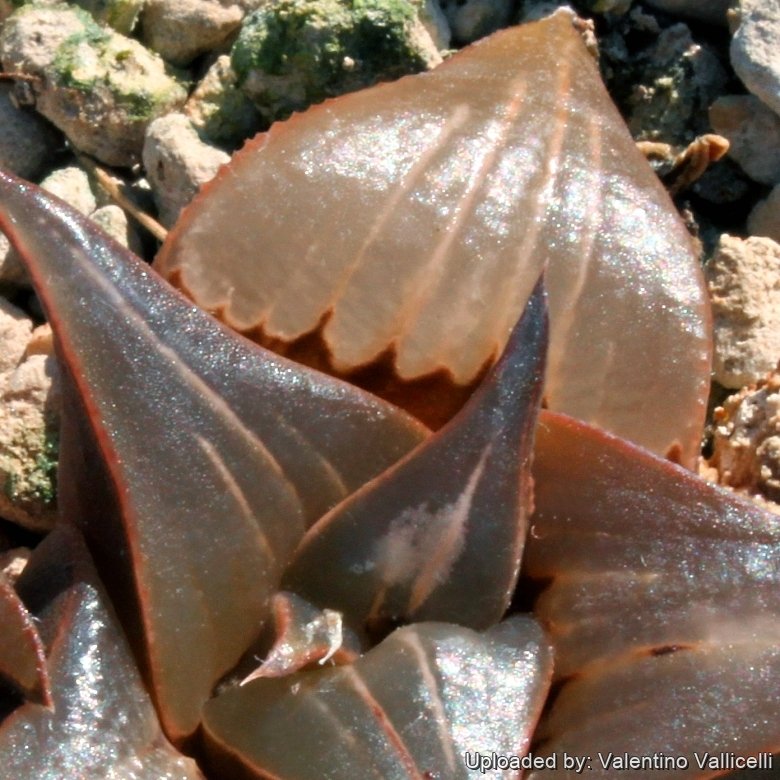
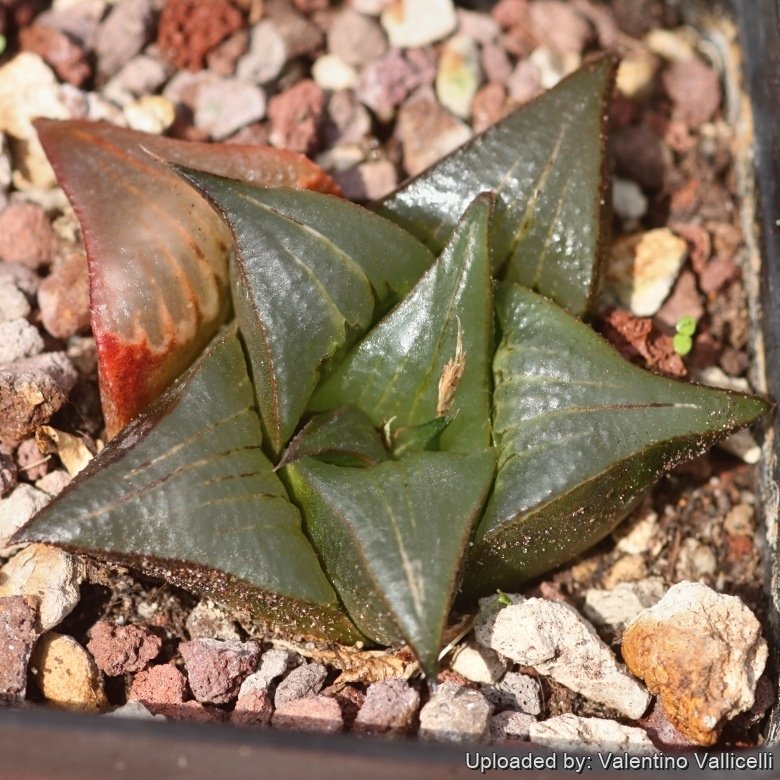
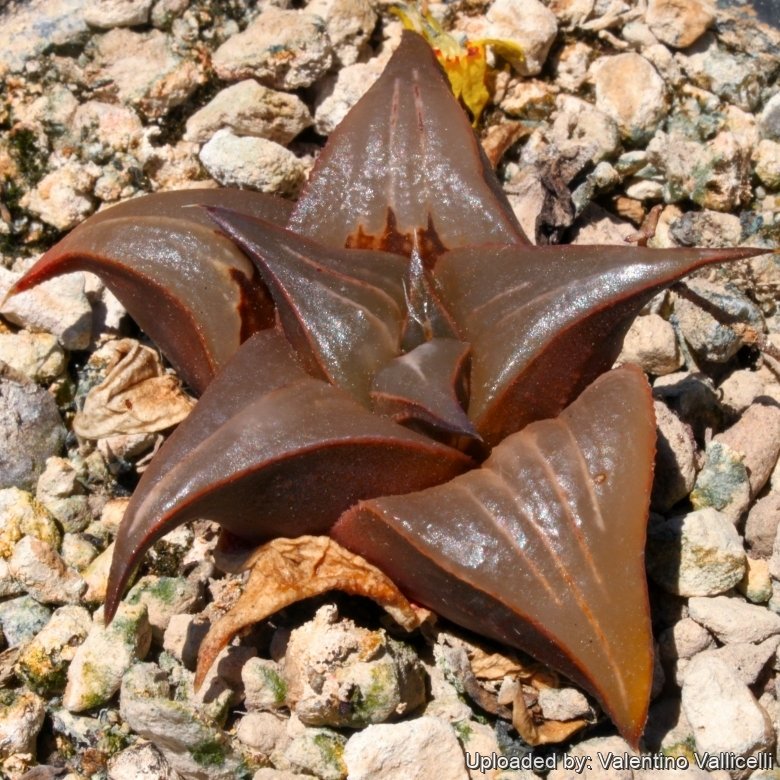
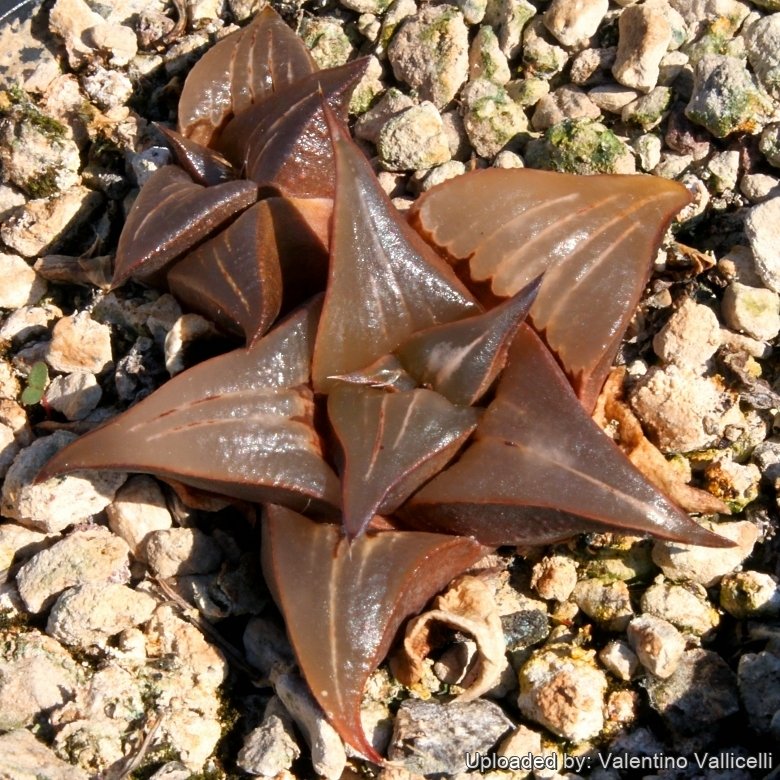
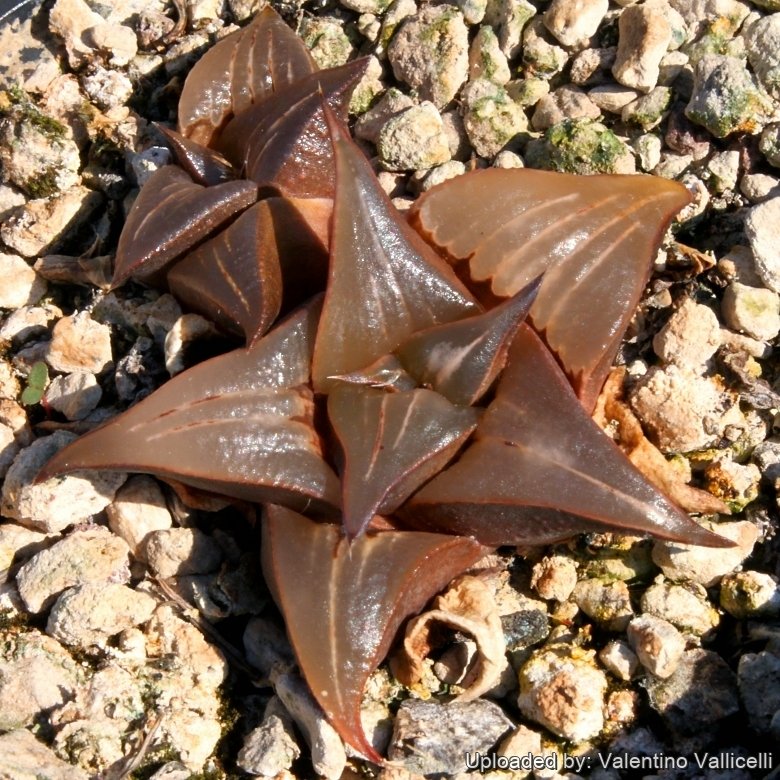
Haworthia mirahilis var. badia is one of the most beautifull species from mirabilis group. It is a slow growing plant with leaves like thick gelatin. With some sun exposure it takes exquisite shades of chestnut brown and when properly grown it is very decorative.
Distinctive characteristic: Differs from var. mirabilis for its stout rosettes, leaves attenuate retuse, smooth, deep shiny brown.
Habit: It stay usually solitary but can occasionally proliferates after several years.
Leaves: Strongly recurved, attenuate, usually reddish brown or bronze-rose, translucent, not tuberculate beneath, margin smooth or slightly rough.
Inflorescence: Slender, simple, slender, sparsely flowered raceme up to to 25 cm tall. Only few flowers open together at the same time.
Flowers: Narrowly elongate, whitish. The flower’s Structure, colour and fruits are typical of the genus. Bud S-shaped.
Origin and Habitat
Republic of South Africa (Western Cape: Napier).
Habitat: It grows under low fynbos vegetation (shrubland vegetation occurring in a small belt of the Western Cape of South Africa, mainly in winter rainfall coastal with a Mediterranean climate) on sandstone derived depauperate clay or among small pebbles and grass. It is threatened by habitat loss and habitat degradation. It is a mostly a winter and spring grower. Type locality was nearly destroyed by stone excavation activities and also invasion by alien vegetation.
Cultivation and Propagation
Haworthia badia are winter grower and are dormant in the hottest summer months.
Growth rate: Haworthia badia is a slow growing species. You have to be patient with it, but when it grows larger, it becomes very attractive.
Soil: They are tolerant of a wide range of soils and habitats, but prefer a very porous potting mix to increase drainage. You can grow a plant in a 10-15 cm pot for years and have perfectly happy plants. For best results, use a shallow pot.
Exposition: The plant needs light shade to shade, but will take full sun part of the day. (with some sun exposure the leaf develops a nice reddish tint and remains compact)
Watering: During the hot summer months, the soil should be kept moist but not overly wet. During the winter months, water only when the soil becomes completely dry. Wet soil quickly causes root and stem rot, especially during chilly winter months. . No water should ever be allowed to stand around the roots. Low ambient humidity is always needed.
Fertilization: The plants are fertilized only once during the growing season with a balanced fertilizer diluted to ½ the recommended strength.
Hardiness: Although the plant will survive mild frost if kept dry (hardy as low as -5° C) it should be protected from severe cold and prolonged frost conditions.
Rot: Rot is only a minor problem with Haworthia if the plants are watered and “aired” correctly. If they are not, fungicides won’t help all that much. Care must be given in watering, keeping them warm and wet while growing, and cooler and dry when dormant.
Remarks: Haworthias are best planted in a shaded and airy part of the greenhouse, and not too close to the glass roof or sides of the house as the plants can overheat during hot spells.
Propagation: It should be propagated by seeds or leave cuttings. To propagate by leaf cuttings, remove a leaf and let it lie for about one month, giving the wound time to heal. Then lay the leaf on its side with the basal part buried in the soil. This leaf should root within a month or two, and small plants will form at the leaf base. They can also be grown from seed.
Bibliography
Major references and further lectures
-
Gordon D. Rowley “The illustrated encyclopedia of succulents” Crown Publishers, 01/Aug/1978
-
Dieter J. Von Willert “Life strategies of succulents in deserts: with special reference to the Namib desert” CUP Archive, 1992
-
Urs Eggli “Illustrated Handbook of Succulent Plants: Monocotyledons” Springer, 2001
-
Charles L. Scott “The genus Haworthia (Liliaceae): a taxonomic revision” Aloe Books, 1985
-
Stuart Max Walters “The European Garden Flora: Pteridophyta, Gymbospermae, Angiospermae-Monocotyledons” Cambridge University Press, 1984
-
M. B. Bayer “The new Haworthia handbook” National Botanic Gardens of South Africa, 1982
-
John Pilbeam “Haworthia and Astroloba: A Collector’s Guide” B. T. Batsford Limited, 1983
-
Bruce Bayer “Haworthia revisited: a revision of the genus” Umdaus Press, 1999