Publication: Saxifrag. Enum. 2: 55 1821. (Revis. Pl. Succ. 55)
Description
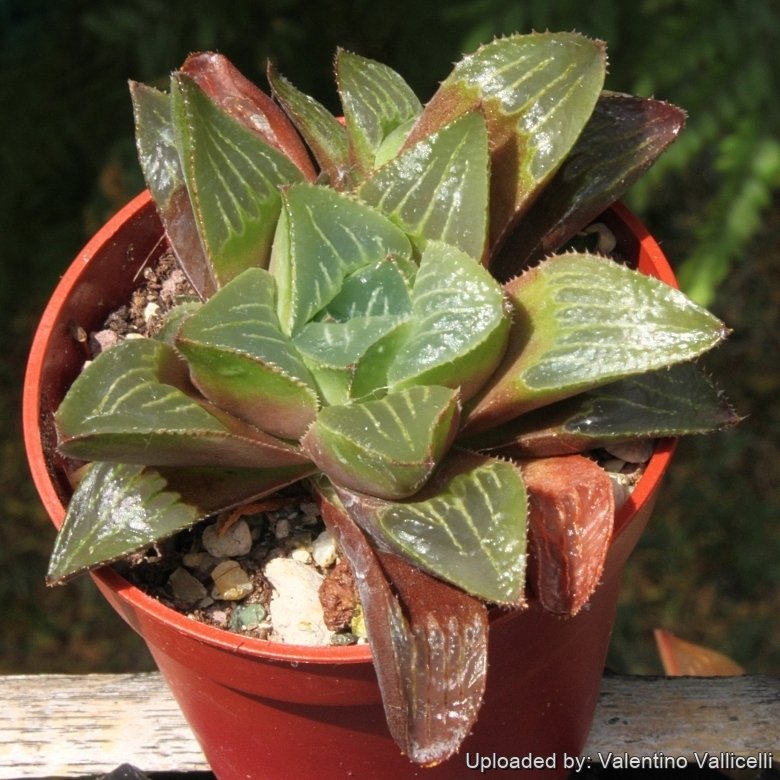
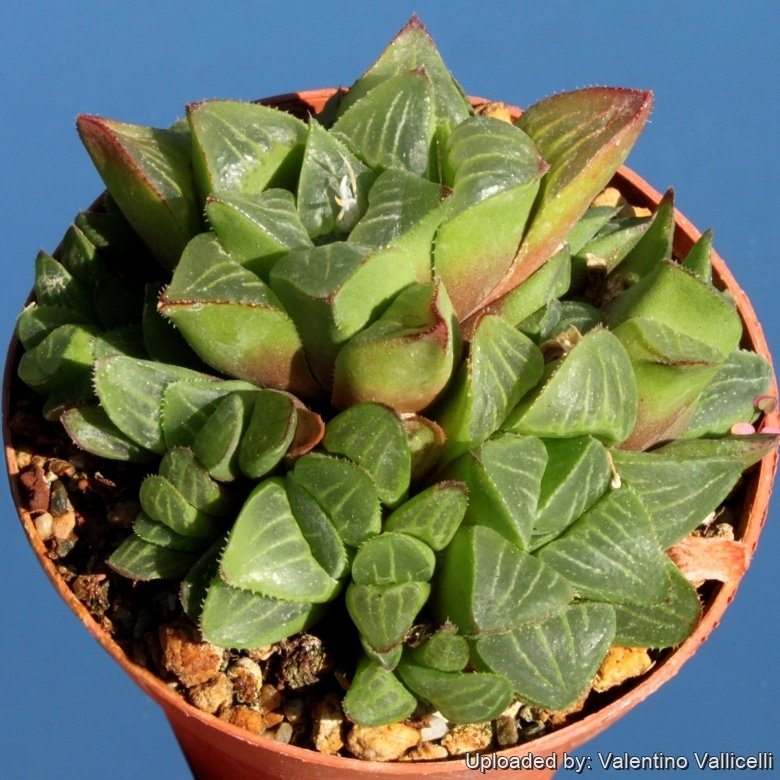
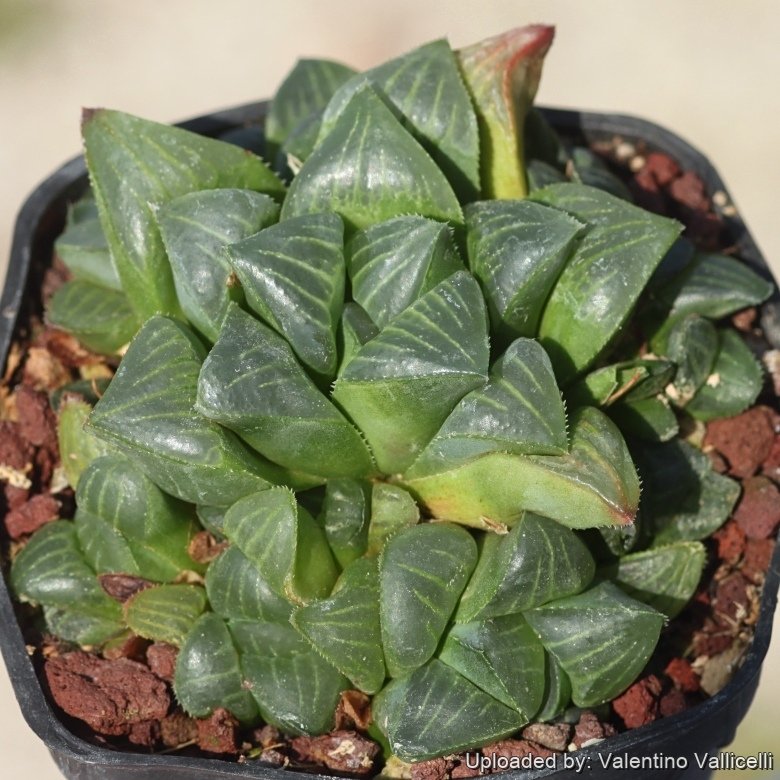
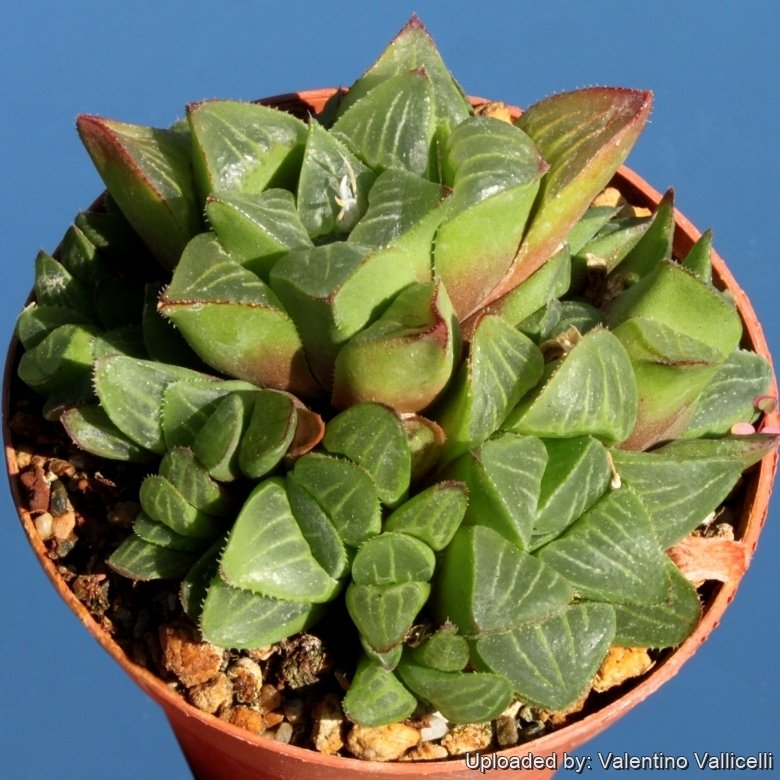
Haworthia mutica is one of the retuse-leaved haworthias, with compact flattened rosettes of prominently windowed leaves. It is mainly a non-proliferous species that do not offsets or offsets slowly, but most of the plants in cultivation derives from very prolific clones and form soon dense clumps. It is a variable species sometimes difficult to distinguish from to Haworthia retusa and Haworthia pygmaea.
Leaves: Thick geometric, truncated and triangular at apex, glaucous grey-green or glossy dark green with a characteristic bluish-brown colouration, often developing purplish cloudiness and striped in subtle shades of green. The tips are transparent and act like windows, allowing sun to enter inside of the leaf for chlorophyll processing.
Flowers: Small, two-lipped, greenish-white with pale purplish veins.
Blooming season: Mainly in Summer but it may flowers in any favourable season.
Origin and Habitat
South Africa (Western Cape: Overberg)
Habitat: Haworthia mutica grows almost buried in the ground on rocky shale ridges often in crevices. It shares its distribution area with Haworthia maraisii, Haworthia russouwii, Haworthia modesta, Haworthia heidelbergensis var. minor and Gasteria carinata. In many other embedded plant forms, including Bulbine mesembryanthemoides and many species of Opthalmophyllum and Lithops, light reaches internal chloroplasts in the buried leaf through windows of unpigmented cells on the exposed leaf tips. Small succulents resemble the soil, stones or dung of their habitats, or the shadows and woody stems of the shrubs that shelter them. Individuals that escape predation may be remarkably long-lived, up to 95 years in the case of Lithops plants.
Cultivation and Propagation
Haworthia mutica grows best in bright but indirect, or moderate light or redden nicely in full sun. It grows without any major problems in cultivation and is an ideal small indoor plant. Outdoors it suit in rockeries, but avoid frost.
Soil: They are slow growing and prefer a porous, well-draining soil.
Moisture: They need regular water, but don’t let the soil be constantly moist or soggy and while not wanting to be excessively wet, they will be equally unhappy if the soil is kept dry for long periods.
Hardiness: They do best in warm dry climates. Frost Tolerance: -1.C° (or less for short periods).
Propagation: They should be propagated by seeds or vegetatively by leave cuttings or division of larger clumps.
Bibliography
Major references and further lectures
-
Gordon D. Rowley “The illustrated encyclopedia of succulents” Crown Publishers, 01/Aug/1978
-
Urs Eggli “Illustrated Handbook of Succulent Plants: Monocotyledons” Springer, 2001
-
Charles L. Scott “The genus Haworthia (Liliaceae): a taxonomic revision” Aloe Books, 1985
-
Stuart Max Walters “The European Garden Flora: Pteridophyta, Gymbospermae, Angiospermae-Monocotyledons” Cambridge University Press, 1984
-
M. B. Bayer “The new Haworthia handbook” National Botanic Gardens of South Africa, 1982
-
John Pilbeam “Haworthia and Astroloba: A Collector’s Guide” B. T. Batsford Limited, 1983
7)Bayer, M.B and van Jaarsveld, E. 2001.” Haworthia. in Illustrated Handbook of Succulent Plants: Monocotyledons.” Springer, Berlin.
- Bruce Bayer “Haworthia revisited: a revision of the genus” Umdaus Press, 1999
From llifle page Haworthia otzenii
Description
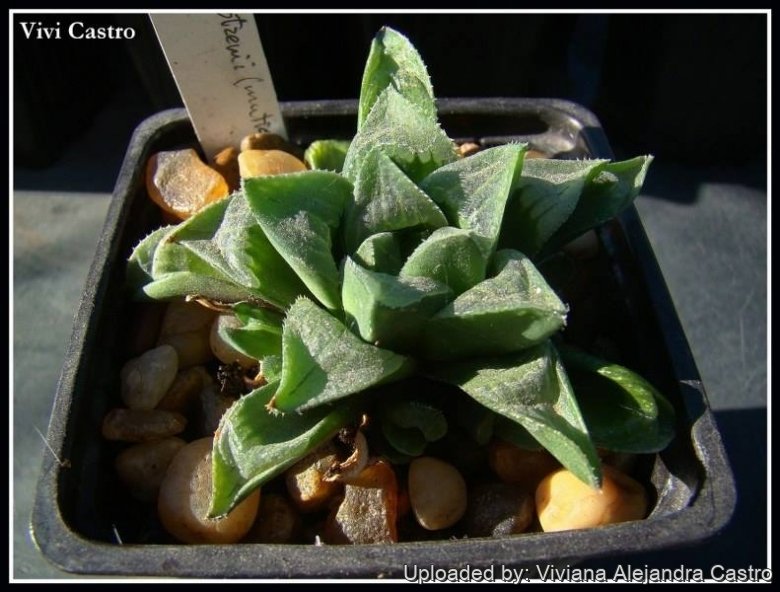
Haworthia otzenii is a medium-sized stemless species that consist of pale to dark green rosettes with parallel light markings on tips. The plant is suckering and blush bronze when grown in bright light.
Remarks: Haworthia otzenii G.G. Smith is regarded by Bayer as a synonym of Haworthia mutica Haw. var. mutica, but even if the the place where this plant was first collected is known, there are no original specimens and plants subsequently collected there do not fit Smith’s description, furthermore plants in cultivation under this name appear to be hybrids of Haworthia mirabils. So much confusion surrounds the name that some suggests that it should not be used.
Origin and Habitat
Haworthia otzenii was apparently collected by Otzen from near Napier (Western Cape, South Africa), but plants subsequently collected there do not fit the original description. Napier is also the country of origin of Haworthia badia.
Cultivation and Propagation
Haworthia otzenii grows best in bright but indirect, or moderate light or redden nicely in full sun. It grows without any major problems in cultivation and is an ideal small indoor plant. Outdoors it suit in rockeries, but avoid frost.
Soil: They are slow growing and prefer a porous, well-draining soil.
Moisture: They need regular water, but don’t let the soil be constantly moist or soggy and while not wanting to be excessively wet, they will be equally unhappy if the soil is kept dry for long periods.
Hardiness: They do best in warm dry climates. Frost Tolerance: -1.C° (or less for short periods).
Propagation: They should be propagated by seeds or vegetatively by leave cuttings or division of larger clumps.
Bibliography
Major references and further lectures
-
Doreen Court “Succulent Flora of Southern Africa” CRC Press, 01/Jun/2000
-
Urs Eggli “Illustrated Handbook of Succulent Plants: Monocotyledons” Springer, 2001
-
Charles L. Scott “The genus Haworthia (Liliaceae): a taxonomic revision” Aloe Books, 1985
-
Stuart Max Walters “The European Garden Flora: Pteridophyta, Gymbospermae, Angiospermae-Monocotyledons” Cambridge University Press, 1984
-
M. B. Bayer “The new Haworthia handbook” National Botanic Gardens of South Africa, 1982
Source: Haworthia otzenii, LLIFLE - Encyclopedia of living forms, CC-BY-SA, retrieved 2026-10-25.