Publication: Haworthia Handb. 149, 1976
Description
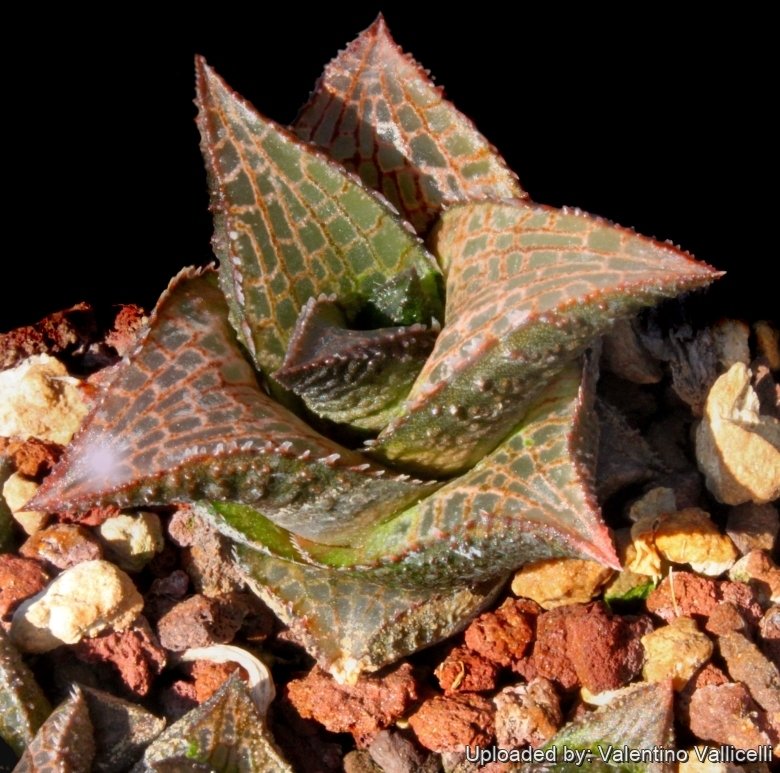
Haworthia venosa subs. recurva (more compact but not easily distinguishable from Haworthia veneosa ssp. tessellata) is a very variable plant and in the past there were a huge number of names amongst this species (at least 15 varieties), but all this varieties merge gradually one with another through a continuous series of transitional forms and it is almost impossible to tell them apart, so now they are all synonymized with Haworthia veneosa.
Rosette: Stemless, low 5-7(-10) cm in diameter with about 7-15 leaves arranged in spirals.
Leaves: Sessile 3-5 cm long, 2-3 cm wide at the base, fleshy, firm in texture, broadly triangular, strongly recurved, brownish to green, cuspidate at the apex; upper surface flattish, marked with six pale green anastomosing vertical lines forming a square patterned design and windowed (sunlight enters the plant body through these translucent windows and is converted into energy by many layers of chlorophyll-rich cells), lower surface is usually rounded slightly scabrid with raised coriaceous tubercles, especially in the upper part where they are arranged in transverse rows, margins with recurved white teeth.
Inflorescence: It is a lax, simple, raceme, few-flowered up to 50 cm tall.
Flowers: Greenish-white with green veins. Pedicels 2-3 mm long; bracts minute, deltoid; perianth 2 cm long; limb half as long as the tube.
Remarks: It was introduced into cultivation by Bowie about 1822.
Chromosome number: There are records of 5 basic numbers: 2n = 14, 28, 42, 56 and 63, distributed among 15 varieties.
Origin and Habitat
Widespread in the climatically severe central-southern Africa (Cape Province, Orange Free state) and Namibia. It is the only Haworthia that grows in Namibia. (May be some arachnoidea as well).
Habitat: It grows in shady place under the bush or in rock crevices. It is one of the most adaptable, widespread and also variable Haworthia primarily found in the summer rainfall area. Usually it is very proliferous or stoloniferous, it forms clusters in nature and fill in the space it has. It is associated with other succulents such as Euphorbia aggregata, Cotyledon toxicaria, Crassula obvallata, Mesembriantemum saxicolum and Stapelia flavirostris.
Cultivation and Propagation
Haworthia are of easy cultivation and relatively low maintenance, which makes them a good houseplant, and can be an excellent subject for the beginning succulentophile (they can grow easily on window sills, verandas and in miniature succulent gardens where they are happy to share their habitat with other smaller succulent plants, or in outdoor rockeries). Haworthias are winter growers and are dormant in the hottest summer months.
Growth rate: They are relatively fast-growing plants that offsets freely to form small clusters quickly.
Soil: They are tolerant of a wide range of soils and habitats, but prefer a very porous potting mix to increase drainage. A non-acid soil is ideal. You can grow a plant in a 10-15 cm pot for years and have perfectly happy plants. For best results, use a shallow pot.
Exposition: The plant needs light shade to shade, but will take full sun part of the day. (with some sun exposure the leaf develops a nice reddish tint and remains compact).
Watering: During the hot summer months, the soil should be kept moist but not overly wet. During the winter months, water only when the soil becomes completely dry. Wet soil quickly causes root and stem rot, especially during chilly winter months. No water should ever be allowed to stand around the roots. Low ambient humidity is always needed.
Fertilization: The plants are fertilized only once during the growing season with a balanced fertilizer diluted to ½ the recommended strength.
Hardiness: Although the plant will survive mild frost if kept dry (hardy as low as -5° C) it should be protected from severe cold and prolonged frost conditions.
Rot: Rot is only a minor problem with Haworthia if the plants are watered and “aired” correctly. If they are not, fungicides won’t help all that much. Care must be given in watering, keeping them warm and wet while growing, and cooler and dry when dormant.
Remarks: Haworthias are best planted in a shaded and airy part of the greenhouse, and not too close to the glass roof or sides of the house as the plants can overheat during hot spells.
Propagation: Haworthia are easily propagated by the removal of offshoots or by leaf cuttings in spring or summer. To propagate by leaf cuttings, remove a leaf and let it lie for about one month, giving the wound time to heal. Then lay the leaf on its side with the basal part buried in the soil. This leaf should root within a month or two, and small plants will form at the leaf base. They can also be grown from seed.
Bibliography
Major references and further lectures
-
Harrison, Lorraine. “RHS Latin for gardeners: Over 3,000 Plant Names Explained and Explored.” Octopus Publishing Group, 2012
-
Christopher Brickell “RHS A-Z encyclopedia of garden plants.” United Kingdom: Dorling Kindersley. 2008.
-
Stuart Max Walters, James Cullen “The European Garden Flora: Pteridophyta, Gymnospermae, Angiospermae” Cambridge University Press, 1986
-
Charles L. Scott “The genus Haworthia (Liliaceae): a taxonomic revision” Aloe Books, 1985
-
M. B. Bayer “The new Haworthia handbook” National Botanic Gardens of South Africa, 1982
-
Helen Glen, D. S. Hardy, G. Germishuizen “Flora of Southern Africa” National Botanical Institute, 2000
-
Maurizio Sajeva, Mariangela Costanzo “Succulents 2” Timber Press, 15/mar/2000
-
John Pilbeam “Haworthia and Astroloba: A Collector’s Guide” B. T. Batsford Limited, 1983
Gallery