Publication: Prodr. [A. P. de Candolle] 8: 665. 1844 [mid Mar 1844] see also: Sweet in Hort. Brit. [Sweet], ed. 2. 359. 1830
Description
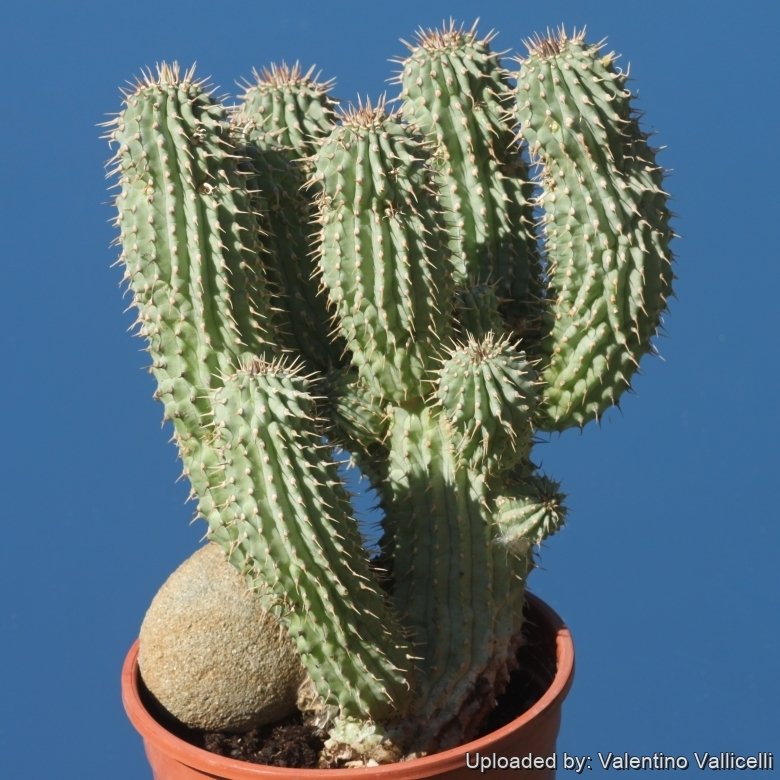
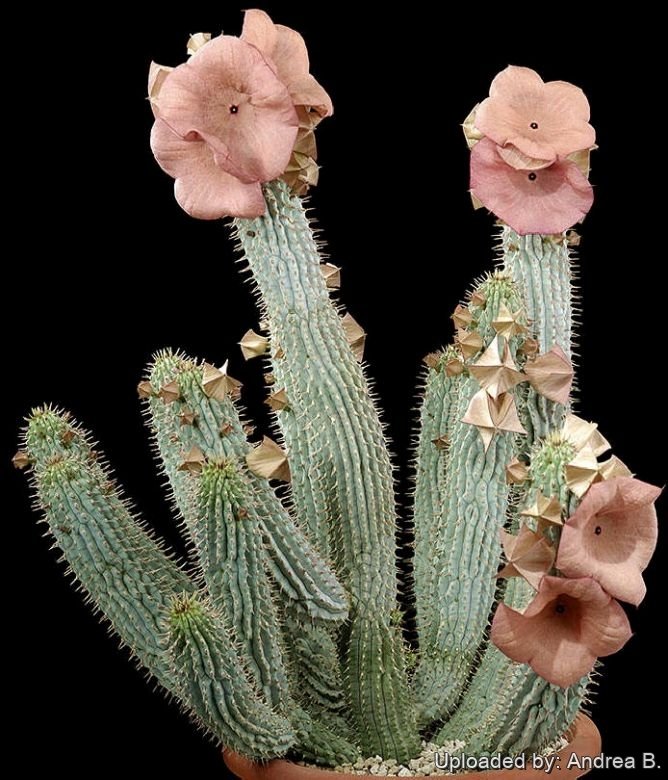
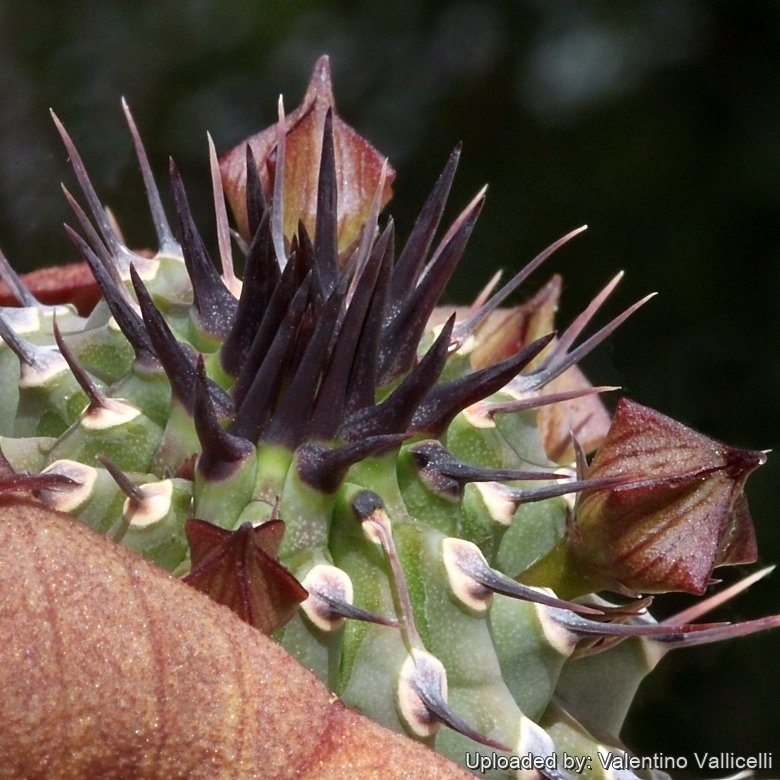
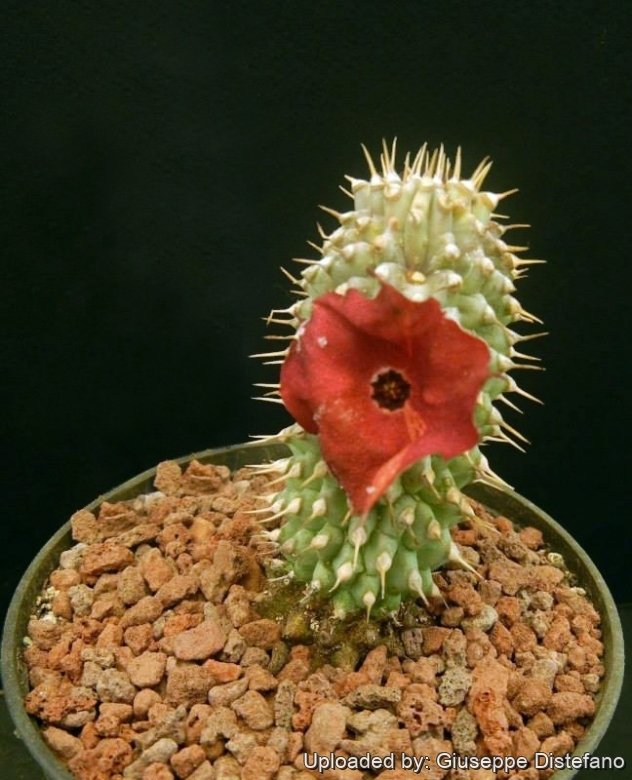
Hoodia gordonii is a leafless fat-stemmed and spiny succulent plant similar to a cactus. In the early stages only one stem is produced but at a later stage the plant produces clusters of green upright stem. Mature plants can have as many as 50 individual branches and weigh as much as 30 kg. Plants under ideal conditions can attain a height of 1 metre. Hoodia gordonii can under ideal conditions live for 25 years in cultivation. In the wild they probably don’t live much longer than 15 years.
Stem: 0,5-1 m tall, greyish-green to pale brown, strictly cylindrical, 2,5-5 in diameter. The knobbly surface helps to scatter the sun’s radiation, minimising the amount of heat they absorb.
Tubercles: Protruding, blunt, arranged in 11-17 ribs. Apically with an acute spine.
Spine: 6-12 mm long.
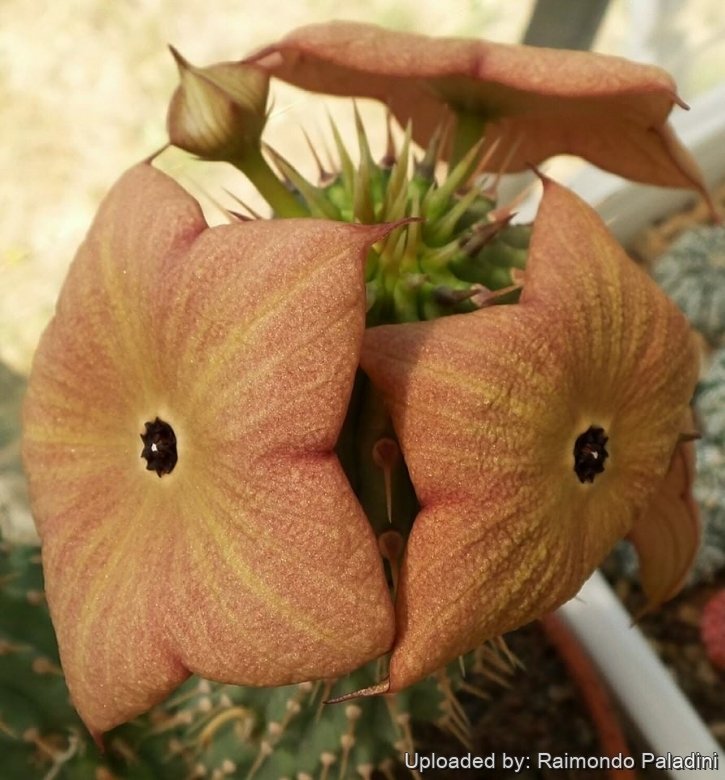
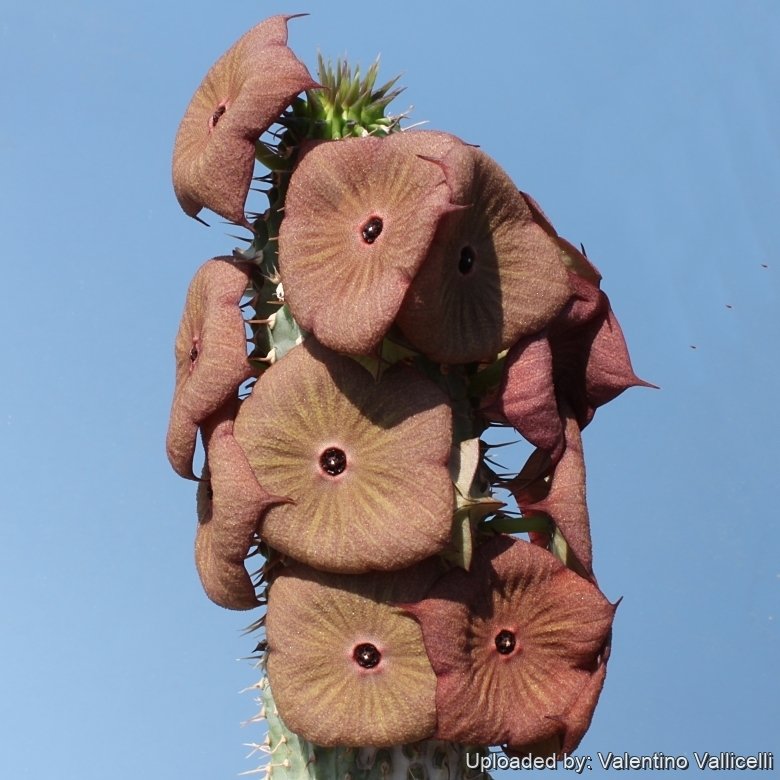
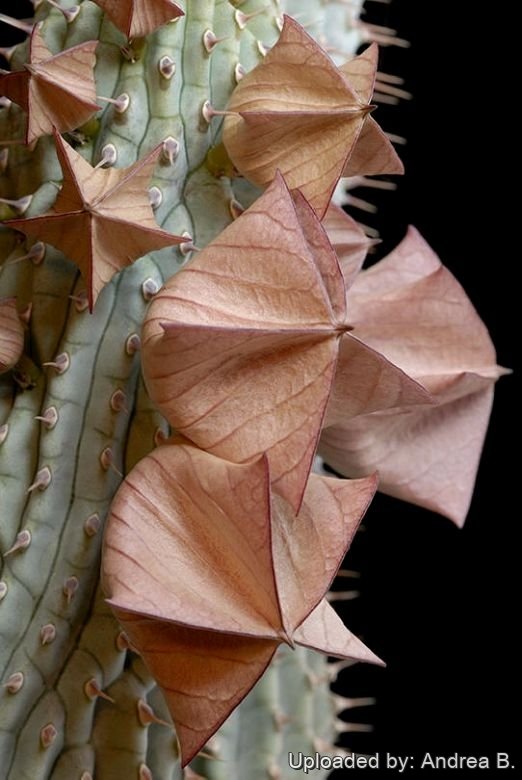
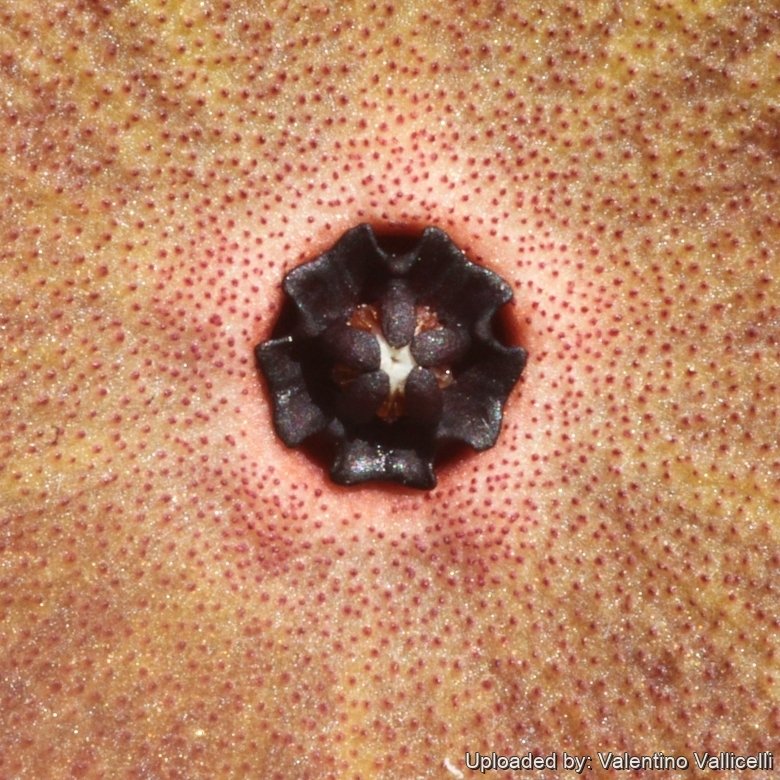
Flower: Saucer-shaped, strictly 5-lobed with a central depression, large up to 75 mm, pale straw, pale purple to dark maroon coloured and usually with darker venation (vaguely resembling a petunia flower) borne on or near the terminal apex (top part of the plant), inflorescence very shortly pedunculate, with group of 1-4 flowers. The flowers smell like rotten meat and are pollinated mainly by flies.
Blooming season: Flowers are normally borne in August or September. Hoodia takes duration of 5 years to be completely mature, till its flowers appear.
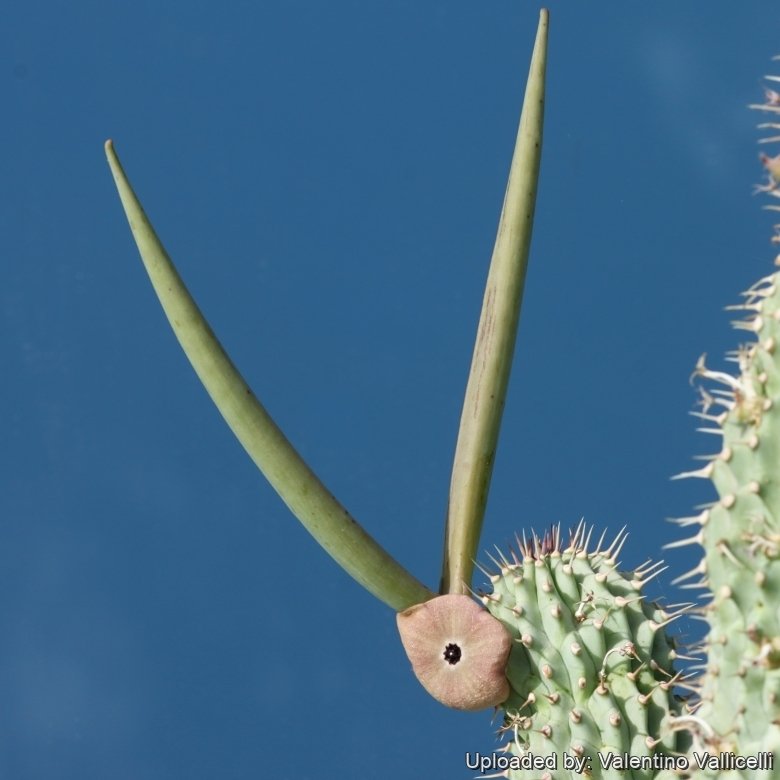
Fruits: The seed capsules resemble small antelope or goat horns.
Seeds: The seeds are light brown in colour, are flat and have a pappus of fluffy hair attached to their one end. This pappus acts as a parachute when the seed pod splits open. The seeds are blown some distance from the parent plant where they will establish themselves.
Remarks: There are many difficulty in Hoodia identification. If we have some plants from unidentified origin ( plants provided unlabeled or with poor identification data), we have to wait until the plant is in flower and also specialists and growers have quite a difficulty to identify correctly this plants.
Origin and Habitat
It grows naturally in a very wide area of the Kalahari desert in South Africa and Namibia. It is also found in the deserts of Botswana and Angola.
Habitat: Grows in winter-rainfall regions in deep Kalahari sands, on dry stony slopes or flats often under the protection of xerophytic bushes but it has a wide tolerance of growing habitats. In places where the temperature soars past 50°C , but it can survive in relatively low temperatures (-3°C). This area is home to a wide range of unique plant species.
Ecology: : Pollination is done mainly by flies. This unusual pollination biology is referred to as myophily (pollination by flies). Myophily takes place in some of the following genera, Stapelia, Huernia and Ceropegia. Life for a young Hoodia plant begins under the protection of a nurse plant. A nurse plant is a shrub under which the young plant germinates and grows, protected by its leaves and branches from the suns strong rays.
Cultivation and Propagation
Hoodia gordonii is one of easiest species to grow but prone to root rot due to overwaterings and lack of fresh air.
Esposure: Indoors only in brightest position.
Watering: Water normally in the growing season, sparsely in the winter.
Hardiness: It is usually recommended to over-winter them in warm conditions (at 10° C), but despite their African origins they seem to grow well and flower without the extra heat which one might have thought necessary, and occasional temperatures near 0°C (or less) are tolerated, if kept dry.
Spring: In the spring leaving them out in the rain may provide them with the water they need.
Summer: In the summer months they will grow well in full sun or partial shade and tolerate heavy rain, but will be just as happy if the season is dry.
Potting medium: Since roots are quite shallow, a gritty, very free-draining compost with extra perlite or pumiceis suitable, and clay pots help the plants to dry out between watering.
Medicinal uses: Hoodia gordonii has long been known by the indigenous populations of Southern Africa that have been using it for centuries to stave off hunger during their long and arduous hunting trips in the harsh South African wild and also for treating indigestion and small infections. Nowadays Hoodia is used as a component in diet pills that leads to the purpose of weight loss and is remarkably wanted in developed countries. It has been called one of the “wonder plants” of the twenty first century. The stems of Hoodia plants that have had their spines removed are the preferred portion of the Hoodia plant for eating. Some manufacturers of dietary supplements describe the use of stems in their slimming pill , but this statement is quite inaccurate, because it is the whole aerial part of the plant that is dried for the preparation of bulk Hoodia powder. Hoodia species have a bitter taste, which is quite noticeable after eating.
Edible uses: Commonly known as: “ghaap” the young pods are liked for their sweetniss.
Propagation: Propagation is done mainly from seed. Cuttings are not really an option, as the severed ends very rarely form a callus from where roots will eventually form. Seeds are produced in March and April of each year (Europe). The seed horns must be semi-dry and starting to split down the middle before seed can be collected. If you try to take a cutting allows it to dry several days before planting.
Bibliography
Major references and further lectures
-
G. J. H. Grubben “Vegetables” PROTA, 2004
-
Kristo Pienaar “The South African what Flower is That?” Struik, 2000
-
Werner Rauh “The Wonderful World of Succulents: Cultivation and Description of Selected Succulent Plants Other Than Cacti” Smithsonian Institution Press, 1984
-
Ramon Folch i Guillén, Josep Maria Camarasa “Encyclopedia of the Biosphere: Deserts” Gale Group, 2000
-
Focke Albers, Ulrich Meve “Illustrated Handbook of Succulent Plants: Asclepiadaceae” Volume 4 Springer, 2002
-
James Cullen, Sabina G. Knees, H. Suzanne Cubey “The European Garden Flora Flowering Plants: A Manual for the Identification of Plants Cultivated in Europe, Both Out-of-Doors and Under Glass” Cambridge University Press, 11/ago/2011
-
Bruyns, P,V. “Stapeliads of Southern Africa and Madagascar.” Umdaus Press, Hatfield, South Africa. 2005.
From llifle page Hoodia bainii
Description
Hoodia bainii has been known for quite a long time and was described in 1878. It is a local or morphological form of the variable Hoodia gordonii. It is an erect bushily branched, leafless, and spiny succulent plant similar to a cactus distinguished by the stems covered with tubercles, ending in long, woody spines. In the early stages only one stem is produced but at a later stage the plant produces clusters of upright stem from the base. Mature plants can have as many as 50 individual branches. Plants under ideal conditions can attain a height of 40 (or more) cm and can under ideal conditions live for 25 years in cultivation. In the wild they probably don’t live much longer than 15 years. The flowers are saucer-shaped, slightly five lobed, dull yellow or buff coloured, fading to reddish or purple, often smaller than in H. gordonii and evil smelling. However the two plants are quite similar and it is hard to tell apart one from the others, if not for the geographical provenance. In accordance with the variability of the species the “bainii” variety is invalid and nowadays considered as a synonym.
Habit: It is perennial stem-succulent.
Stem: 15-40 cm tall, glabrous, glaucous-green, strictly cylindrical, 2,5-4 cm in diameter. The angles are broken up into compressed tubercles each bearing a spine.
Tubercles: Protruding, blunt, divided by a sharp, diagonal furrow, arranged in 12-15 ribs. Apically with an acute spine.
Spine: Pale-brown 6-10 mm long. The spines are very useful, protecting it from herbivores and reducing water loss due to evaporation by creating a thick layer of air saturated with water vapour next to the plant’s surface. Spines also reflect and disperse the sun’s rays.
Flower: Saucer-shaped and often almost circular in outline, strictly 5-lobed with a central depression, with a deep dish shape, are completely glabrous (even in the centre). light yellow tinged with pink, pale purple or dark maroon and usually with darker venation (vaguely resembling a petunia flower) borne singly or in two on or near the terminal apex (top part of the plant), inflorescence very shortly pedunculate. Pedicels 6-12 mm long; sepals 4-5 mm long, ovate-lanceolate, acuminate; corolla in bud hemispheric at the basal part, 5-winged above, truncate, with a short central point, when expanded (25-)50-70(-75) mm in diameter, cup-shaped, about 25 mm deep, subtruncate at the margin with 5 subulate or awn-like points 3-6 mm long, glabrous, smooth, not papillate on the central part, light yellow or pale buff, sometimes tinged with pinkish or very pale purple; tube obsolete, represented by a slight depression from which the blackish corona is exserted or its margin resting upon the rim, when dried contained in a very small cup; outer corona 3-4 mm in diameter, cupular, 5-lobed; lobes 0.5-0.7 mm long, nearly 2 mm broad, transverse, emarginate; inner corona-lobes 0.8 mm long, oblong, obtuse, closely incumbent upon the backs of the anthers and not exceeding them, dorsally connected to the inflexed sinuses of the outer corona. The flowers smell like rotten meat and are pollinated mainly by flies.
Blooming season: Flowers are normally borne in August or September. Hoodia takes duration of 5 years to be completely mature, till its flowers appear.
Fruits (follicles): Terete-fusiform, resembling small antelope or goat horns, 10-13 (or more) cm long, 10-12 mm thick, tapering to a beak, glabrous, smooth.
Seeds: The seeds are light brown in colour, smooth, 6-7 mm long, 3 mm broad, ovate, flat, with a slightly thickened margin, and have a pappus of fluffy hair attached to their one end. This pappus acts as a parachute when the seed pod splits open. The seeds are blown some distance from the parent plant where they will establish themselves.
Remarks: There are many difficulty in Hoodia identification. If we have some plants from unidentified origin ( plants provided unlabeled or with poor identification data), we have to wait until the plant is in flower and also specialists and growers have quite a difficulty to identify correctly this plants.
Origin and Habitat
Namaqualand, Karoo (Localities: Prince Albert or Beaufort West, Dwyka River and Uitkyk, Van Wyks Vlei, and adjacent areas). South africa.
Cultivation and Propagation
Hoodia bainii is one of easiest species to grow but prone to root rot due to overwaterings and lack of fresh air.
Esposure: Indoors only in brightest position.
Watering: Water normally in the growing season, sparsely in the winter.
Hardiness: It is usually recommended to over-winter them in warm conditions (at 10° C), but despite their African origins they seem to grow well and flower without the extra heat which one might have thought necessary, and occasional temperatures near 0°C (or less) are tolerated, if kept dry.
Spring: In the spring leaving them out in the rain may provide them with the water they need.
Summer: In the summer months they will grow well in full sun or partial shade and tolerate heavy rain, but will be just as happy if the season is dry.
Potting medium: Since roots are quite shallow, a gritty, very free-draining compost with extra perlite or pumiceis suitable, and clay pots help the plants to dry out between watering.
Edible uses: Commonly known as: “ghaap” the young pods are liked for their sweetniss.
Propagation: Propagation is done mainly from seed. Cuttings are not really an option, as the severed ends very rarely form a callus from where roots will eventually form. Seeds are produced in March and April of each year (Europe). The seed horns must be semi-dry and starting to split down the middle before seed can be collected. If you try to take a cutting allows it to dry several days before planting.
Notes
This plant stores its seeds, which are like parachutes, within pods that only explode and release the seeds under certain conditions. Once released, the seeds are dispersed by the wind.
Bibliography
Major references and further lectures
-
N. E. Brown “Flora Capensis” Vol 4, page 518 1909
-
Kristo Pienaar “The South African what Flower is That?” Struik, 2000
-
Werner Rauh “The Wonderful World of Succulents: Cultivation and Description of Selected Succulent Plants Other Than Cacti” Smithsonian Institution Press, 1984
-
Ramon Folch i Guillén, Josep Maria Camarasa “Encyclopedia of the Biosphere: Deserts” Gale Group, 2000
-
Focke Albers, Ulrich Meve “Illustrated Handbook of Succulent Plants: Asclepiadaceae” Volume 4 Springer, 2002
-
James Cullen, Sabina G. Knees, H. Suzanne Cubey “The European Garden Flora Flowering Plants: A Manual for the Identification of Plants Cultivated in Europe, Both Out-of-Doors and Under Glass” Cambridge University Press, 11/ago/2011
-
Bruyns, P,V. “Stapeliads of Southern Africa and Madagascar.” Umdaus Press, Hatfield, South Africa. 2005.
Source: Hoodia bainii, LLIFLE - Encyclopedia of living forms, CC-BY-SA, retrieved 2026-10-25.
From llifle page Hoodia longispina
Origin and Habitat
Namibia.
Source: Hoodia longispina, LLIFLE - Encyclopedia of living forms, CC-BY-SA, retrieved 2026-10-25.
Cultivars and forms (1)
Forms (1)
Gallery