Publication: Hort. Franc. 73 1866
Description
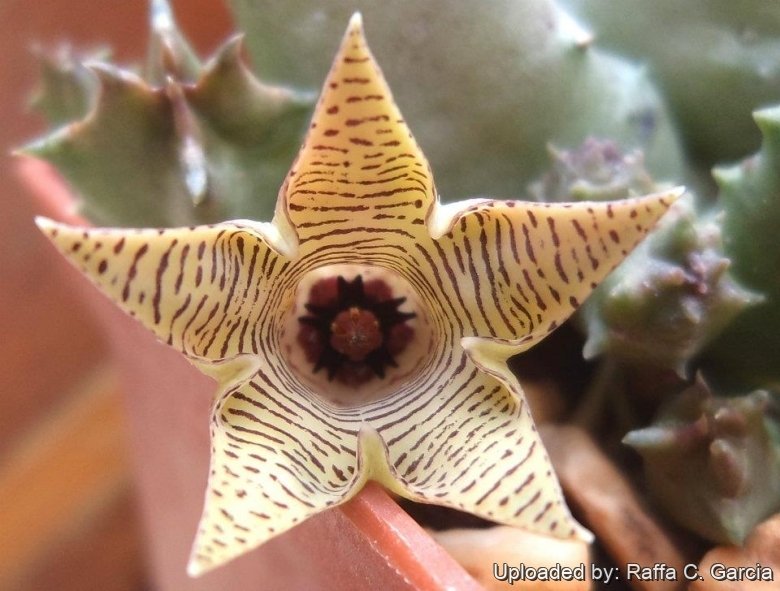
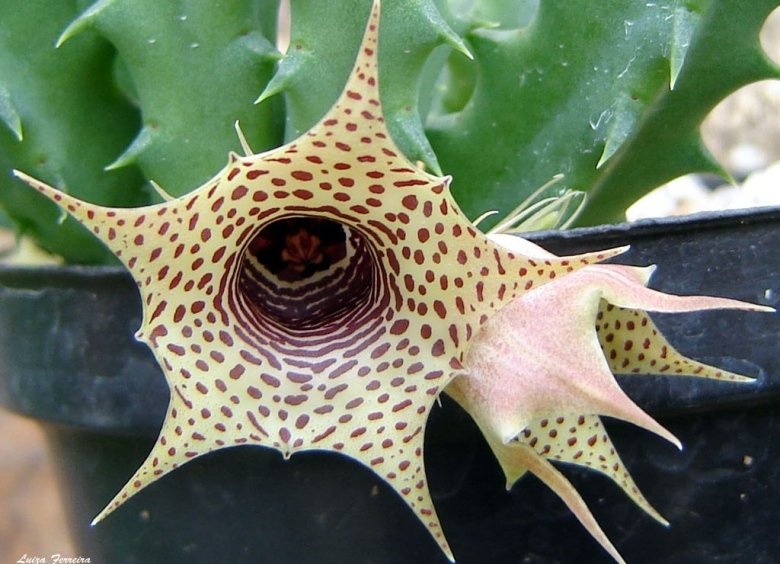
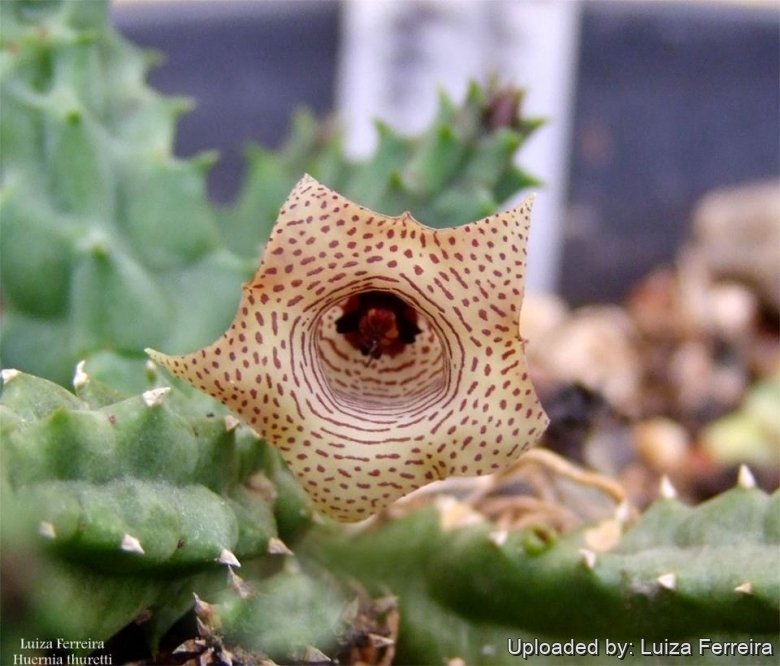
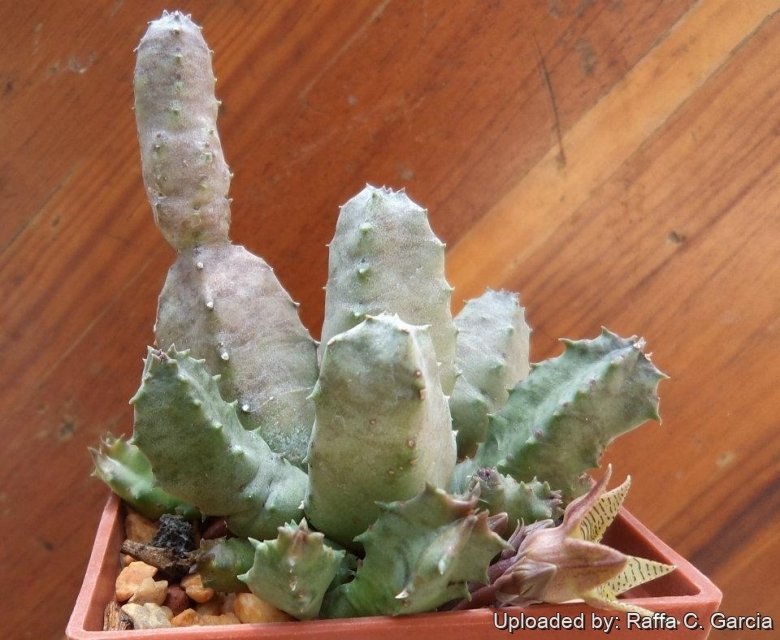
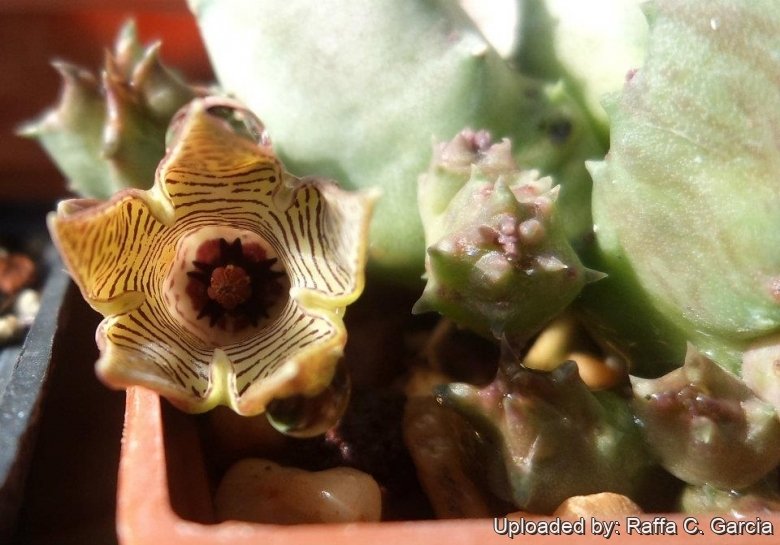
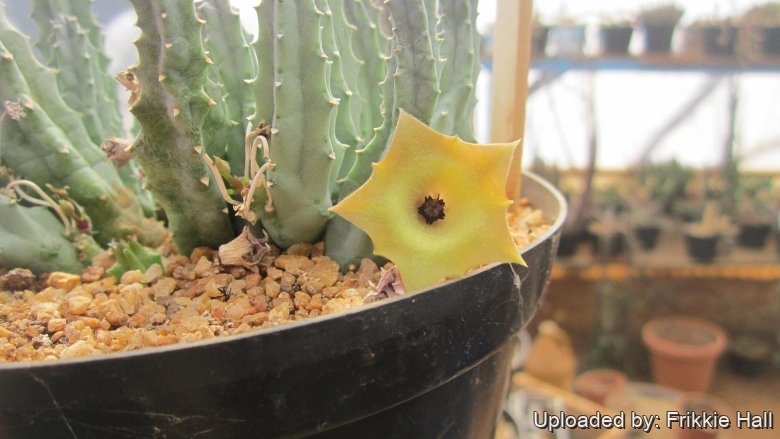
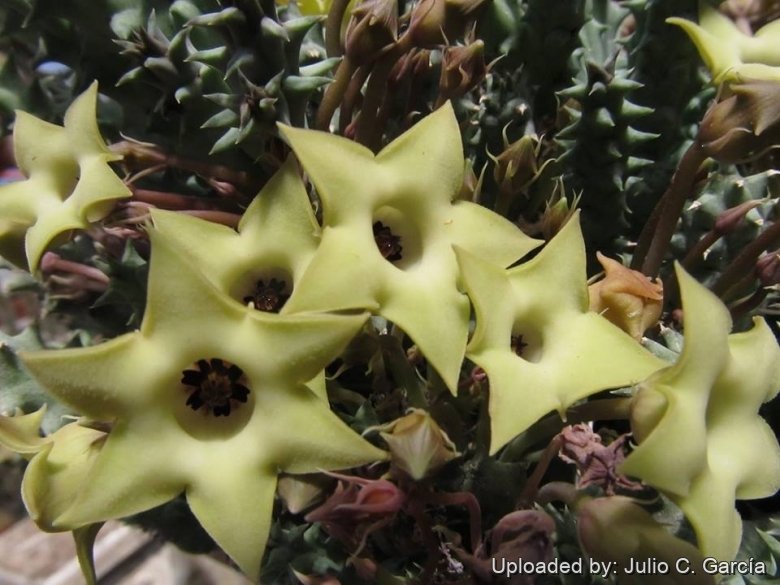
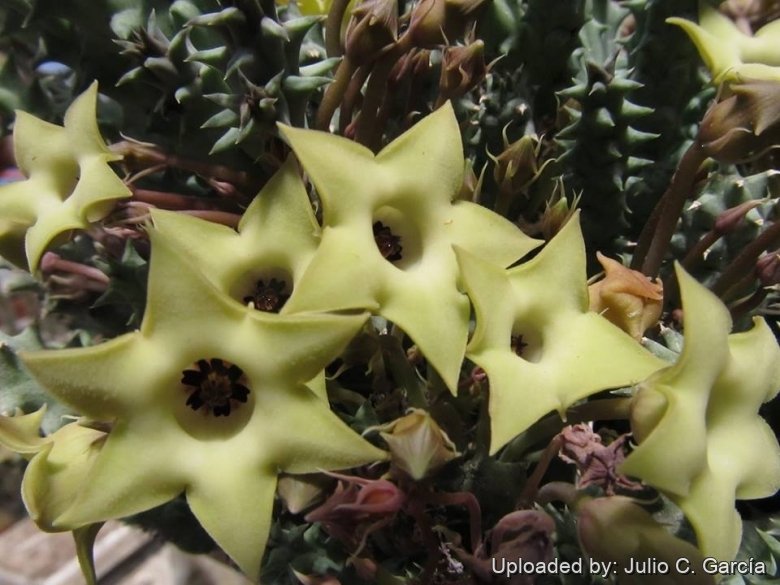
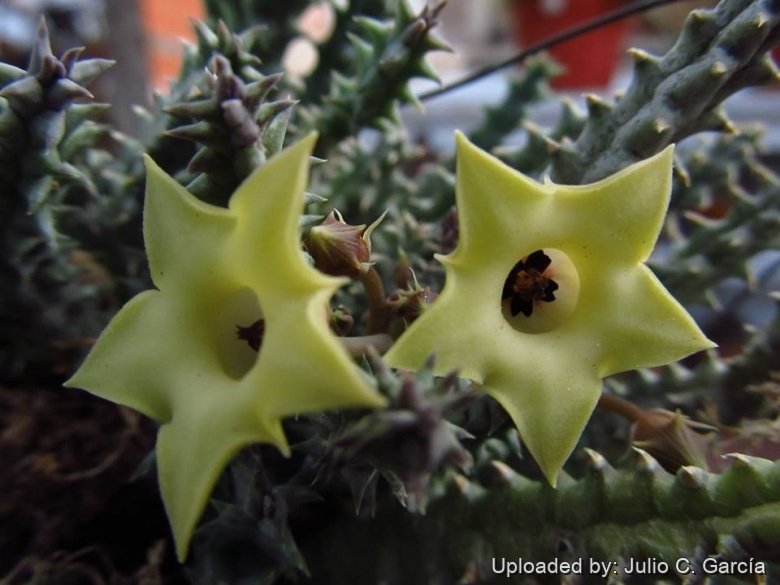
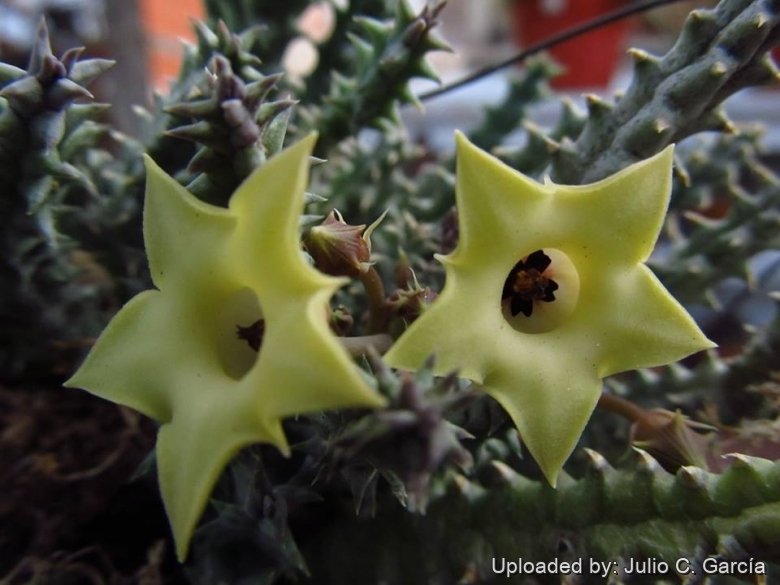
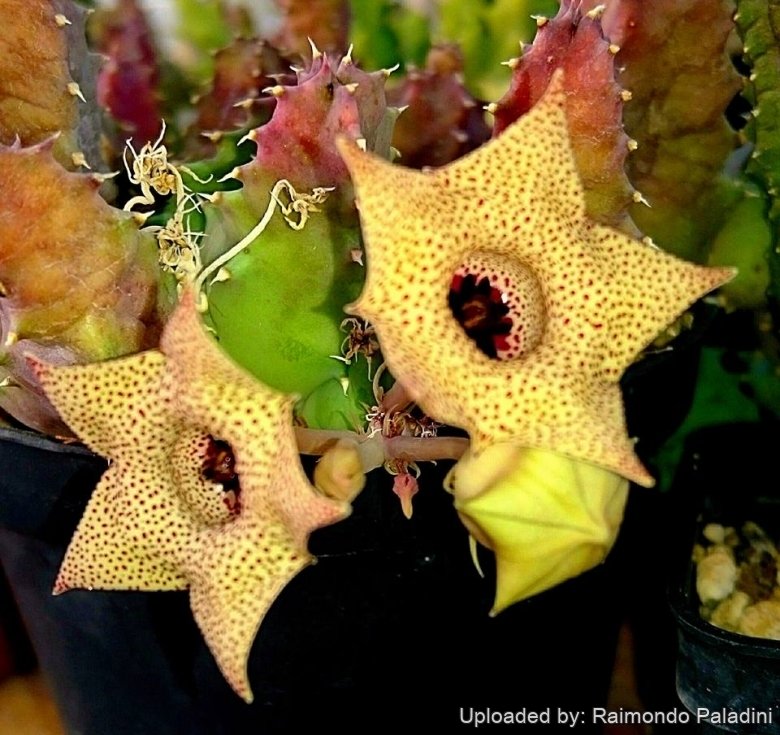
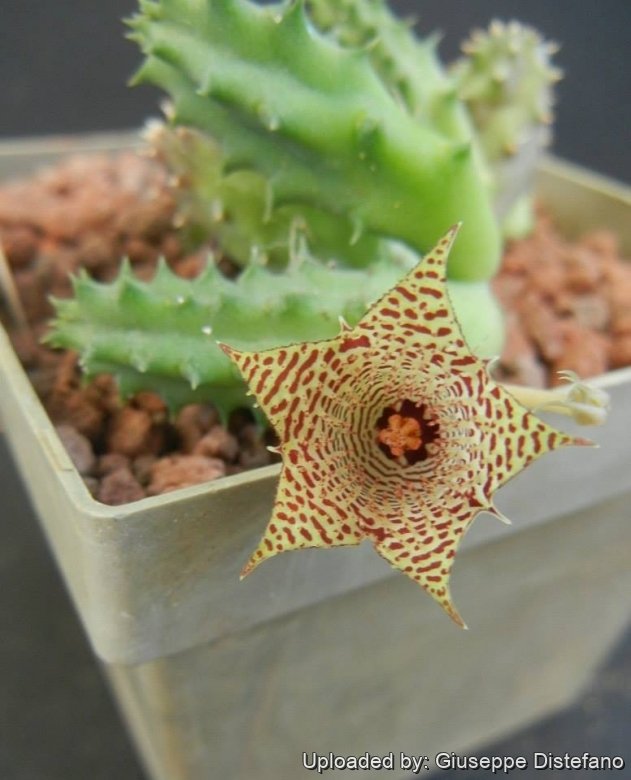
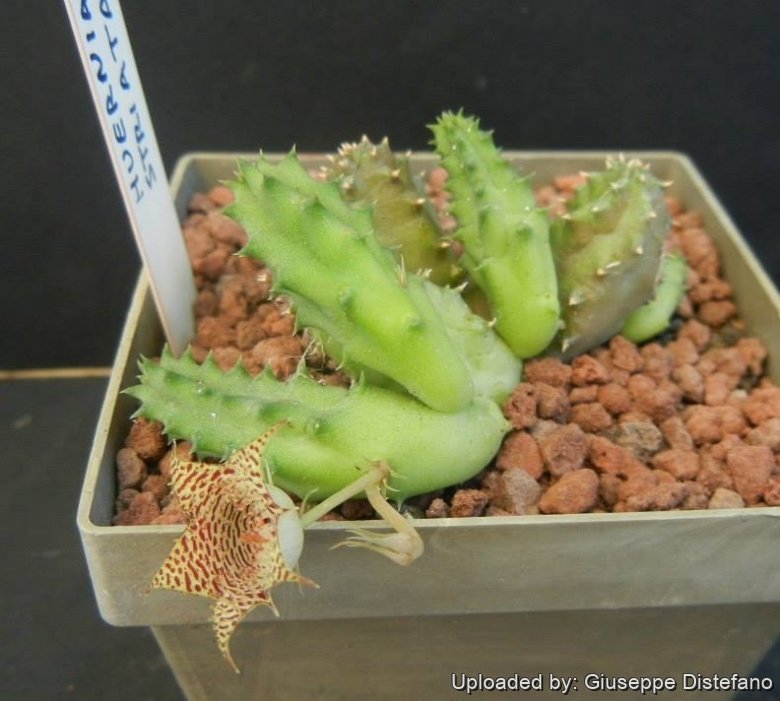
Huernia thuretii is an interesting tufted species with erect stems that varies considerably in the size and the shape of the flowers. The flowers, which arise in succession at the base of the stems, are cup-shaped, with petals dull yellow in colour and spotted or banded with red and a maroon throat. Due to its wide area of origin H. thuretii is very variable and many varieties, previously classified as different species, have been described (as many as eight) using the characters of degree of annulation of the disc and colouration of the corolla face to distinguish them, but most botanist agree on the fact that all the ones described until now should all be included in the H. thuretii.
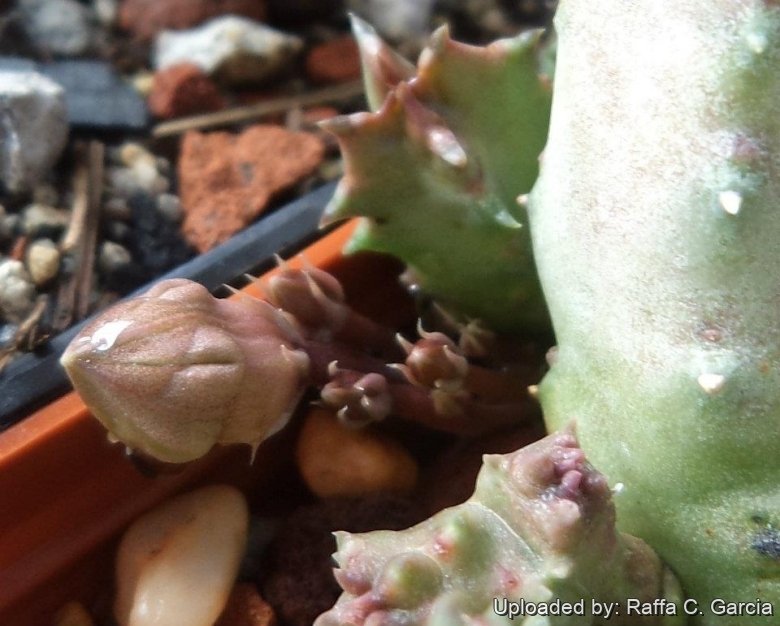
Stems: Erect, crowded in fairly large clumps, up to 5 cm long, 8-10(-20) mm thick, 4- (to 5- to 6-) angular, glabrous, glaucous-green, with acute small deltoid teeth (c.2-3 mm long).
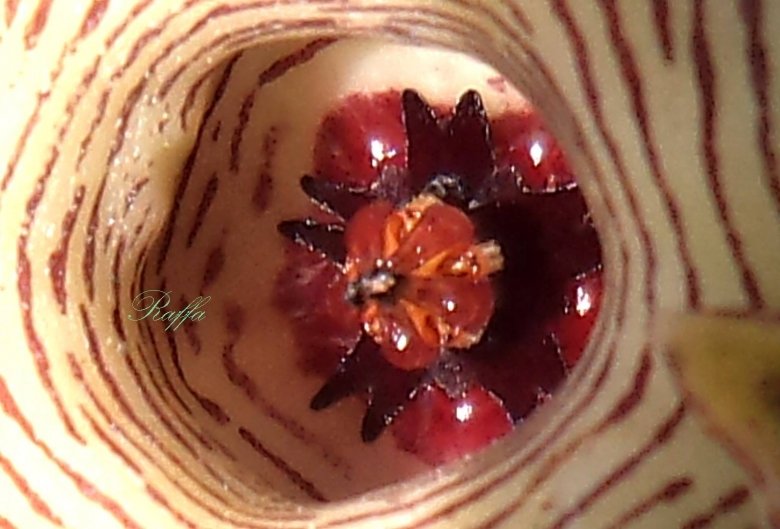
Flowers: 1–4 together, (15-)25-35(-40) mm across, facing upwards or outwards, opening in rapid succession, sometimes irregularly borne along the stems, often with several inflorescences on single stems; peduncle (if present) long slender, erect. Pedicel 12- 25 mm long, 2-2.5 mm in diameter basally thickened, glabrous. Sepals about 5 mm long, lanceolate-subulate, glabrous. Corolla with a shallow bowl, sometimes annular. Corolla-lobes 8 mm long, 9 mm broad, triangular, acute or weakly acuminate, often longitudinally convex, erect to divaricate, sometimes revolute, outside sometimes weakly roughened, inside sometimes very weakly papillose, apex often densely furnished with fine acute tubercles to papillae, outside cream-coloured or greenish pale yellow, often dotted with red-brown, inside cream-coloured to (pale) yellowish, yellow-ochre or rarely brown, with concentric pink to dark brown transverse lines, lines broken, partly composed of dots. Tube basally bright maroon, globose-campanulate or rarely tubular, about 6 mm long and 9 mm in diameter, mouth slightly constricted, margin abruptly spreading. Outer corona-lobes corona dark crimson to black, lobes narrowly 3- or 4-angular, emarginate, bifid or deeply lobed , alternating with 5 minute tubercles. Inner corona-lobes orange-brown to black, lobes 1.5 - 2 mm, connivent-erect, ribbon-like with the slightly spreading tips produced 6-8 mm or more above the anthers, acuminate, with a slight transverse thickening at the base, often with nectar droplets. Pollinia brownish-yellow.
Origin and Habitat
South Africa (Eastern Cape). Namibia.
Habitat: It grows in fully exposed places.
Cultivation and Propagation
Very easy to grow, it needs light shade to full sun (but tolerate shadow), very resistant to heat will also tolerate quite cold temperatures but avoid frost, best in a ventilated environment. It is quite resistant to the “Balck spot” disease of Asclepiads, Water regularly during the growing season, keep dry in winter. Use a gritty, well-drained soil.
Propagation: It is easily propagated by removing a cutting, sometimes with roots attached, in spring and summer, but seeds germinate readily if they are sown when fresh.
Bibliography
Major refrerences and further lectures
-
Excelsa Taxon. Ser. 4: 182-187 1988
-
Focke Albers, Ulrich Meve “Illustrated Handbook of Succulent Plants: Asclepiadaceae: Asclepiadaceae” Volume 4 Springer, 2002
-
Doreen Court “Succulent Flora of Southern Africa” CRC Press, 01/Jun/2000
-
N. E. BROWN. “Flora Capensis” Vol 4, page 518 1909
-
White & Sloane “The Stapelieae” edn 2. 3: 879-882, 1170-1176 1937
-
Excelsa Taxonomic Series 4:184 1988
-
James Cullen, Sabina G. Knees, H. Suzanne Cubey “The European Garden Flora Flowering Plants: A Manual for the Identification of Plants Cultivated in Europe, Both Out-of-Doors and Under Glass” Cambridge University Press, 11/Aug/2011
-
Luckhoff “The Stapelieae of Southern Africa” Capetown, A.A. Balkema 1952
-
Bruyns, P.V. 2005. “Stapeliads of southern Africa and Madagascar.” Vol. II. Umdaus Press, Hatfield.
From llifle page Huernia bayeri
Description
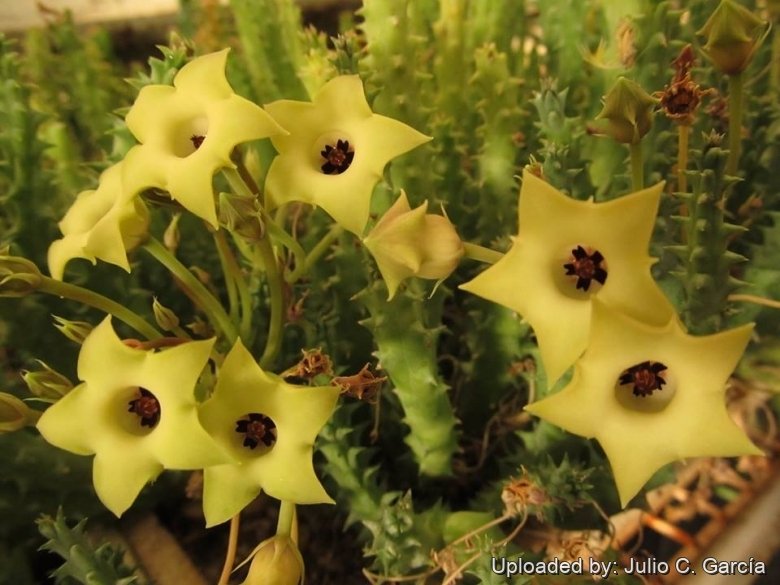
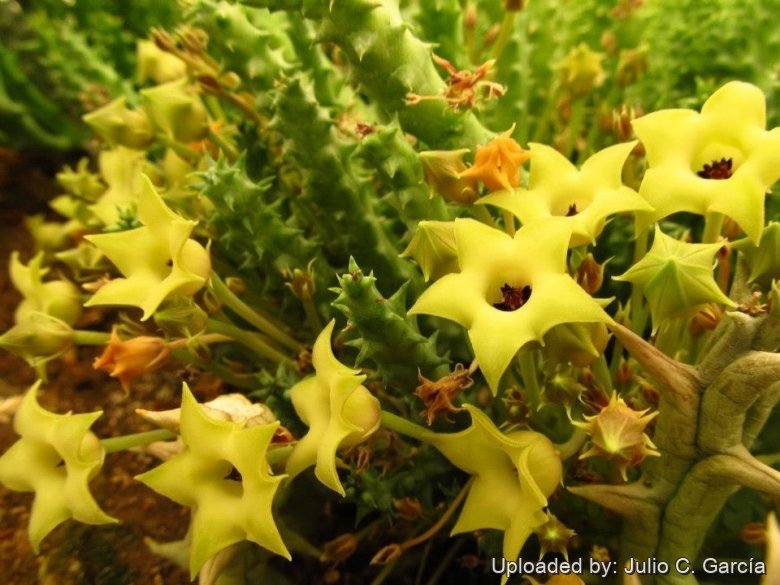
Huernia bayeri is an interesting multiple stem species with plump stems mall tubercles along the ribs that resemble teeth. Readily offsets to form large low growing mounds. The flowers, which arise in succession at the base of the stems, are cup-shaped, with creamy white to dull yellow petals unspotted or sometimes finely spotted with red, the coronas at the centres of the flowers are dark purple.
Related species: Huernia bayeri is linked closely to Huernia thuretii and in particular to Huernia thuretii var. primulina. Due to its wide area of origin H. thuretii is very variable and many varieties with different degree of annulation of the disc and colouration of the corolla face was previously classified as different species, but most botanist agree on the fact that all the ones described until now, included H. bayeri, now should all be included in the H. thuretii.
Stems: Erect, crowded in fairly large clumps, 3 - 6 cm long, 8-10(or more) mm thick, 4 to 5 angular, glabrous, glaucous-green, with acute small triangular tubercles (c.2-3 mm long) ending in a fleshy teeth.
Inflorescences: Often several on single stems, 1–4 flowered with flowers opening in rapid succession, sometimes irregularly borne along the stems. Peduncle (if present) long slender, erect. Pedicel 35 mm long erect, basally thickened often overtopping the stems.
Flowers: Campanulate, (15-)25-35(-40) mm across facing outwards. Sepals 6 - 7 mm long, 2 mm in diameter keeled. Corolla, glabrous, with a shallow bowl, mouth of the tube occasionally annulus-like, outside greenish-creamy inside cream-coloured, pale greenish, yellow or bright pink-brownish, rarely weakly lined with reddish towards the apex, 2.5 - 3 cm in diameter. Corolla-lobes 5 – 7 mm long, 6 - 9 mm broad, triangular, acute or weakly acuminate, erect or ascending, sometimes revolute, outside finely scabrous, scabrous parts elevated, often with short stiff hairs inside papillose, apex often densely furnished with fine hairs to papillae. Hairs colourless or white, to 2 mm long, slender, linear. Intermediate lobes protruding particularly in the bud. Corona black-purple. 4 mm long, 4.5 - 5 mm wide. Outer corona lobes approx 1 x 1.5 mm, dark crimson to black bifid or deeply lobed. Inner corona-lobes orange-brown to black approx 3 mm long, subulate, finely pointed, meeting each other above the anthers, above divaricate. basally with a prominent verrucose hump. Pollinia brownish.
Origin and Habitat
Eastern Cape
Cultivation and Propagation
Huernia bayeri isn’t difficult to grow and flower.
Spring: When winter ends and they begin to grow again, they will require much water and soaking the pots will no longer put the plants at risk for rot. In the spring they will grow well in partial shade and leaving them out in the rain may provide them with the water they need.
Summer: In the summer months they will tolerate heavy rain, but will be just as happy if the season is dry. It’s best to sort out the stems while the plants are resting in the summer before they begin their autumnal growth cycle. They will tolerate very hot weather outdoors as long as they are kept in filtered light and this will encourage them to flower in the Autumn. They also enjoy some fertiliser. Moving the plants as they are developing buds may cause them to spontaneously abort the flowers all together.
Autumn: In the fall keep them outdoors until the night time temperatures drop below the 10°C.
Winter: Winter care presents no problems at 10° C with plenty of light. As soon as they are flowered be sure to take extra precautions to keep them dry, because damp cool conditions when the plants are resting is an invitation to fungal infections, but - according to temperatures –some occasional lit watering may be useful.
Potting medium: Since roots are quite shallow, use a cactus mix or add extra perlite or pumice to regular soil potting soil. A gritty, very free-draining compost is suitable, and clay pots help the plants to dry out between watering. Re-pot every 2 years.
Pest and diseases: Huernia are generally fairly easy to grow, especially if kept pest-free. They are very susceptible to stem and root mealy bugs, and damage from these may well initiate fungal attack. Any time when there is a dead or dying stem in the pot it is important to remove it immediately and completely before other healthy stems can become ill too, isolate the healthy parts, dry them off, and re-root them in new compost.
Propagation: Easiest with stem cuttings. Allow cuttings to dry a day before planting. Stems must be laid (Not buried) on gritty compost and will then root from the underside of the stems. It can also be increased from seeds sowing in spring in moist, sandy peat moss. Barely cover seeds. Seeds germinate quickly.
In any season it’s best to lay the stems out for several days before replanting them and then pot them only in dry soil and withhold any water until they begin to shrivel or start growing again.
Bibliography
Major refrerences and further lectures
-
Focke Albers, Ulrich Meve “Illustrated Handbook of Succulent Plants: Asclepiadaceae: Asclepiadaceae” Volume 4 Springer, 2002
-
Doreen Court “Succulent Flora of Southern Africa” CRC Press, 01/Jun/2000
-
James Cullen, Sabina G. Knees, H. Suzanne Cubey “The European Garden Flora Flowering Plants: A Manual for the Identification of Plants Cultivated in Europe, Both Out-of-Doors and Under Glass” Cambridge University Press, 11/Aug/2011
-
Bruyns, P.V. 2005. “Stapeliads of southern Africa and Madagascar.” Vol. II. Umdaus Press, Hatfield.
-
Peter Goldblatt “Cape Plants: A Conspectus of the Cape Flora of South Africa” National Botanical Institute of South Africa, 2000
-
Excelsa Taxon. Ser. 4: 182-187 1988
-
N. E. BROWN. “Flora Capensis” Vol 4, page 518 1909
-
White & Sloane “The Stapelieae” edn 2. 3: 879-882, 1170-1176 1937
-
Luckhoff “The Stapelieae of Southern Africa” Capetown, A.A. Balkema 1952
Source: Huernia bayeri, LLIFLE - Encyclopedia of living forms, CC-BY-SA, retrieved 2026-10-25.
From llifle page Huernia brevirostris
Description
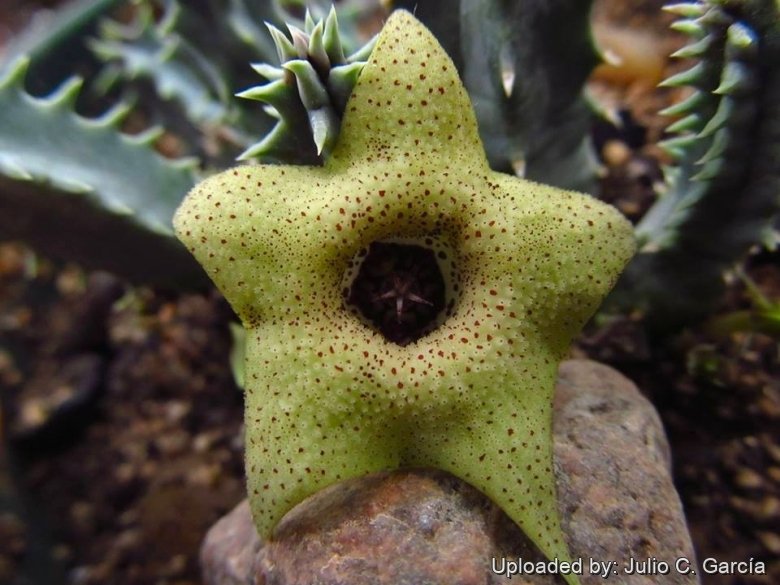
Huernia brevirostris is an interesting low-growing succulents with stems rooting where they touch the ground. Readily offsets to form large low growing mounds. The flowers, which arise in succession at the base of the stems, are cup-shaped, with pale greenish-yellow to dull yellow petals finely spotted with red, and lined tube. The corona at the centers of the flower is dark purple.
Related species: Huernia brevirostris is linked closely to Huernia thureti. Due to its wide area of origin H. thuretii is very variable and many varieties with different degree of annulation of the disc and colouration of the corolla face was previously classified as different species, but most botanist agree on the fact that all the ones described until now, included H. brevirostris, should all be included in the H. thuretii.
Stems: Erect, rooting where they touch the ground, crowded in fairly large clumps, 3 - 6 cm long, 8-10(or more) mm thick, 4 to 5 angular, glabrous, glaucous-green, with acute small triangular tubercles (c.2-3 mm long) ending in a fleshy teeth.
Inflorescences: Often several on single stems, 1–4 flowered with flowers opening in rapid succession, sometimes irregularly borne along the stems. Peduncle (if present) long slender, erect. Pedicel 35 mm long erect, basally thickened often overtopping the stems.
Flowers: Campanulate, (15-)25-35(-40) mm across facing outwards. Sepals 6 - 7 mm long, 2 mm in diameter keeled. Corolla, glabrous, with a shallow bowl, mouth of the tube annulus-like, outside greenish-creamy inside cream-coloured, pale greenish, yellow or pale pink, 2.5 - 3 cm in diameter. Corolla-lobes,triangular, acute or weakly acuminate, 5 – 7 mm long, 6 - 9 mm broad, erect or ascending, sometimes revolute, outside finely scabrous, scabrous parts elevated, often with short stiff hairs inside papillose, conspicuously spotted with marron-red apex often furnished with fine hairs to papillae. Hairs colourless or white, to 2 mm long, slender, linear. Intermediate lobes protruding particularly in the bud. Corona black-purple. 4 mm long, 4.5 - 5 mm wide. Outer corona lobes approx 1 x 1.5 mm, dark crimson to black bifid or deeply lobed. Inner corona-lobes orange-brown to black approx 3 mm long, subulate, finely pointed, meeting each other above the anthers, above divaricate. basally with a prominent verrucose hump. Pollinia brownish.
Origin and Habitat
Graaff-Reinet to Willowmore and associated with the Sundays and Groot River valleys.
Bibliography
Major refrerences and further lectures
-
Excelsa Taxon. Ser. 4: 182-187 1988
-
Focke Albers, Ulrich Meve “Illustrated Handbook of Succulent Plants: Asclepiadaceae: Asclepiadaceae” Volume 4 Springer, 2002
-
Doreen Court “Succulent Flora of Southern Africa” CRC Press, 01/Jun/2000
-
N. E. BROWN. “Flora Capensis” Vol 4, page 518 1909
-
White & Sloane “The Stapelieae” edn 2. 3: 879-882, 1170-1176 1937
-
Excelsa Taxonomic Series 4:184 1988
-
James Cullen, Sabina G. Knees, H. Suzanne Cubey “The European Garden Flora Flowering Plants: A Manual for the Identification of Plants Cultivated in Europe, Both Out-of-Doors and Under Glass” Cambridge University Press, 11/Aug/2011
-
Luckhoff “The Stapelieae of Southern Africa” Capetown, A.A. Balkema 1952
-
Bruyns, P.V. 2005. “Stapeliads of southern Africa and Madagascar.” Vol. II. Umdaus Press, Hatfield.
10)George Gilbert Green “Cacti and succulents” Pitman Pub. Corp., 1953
Source: Huernia brevirostris, LLIFLE - Encyclopedia of living forms, CC-BY-SA, retrieved 2026-10-25.
From llifle page Huernia brevirostris subs. baviaana
Origin and Habitat
South Africa (Cape Province).
Source: Huernia brevirostris subs. baviaana, LLIFLE - Encyclopedia of living forms, CC-BY-SA, retrieved 2026-10-25.
From llifle page Huernia brevirostris var. parvipuncta
Description
Huernia brevirostris var. parvipuncta, firstly described A. C. White & B. Sloane in 1937, is a local or morphological form of the widespread and variable Huernia thuretii. Huernia thuretii is very variable and many varieties with different degree of annulation of the disc and colouration of the corolla face was previously classified as different species, but most botanist agree on the fact that all the ones described until now, included Huernia brevirostris var. parvipuncta, should all be included in the H. thuretii. The var. parvipuncta has a cream-coloured to yellowish corolla, rarely with a low annulus, with well marked and evenly spaced marron-red dots. However the distinguishing characteristics of var. parvipuncta, appear to fall within the natural variation of Huernia thuretii and it should be synonymized with the latter.
Cultivation and Propagation
Huernia brevirostris var. parvipuncta is easy to grow, it needs light shade to full sun (but tolerate shadow), very resistant to heat will also tolerate quite cold temperatures but avoid frost, best in a ventilated environment. It is quite resistant to the “Balck spot” disease of Asclepiads, Water regularly during the growing season, keep dry in winter. Use a gritty, well-drained soil.
Propagation: It is easily propagated by removing a cutting, sometimes with roots attached, in spring and summer, but seeds germinate readily if they are sown when fresh.
Source: Huernia brevirostris var. parvipuncta, LLIFLE - Encyclopedia of living forms, CC-BY-SA, retrieved 2026-10-25.
From llifle page Huernia striata
Description
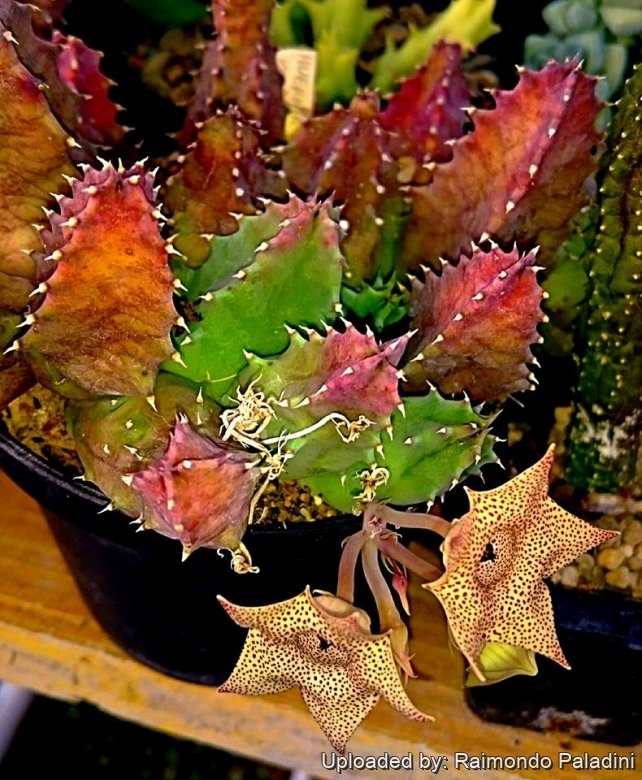
Huernia striata is an extremely neat little species with distinctive banding on the star shaped flowers. It does not make a large flower, but the stripes in the design still make it a standout bloom. It is one of the several forms of the very variable Huernia thuretii which comprise plants with different degrees of annulation of the disc and colouration of the corolla face, but most botanist agree on the fact that all the varieties described until now should all be included in the H. thuretii. The flowers, which arise in succession at the base of the stems, are cup-shaped, with petals white to off-white with red or red-brown broken stripes and a maroon throat. Flowers appear most heavily in late summer.
Remarks: Darryl Plowes believes that there is sufficient evidence to warrant the resurrection of H. striata as a separate species.
Stems: Erect, crowded in fairly large clumps, up to 5 cm long, 8-10(-20) cm thick , 4- (to 5- to 6-) angular, glabrous, glaucous-green, with acute small deltoid teeth (c.2-3 mm long),
Flowers: 1–4 together, (15-)25-35(-40) mm across, facing upwards or outwards, opening in rapid succession, sometimes irregularly borne along the stems, often with several inflorescences on single stems; peduncle (if present) long slender, erect. Pedicel 12- 25 mm long, 2-2.5 mm in diameter basally thickened, glabrous. Sepals about 5 mm long, lanceolate-subulate, glabrous. Corolla with a shallow bowl, sometimes annular. Corolla-lobes 8 mm long, 9 mm broad, triangular, acute or weakly acuminate, often longitudinally convex, erect to divaricate, sometimes revolute, outside sometimes weakly roughened, inside sometimes very weakly papillose, apex often densely furnished with fine acute tubercles to papillae, outside cream-coloured or greenish pale yellow, often dotted with red-brown, inside white, off-white, cream-coloured to (pale) yellowish, with concentric pink to red or brown transverse lines, lines broken, partly composed of dots. Tube basally bright maroon, globose-campanulate or rarely tubular, about 6 mm long and 9 mm in diameter, mouth slightly constricted, margin abruptly spreading.
Outer corona-lobes corona dark crimson to black, lobes narrowly 3- or 4-angular, emarginate, bifid or deeply lobed , alternating with 5 minute tubercles.
Inner corona-lobes orange-brown to black, lobes 1.5 - 2 mm, connivent-erect, ribbon-like with the slightly spreading tips produced 6-8 mm or more above the anthers, acuminate, with a slight transverse thickening at the base, often with nectar droplets. Pollinia brownish-yellow.
Origin and Habitat
Tiras Mountains of Namibia
Cultivation and Propagation
Huernia striata isn’t difficult to grow and flower.
Spring: When winter ends and they begin to grow again, they will require much water and soaking the pots will no longer put the plants at risk for rot. In the spring they will grow well in partial shade and leaving them out in the rain may provide them with the water they need.
Summer: In the summer months they will tolerate heavy rain, but will be just as happy if the season is dry. It’s best to sort out the stems while the plants are resting in the summer before they begin their autumnal growth cycle. They will tolerate very hot weather outdoors as long as they are kept in filtered light and this will encourage them to flower in the Autumn. They also enjoy some fertiliser. Moving the plants as they are developing buds may cause them to spontaneously abort the flowers all together.
Autumn: In the fall keep them outdoors until the night time temperatures drop below the 10°C.
Winter: Winter care presents no problems at 10° C with plenty of light. As soon as they are flowered be sure to take extra precautions to keep them dry, because damp cool conditions when the plants are resting is an invitation to fungal infections, but - according to temperatures –some occasional lit watering may be useful.
Potting medium: Since roots are quite shallow, use a cactus mix or add extra perlite or pumice to regular soil potting soil. A gritty, very free-draining compost is suitable, and clay pots help the plants to dry out between watering. Re-pot every 2 years.
Pest and diseases: Huernia are generally fairly easy to grow, especially if kept pest-free. They are very susceptible to stem and root mealy bugs, and damage from these may well initiate fungal attack. Any time when there is a dead or dying stem in the pot it is important to remove it immediately and completely before other healthy stems can become ill too, isolate the healthy parts, dry them off, and re-root them in new compost.
Traditional Uses: In Kenya the sap of Huernia aspera is harnessed from the plant by breaking it and is applied onto wounds to treat them by drying them up.
Propagation: Easiest with stem cuttings. Allow cuttings to dry a day before planting. Stems must be laid (Not buried) on gritty compost and will then root from the underside of the stems. It can also be increased from seeds sowing in spring in moist, sandy peat moss. Barely cover seeds. Seeds germinate quickly.
In any season it’s best to lay the stems out for several days before replanting them and then pot them only in dry soil and withhold any water until they begin to shrivel or start growing again.
Source: Huernia striata, LLIFLE - Encyclopedia of living forms, CC-BY-SA, retrieved 2026-10-25.
Gallery