Publication: Gartenflora 85: 10 1936
Description
Huernia volkartii (commonly known as dragon flower) is a an attractive tufted, leafless succulent, consisting of a number of five-angled stems, occasionally forming clumps or carpets. These stems are green during the rains but usually turn reddish brown in the dry winter months. The ridges on the stems form fleshy, thorn-like points, which serve as “leaves”.
Stems: Erect, shortly decumbent to ascending, 3-5 cm tall, (4- to) 5-angular. Tubercles low conical with weak-pointed tips.
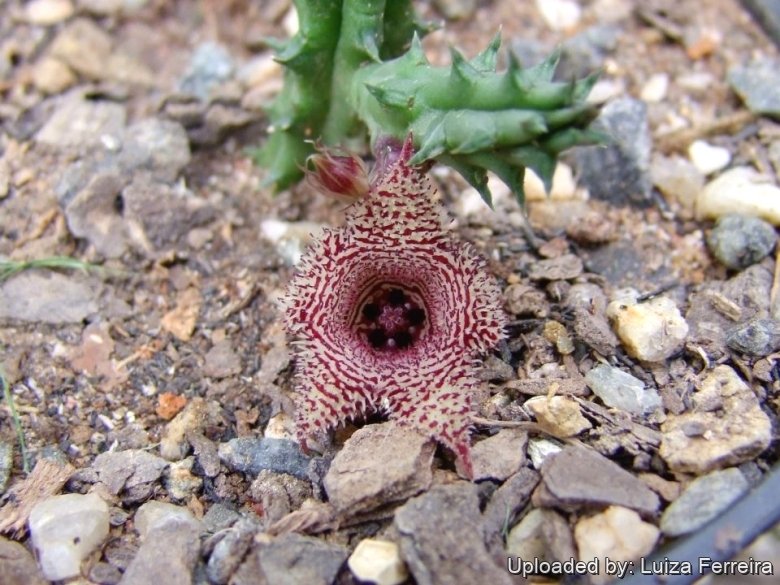
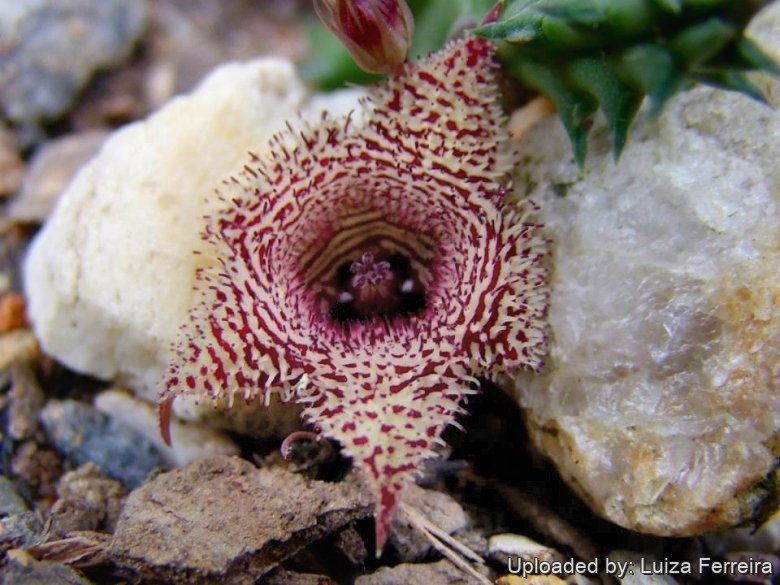
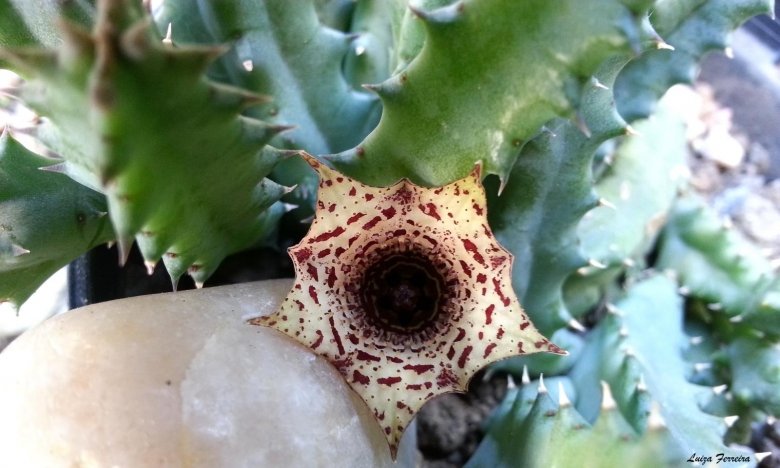
Flowers: Facing upwards, rarely prostrate or inclined on short peduncles to 10 mm long. Sepals 5.5 -8 mm long. Corolla 2-3 cm in diameter, tube bowl-shaped, c. 10 mm across and half as deep. Corolla outside cream-coloured, inside cream with deep pink transverse lines and dots, rough-papillose, the papillae mottled. Corolla lobes triangular, 4.5-9 mm long, 7-10 mm wide. Corona to 7 mm in diameter, 3.5 mm tall, the inner lobes capitate, conically tapering to an oblique fuzzy head from a chinned base.
Origin and Habitat
Angola, Namibia, Zimbabwe, Mozambique.
Altitude range: Around 1000 metres above sea level.
Habitat: Huernia volkartii grows on low ridges of partially decomposed granite with Aloe andongensis within the mist belt.
Cultivation and Propagation
Huernia volkartii isn’t difficult to grow and flower.
Spring: When winter ends and they begin to grow again, they will require much water and soaking the pots will no longer put the plants at risk for rot. In the spring they will grow well in partial shade and leaving them out in the rain may provide them with the water they need.
Summer: In the summer months they will tolerate heavy rain, but will be just as happy if the season is dry. It’s best to sort out the stems while the plants are resting in the summer before they begin their autumnal growth cycle. They will tolerate very hot weather outdoors as long as they are kept in filtered light and this will encourage them to flower in the Autumn. They also enjoy some fertiliser. Moving the plants as they are developing buds may cause them to spontaneously abort the flowers all together.
Autumn: In the fall keep them outdoors until the night time temperatures drop below the 10°C.
Winter: Winter care presents no problems at 10° C with plenty of light. As soon as they are flowered be sure to take extra precautions to keep them dry, because damp cool conditions when the plants are resting is an invitation to fungal infections, but - according to temperatures –some occasional lit watering may be useful.
Potting medium: Since roots are quite shallow, use a cactus mix or add extra perlite or pumice to regular soil potting soil. A gritty, very free-draining compost is suitable, and clay pots help the plants to dry out between watering. Re-pot every 2 years.
Pest and diseases: Huernia are generally fairly easy to grow, especially if kept pest-free. They are very susceptible to stem and root mealy bugs, and damage from these may well initiate fungal attack. Any time when there is a dead or dying stem in the pot it is important to remove it immediately and completely before other healthy stems can become ill too, isolate the healthy parts, dry them off, and re-root them in new compost.
Propagation: Easiest with stem cuttings. Allow cuttings to dry a day before planting. Stems must be laid (Not buried) on gritty compost and will then root from the underside of the stems. It can also be increased from seeds sowing in spring in moist, sandy peat moss. Barely cover seeds. Seeds germinate quickly.
In any season it’s best to lay the stems out for several days before replanting them and then pot them only in dry soil and withhold any water until they begin to shrivel or start growing again.
Bibliography
Major references and further lectures
-
Focke Albers, Ulrich Meve “Illustrated Handbook of Succulent Plants: Asclepiadaceae: Asclepiadaceae” Volume 4 Springer Science & Business Media, 2002
-
James Cullen, Sabina G. Knees, H. Suzanne Cubey “The European Garden Flora Flowering Plants: A Manual for the Identification of Plants Cultivated in Europe, Both Out-of-Doors and Under Glass” Cambridge University Press, 11/August/2011
-
Doreen Court “Succulent Flora of Southern Africa” CRC Press, 01 June 2000
-
White & Sloane, “The Stapelieae” edn 2, 3: 907, 908 1937
-
Excelsa Taxonomic Series 4: 78 1988
-
Bruyns, “Stapeliads of southern Africa and Madagascar” 201-202, 2005
From llifle page Huernia decumbens
Description
“Huernia decumbens”, is a mysterious species apparently not known in official literature, but sometimes offered in plant lists. The more credited hypothesis is that Huernia decumbens is a morphological form of Huernia volkartii and would be fully synonymized with it.
Habit: It has a classic huernia look.
Stem: Deflexed or creeping to half-upright, ca. 5-10 cm long, divided into 4 lengthwise ribs with conical fleshy tubercles ending in a soft tip, dark green and often tinged with purple where exposed to the sun.
Flowers: 1.5-2 cm in diameter, at the base of new shoots. Corolla broadly campanulate, divided into five main lobes, and five smaller secondary loblets between them. The flowers are creamy-yellow to sand coloured with red transverse irregular lines and dots, rough-papillose, the papillae mottled.
Origin and Habitat
Unknown.
Source: Huernia decumbens, LLIFLE - Encyclopedia of living forms, CC-BY-SA, retrieved 2026-10-25.