Publication: Wrightia 2(6): 251 1963
Description
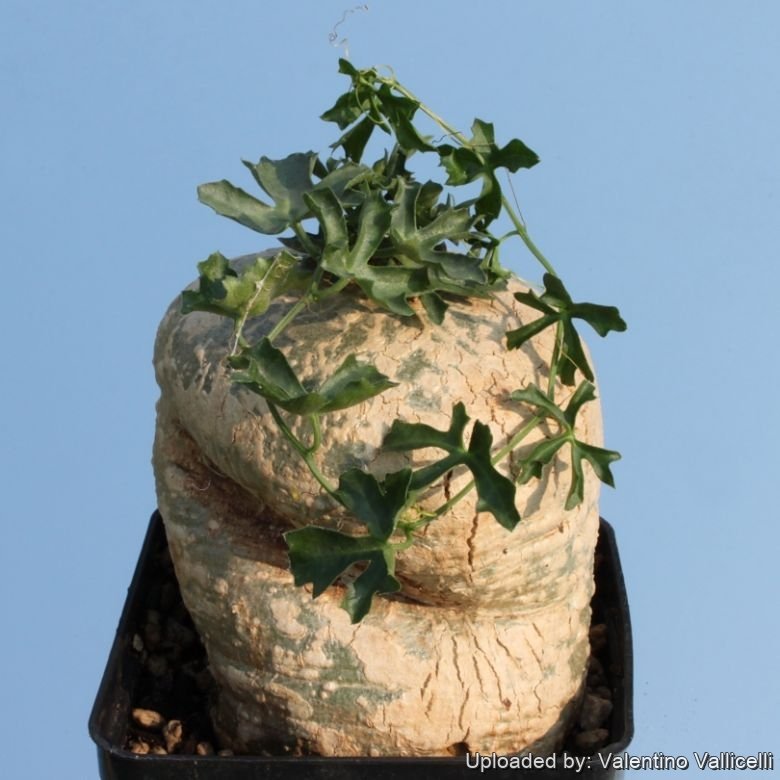
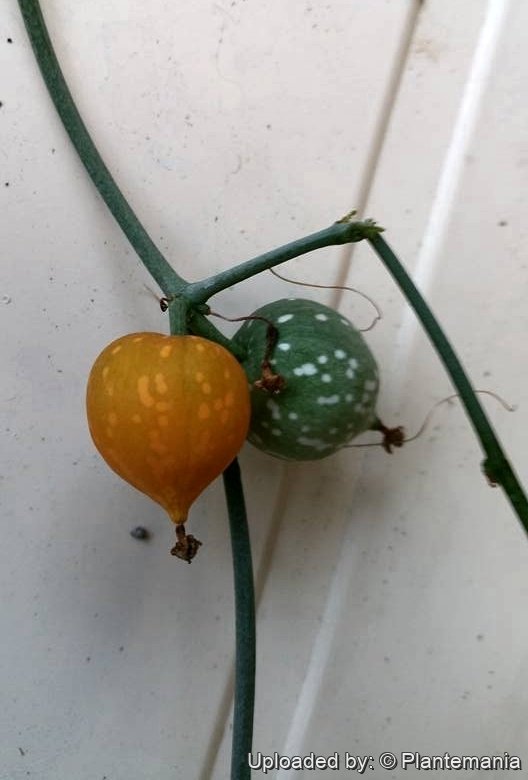
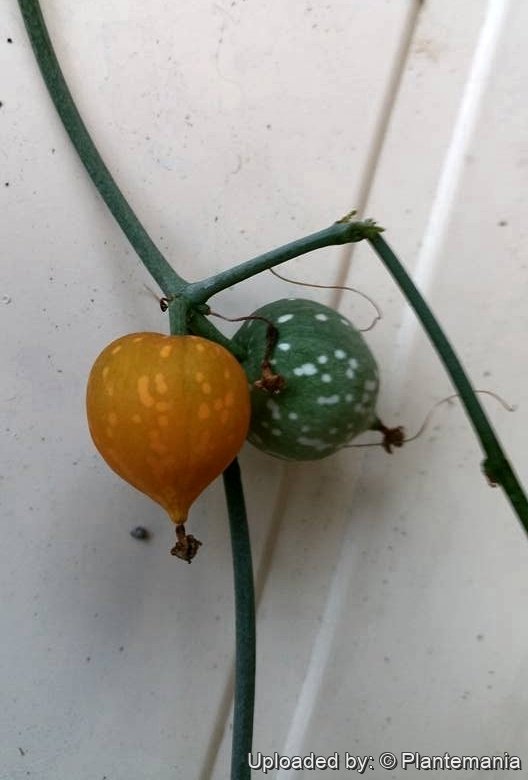
Ibervillea tenuisecta is an herbaceous perennial climbing vine with a large caudex, it produces yellow flowers in summer and little bright miniature red-orange melons in autumn. The fruits are more noticeable than the flowers. It is similar and strictly related to Ibervillea lindheimeri.
Habit: Geophyte twining vine, the vine part is mostly annual and deciduous.
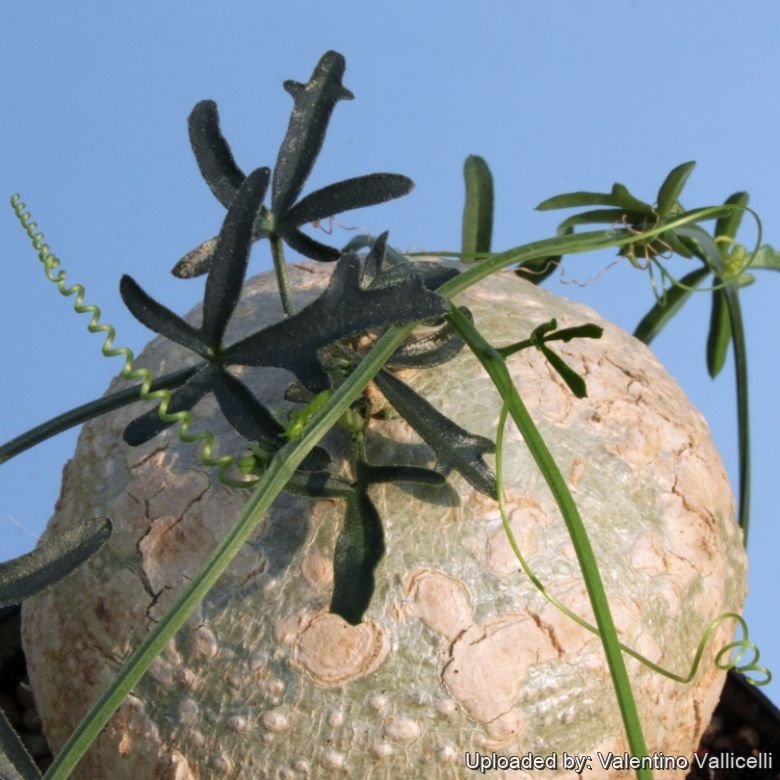
Caudex: Thick nearly globose up to 35 cm in diameter.
Stems: Slender and branched up to 3 metres long, glabrous, finely striate. Tendrils very small, jointed 1-3 mm above the enlarged base.
Leaves: Up to 6 cm wide, palmately divided, deeply cleft into 3-5 linear to filiform or coarsely toothed lobes, irregularly lobulate even in the same plant, upper face glabrous, lower face pustulate-hispid: petiole 1-2 cm long.
Flowers: Diurnal, yellow with a dash of green. This Ibervillea is dioecious, there are male and female plants, and both are needed to get viable seeds. Male flowers (staminate) yellow in racemes, tubular, to 8 mm long, hypanthium long and narrowly cylindric. Petiole spreading, 3-4 mm long. Female flowers (pistillate) solitary, small, looking like they have growing from a miniature zucchini. Calyx puberulent.
Blooming season: The flowers coming throughout most of the summer. The fruit becomes red as it ripens.
Fruits: Globose berries, 1,5-3 cm in diameter, green, white-striped, becoming bright red when ripe, smooth, several-seeded.
Seeds: Rounded at the large end.
Origin and Habitat
South USA: Arizona, New Mexico and Texas (Guadalupe Canyon, Cochise County, in the extreme southeastern corner of the State). Northern Mexico: Chihuahua, Coahuila, San Luis Potosi.
Habitat: Common on Chihuahuan desert on heavier sands, clay, or caliche, in flat brushy pastures, edges of thickets, open woods, rocky slopes and along canyon walls. It grows on, using its tendrils to climb over rocks and various woody shrubs and fences, especially allthorn (Koeberlinia spinosa).
Cultivation and Propagation
This plant is suited to greenhouse culture, but does well out of doors in Mediterranean climate, it responds well to cultivation and can eventually make a wonderfully unusual houseplant. Indoors they are often grown in shallow pots, with a tuft of wining stems emerging from a bulbous stem that seems to erupt from the soil. It is a plant for people who don’t want a lot of work taking care of their plants, as it seems to thrive on neglect. Plants even five to ten years old are extremely nice.
Growth rate: The plants are very slow growing, so don’t expect great growth spurts from year to year.
Growing substrata: Grows in a rich, very well drained, preferably stony and drained soil mix.
Watering needs: It is very drought tolerant, water deeply but infrequently in summer. It doesn’t like a wet winter when the tuber is dormant (after shedding its leaves), but will survive. Over-watering is the most frequent cause of failure when growing Ibervillea, and should be kept on the dry side. It will start growing again in Spring. Watering can recommence once the plant has shown signs of producing a fresh shoot. Sometimes it ignores its proper growing seasons (from spring to autumn) and keeps its vines growing long into its rest period, or sends up new vines much earlier than expected. In that case, paying attention to the plant and not the calendar is a good idea.
They are pretty resistant to rotting if all other conditions are good.
Fertilization: Fertilize them only once during this period.
Exposition: Keep the root in the shade, light shade to full sun for the vine.
Hardiness: When it drops its leaves protect from frost and stop watering. It is hardy to -7 degrees Celsius if kept dry. However warmth throughout the year will increase the grower’s success (at temperatures from 5 to 10 degrees centigrade during rest season).
Maintenance: Remove the spent branches. Leaf tips have a tendency to dry and be brown in the house, so if possible place it outside in the summer.
Pest and disease: Bugs, mealy bugs and mites usually are not a problem with the Ibervillea, however if they do appear, simply spray the houseplant down with a soapy water mix twice a day until they are gone.
Propagation: Propagates usually from seeds that must be sown in the spring and will germinate at about 20° C. The seedlings’ caudex forms below ground and will grow much faster if left underground for some years.
Bibliography
Major references and further lectures
-
Urs Eggli “Illustrated Handbook of Succulent Plants: Dicotyledons” Springer, 2002
-
Ronald J. Taylor “Desert wildflowers of North America” Mountain Press Publishing, 1998
-
Thomas Henry Kearney, Robert Hibbs Peebles “Flowering Plants and Ferns of Arizona” U.S. Government Printing Office, 1942
-
Roland H. Wauer, Carl M. Fleming “Naturalist’s Big Bend: an introduction to the trees and shrubs, wildflowers, cacti, mammals, birds, reptiles and amphibians, fish, and insects” Texas A&M University Press, 01/Jan/2002
-
Roy L. Lehman, Ruth O’Brien, Tammy White “Plants of the Texas Coastal Bend” Texas A&M University Press, 27/Feb/2009
-
Delena Tull, George Oxford Miller “A Field Guide to Wildflowers, Trees & Shrubs of Texas” Gulf Publishing Company, 01/Nov/1991