Publication: Bot. Jahrb. Syst. 33: 284 (1903)
From llifle page Jatropha fissispina
Description
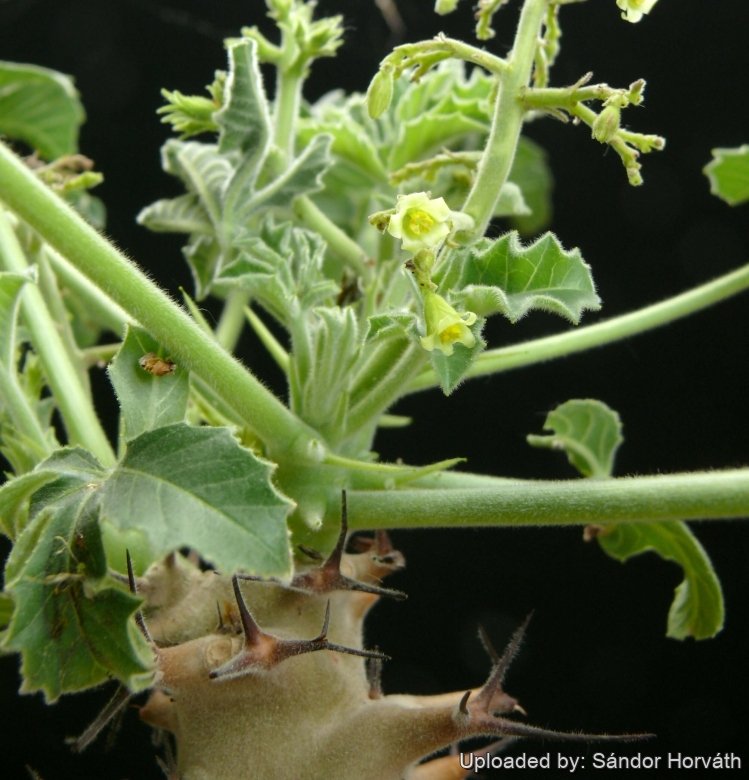
Jatropha fissispina is a short sparingly-branched, pachycaul shrub 0.1-1 m tall, but exceptional plants to 2.5 m tall are known. The branches, are thick, somewhat fleshy, soft, spiny and tomentose when young. The pelargonium-like leaves are deeply lobed and hairy, the flowers are green or yellow-green and not very showy. Jatropha fissispina, at present is considered synonym of Jatropha ellenbeckii and not easily differentiated from the latter.
Derivation of specific name: fissispina = with divided spine, because of the typical shape of the spines.
Stem: Trunk unbranched for about 5-30 cm hight, greenish grey, irregularly covered by long conical tubercles arranged in pairs on each side of the leaf scar, and each topped with a curious double or triple aciculate, black spine about 10 mm long (modified 2–3-lobed stipules with a hard wide base). Branches thick, somewhat fleshy, soft, spiny and tomentose when young.
Leaves: Deciduous, long-stalked, appearing at the top of the stem, palmately lobed, deeply 5–6-partite, 6.5-10 cm long and about 7.5 cm broad. Segments oblanceolate, acute, glandular-dentate, thinly chartaceous, pubescent on both surfaces. Margins more or less wavy. Petiole 3-5 (or more) cm long, softly tomentose.
Inflorescences: Cymes lax, long-pedunculate, the flowering part about 5 cm long. Peduncle 5-9 cm long. Bracts linear, up to 6 mm long, with several glandular teeth, softly pubescent.
Male flowers: Sepals lanceolate, acutely acuminate, 2 mm long, glandular-toothed, pubescent. Petals oblong, acute, glabrous, about as long as the sepals. Disk-glands small. Stamens 8; filaments partially connate.
Female flowers: Sepals similar to the male but longer. Ovary glabrous.
Origin and Habitat
Jatropha fissispina is native to Tropical East Africa (Ethiopia, Somalia, Kenya, Tanzania.)
Altitude range: 90-1,050 metres above sea level.
Habitat and origin: This species is extremely rare and dispersed in its habitat, where it is found in rock crevices, on barren flood prone rocky areas with silt deposited soil, on slopes of clastic rocks of volcanic origin, on limestone and on sandy soil over basement complex, in Acacia, Commiphora bushland. It also grows in disturbed grounds. Even rarer in culture, where it is visually unknown.
Cultivation and Propagation
Jatropha fissispina is a beautiful caudiciform plant, and it seems to like the container as much as being planted in the ground. It will be an indoor bonsai in all but the warmest climates. It is easy to grow and suited for any well drained soil on bright light. It can be cultivated in open air in tropical or subtropical climate zones, in full sun, or (preferably) in light shade. It is a good plants for rock gardens.
Soil: The ideal potting-medium is one with good moisture-retaining capacity but open and well drained and be allowed to dry between waterings. .
Exposure: These plants don’t seem to love being blasted by the sun in the summer but prefer bright light, and will therefore not make demands on your prime growing space. However shade grown plants will tend to produce fewer, and etiolated growth (weak, oft and gummy stems with unusually long internodes, and generally paler green coloration). The colour of this plant is much more marked if grown in full sun.
Watering: It is relatively flexible in its watering requirements. It needs much water when it is growing. It can be watered regularly as long as the medium is open and well drained. As with any normal plant when watering, it is best to do so thoroughly, until a little water comes out through the drain holes. Allow the medium to dry out somewhat between waterings. From autumn onwards it must be given a rest period and stop watering during the winter when it sheds the leaves.
Space plants apart to allow air movement between branches and leaves. This will help with evaporation of extra water droplets collected during watering.
Fertilization: Use fertilizer with low nitrogen and high phosphorus and potassium ratios. Feed during spring and summer and withhold feeding during winter.
Hardiness: Tender, protect from frost . Temperature spring to autumn: nocturnal at least 18°C and diurnal up to 38°C. Wintering: nocturnal 12°C and diurnal 20°C or more.
Pests and diseases: It can rot if it is cold and damp.
Propagation: Seeds.
Bibliography
Major references
-
J. G. Baker, with additions by C. H. Wright.“Flora of Tropical Africa”, Vol 6, 1913
-
“Lake Turkana Wind Power Project - Updated Environmental and Social Impact Assessment Study Report” <https://www3.opic.gov/Environment/EIA/laketurkanawind/ESIA%20wind%20farm%20site\_2009.pdf\> web 07 January 2015
-
C. F. Hemming “The South Turkana Expedition: Scientific Papers VIII the Ecology of South Turkana: A Reconnaissance Classification” The Geographical Journal Vol. 138, No. 1 (Mar., 1972), pp. 15-40
-
fiche de “Jatropha fissispina” Texte & Photo: Joél Lodé. <https://www.cactuspro.com/biblio\_fichiers/pdf/Lode/LodeS-Faucaria-fin-DIVERS\_O.pdf\> web 07 January 2015
Source: Jatropha fissispina, LLIFLE - Encyclopedia of living forms, CC-BY-SA, retrieved 2026-10-25.
Gallery