Publication: Bot. Mag. 74: t. 4376 1848
Description
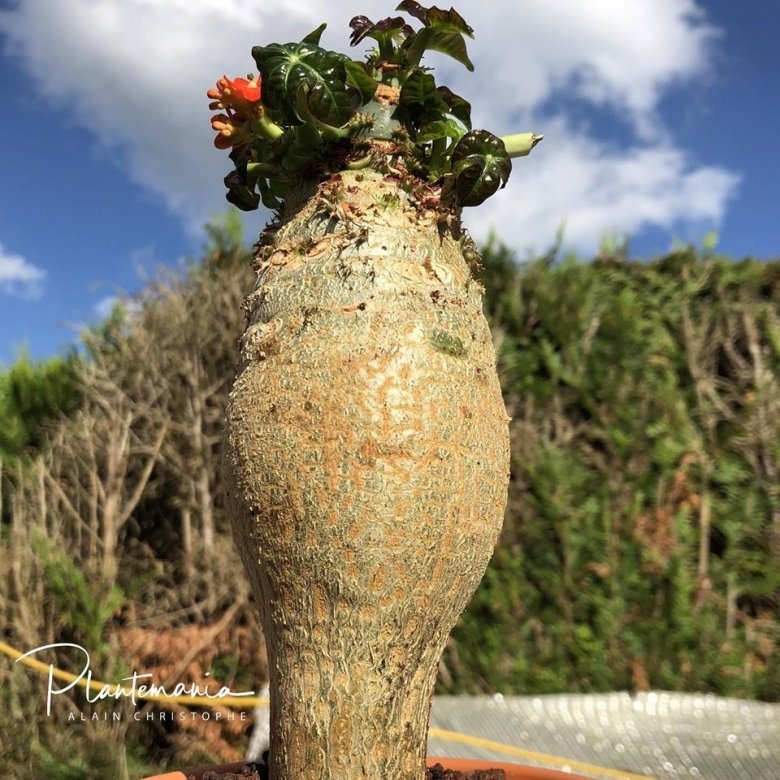
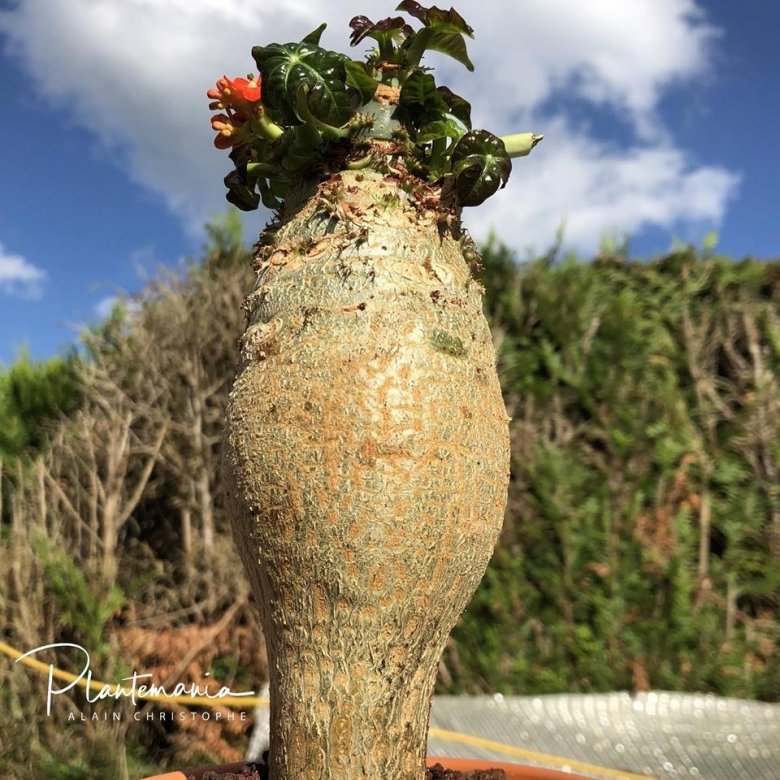
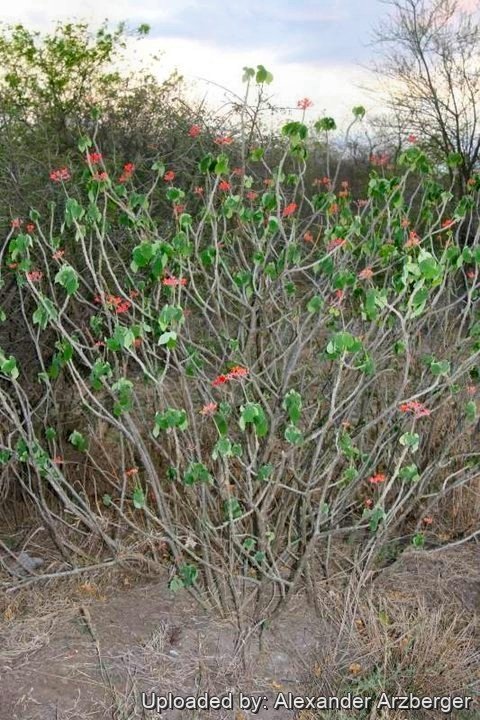
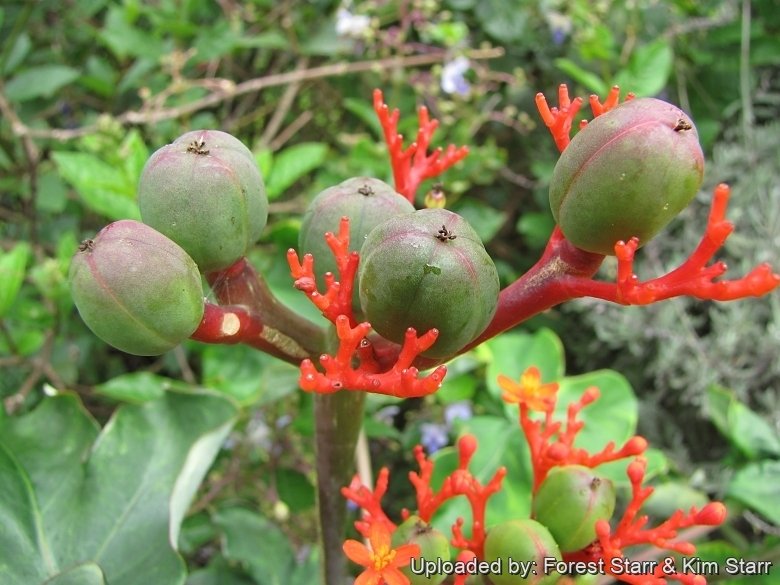
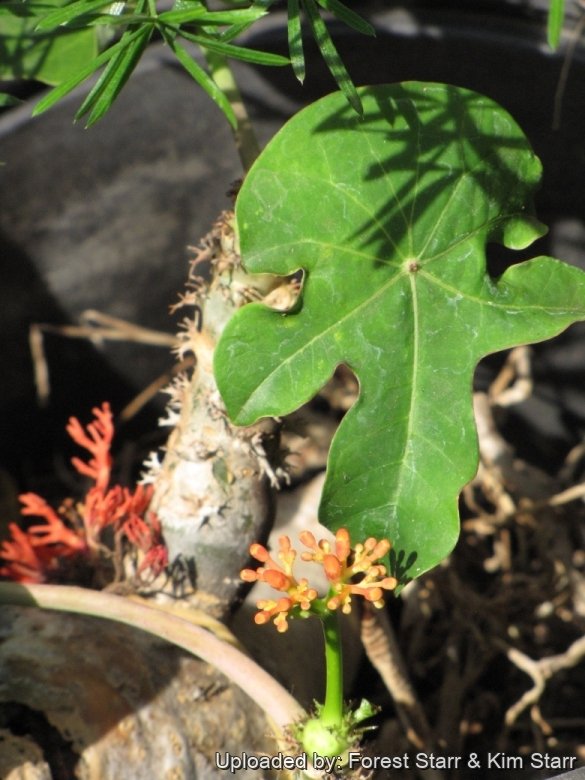
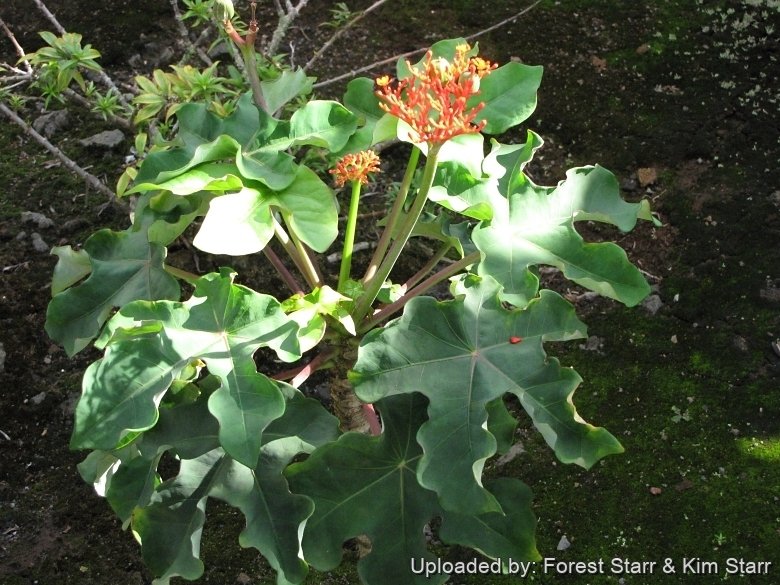
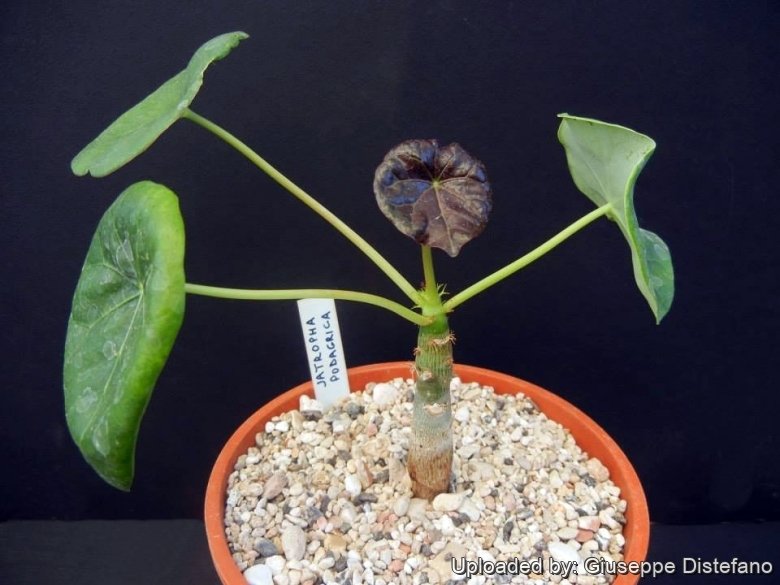
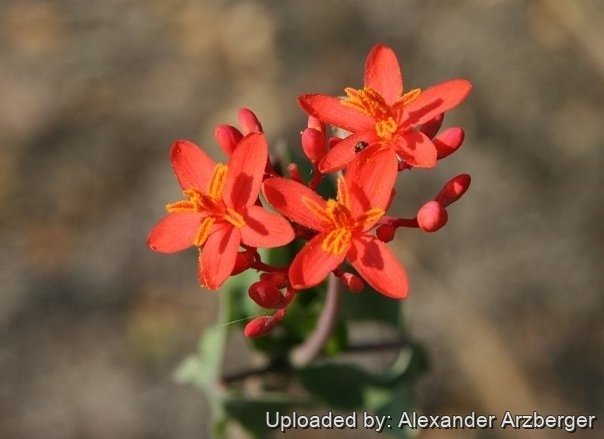
Jatropha podagrica (Gout Stalk or Buddha belly) is a very remarkable small erect succulent or sub-woody shrub with a singularly distorted stem and branches much swollen at their bases, giving it the common name. The large, long petioled, only shallowly lobed leaves are arranged at the end of the branches. Throughout the year it produces small red-orange flowers in clusters like a coral at the tip of a long red stalk. It is one of the most popular caudiciform greatly priced by the succulent enthusiast and one that is easily raised from seed. All parts, especially the seeds, of the plant contain the toxic curcin, making it poisonous.
Stems: Thick, somewhat fleshy, completely glabrous, pale greenish brown, simple or slightly branched, 40-80(-200) cm high much and irregularly swollen and tuber-like (caudiciform) at the base, branches also swollen at the base the rest terete green and succulent marked with numerous pits or hollows whence the leaves have dropped, the younger portions of the branches of the plant which are about 2,5 cm in thickness showing the much larger scars of recently shed leaves rendered more conspicuous by the persistentstipules one on each side the large scar. Stipules up to 5 mm long, branched, glandular, becoming indurated. Bark grey. The stem is filled with a watery or slightly milky sap.
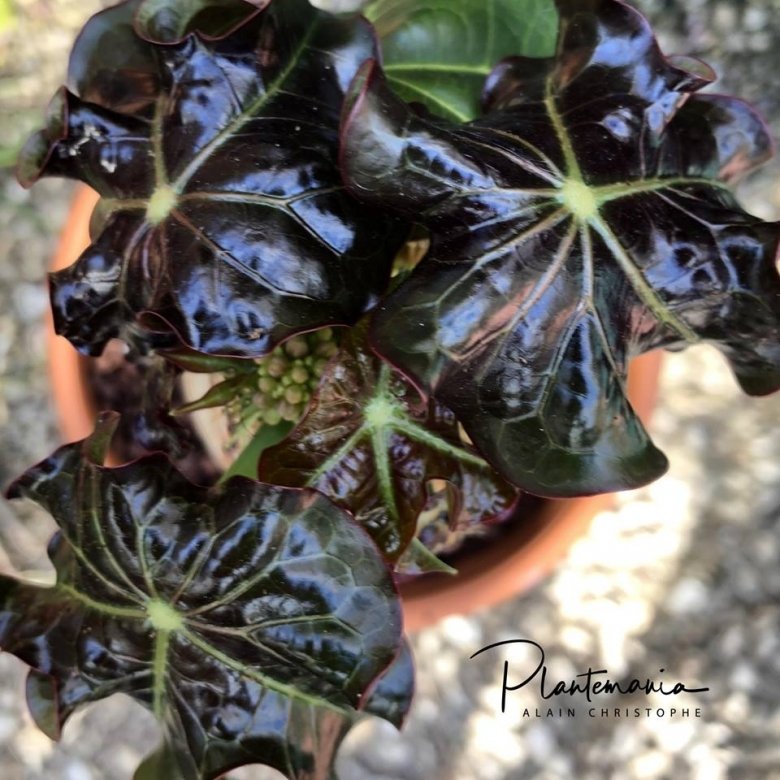
Leaves: Only a few leaves appear at one time and they are confined to the apices of the branches on 10–20 cm long petioles. Leaf blades, bright or dark green above, paler beneath, 10–20 × 10–20 cm, peltate, 3–5-lobed, cordate, peltate, circular-ovate or obovate, glabrous, the lobes obtuse entire somewhat ovate, subacute, the median lobe 8–12 × 6–11 cm, the laterals the same or slightly smaller.
Inflorescence: Terminal 20–25 cm long. Peduncles 17–22 cm long elongated bearing a rather large densely corymbiform to subcapitate head. Bracts up to 2 mm long, triangular, subacute, subentire. Pedicels 1–2 mm long and stout.
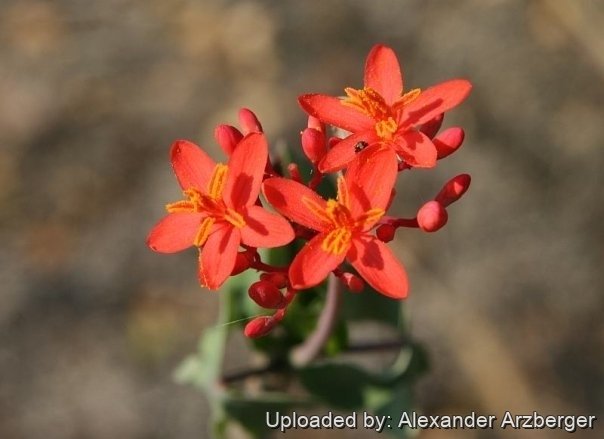
Flowers: Numerous rather small orange red monoecious rich orange scarlet. The male flowers with a cup shaped calyx 1.5-2 mm long, 5-lobed. Calyx lobes 0.5 × 1 mm, erect, transversely ovate, emarginate, entire. Corolla deeply five or six partite the segments ovate spreading. Petals 5–6 in length, 2 mm broad, obovate-oblong, obtuse, scarlet; disk urceolate. Stamens six to eight, yellow. 5 mm long, filaments connate at the base and having five glands there united into a ring, anthers 2 mm long, orange. The females few in the axils of the main bracteas of the peduncles. Ovary ovate with similar glands style 1.5 mm long much divided into several green 2-lobed stigmas.
Blooming seson: It flowers at almost all seasons of the year mostly during the rains.
Fruits (capsules): Black 1.4 × 1.3 cm when dried, ellipsoid-ovoid, 3-lobed, apically and basally truncate. The small capsule opens when ripe.
Seeds: 1.2 × 0.6 × 0.4 cm, ellipsoid, triangular-convex in section, brown, with a small fluted caruncle.
Seedlings: Hypocotyl thickened upwards from 5 mm at the base to 8 mm near the apex, 7 cm long. Cotyledons broadly oblong, rounded at the apex, obsoletely auricled at the base, palmately trinerved, 8.1 cm long, 2.2 cm. wide, glabrous and smooth; petiole 1.5 cm long, semiterete, channelled on the upper side, red. Leave blade almost round.
Origin and Habitat
It is native to the tropical Americas Colombia, Guatemala, Honduras, Nicaragua but it is propagated as an ornamental plant in many tropical countries and often becoming naturalized
Cultivation and Propagation
Jatropha podagrica is a very ornamental species, easy to grow and suited for any well drained soil on bright light. It can be cultivated in open air in tropical or subtropical climate zones, in full sun, or (preferably) in light shade. It is a good plants for rock gardens. It is a good shrub for the rockery. Good for pot culture it adapts well in bright windows in the home and greenhouses too. Its clean outline and simple form have a sculptural drama and can suit a stark modern interior. It looks its best in winter while it is still without leaves and has only its flowers.
J. podagrica is also known for its incredible ability to attract a variety of butterflies wherever it is grown.
Soil: The ideal potting-medium is one with good moisture-retaining capacity but open and well drained and be allowed to dry between waterings. .
Exposure: These plants don’t seem to love being blasted by the sun in the summer but prefer bright light, and will therefore not make demands on your prime growing space. However shade grown plants will tend to produce fewer, and etiolated growth (weak, oft and gummy stems with unusually long internodes, and generally paler green coloration). The colour of this plant is much more marked if grown in full sun.
Watering: It is relatively flexible in its watering requirements. It needs much water when it is growing. It can be watered regularly as long as the medium is open and well drained. As with any normal plant when watering, it is best to do so thoroughly, until a little water comes out through the drain holes. Allow the medium to dry out somewhat between waterings. From autumn onwards it must be given a rest period and stop watering during the winter when it sheds the leaves.
Space plants apart to allow air movement between branches and leaves. This will help with evaporation of extra water droplets collected during watering.
Fertilization: Use fertilizer with low nitrogen and high phosphorus and potassium ratios. Feed during spring and summer and withhold feeding during winter.
Hardiness: Tender, protect from frost . Temperature spring to autumn: nocturnal at least 18°C and diurnal up to 38°C. Wintering: nocturnal 12°C and diurnal 20°C or more.
Pests and diseases: It can rot if it is cold and damp.
Propagation: Seeds/Cuttings
Warning: All the parts of the plant are considered as poisonous. When a plant get damaged it exudes a thick white milky sap known as latex. This latex is poisonous and particularly dangerous for the eyes, skin and mucous membranes. So pay extreme attention not to get any in your eyes or mouth. Cultivated plants must be handled carefully. If consumed severe nausea, vomiting, diarrhea, gastroenteritis, blindness are expected.
Medicine:Antipyretic, diuretic, purgative, antibacterial, anti-fungal, hypotensive, spasmolytic and appears to act as a nerve-blocking agent. All parts used as medicine for subsidence of swelling, to treat jaundice, gonorrhea, relieve pains and detoxify the viper bites. From the seeds a powerful purgative oil.
Traditional uses: Jatropha podagrica was used to tan leather and produce a vibrant red dye in Mexico and the south-western United States.
Propagation: Propagated by division or seeds.
Bibliography
Major references and further lectures
-
Sir William Jackson Hooker, David Prain, Otto Stapf “Curtis’s Botanical Magazine” Volume 74 Reeve Brothers, 74: pl. 4376.1848
-
University of California Publications in Botany 74: 1-73. 1979
-
Taxon 29: 536-537, 715-716. 1980
-
Listados Floristicos de Mexico 4: i-v, 1-246. 1986
-
Proceedings of the Indian Science Congress Association 76(3,VI): 183. 1989
-
Umberto Quattrocchi “CRC World Dictionary of Medicinal and Poisonous Plants: Common Names, Scientific Names, Eponyms, Synonyms, and Etymology” (5 Volume Set) Copertina anteriore CRC Press, 03/May/2012
-
Nasir El Bassam “Handbook of Bioenergy Crops: A Complete Reference to Species, Development and Applications” Earthscan, 2010
-
Swaddiwudhipong W, Kunasol P, Sangwanloy O, et al. “Foodborne disease outbreaks of chemical etiology in Thailand, 1981-1987.” Southeast Asian J Trop Med Public Health 20(1):125-132. 1989
-
D. Jesse Wagstaff “International Poisonous Plants Checklist: An Evidence-Based Reference” CRC Press, 07/Jul/2008
-
Gurcharan Singh Randhawa, Amitabha Mukhopadhyay “Floriculture in India” Allied Publishers, 01/Jan/1986
-
Torstar Books (Firm) “Flowering plants/2” Torstar Books, 1985
-
Hans-August Rotter “Growing plants without soil: easy-care plants for home and office” EP Pub., 28/Oct/1982
-
Nathaniel Lord Britton “Flora of Bermuda” Scribner, 1918
-
Bernice P. Bishop, “Museum Bulletin” - Bishop Museum Press, 1935
-
William C. Burger “Flora Costaricensis” Edition 36 Field Museum of Natural History, 1971
-
SIR JOHN LUBBOC BART. “SEEDLINGS” 1892
-
Werner Rauh “The Wonderful World of Succulents: Cultivation and Description of Selected Succulent Plants Other Than Cacti” Smithsonian Institution Press, 1984
-
Burkill, H.M. “The useful plants of west tropical Africa” Vol 2 1985.
-
A. Radcliffe-Smith “Flora Zambesiaca” Vol 9 Part 4 1996
Cultivars and forms (2)
Cultivars (1)
Other names (1)
Gallery