Publication: Z. Sukkulentenk. ii. 183 (1926)
Description
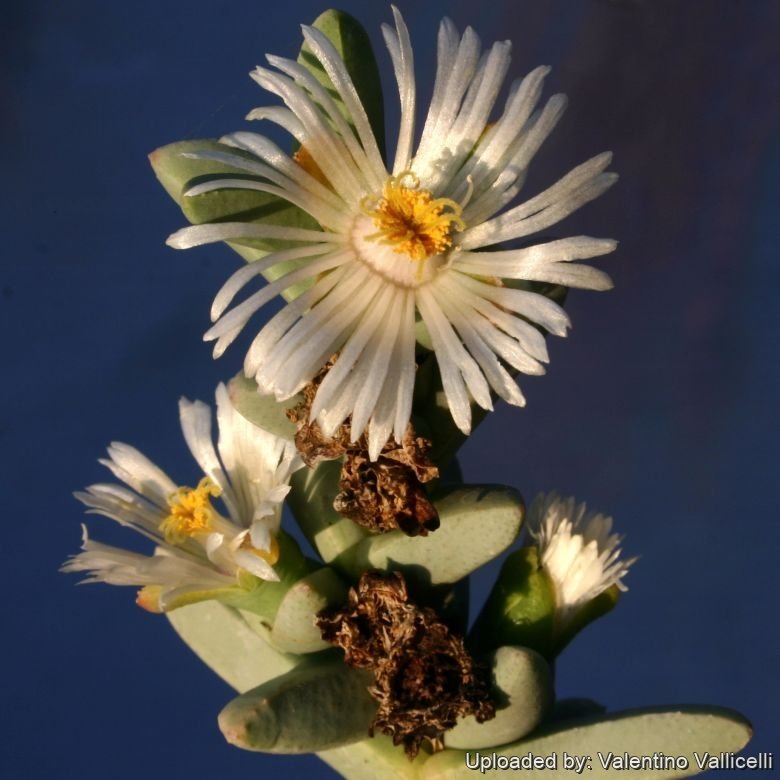
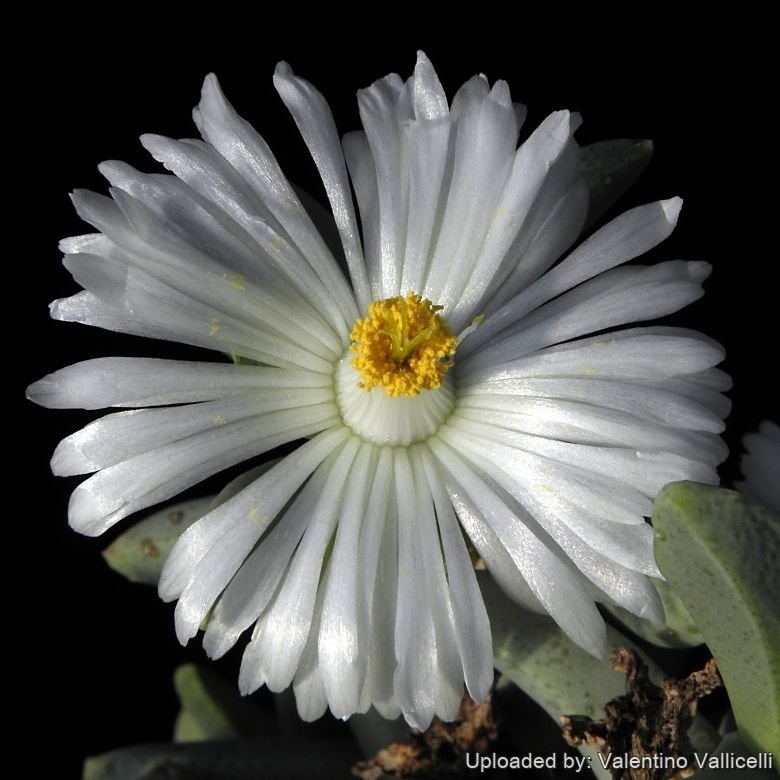
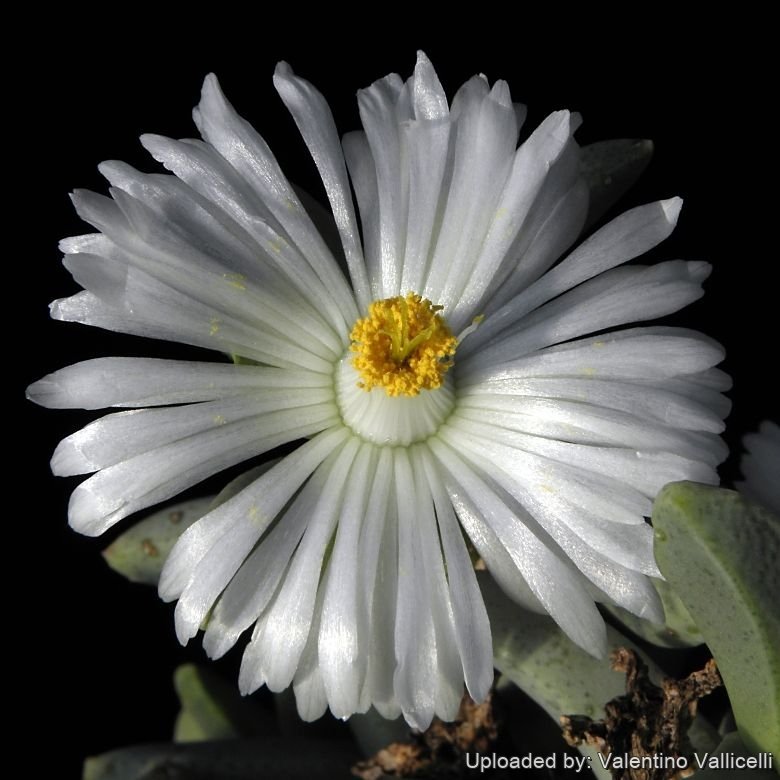
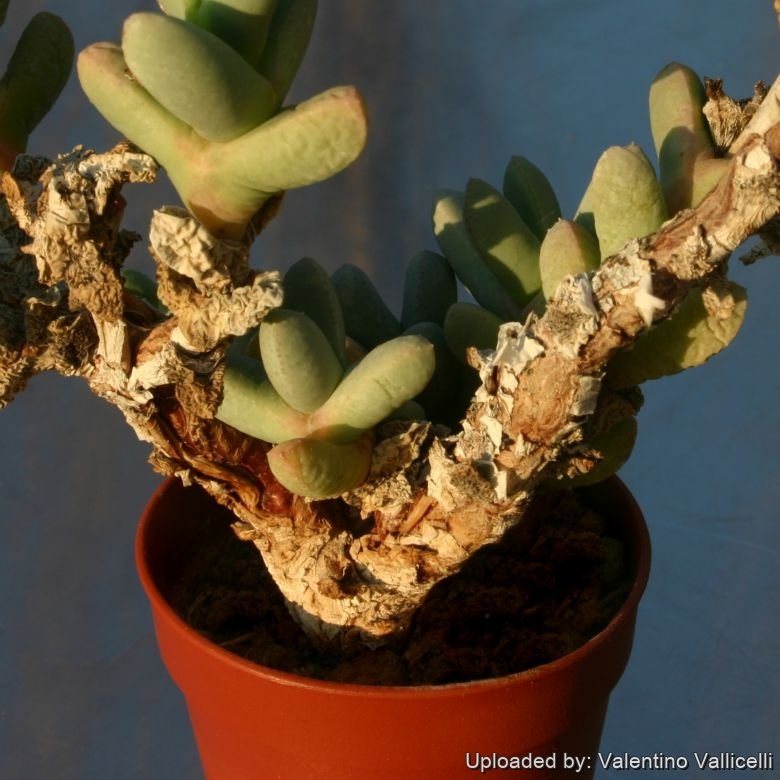
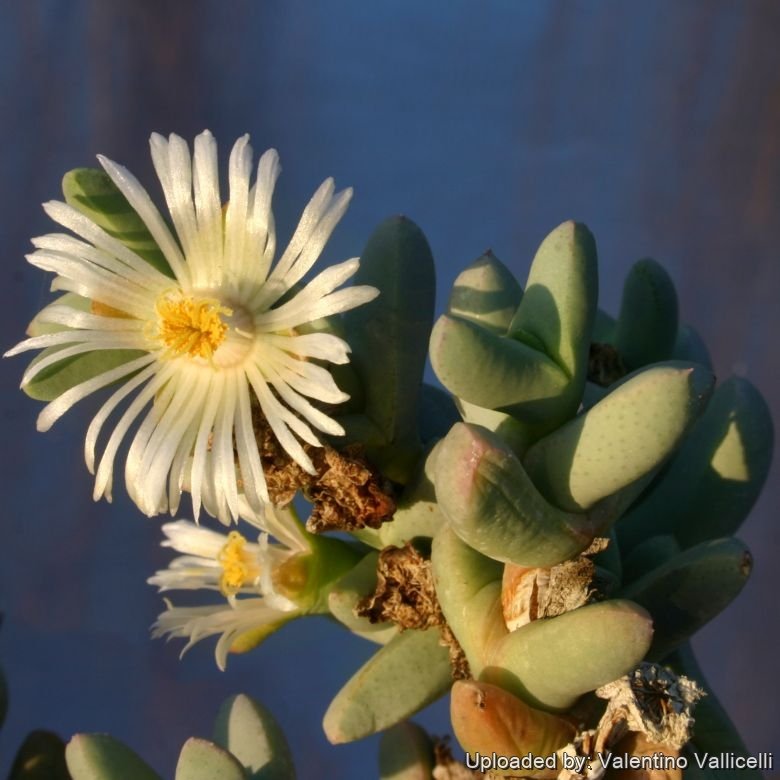
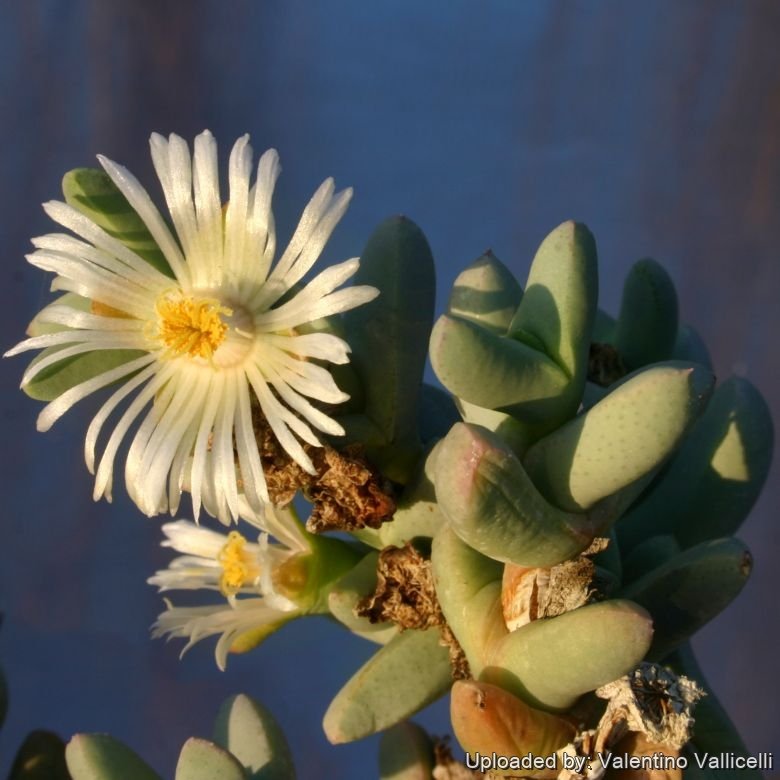
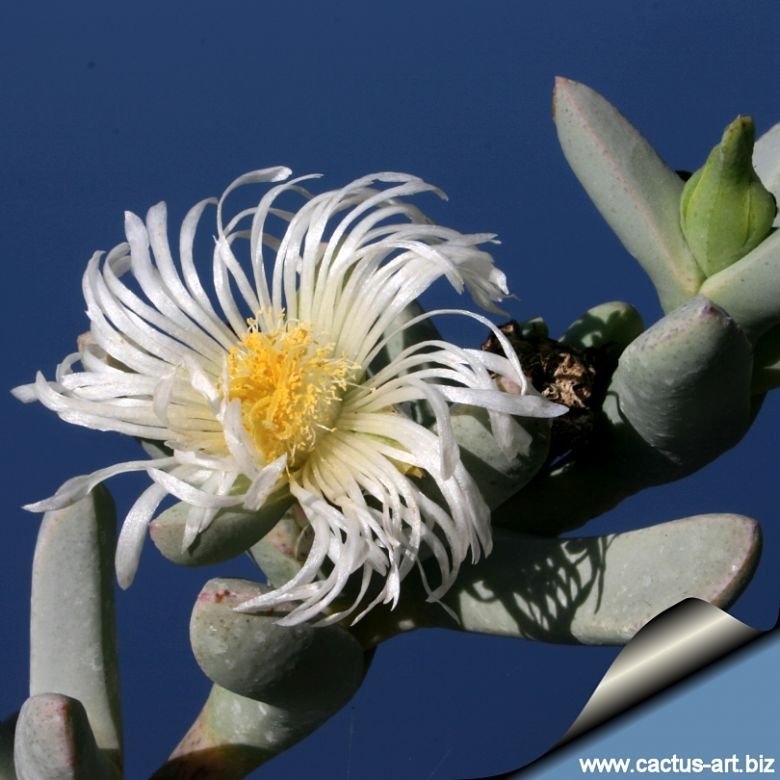
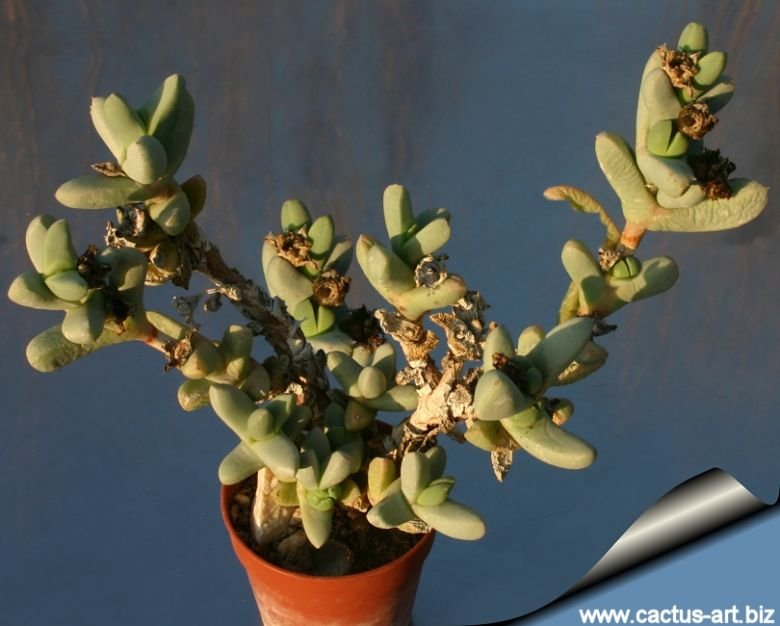
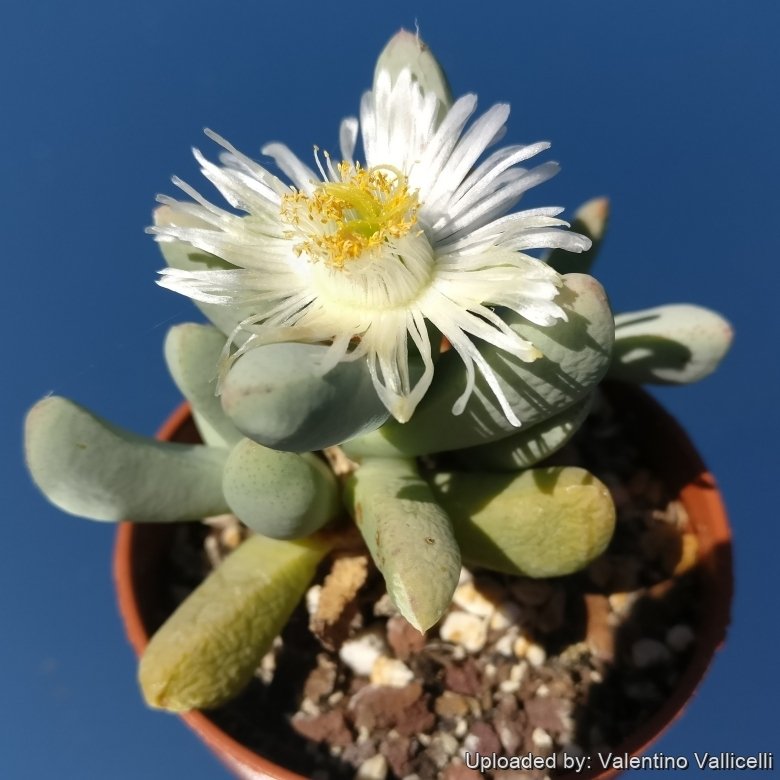
Juttadinteria deserticola is a low growing succulent sub-shrub on woody roots, up to 20 cm tall. It has whitish, boat-shaped leaves and white flowers that appear in the growing season in autumn and winter.
Derivation of specific name: “deserticola” , from Latin “desertus”, deserted, desert; and Latin “-cola”, inhabiting; for the occurrence in very arid regions.
Stems: Decumbent, rarely ascending or erect, internodes rarely visible, in cultivation too.
Leaves: Pale green to whitish-grey, short, boat-shaped to pointed, length, stony up to 30(-40) mm long and less than 20 mm wide. Margins only in some northern populations with minute teeth. Northern and southern populations differ in their leaf shapes, the northern being more rounded apically, appearing broader, the southern more pointed, appearing slender.
Flowers: Large white in winter. Short stalked, daisy-like, 20-30 mm in diameter. Stamens 150-250, Petals 40-60.
Fruits (capsules): About 8-(or more)-loculed, 11-19 mm long, 6-10 mm broad, covering membranes absent or to 1 mm broad. Capsules are hygrochastic, a mechanism whereby seeds are dispersed by raindrops. When it rains, the keels of the wet seed capsules push open valves. Raindrops hitting the open seed capsule splatter seeds in different directions, thus ensuring recruitment and the subsequent survival of the species.
Origin and Habitat
Juttadinteria deserticola has a very wide, almost continuous, distribution along the coast from the Western Namaqualand (south of Alexanderbay), in South Africa to the District Lüderitz-South in Namibia. This species is known from 20 subpopulations with extent of occurrence estimated at 15,000–20,000 km².
Altitude range: It has been recorded at altitudes of 70 to 450 metres above sea level.
Habitat and ecology: Juttadinteria deserticola grows in sand-blown plains between rocky outcrops, gentle slopes covered by gravel from quartz, dolomite, and lime-stone, rarely on phonolite (black) or sedimentary schists. The plant is perfectly adapted to live in the fog zone and draws most of its water from the fogs which roll in from the sea. The plants are associated with low succulent dwarf shrubby vegetation in association with Psilocaulin dinteri, Euphorbia verruculosa, Conophytum taylorianum, Conophytum saxetanum, Crassula aurusbergensis, Pelargonium cortusifolium, Bulbine rhopalophylla, Sarcocaulon multifidum}}, Tromotriche ruschiana, Hoodia officinalis subsp. delaetiana, Dracophilus dealbatus and Cephalophyllum ebracteatum plus several other. No threats are known at present and the population is believed to currently be stable.
Cultivation and Propagation
Juttadinteria is a “winter” grower which is most active from late winter until later spring and heading for summer dormancy, but in favourable growing conditions it keeps going over the summer too and don’t’ need particular care.
Soil: Requires good drainage as it it is prone to root rot.
Fertilization: they thrives in poor soils ans seems very sensitive to an excess of potassium.
Watering: Water minimally in summer, only when the plant starts shrivelling, water more abundantly when they are growing in the fall and spring. Requires little water otherwise its epidermis breaks (resulting in unsightly scars).
Light: Keep cool and shaded in summer, need full sun or light shade.
Hardiness: USDA zones 9A – 11. They prefer a very bright and arid situation and will take a light frost (Hardy to -5°C) if they are in dry soil.
Uses: Container, rock garden.
Propagation: Seeds, cuttings. It is difficult to root juttadinterias from cuttings and generally pointless as well, so quick are they from seed. They are easily propagated by seed.
Bibliography
Major references and further lectures
-
van Jaarsveld, E. & Potter, L. 2005. Juttadinteria deserticola (Marloth) Schwantes. National Assessment: Red List of South African Plants version 2015.1. Accessed on 2015/12/17
-
Hermann Jacobsen “Handbuch der sukkulenten Pflanzen: Mesembryanthemaceae” G. Fischer, 1955
-
Urs Eggli, Leonard E. Newton “Etymological Dictionary of Succulent Plant Names” Springer Science & Business Media, 29 June 2013
-
Loots, S. & Mannheimer, C. 2004. Juttadinteria deserticola. The IUCN Red List of Threatened Species 2004: e.T46783A11076701. http://dx.doi.org/10.2305/IUCN.UK.2004.RLTS.T46783A11076701.en. Downloaded on 17 December 2015.
-
Heidrun E.K. Hartmann “Illustrated Handbook of Succulent Plants: Aizoaceae F-Z” Springer Science & Business Media, 2002
From llifle page Juttadinteria decumbens
Description
Juttadinteria decumbens, is a low growing succulent sub-shrub on woody roots, up to 5 cm high. It is generally included within (as a synonym of) Juttadinteria deserticola, suggesting that there is not really a fundamental difference between the two, and hard to name accurately without knowing where they come from. It has whitish, pretty closely set, boat-shaped leaves and white flowers that appear in the growing season in autumn and winter.
Derivation of specific name: The name decumbens, meaning “Lying or growing on the ground but with erect or rising tips ”, refers to the low growing branches of this species.
Habit: Plant decumbent (stem creeps along ground) 5 cm high, branched. Branches to 25 cm long. 2-4 leaved. Older plants show the peculiarity that their growth mainly extends along the ground on both sides in one direction only, so that they produce clumps that are usually much longer (- 25 cm) than wide (-10 cm). The main horizontally extending roots show the same peculiarity, these are very long (to 50 cm). Secondary branches have l-2 pairs of leaves.
Leaves: Paired, fused at the base, thick, upper side flat or slightly convex, up to 1.5-3 cm long, 1-2 cm wide and 1-1.5 cm thick, grey-green to almost whitish, obtuse, keeled, glabrous.
Flower: Peduncle up to 2 cm long. Flowers up to 3 cm in diameter. Sepals 4. Petals white, up to 7 mm long. Stamens 7-20 mm long: Anthers yellowish. Stigmas 7-8, filiform, to 8 mm long.
Origin and Habitat
Juttadinteria decumbens grows in the arid region of Namaqualand (Namibia and South Africa)
Bibliography
Major references and further lectures
- J. Neumann, “Kakteenkunde” 1933
Source: Juttadinteria decumbens, LLIFLE - Encyclopedia of living forms, CC-BY-SA, retrieved 2026-10-25.
From llifle page Juttadinteria tetrasepala
Origin and Habitat
Namaqualand
Source: Juttadinteria tetrasepala, LLIFLE - Encyclopedia of living forms, CC-BY-SA, retrieved 2026-10-25.
Gallery