Publication: Z. Sukkulentenk. 2: 183 (1926)
From llifle page Juttadinteria kovisimontana
Description
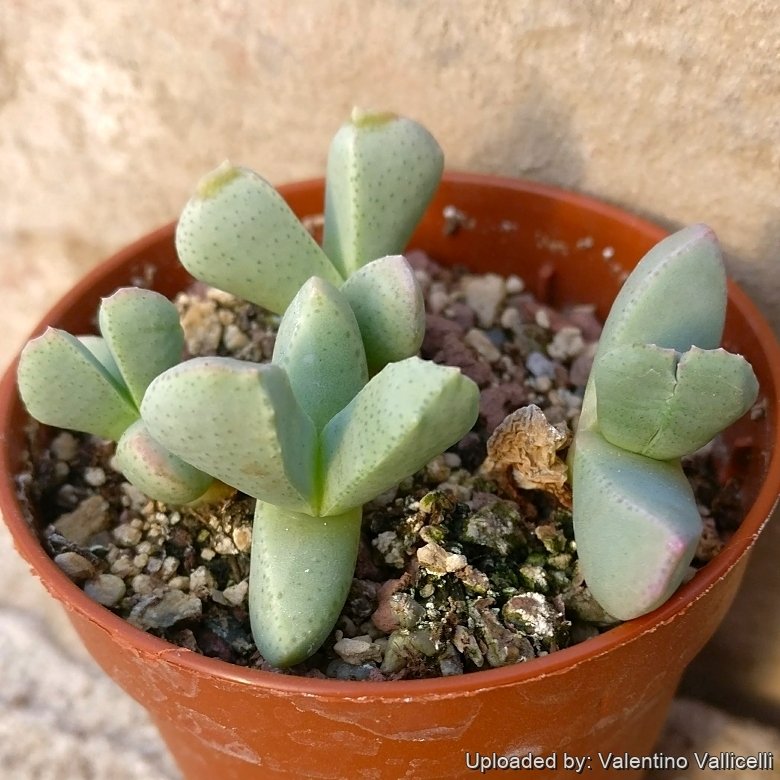
Juttadinteria kovisimontana is a perennial succulent shrub that grows to about 20-25 cm in diameter with short hardly woody stems.
Note: Juttadinteria kovisimontana and Juttadinteria simpsonii are united as they are considered to differ only in minor characters, mainly in leaf roughness, which can vary in and between populations. The peculiar roughness in Juttadinteria kovisimontana is due to the occurrence of incompletely developed teeth forming wart-like protrusions, a feature occur-ring irregularly in several populations. Both names appear in the same publication, J. simpsonii is chosen as the valid name because its character set is more typical of the species.
Stems: Branches up to 15, ascending, 6-10(-25) cm long; Internodes barely recognizable, longer in cultivation.
Leaves: 15-22 mm long, 10-18 mm thick, whitish, boat-shaped, about 10 mm wide at the base and 20 mm wide at the base of the triangular tip. Leaf surface slightly arched with shallow humps, margins and keel, often also the faces, with teeth, mostly fiercely toothed, sometimes smoother.
Flowers: Short stalked, about 22-35 mm in diameter, white. Stamens 180-305. Petals 40-60.
Fruit (capsules): 8(-12)-locular, 13-18 mm long, covering membranes as ledges to 3 mm, sometimes overlapping in the centre for abput 1/2 their length. Capsules are hygrochastic, a mechanism whereby seeds are dispersed by raindrops. When it rains, the keels of the wet seed capsules push open valves. Raindrops hitting the open seed capsule splatter seeds in different directions, thus ensuring recruitment and the subsequent survival of the species.
Origin and Habitat
Karas Mountains, about 25 km east of Lüderitz. Southern Namib, Namibia, extent of occurrence less than1,250 km² with area of occupancy less than 4 km². It is known from 2–4 subpopulations.
Habitat and Ecology: Juttadinteria kovisimontana grows in sandy pockets amongst dolomite rocks. It has a restricted range and the population is suspected to be declining as a result of collectors gathering live plants and seeds.
Cultivation and Propagation
Juttadinteria kovisimontana is a “winter” grower which is most active from late winter until later spring and heading for summer dormancy, but in favourable growing conditions it keeps going over the summer too and don’t’ need particular care.
Soil: Requires good drainage as it it is prone to root rot.
Fertilization: they thrives in poor soils ans seems very sensitive to an excess of potassium.
Watering: Water minimally in summer, only when the plant starts shrivelling, water more abundantly when they are growing in the fall and spring. Requires little water otherwise its epidermis breaks (resulting in unsightly scars).
Light: Keep cool and shaded in summer, need full sun or light shade.
Hardiness: USDA zones 9A – 11. They prefer a very bright and arid situation and will take a light frost (Hardy to -5°C) if they are in dry soil.
Uses: Container, rock garden.
Propagation: Seeds, cuttings. It is difficult to root Dracophilus from cuttings and generally pointless as well, so quick are they from seed. They are easily propagated by seed.
Bibliography
Major references and further lectures
-
Loots, S. & Mannheimer, C. 2004. Juttadinteria kovisimontana. The IUCN Red List of Threatened Species 2004: e.T46784A11076817. http://dx.doi.org/10.2305/IUCN.UK.2004.RLTS.T46784A11076817.en. Downloaded on 16 December 2015.
-
Hermann Jacobsen “Handbuch der sukkulenten Pflanzen: Mesembryanthemaceae” G. Fischer, 1955
-
Heidrun E.K. Hartmann “Illustrated Handbook of Succulent Plants: Aizoaceae F-Z” Springer Science & Business Media, 2002
Source: Juttadinteria kovisimontana, LLIFLE - Encyclopedia of living forms, CC-BY-SA, retrieved 2026-10-25.
Gallery