Publication: Bull. Soc. Bot. France 57: 52 1910.
Description
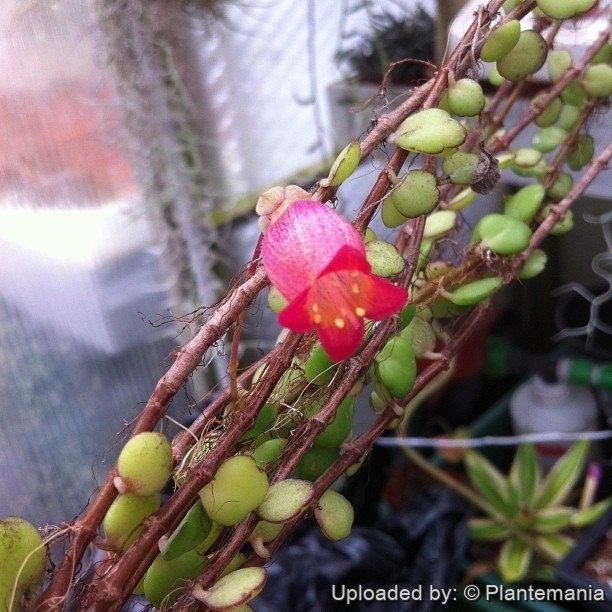
Kalanchoe uniflora or coral bell plant is a most attractive plant with thick, fleshy, leaves to 25 mm long, each one scalloped several times near the rounded tip. K. uniflora is one of the few epiphytic species of its genus of trailing, stem-rooting habit, somewhat in the fashion of Crassula perfossa and similar plants. This species name refers to the fact that each stem bears a single flower, however plants do not always make just one flower at the end of each stem - a pair or even three can appear. And what flowers they are: coral red, puffed-up blossoms that resemble tiny hot-air balloons and cover the plant in late winter, lasting for almost a month. In the vegetative state it resembles the epiphytic Peperomia rotundifolia.
Stems: Slender, glabrous, green, prostrate or climbing, rooting at the nodes whenever these touch a suitable growing medium.
Leaves: Small (4-35 mm long, 04-15 mm wide) opposite, almost sessile to petiolate, very thick, fleshy, glabrous, along the slender stems, obovate, almost round, orbicular-oblong to oblong, base truncate to cuneate, margins crenulate, with 2- to 4 indistinct teeth in their upper part, sometimes almost trilobate, rather thick, bright-green ot grey-green with reddish margins, tip obtuse to rounded. Petiole slender, 1-2.5 mm long.
Inflorescence: 1- to 3-flowered cymes, at the ends of the branches. Peduncle 5-15 mm brown, hairy.
Flowers: Pinkish or purplish red, pendent, borne on thread-like, thinly pubescent, purple pedicels 5-15 mm long. They are quite large for the size of the plant, nodding, urn-shaped, the free tips sharply reflexed deep wine-red in colour. The calix green, sparsely glandular-pilose. The tube 11 - 19 mm long, lobes ovate, subacute, cuspidate, 2-4 mm long 3.5-4.5 mm long, 3-6 mm wide, bright red to red-violet. Stamens inserted below the middle of the corolla-tube, included. Anthers ovate, 1.2-1.4 mm. Style 6.5-12 mm long. As in all the species, the segments are 4, the stamens 8.
Seeds: Oblong, c. 0.6 mm
Origin and Habitat
North-West and North Madagascar.
Altitude range: 1000 - 2000 metres above sea level.
Habitat and ecology: Kalanchoe uniflora is an epiphyte, a prostrate trailer or creeper that grows in forests and ericoid vegetation.
Cultivation and Propagation
Kalanchoe uniflora is a delightful garden plant suitable for low watering and maintenance conditions, grows well among trees, also in limited sunlight. It is naturally epiphytic, and is best in a hanging basket, these plants must have filtered sunlight and require a soil that provides excellent drainage. This habit, in combination with its large red flowers should make it a prominent rock garden subject, except that it has already acquired a reputation of being difficult to grow. Kalanchoe uniflora is a short day plant that blooms in late winter.
Potting mix: They thrive in nutrient poor soils, possibly acidic or neutral, consisting of equal parts of loam and sand, with pumice or lava grit added to ensure good drainage.
Exposure: Mature plants do best in full sun to partial shade. Indoors, it does best in bright light, but not direct sun through a window.
Watering: It needs moderate watering in autumn and spring while in summer it should be watered thoroughly and allowed to dry before watering again. In winter give only occasional watering (only when the plant starts shrivelling), but it will generally grow even in winter if given water. These plants will survive on neglect and are very drought resistant often growing where there is virtually no soil. Over-watering is the most common cause of plant failure. It can resist also to long drought periods.
Fertilization: From the end of spring to the beginning of autumn, feed the plant with a monthly dose of fertiliser. Pruned plants may be given a dose of full strength fertilising as a boost. Be careful not to over fertilize.
Frost resistance: The plant can be cultivated in open air only in the zones with tropical, subtropical and, marginally, warm temperate climate.
Propagation: This is an easy plant to propagate from both seed and cuttings. The basal leaves tend to form new leaves and form new plants spontaneously, the old basis sometimes persisting and supporting the leaves that sprout new plants in spring; some old plants will survive into a second and third year; cuttings from the base of older plants or the soft tips grow easily in sandy soil, semi-shade and with mild watering.
Bibliography
Major references and further lectures
-
Urs Eggli “Illustrated Handbook of Succulent Plants: Crassulaceae” Springer Science & Business Media, 06 December 2012
-
“The Garden”, Volume 119, New Perspectives Publishing Limited, 1994
-
Journal of the Cactus and Succulent Society of America, Volume 2 The Society., 1930
-
H. Peter Loewer “The Indoor Window Garden: A Guide to More Than 50 Beautiful and Unusual Plants that Will Flourish Year-round in Your Home” Contemporary Books, 01 January 1990
-
W. Rauh, “Succulent and Xerophytic Plants of Madagascar” Strawberry Press. Mill Valley, California (USA). 2 vol. 1998.
-
Werner Rauh “The Wonderful World of Succulents: Cultivation and Description of Selected Succulent Plants Other Than Cacti” Smithsonian Institution Press, 1984
-
M. Sajeva and M. Costanzo, “Succulents, The Illustrated Dictionary” 1994
Cultivars and forms (1)
Varieties (1)
Gallery