Publication: J. S. African Bot. xxxvi. 253 (1970)
Description
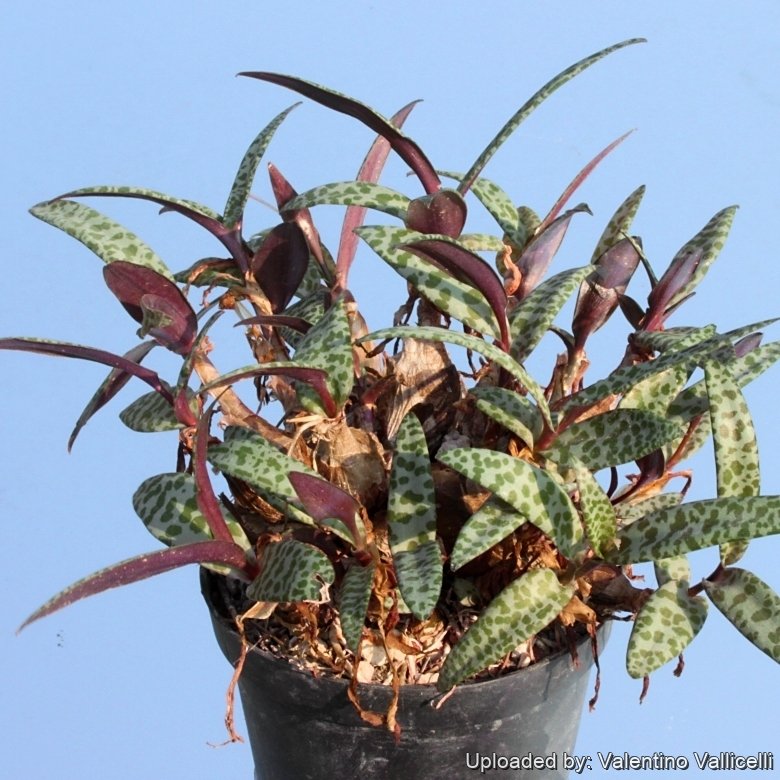
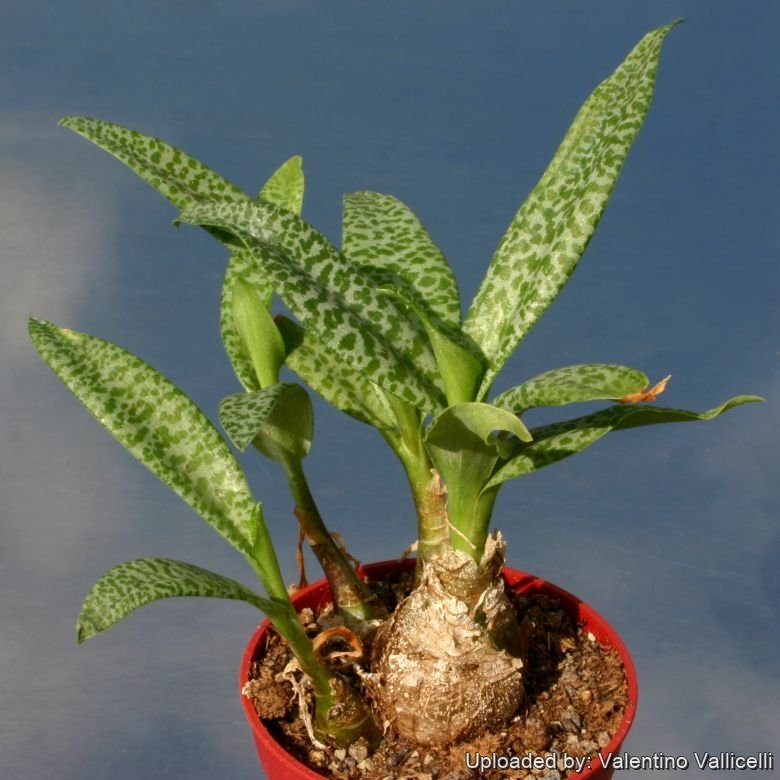
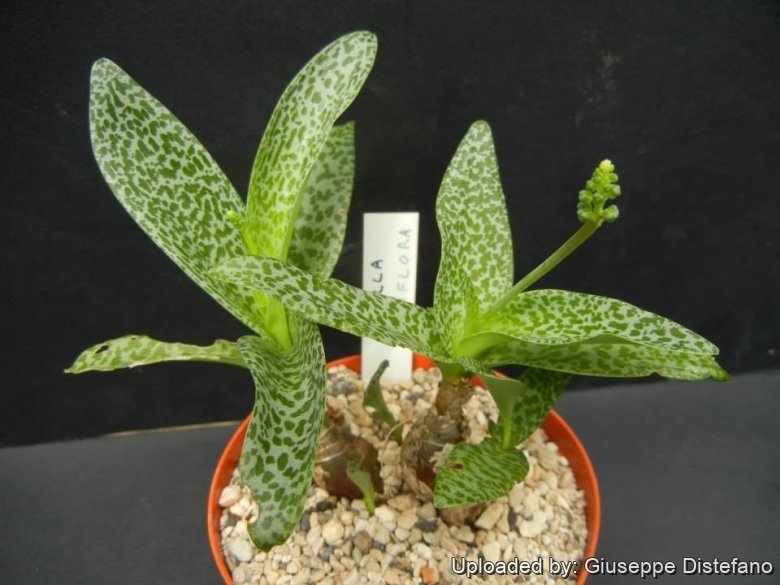
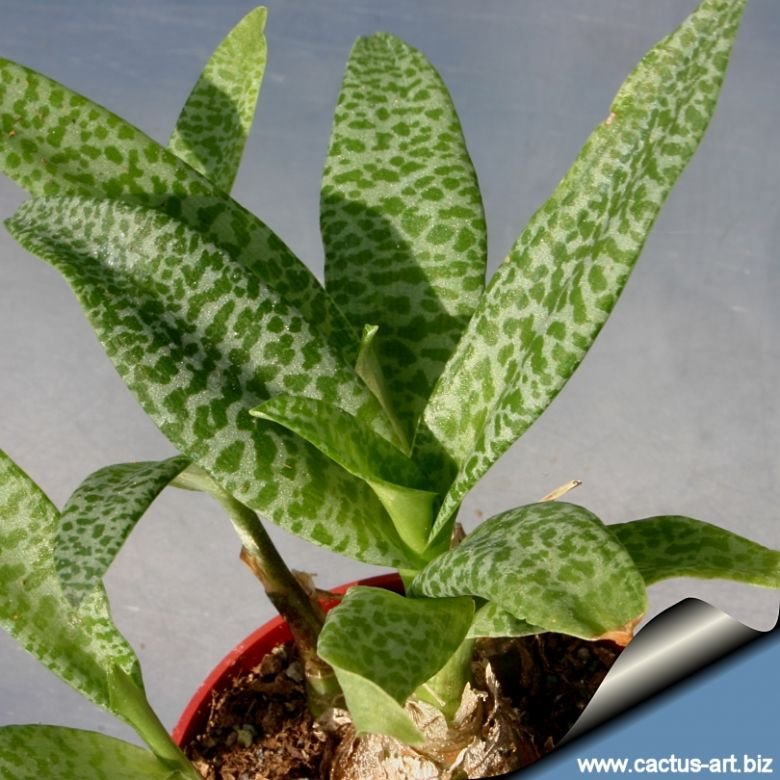
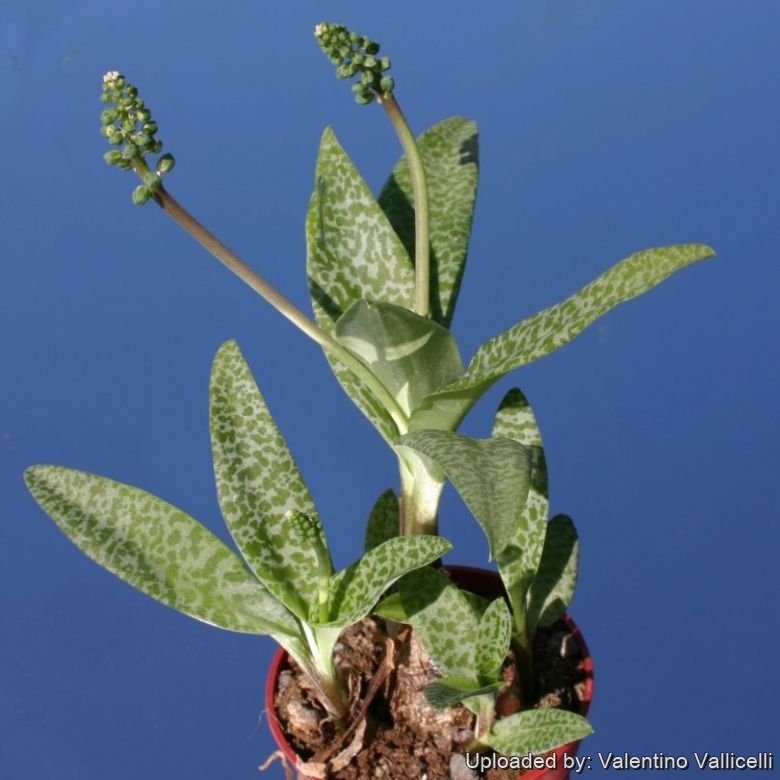
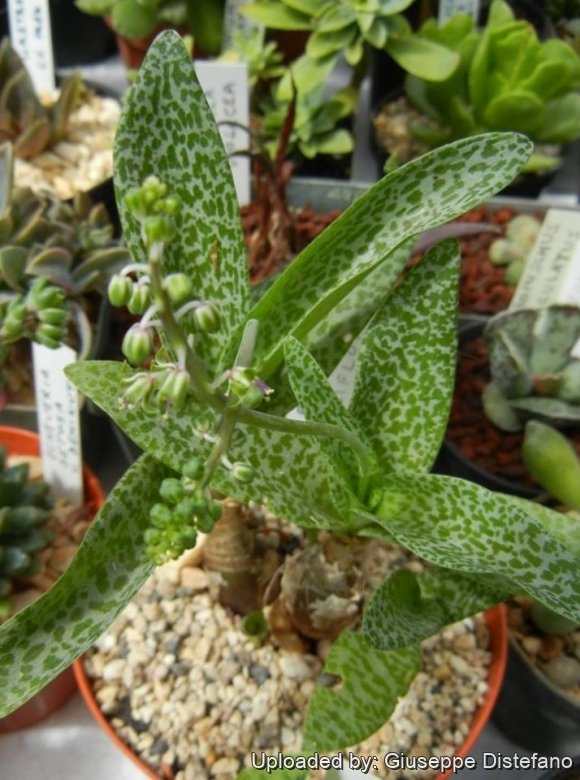
The silver squill (Ledebouria socialis) is a small geophytic, evergreen bulbous member of the lily family that forms small, somewhat teardrop-shaped bulbs that sit on top of the soil in thick clusters. It survives drought as effectively as any succulent. The leaves are small, silvery white, shield-shaped and beautifully adorned with dark green dots. The small, green and purple flowers are borne in short, nodding racemes. It was first described by John Gilbert Baker as Scilla socialis in 1870. John Peter Jessop later revised the genus Scilla and split off several species, reclassifying Scilla socialis into the genus Ledebouria in 1970.
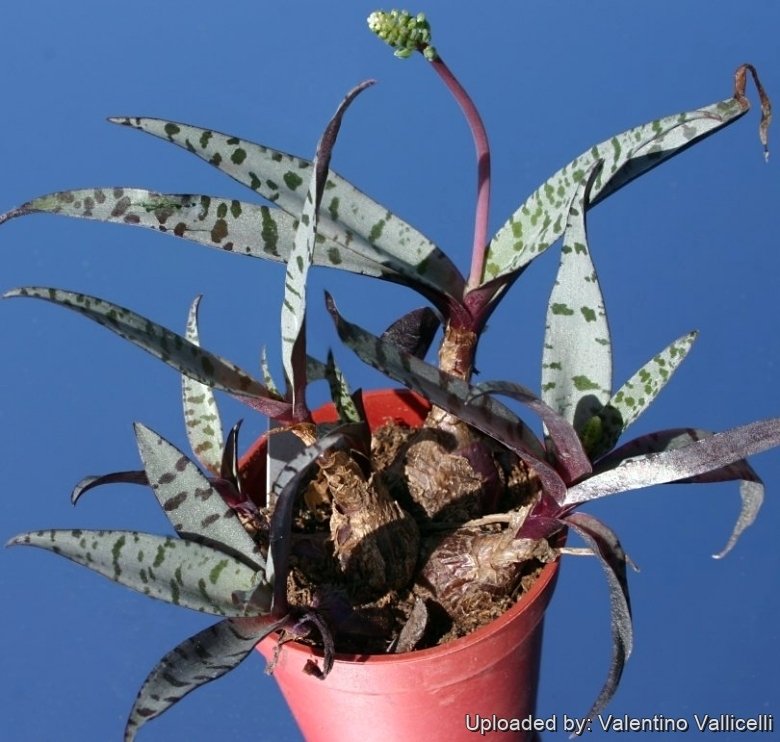
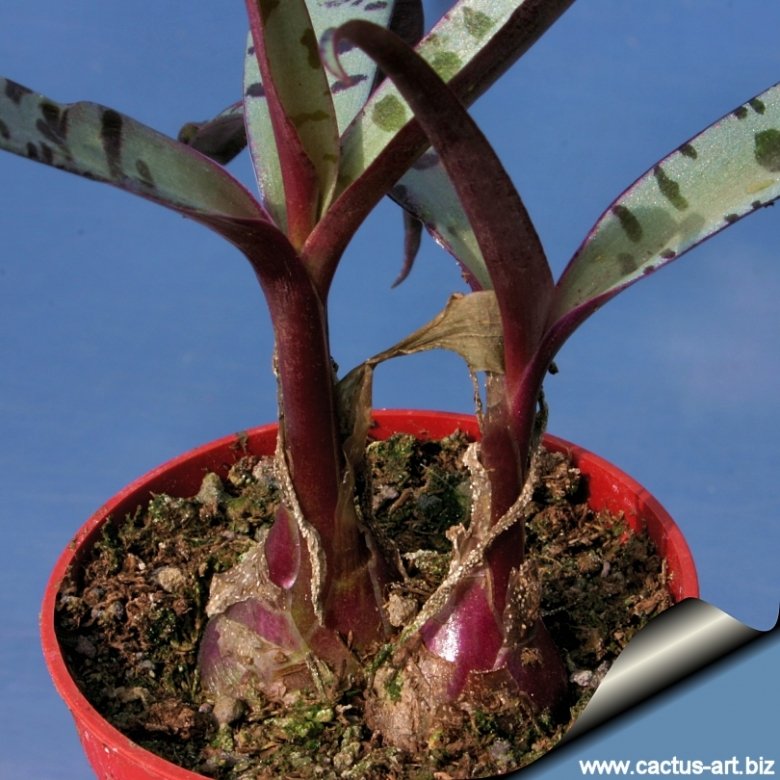
Bulb: Above-ground, conical, tapering , green to purple, clothed in peeling, papery tunics that prevent water loss, (15-)20-35(-40) cm tall 8-20 mm in diameter, it will soon cluster from the base to form dense mounds.
Roots: Succulent, 1 mm in diameter.
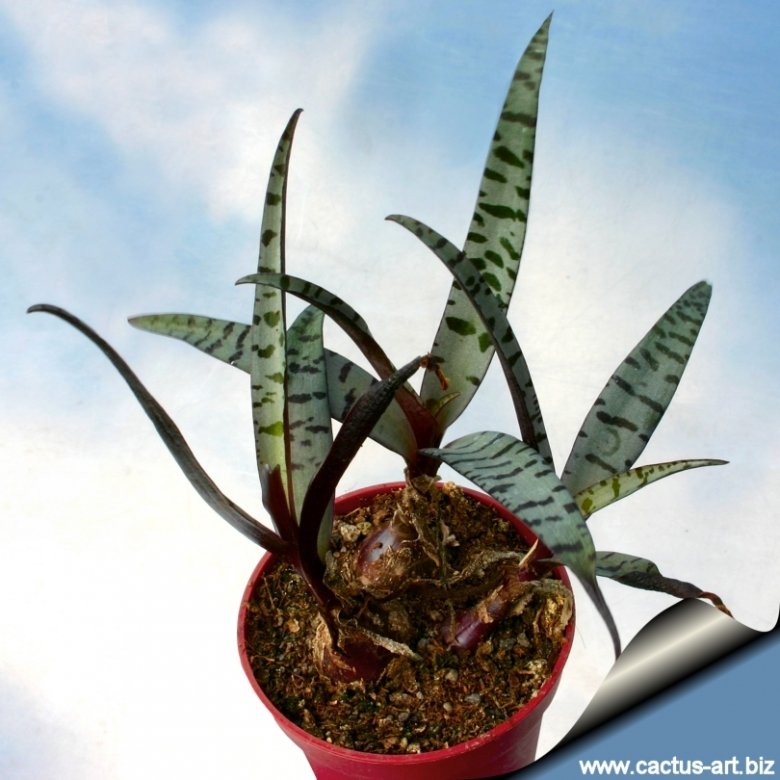
Leaves: 2 – 4, lance-shaped, strap-like, 4-7(-15) cm long and 1-2 cm wide, upright to spreading, fleshy, light silvery green, and basal with dark-green, turquoise, olive or aquamarine markings above and wine-red to purple beneath.
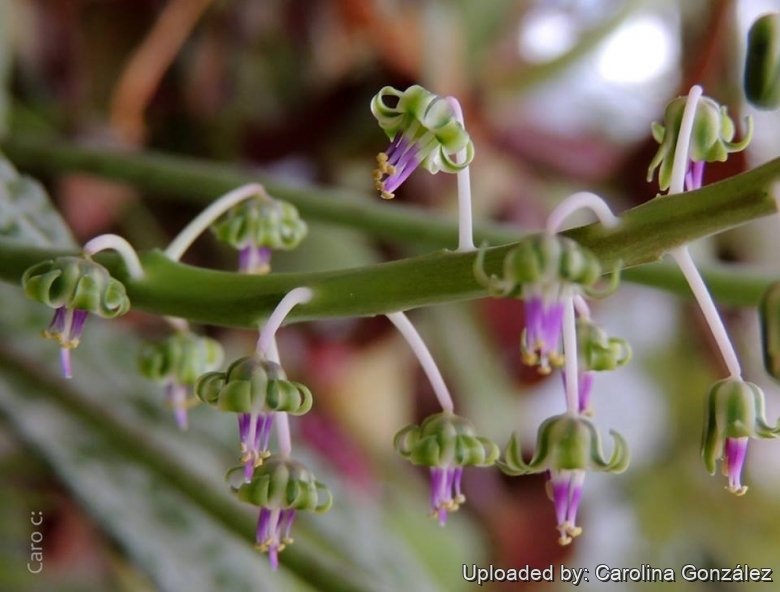
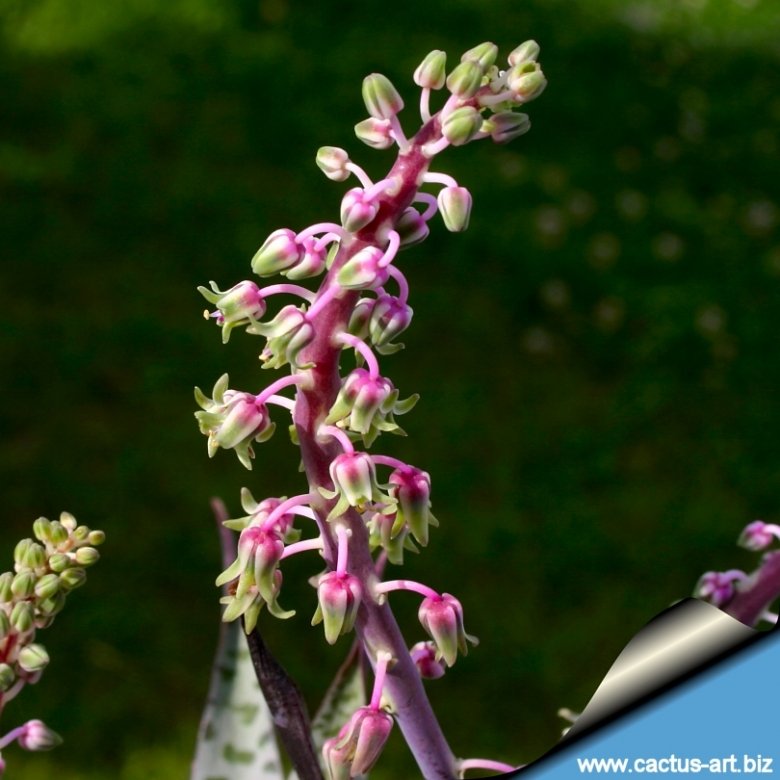
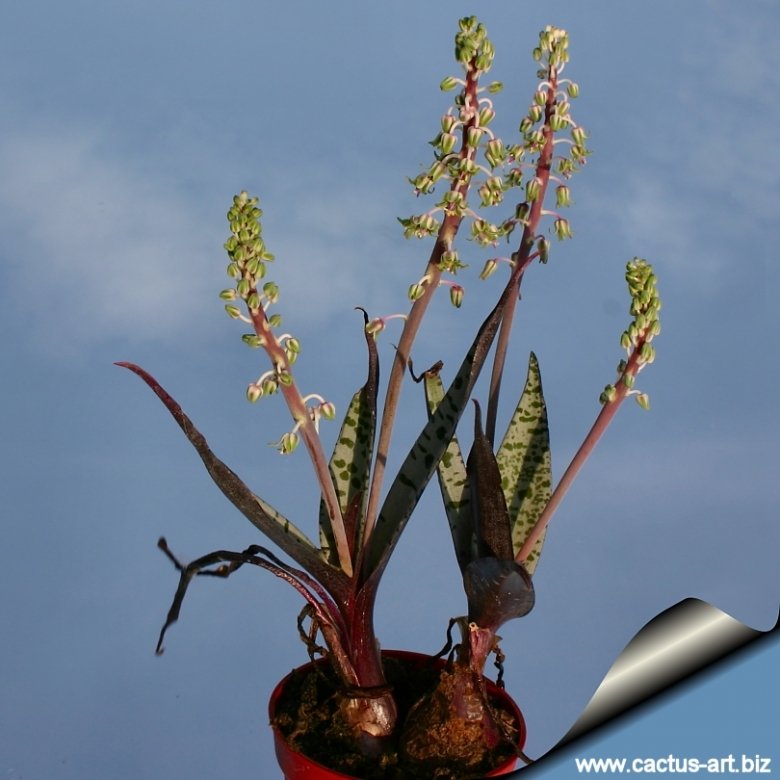
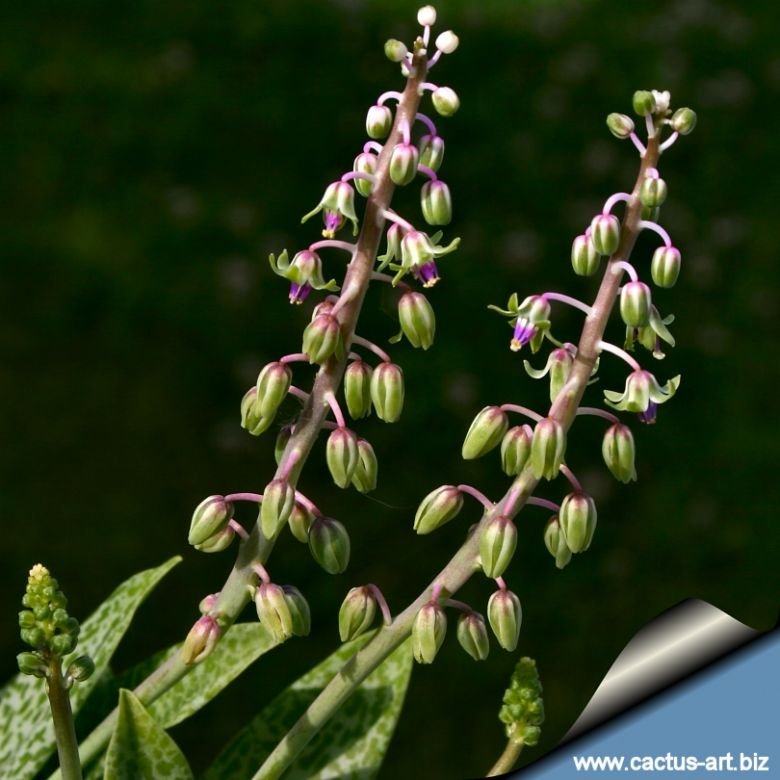
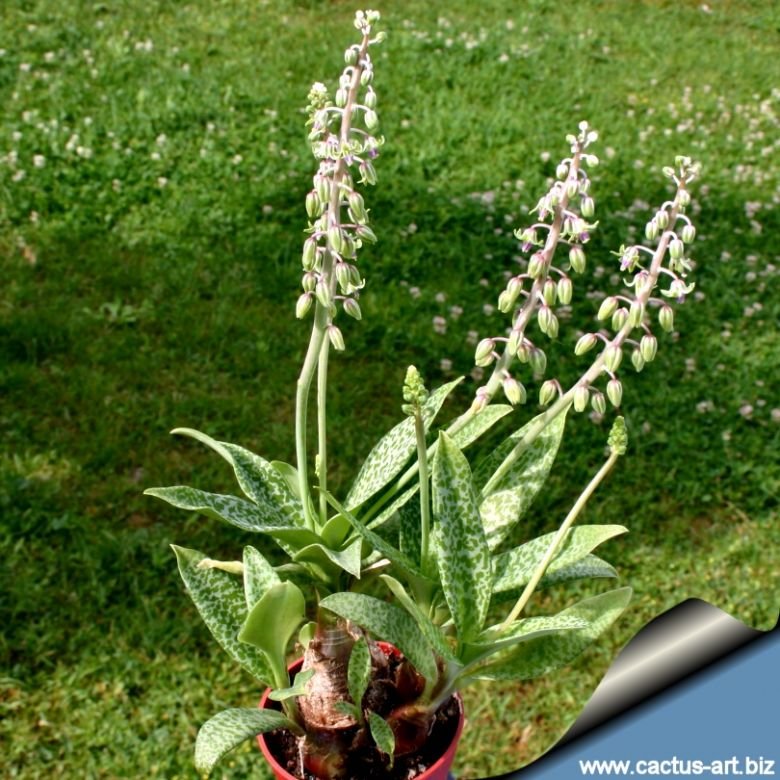
Flowers: Forms spreading-ascending racemes 9 - 17 cm long of bell-shaped flowers. Pedicels 6 mm long, bracts small, ovate. The flowers are tiny (about 3 mm) but showy, , campanulate, greenish purple-pink with a small pink stripe running down each petal, can be up to 20+ flowers on each spike. Filaments purple, exserted. Ovary globose, stipitate.
Blooming season: Spring and summer.
Origin and Habitat
It is native to KwaZulu-Natal and Eastern Cape Province of South Africa.
Habitat: Grows in arid savanna in summer-rainfall regions, this species has mottled leaves enabling it to blend into its thicket backdrop.
Cultivation and Propagation
Ledebouria socialis is an easy-to-care plant. Bulbs at the base of the plant must be above the soil. The horticultural usefulness of Ledebouria socialis lies in the fact that it thrives in rich compost in shade and semi-shade, where many other plants will flounder. It is an excellent plant for the classroom or terrarium; flowers freely.
Soil: It prefers a well-drained but rich soil mix.
Exposure: It needs full sun to semi-shade, but adapts to shade too.
Waterings: Let it dry completely between waterings.
Fertilization: Feed monthly with 50% strength soluble house plant food when it is actively growing.
Hardiness: Hardy down to freezing so best kept in a frost free place indoors and can be grown outside where there is no danger of frost. It is very happy sitting in window sill too.
Propagation: Seeds or (usually) by division of bulb-clusters.
Bibliography
Major references and further lectures
-
Arnold, T. H. & B. C. De Wet, eds. “Plants of southern Africa: names and distribution.” Mem. Bot. Surv. S. Africa no. 62. 1993.
-
Huxley, A., ed. “The new Royal Horticultural Society dictionary of gardening.” 1992.
-
Zachos, E. “Tempting Tropicals: 175 Irresistible Indoor Plants.” Portland, Oregon: Timber Press. 2005.
-
Urs Eggli “Illustrated Handbook of Succulent Plants: Monocotyledons” Springer Science & Business Media, 17 July 2001
-
Smith Prof. Gideon “Gardening with Succulents” Struik, 01 March 2006
From llifle page Ledebouria violacea
Description
The silver squill (Ledebouria socialis) is a geophytic, evergreen bulbous member of the lily family that forms small, somewhat teardrop-shaped bulbs that sit on top of the soil in thick clusters. It comprises several questionable varieties and its taxonomic history has undergone several changes.
Ledebouria violacea, formerly known as Scilla violacea , is one of the forms of Ledebouria socialis which is a widespread and morphologically variable taxon. The upper surfaces of this small lily’s foliage are flecked with dark green against a ground of silvery gray-green and the undersurfaces of the leaves are violet (hence the specific name), but most botanist agree on the fact that all the varieties described until now should all be included in the Ledebouria socialis. Flowers appear most heavily in spring and summer. Scilla violacea belongs to a group of very easily cultivated plants, decorative with pleasing appearance of leaves and flower alike. It survives drought as effectively as any succulent. The small, green and purple flowers are borne in short, nodding racemes.
Bulb: Above-ground, conical, tapering , green to purple, clothed in peeling, papery tunics that prevent water loss, (15-)20-35(-40) cm tall 8-20 mm in diameter, it will soon cluster from the base to form dense mounds.
Roots: Succulent, 1 mm in diameter.
Leaves: 2 – 4, lance-shaped, strap-like, 4-7(-15) cm long and 1-2 cm wide, upright to spreading, fleshy, light silvery green, and basal with dark-green, turquoise, olive or aquamarine markings above and wine-red to purple beneath.
Flowers: Forms spreading-ascending racemes 9 - 17 cm long of bell-shaped flowers. Pedicels 6 mm long, bracts small, ovate. The flowers are tiny (about 3 mm) but showy, , campanulate, greenish purple-pink with a small pink stripe running down each petal, can be up to 20+ flowers on each spike. Filaments purple, exserted. Ovary globose, stipitate.
Blooming season: Spring and summer.
Origin and Habitat
It is native to South Africa.
Habitat: Grows in arid savanna in summer-rainfall regions, this species has mottled leaves enabling it to blend into its thicket backdrop.
Cultivation and Propagation
Ledebouria violacea (= Ledebouria socialis ) is an easy-to-care plant. Bulbs at the base of the plant must be above the soil. The horticultural usefulness of Ledebouria socialis lies in the fact that it thrives in rich compost in shade and semi-shade, where many other plants will flounder. It is an excellent plant for the classroom or terrarium; flowers freely.
Soil: It prefers a well-drained but rich soil mix.
Exposure: It needs full sun to semi-shade, but adapts to shade too.
Waterings: Let it dry completely between waterings.
Fertilization: Feed monthly with 50% strength soluble house plant food when it is actively growing.
Hardiness: Hardy down to freezing so best kept in a frost free place indoors and can be grown outside where there is no danger of frost. It is very happy sitting in window sill too.
Propagation: Seeds or (usually) by division of bulb-clusters.
Source: Ledebouria violacea, LLIFLE - Encyclopedia of living forms, CC-BY-SA, retrieved 2026-10-25.
From llifle page Scilla pauciflora
Description
Small bulbous perennial.
Bulb: Clustering, teardrop-shaped with a glossy surface, clothed in peeling, papery tunics that prevent water loss 2-5 cm broad that necks above soil. Bulbs likes to stay above the soil surface.
Leaves: A pair, opposite, or rarely three, fleshy, spreading, oblong-lanceolate, acute, undulated, delicately pale green and spotted on the face, 5-7 cm long and 2-3 cm wide, narrowed at base.
Flowers: Perianth greenish, rounded-campanulate, nearly or quite 6-7mm long, the segments falcate; pedicels five to six lines long, the lower ones drooping; raceme loose, twenty to thirty-flowered, oblong, 7. to 10 cm. long, 3 to 4 cm broad; scape firm, unspotted, terete, 7 to 10 cm long.
Blooming season: It is a summer grower and blooms in spring.
Origin and Habitat
It is native to South Africa (Cape of Good Hope)
Cultivation and Propagation
It is a Lovely undemanding houseplant; always a favorite carefree windowsill citizen; excellent addition to any dish garden. Needs full sun to partial shade with a well-drained soil mix. Let it dry completely between waterings. Feed monthly with 50% strength soluble house plant food when it is actively growing. Hardy down to freezing so best kept in a frost free place indoors and can be grown outside where there is no danger of frost. Bulbs at the base of the plant must be above the soil.
Propagation: Seeds or (usually) by division of bulb-clusters.
Notes
Scilla pauciflora is a horticultural name for a plant that is likely a Ledebouria socilais. The name has not been published, but this plant is often available on the trade.
Source: Scilla pauciflora, LLIFLE - Encyclopedia of living forms, CC-BY-SA, retrieved 2026-10-26.
Gallery