Publication: Smithsonian Misc. Collect. 47(2): 160 1904
Description
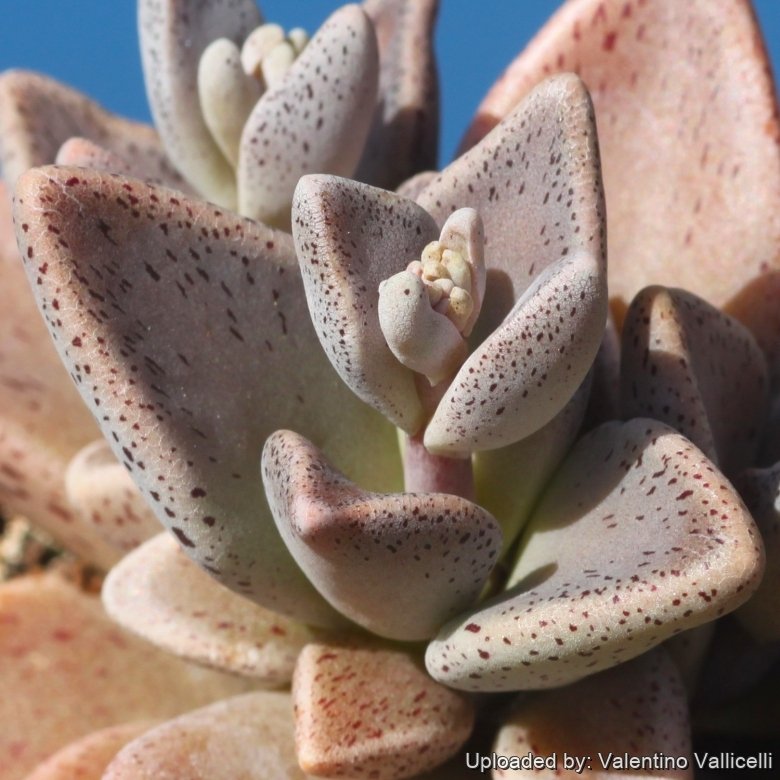
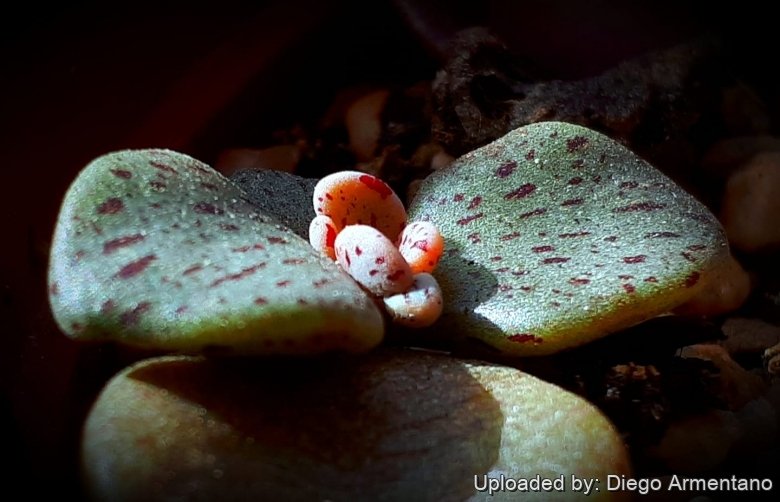
Lenophyllum guttatum is an hairless, succulent, perennial herb with attractively brown-dappled, flat, obtuse leaves. Formerly described by Mr. Rose as a doubtful Sedum, its distinct petals excluding it from all the other related genera. Living specimens show little connection with Sedum, but in foliage and habit more resemble Echeveria, from which, however, they are clearly distinct.
Stock (thick stem): Whitish, suckering at the base.
Roots: Pale brown.
Leaves: Few, 1.8-3.5(-4) cm long, in opposite pairs on non-flowering shoots, crowded together, elliptic-ovate to rhombic, broadest at base, deeply but shallowly grooved above (boat-shaped), apex obtuse or rounded, olive green-grey, greyish pink or light green, and scurfy, and covered with fine dots and stripes of black-brown or black-purple.
Flowering-stems: Terminal, up to 20 cm tall, pinkish with scattered alternate leaves, branched towards apex; branches 2-6 with 5-12 flowers.
Flowers: Green-yellow, almost stalkless. Sepals 5, fleshy, obtuse, c. 6 mm long, club-shaped; petals 5, almost equalling sepals c. 5 mm long, obtuse, yellowish, eventually drying reddish. Stamens 10, 5 arising directly from petals, 5 from between petals; nectaries oblong, orange or deep yellow; carpels erect, joined at base, green; stigmas white.
Blooming season: Late summer—autumn. Flowers open in succession one after another and last on the plant for a long time.
Fruits ( follicles): Spreading, brown.
Seeds: Oblong-elliptic, brown.
Origin and Habitat
North-East Mexico (Coahuila and Nuevo Leon ).
Habitat and ecology: Lenophyllum guttatum is an inconspicuous succulent plant that loves to grow in rock crevices and forms little clusters.
Cultivation and Propagation
Lenophyllums are closely related to Echeveria and with similar cultivation requirements. All can be readily rooted from leaf cuttings or seed. It is essential in cultivation to use a very porous soil, with adequate drainage.
Exposition: Bright light is required to prevent “stretching” of Echeverias (“stretching” occurs when a moderately fast growing plant such as an Echeveria or Lenophyllum, is grown in dim light or over-fertilized, which causes overly lush growth that contributes to weak, pallid plants).
Watering: Water thoroughly when soil is dry to the touch.
Hardiness: Protect from frost.
Propagation: Quite easy from seed or from cuttings, the latter either from individual leaves or from offset rosettes.
Notes
Plants in this genus are distinguished from Sedum species by the presence of terminal inflorescences, erect petals, and opposite leaves
Bibliography
Major references and further lectures
-
Rose “Smithsonian Miscellaneous Collections” Smithsonian Institution, Collections 47: t. 20 1904
-
James Cullen “The European Garden Flora Flowering Plants: A Manual for the Identification of Plants Cultivated in Europe, Both Out-of-Doors and Under Glass” Cambridge University Press, 11 August 2011
-
Alfred Byrd Graf “Exotica, series 4 international: pictorial cyclopedia of exotic plants from tropical and near-tropic regions” Roehrs Co. Publishers, 1985
-
Stephenson, Ray. “Sedum: Cultivated Stonecrops.” Timber Press.1994