Description
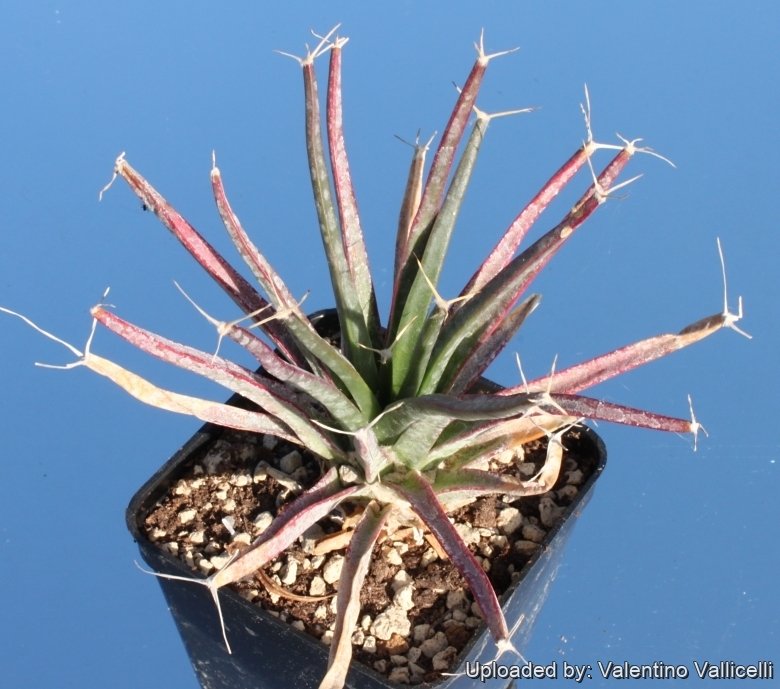
This is an easily recognizable form of Leuchtembergia with very thin and long tubrecles.
Origin and Habitat
Unknown (hort.?)
Cultivation and Propagation
It grow easily from seed in cultivation. Despite being revered by many collectors, they are not too difficult. The plants on their own roots need deep pots to accommodate the strong napiform unit formed by the stem base and the rootstock, and a loose mineral soil with a well-drained substrate. They need a good amount of light, a place near the roof of the greenhouse helps drying the pot after watering. This can be done weekly during summertime, if the weather is sunny enough, with a little fertilizer added, lack of water will make the tip of the tubercles yellow. Too much water will make it rot. Kept this way, plants will show a healthy, although slow growth.
Grafted specimens must be cultivated according to the needs of the grafting stock.
Frost Tolerance: Light frost protection required for safe cultivation, but can tolerate sporadic brief periods to -8 degrees.
Diseases and pests: Watch for infestations of mealybug, scale insects and spider mite.
Propagation: Usually by seeds, but it is possible to make tubercles cuttings that roots erratically.
Bibliography
Major references and further lectures
-
James Cullen, Sabina G. Knees, H. Suzanne Cubey “The European Garden Flora Flowering Plants: A Manual for the Identification of Plants Cultivated in Europe, Both Out-of-Doors and Under Glass” Cambridge University Press, 11/Aug./2011
-
David Hunt, Nigel Taylor “The New Cactus Lexicon” DH Books, 2006
-
Edward F. Anderson “The Cactus Family” Timber Press, 2001
-
Nathaniel Lord Britton, Joseph Nelson Rose “Cactaceae: Descriptions and Illustrations of Plants of the Cactus Family” Volume 3, 1922
-
Fitz Maurice, B & Fitz Maurice, W.A. 2013. Leuchtenbergia principis. The IUCN Red List of Threatened Species. Version 2014.2. <www.iucnredlist.org>. Downloaded on 10 September 2014.
Gallery