Description
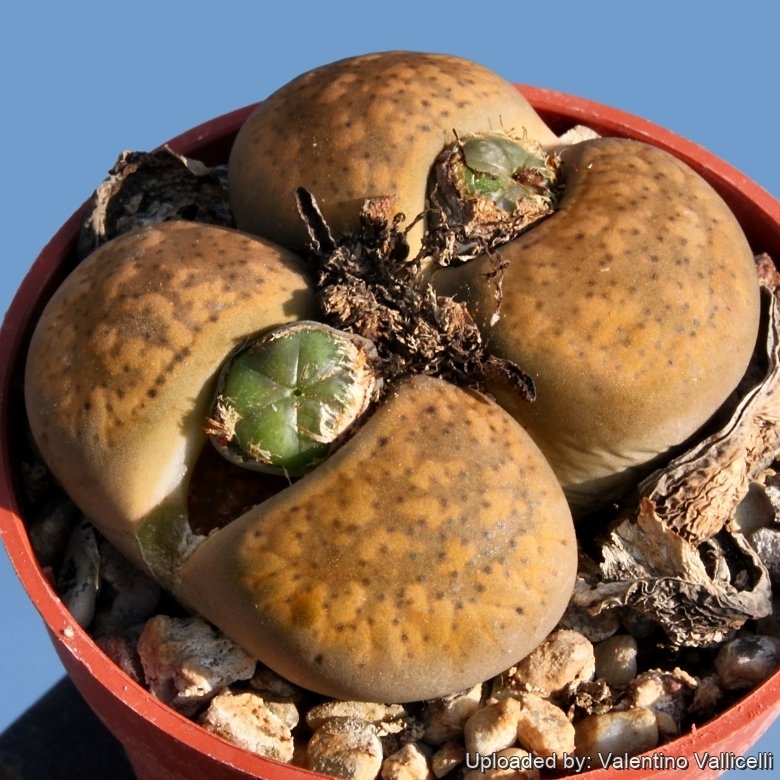
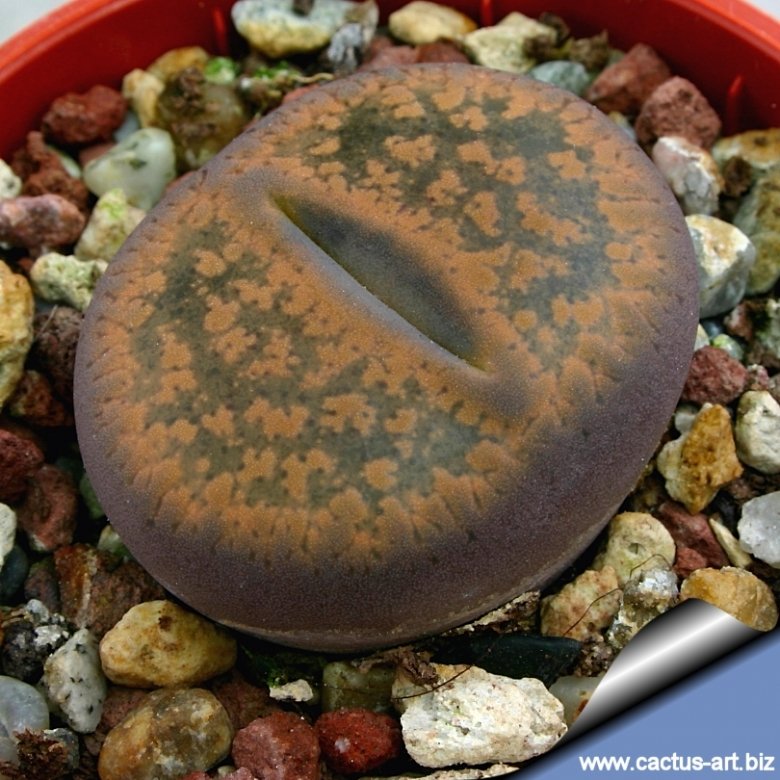
Lithops aucampiae is a tiny caespitose succulent that grows almost completely buried in reddish soil with only the upper truncated portion of leaves visible. With age it may form small clusters of up to 12 or more, bodies (mostly 2-5). It is very variable with brown-red bodies with intricate brown patterns, but conforms to the typical Lithops morphology: two thick, fleshy windowed leaves separated by a crack from which a yellow flower appears. The windowed part allows light into the inner portion of the leaf where the process of photosynthesis is carried out.
Bodies (Paired leaves): Medium to very large 25-55 mm x 20-40 mm across, obconical (upside down cone-shaped) upper surface truncate, smooth to slightly rugose, mostly slightly convex. Lobes often unequal conjunct with a shallow fissure between. Face elliptic-reniform. Margins irregularly indented with many peninsulas, yellowish to reddish brown, often more intensely coloured than the islands. Windows yellowish to dark reddish brown, usually with fine irregularly branched lines becoming gradually narrower toward the margins. Channels asymmetrical varying in size yellowish to brown, sometimes very dark. Islands usually clearly defined, very irregular, sometimes slightly in relief. Rubrications absent. Dusky dots dark greenish grey, variable in number, in the channels and small islands, but usually not evident. Shoulders whitish-violaceous, pinkish-grey or brownish.
Flowers: Daisy-like, bright yellow up to 52 mm in diameter.
Fruits: Capsule mostly 6-chambered (otherwise 5 to 8-chambered). This capsule only opens when moistened, exposing the tiny seeds. In nature, falling rain drops splash out the seeds to a distance of a few centimetres to up to a metre or more from the parent plant. After the capsule dries up it closes again, protecting any seeds left behind.
Seeds: Tiny, light brown to brown.
Origin and Habitat
10 km East of Kuruman, South Africa
Cultivation and Propagation
Need an open mineral, fast draining mix and the maximum amount of light you are able to give them. The basic cultivation routine is: Stop watering after flowering. Start watering after the old leaves completely dry. (Usually late March or Early April) Water freely during the growing season, soak the compost fully but allow it to dry out between waterings, no water when cold. Some growers fertilize frequently, some hardly ever. Keep them dry during the winter. Nearly all problems occur as a result of overwatering and poor ventilation especially when weather conditions are dull and cool or very humid. This plant is best for a well lit area (Bright shade to full sun). But don’t be afraid even the best growers have plants that mysteriously dry up, or leave during the night.
Remarks: After flowering in the autumn and extending through winter season the plant doesn’t need watering, but they will still be growing, the new bodies will be increasing in size extracting water from the outer succulent leaves, allowing them to shrivel away. In fact the plant in this time extracts water and nutrient stored in the outer succulent leaves, allowing them to dehydrate relocating the water to the rest of the plant and to the new leaves that form during this period until the old leaves are reduced to nothing more than “thin papery shells”.
Notes
Lithops are partly subterranean, with only the clear ‘window’ in each leaf tip exposed above soil. A type of optical system exists whereby a layer of apical tissue rich in calcium oxalate crystals acts as a filter to intense sunlight before it reaches the thin chlorophyllous layer below. They are also called mimicry plants as they show a striking similarity to their background rocks and are difficult to detect when not in flower. These are the commonly known as pebble plants or living stones; each species is associated with one particular type of rock formation and occurs nowhere else. Its soil-embedded, subterranean growth form also reduces the need for chemical defences against herbivores.
Bibliography
Major refences and further lectures
-
Heidrun E. K. Hartmann (2002) “Aizoaceae F – Z” Springer
-
Achim Hecktheuer (2008) “Mesembs, mehr als nur Lithops” Books on Demand GmbH Norderstedt. ISBN-13 978-3-8370-1724-3
-
Desmond T. Cole & Naureen A. Cole, Uwe Beyer, Yves Delange (2008) “Les Lithops” SUCCULENTES Spécial 2008 AIAPS (now Terra seca). ISSN 0258-5359
-
Desmond T. Cole & Naureen A. Cole (2005) “LITHOPS Flowering Stones” Cactus & Co. Libri. ISBN 88-900511-7-5 ISBN-13 978-88-900511-7-3
-
Yasuhiko Shimada (2001) “The Genus Lithops” Dobun Shoin. ISBN 4-8103-4066-X
-
Rudolf Heine (1986) “Lithops - Lebende Steine” Neumann Verlag. ISBN 3-7402-0000-6; ISBN-13 978-3-7402-0000-8
-
Bernd Schlösser (2000) “Lithops – Lebende Steine” Praktische Anleitung für die Zimmerkultur. BussinessPoint MEDIA. ISBN 3-934945-01-5; ISBN-13 978-3-934945-01-2
-
Steven A. Hammer (1999) “Lithops – Treasures of the veld” British Cactus and Succulent Society. ISBN 0-902-099-64-7; ISBN-13 978-0-902099-64-7
-
Desmond T. Cole (1988) “Lithops – Flowering Stones” Acorn Books CC. ISBN 0-620-09678-0; ISBN-13 978-0-620-09678-2
-
Rudolf Heine (1986) “Lithops – lebende Steine” Neumann Verlag. ISBN 3-7402-0000-6; ISBN-13 978-3-7402-0000-8
-
David L. Sprechman (1970) “Lithops” Associated University Presses, Inc. SBN 8386-6902-6
-
Gert Cornelius Nel (1946) “Lithops” Hortors Limited, South Africa
-
Edgar Lamb (1978) “The illustrated reference on cacti and other succulents” Blandford Press.
-
Mesa garden seed list. Belen. New mexico. USA