Description
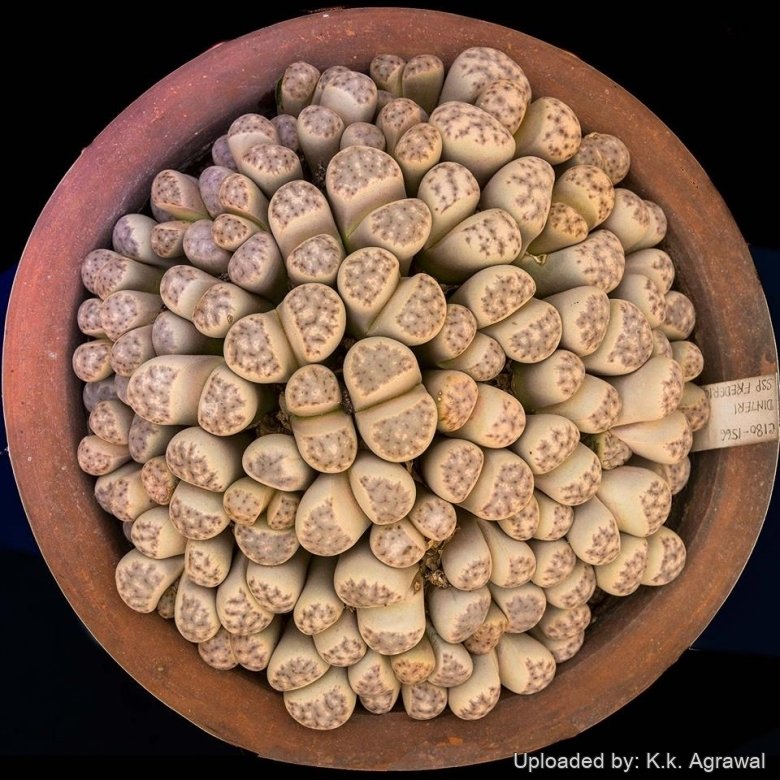
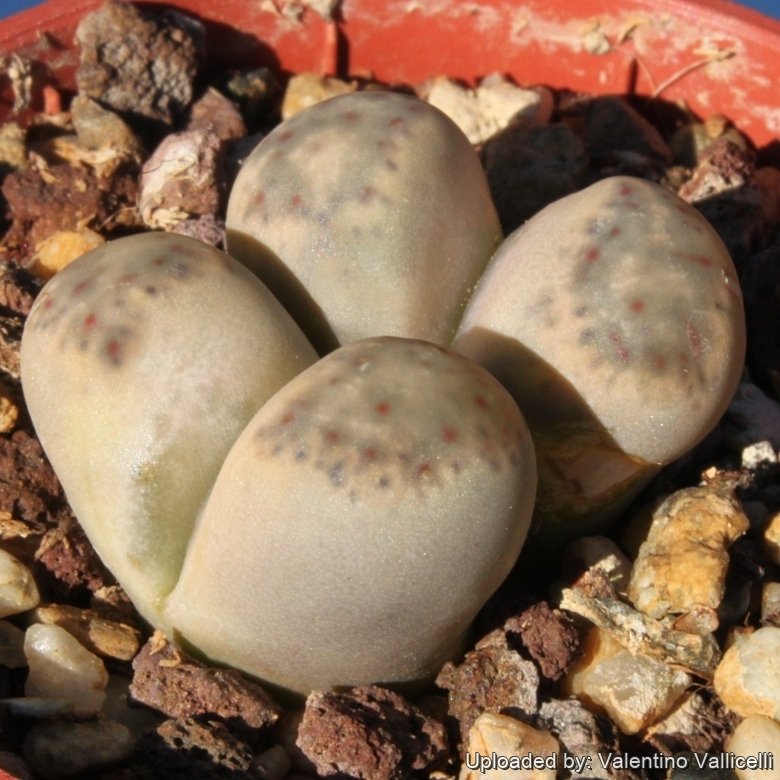
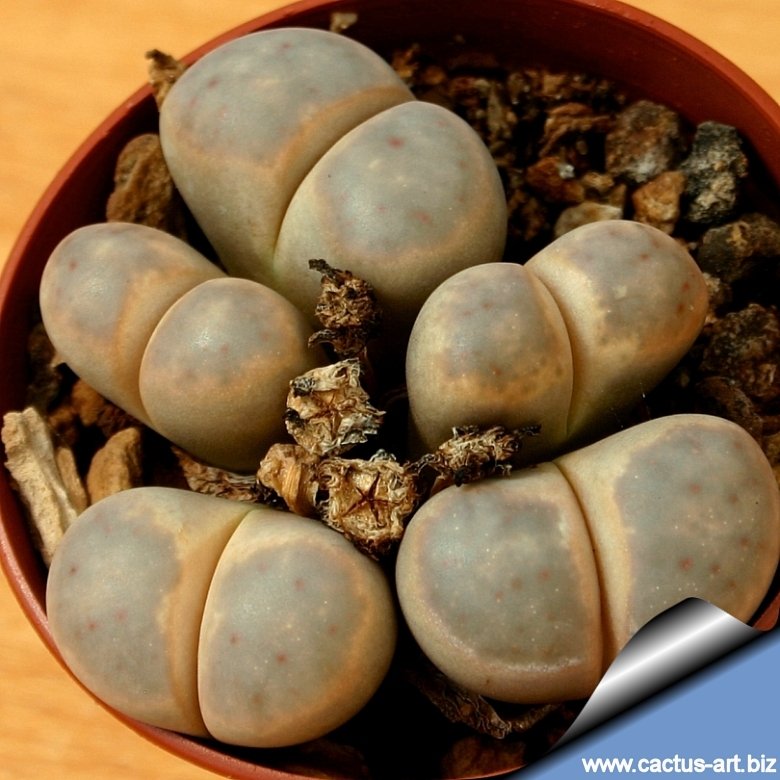
Lithops dinteri ssp. frederici is one of the local or morphological forms of the variable Lithops dinteri distinguished by its small sized and more convex heads with paler coloured bodies with less marked red-dots (Rubrications). It is however quite variable in colouration and the numbers and design of red dots on the tops of the leaves may vary a lot, and sometime the heads are ivory coloured with no red at all.
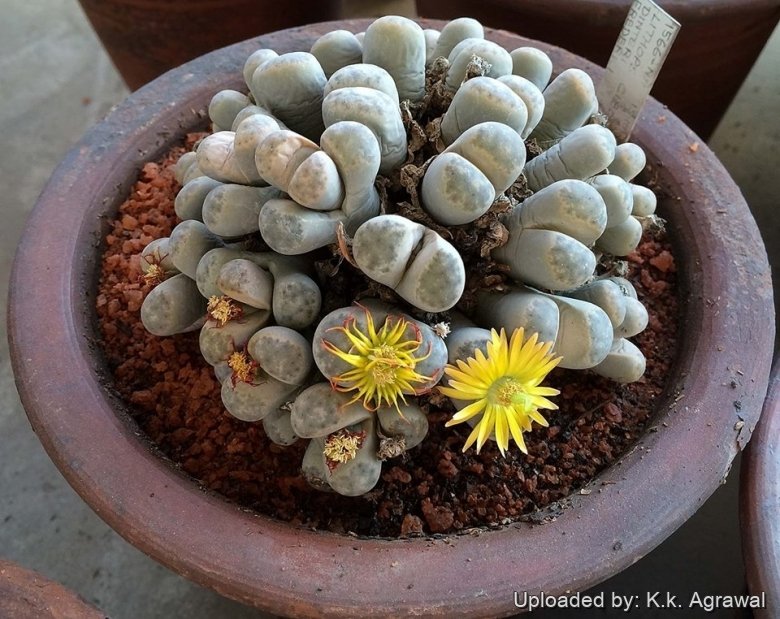
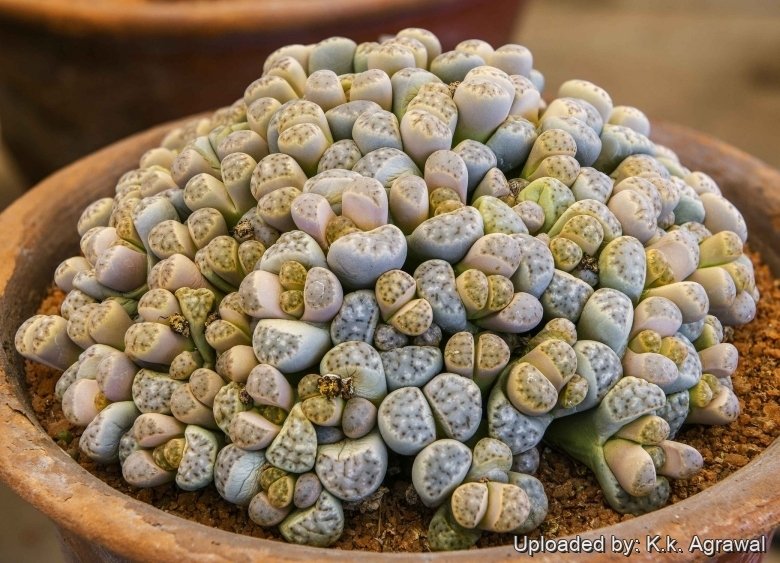
Habit: Growths solitary or few (2-3) in a clump to 3 cm high, but occasionally with more than 6 heads.
Bodies (paired leaves): Small sized, 12-20 mm long, 10-14 mm broad, compact, cordate-truncate. Sides coloured purplish green. Fissure 5-7 mm deep. Lobes elliptic-rectangular from above view, convex in profile, more or less equal, top of lobes, smooth, window more or less densely occluded and indistinct; in the window dull dark red dots and/or short dashes and/or hooks and/or lines (rubrications) distributed unevenly over the surface, but often not so bright red as in the other varieties. (The cell walls in the rubrications are coloured red); window bordered by a coloured band, outer part of which is light to dark yellow tinged with brown, this coloured margin more prominent and broader than the inner part of the border; in the margin at both ends where the fissure ends several dark-green to dark blue-green dots in the surface; inner margin practically straight and scarcely lobed or laciniated; outer margin usually absent or indistinct and irregularly incised. Islands few and indistinct, various shades of opaque creamy buff or beige tinged with pink or yellow. Channels often narrow and indistinct, obscurely translucent greenish grey, dull grey-green, often with a reddish tint.
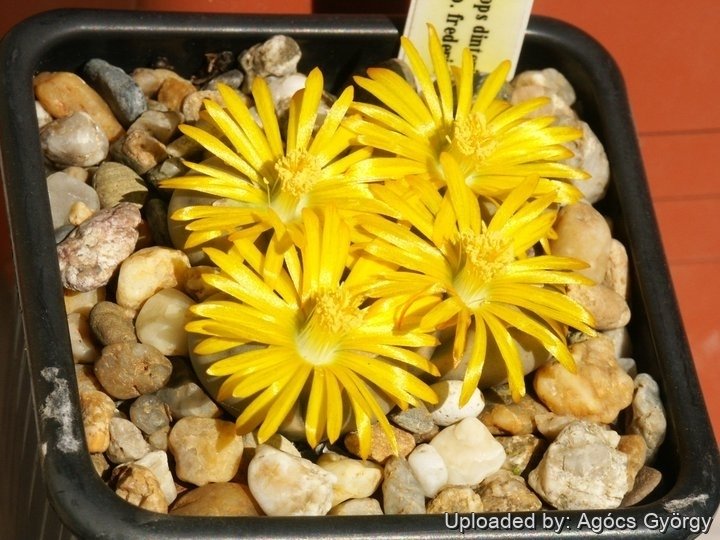
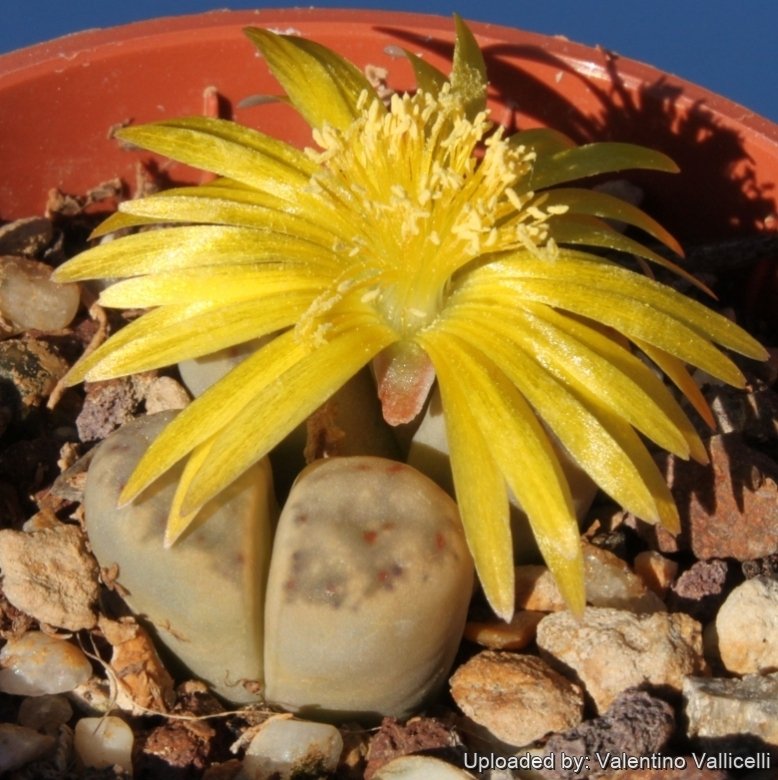
Flowers: Daisy-like, diurnal, yellow, small to medium, up to 32 mm across, mostly 20-25 mm across.
Fruits: Capsules 4 or 5-chambered. Profile boat-shaped, top broadly elliptic, with hinge-rim flat, occasionaly slightly peaked.
Seeds: Very fine, brown, tuberculate.
Origin and Habitat
Type Locality 30 km North-West of Pofadder, South Africa.
Habitat: It grows in barren minerals terrains clinging to life in this harsh landscape. They live a precarious existence almost completely buried in the ground hidden beneath outcrops of fine pegmatite gravel, white, grey-white, light brown and are very difficult to find in the field, especially when slightly covered with a fine somewhat brownish sand. The colour of the sand approximates that of the upper surface of the lobes, and these are practically level with the soil. This way they resist attacks from herbivorous predators, and arealmost impossible to distinguish from their surroundings until they erupt into vivid daisy-like yellow flowers.
Cultivation and Propagation
Need an open mineral, fast draining mix and the maximum amount of light you are able to give them. The basic cultivation routine is: Stop watering after flowering. Start watering after the old leaves completely dry. (Usually late March or Early April) Water freely during the growing season, soak the compost fully but allow it to dry out between waterings, no water when cold. Some growers fertilize frequently, some hardly ever. Keep them dry during the winter. Nearly all problems occur as a result of overwatering and poor ventilation especially when weather conditions are dull and cool or very humid. This plant is best for a well lit area (Bright shade to full sun).
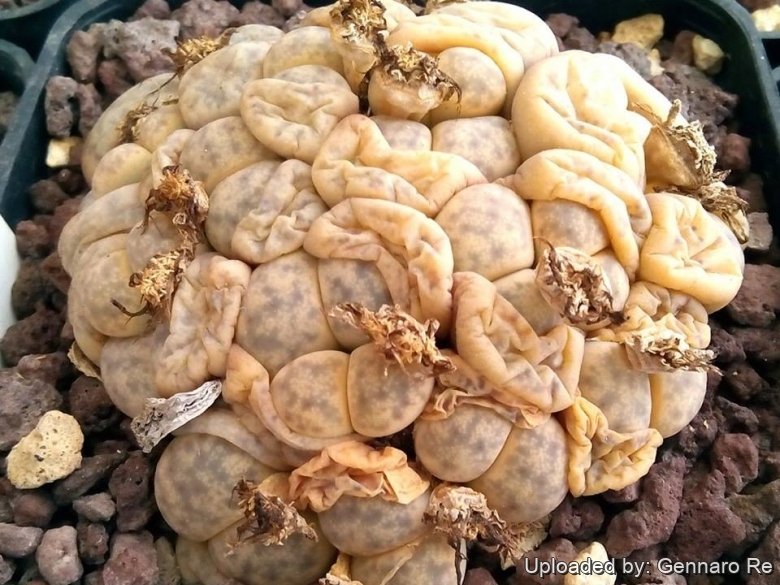
Note: After flowering in the autumn and extending through winter season the plant doesn’t need watering, but they will still be growing, the new bodies will be increasing in size extracting water from the outer succulent leaves, allowing them to shrivel away. In fact the plant in this time extracts water and nutrient stored in the outer succulent leaves, allowing them to dehydrate relocating the water to the rest of the plant and to the new leaves that form during this period until the old leaves are reduced to nothing more than “thin papery shells”.
Bibliography
Major refences and further lectures
-
Heidrun E. K. Hartmann “Aizoaceae F – Z” Springer 2002
-
Achim Hecktheuer “Mesembs, mehr als nur Lithops” Books on Demand GmbH Norderstedt. 2008
-
Desmond T. Cole & Naureen A. Cole, Uwe Beyer, Yves Delange “Les Lithops” SUCCULENTES Spécial 2008 AIAPS (now Terra seca). 2008
-
Desmond T. Cole & Naureen A. Cole “LITHOPS Flowering Stones” Cactus & Co. Libri. 2005
-
Yasuhiko Shimada “The Genus Lithops” Dobun Shoin. 2001
-
Rudolf Heine “Lithops - Lebende Steine” Neumann Verlag. 1986
-
Bernd Schlösser “Lithops – Lebende Steine” Praktische Anleitung für die Zimmerkultur. BussinessPoint MEDIA. 2000
-
Steven A. Hammer “Lithops – Treasures of the veld” British Cactus and Succulent Society. 1999
-
Desmond T. Cole “Lithops – Flowering Stones” Acorn Books 1988
-
Rudolf Heine “Lithops – lebende Steine” Neumann Verlag. 1986
-
David L. Sprechman “Lithops” Associated University Presses, Inc. 1970
-
Gert Cornelius Nel “Lithops” Hortors Limited, South Africa 1946
-
Edgar Lamb “The illustrated reference on cacti and other succulents” Blandford Press. 1978
-
Christopher Brickell, Royal Horticultural Society “RHS A-Z Encyclopedia of Garden Plants: K-Z., Volume 2” Kindersley, 2008
-
G. C. Nel “Lithops: Plantae succulantae, rarissimae, in terra obscuratae, e famailia Aizoaceae, ex Africa australi” Hortors Limited, 1946
Gallery