Description
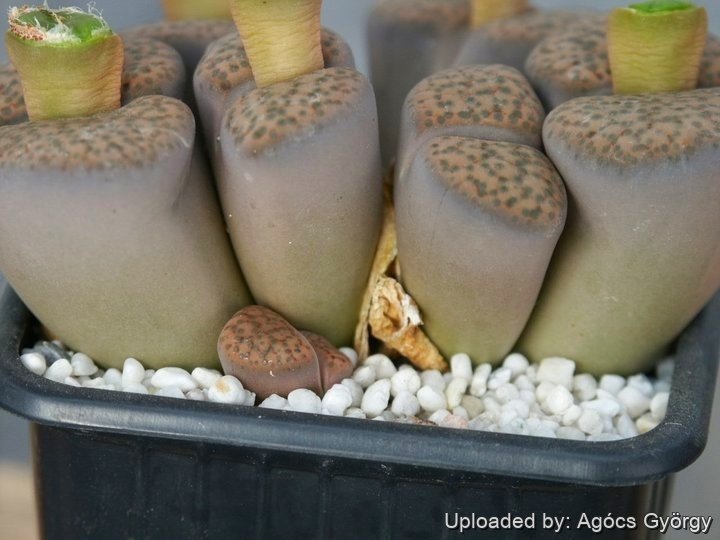
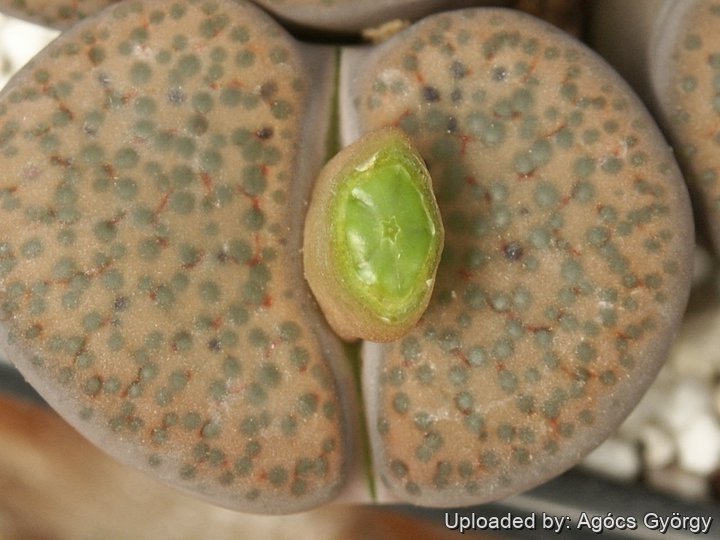
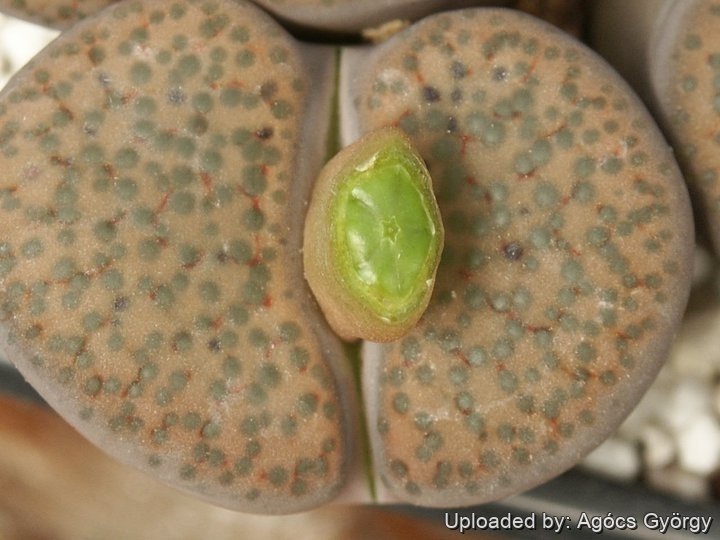
Lithops fulviceps is an orange-brown species generally smaller than most Lithops but its shape follows the same pattern of a cordate (heart-shaped), bifurcate body of two leaves. The bodies (paired leaves) are truncate in profile, with a cleft nearly to the base. Faces flush, elliptic-reniform, slightly rugose, variable in colour. This species usually do not shows clearly evident margins, windows, channels and islands, but the top of the leaves are more or less reticulated by slightly impressed grooves that sometime form a conspicuous network, the usually very numerous and slightly raised dusky dots like miniature blisters over whole face. The patterns of colour and dots on the face is more or less regular within certain ranges of similarity. For this species, the dusky dots are very specific ranging in colour from dark grey through browns to purple.
Desmond Cole field number C220: This population distinguishes for having large dots, red lines and rust body.
Origin and Habitat
75 km North of Karasburg, Namibia (Type locality).
Habitat: Its natural habitats are rocky areas and cold desert.
Cultivation and Propagation
Lithops fulviceps needs an open mineral, fast draining mix and the maximum amount of light you are able to give them. The basic cultivation routine is: Stop watering after flowering. Start watering after the old leaves completely dry. (Usually late March or Early April) Water freely during the growing season, soak the compost fully but allow it to dry out between waterings, no water when cold. Some growers fertilize frequently, some hardly ever. Keep them dry during the winter. Nearly all problems occur as a result of overwatering and poor ventilation especially when weather conditions are dull and cool or very humid. This plant is best for a well lit area (Bright shade to full sun). But don’t be afraid even the best growers have plants that mysteriously dry up, or leave during the night.
Comment: After flowering in the autumn and extending through winter season the plant doesn’t need watering, but they will still be growing, the new bodies will be increasing in size extracting water from the outer succulent leaves, allowing them to shrivel away. In fact the plant in this time extracts water and nutrient stored in the outer succulent leaves, allowing them to dehydrate relocating the water to the rest of the plant and to the new leaves that form during this period until the old leaves are reduced to nothing more than “thin papery shells”.
Bibliography
Major refences and further lectures
-
Heidrun E. K. Hartmann (2002) “Aizoaceae F – Z” Springer
-
Achim Hecktheuer (2008) “Mesembs, mehr als nur Lithops” Books on Demand GmbH Norderstedt.
-
Desmond T. Cole & Naureen A. Cole, Uwe Beyer, Yves Delange (2008) “Les Lithops” SUCCULENTES Spécial 2008 AIAPS (now Terra seca).
-
Desmond T. Cole & Naureen A. Cole (2005) “LITHOPS Flowering Stones” Cactus & Co. Libri.
-
Yasuhiko Shimada (2001) “The Genus Lithops” Dobun Shoin.
-
Rudolf Heine (1986) “Lithops - Lebende Steine” Neumann Verlag.
-
Bernd Schlösser (2000) “Lithops – Lebende Steine” Praktische Anleitung für die Zimmerkultur. BussinessPoint MEDIA.
-
Steven A. Hammer (1999) “Lithops – Treasures of the veld” British Cactus and Succulent Society.
-
Desmond T. Cole (1988) “Lithops – Flowering Stones” Acorn Books CC.
-
Rudolf Heine (1986) “Lithops – lebende Steine” Neumann Verlag.
-
David L. Sprechman (1970) “Lithops” Associated University Presses, Inc.
-
Gert Cornelius Nel (1946) “Lithops” Hortors Limited, South Africa
-
Victor, J.E. 2005. Lithops fulviceps (N.E.Br.) N.E.Br. National Assessment: “Red List of South African Plants” version 2013.1. Accessed on 2014/02/09
-
Sonja Loots “Red Data Book of Namibian Plants” SABONET, 2005