Description
L. hallii is one of the most variable white flowering species related and often synonymized to Lithops julii (including Lithops fulleri). Furthermore it shares several characteristics with Lithops hookeri and Lithops salicola. It forms small clumps with up to 6 or more heads, mostly 2-3.
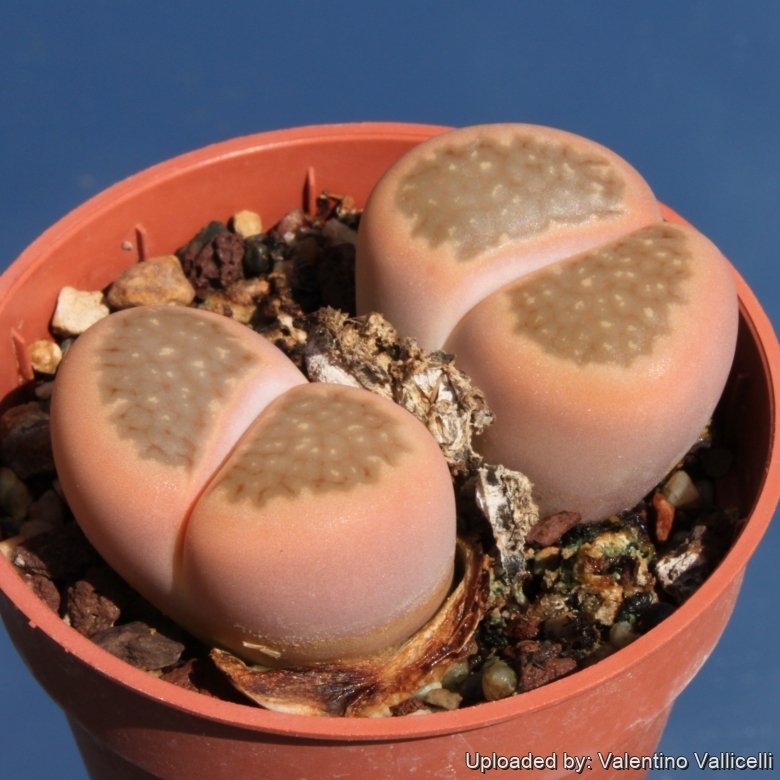
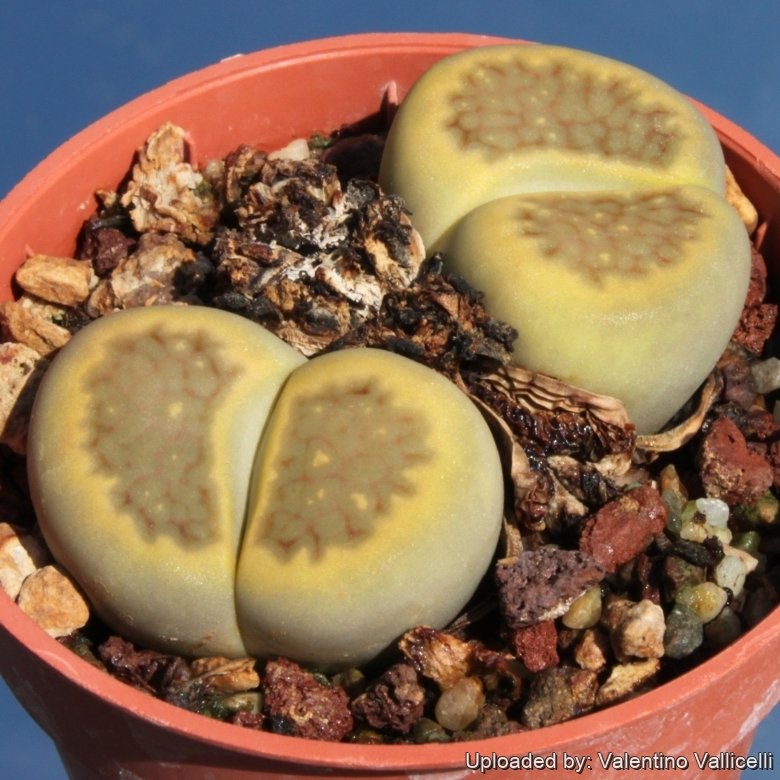
Bodies (paired leaves): Medium to large, 20-47 mmlong and 15-30 mm wide at the fissure. Broadly kidney shaped, top surface truncate, mostly flat, sometimes slightly convex; fissure shallow, 4-7 mm; lobes conjunct. Face somewhat reniform; lobes equal-unequal; opaque, slightly rugose. This species is fairly easy to identify and shows shades of reddish-brown with regular fine to broad interlacing network of channels with mostly small islands and fairly distinct irregularly dentate margins. It never has a brown line along the lip of the fissure. Shoulders as for the margins, or lighter, or milky bluish grey.
Flowers: The blooms are white 20-45 mm in diameter.
Blooming season: Autumn.
Fruits: (5-)6(-7)-loculed capsules up to 6-10 mm long 4-6,5 mm wide, boat-shaped, top flat to slightly convex. Face narrowly elliptic.
Seeds: Light yellow-brown to yellow-brown, smooth to rugose.
Remarks: After flowering in the autumn and extending through winter season the plant doesn’t need watering, but they will still be growing, the new bodies will be increasing in size extracting water from the outer succulent leaves, allowing them to shrivel away. In fact the plant in this time extracts water and nutrient stored in the outer succulent leaves, allowing them to dehydrate relocating the water to the rest of the plant and to the new leaves that form during this period until the old leaves are reduced to nothing more than “thin papery shells”.
Origin and Habitat
25 km South-East of Prieska, South Africa.
Cultivation and Propagation
The Lithops (a.k.a. Living Stones) are some of the world’s most fascinating plants and are sought by the collector of succulent plants. Being small plants, a representative collection can be grown on a patio table, a sunny windowsill or a shelf in the greenhouse.
Soil: They grow best in an open mineral, sandy-gritty soil and requires good drainage as they are prone to root rot. They can grow outdoor in sunny, dry, rock crevices (protection against winter wet is required) They can also be cultivated in alpine house, in poor, drained soil.
Repotting: They may stay in the same pot for many years. Plants grown in larger containers have frequently relatively poor flowers. Flowers might improve when the plants are given their own, small individual pots.
Watering They Require little water otherwise the epidermis breaks (resulting in unsightly scars). The basic cultivation routine is: Stop watering after flowering. Start watering after the old leaves are completely dry (usually late March or Early April). Water freely during the growing season, soak the compost fully but allow it to dry out between waterings. In the winter season the plant doesn’t need watering, the plant in this time extracts water from the outer succulent leaves, allowing them to shrivel away, relocating water to the rest of the plant and to the new leaves that form during this period. If grown in a container, bottom watering by immersing the container is recommended. Water sparingly only when warm, no water when cold. Nearly all problems occur as a result of overwatering and poor ventilation, especially when weather conditions are dull and cool or very humid. They must have very dry atmosphere.
Fertilization: Feed them once during the growing season with a fertilizer specifically formulated for cactus and succulents (high potash fertilizer with a dilute low nitrogen), including all micro nutrients and trace elements diluted to ½ the strength recommended on the label. They thrive in poor soils and need a limited supplies of fertilizer to avoid the plants developing excess vegetation, which is easily attacked by fungal diseases. Some growers fertilize frequently, some hardly ever. However, for the highly succulent mesembs, (Lithops, Conophytums etc.) fertilization is not really necessary.
Light: They prefer a very bright situation and in winter they need the maximum amount of light you are able to give them, but keep more cool and partially shaded in summer.
Hardiness: They require a minimum temperature 5°C (But will take a light frost and are hardy down to -7° C for short periods if they are in dry soil). USDA zones 9A – 11.
Uses: Container, rock garden.
Pests and diseases: They are vulnerable to mealybugs and rarely scale.
Remarks: After flowering in the autumn and extending through winter season the plant doesn’t need watering, but they will still be growing, the new bodies will be increasing in size extracting water from the outer succulent leaves, allowing them to shrivel away. In fact the plant in this time extracts water and nutrient stored in the outer succulent leaves, allowing them to dehydrate relocating the water to the rest of the plant and to the new leaves that form during this period until the old leaves are reduced to nothing more than “thin papery shells”.
Propagation: Seed or (or rarely) cuttings. The small seeds can be sown in pots of fine, well-drained sand, any time during the spring and summer months when temperatures are warm. Cover the seeds with a very fine layer of grit and water from below with a fungicide to prevent damping off. For the first 3-4 days cover the pots with a sheet of glass/clear perspex to keep the humidity levels high. Remove the glass and replace it with light shadecloth and mist once or twice a day for the next two weeks after which most seeds should have germinated. From then on mistings can be reduced to every second and then every third day as the little plants grow. Take the cuttings from a grown-up mother plant. Each cutting must contain one or more heads along with a fraction of root and permit them to dry out a couple of days, lay the cuttings on the soil and insert the stem end partially into the soil. Try to keep the cutting somewhat upright so that the roots are able to grow downward. It is relatively difficult to root Lithops from cuttings and generally pointless as well, so quick are they from seed.
Bibliography
Major refences and further lectures
-
Heidrun E. K. Hartmann “Aizoaceae F – Z” Springer 2002
-
Achim Hecktheuer “Mesembs, mehr als nur Lithops” Books on Demand GmbH Norderstedt. 2008
-
Desmond T. Cole & Naureen A. Cole, Uwe Beyer, Yves Delange “Les Lithops” SUCCULENTES Spécial 2008 AIAPS (now Terra seca). 2008
-
Desmond T. Cole & Naureen A. Cole “LITHOPS Flowering Stones” Cactus & Co. Libri. 2005
-
Yasuhiko Shimada “The Genus Lithops” Dobun Shoin. 2001
-
Rudolf Heine “Lithops - Lebende Steine” Neumann Verlag. 1986
-
Bernd Schlösser “Lithops – Lebende Steine” Praktische Anleitung für die Zimmerkultur. BussinessPoint MEDIA. 2000
-
Steven A. Hammer “Lithops – Treasures of the veld” British Cactus and Succulent Society. 1999
-
Desmond T. Cole “Lithops – Flowering Stones” Acorn Books 1988
-
Rudolf Heine “Lithops – lebende Steine” Neumann Verlag. 1986
-
David L. Sprechman “Lithops” Associated University Presses, Inc. 1970
-
Gert Cornelius Nel “Lithops” Hortors Limited, South Africa 1946
-
Edgar Lamb “The illustrated reference on cacti and other succulents” Blandford Press. 1978
-
Christopher Brickell, Royal Horticultural Society “RHS A-Z Encyclopedia of Garden Plants: K-Z., Volume 2” Kindersley, 2008
-
G. C . Nel “Lithops: Plantae succulantae, rarissimae, in terra obscuratae, e famailia Aizoaceae, ex Africa australi” Hortors Limited, Cape Town, South Africa 1946
-
Heidrun E. K. Hartmann “Illustrated Handbook of Succulent Plants: Aizoaceae F-Z” Springer, 2002
-
Steven A. Hammer “Lithops: Joyaux du veld” Editions Quae, 25/nov/2010