Description
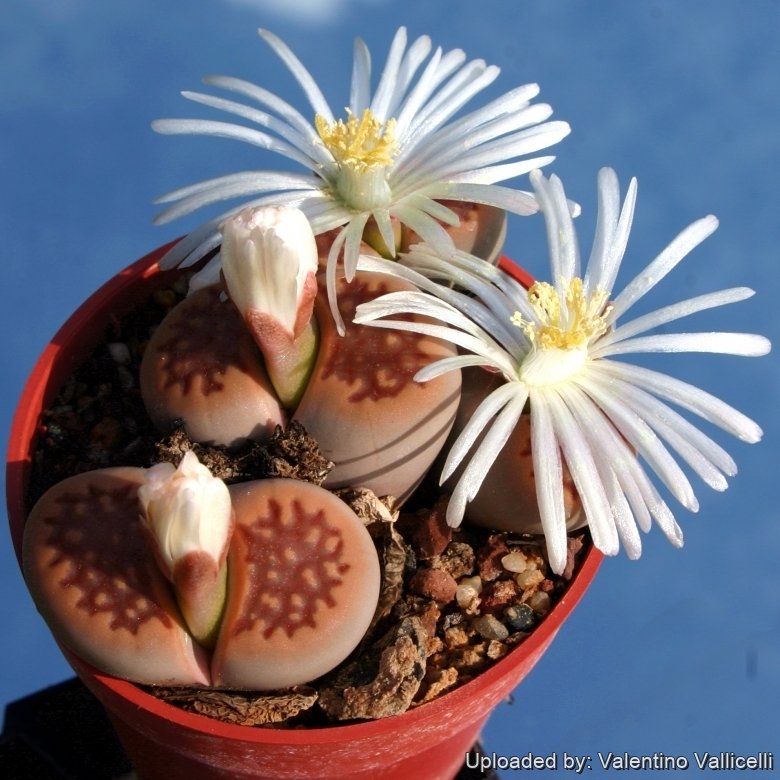
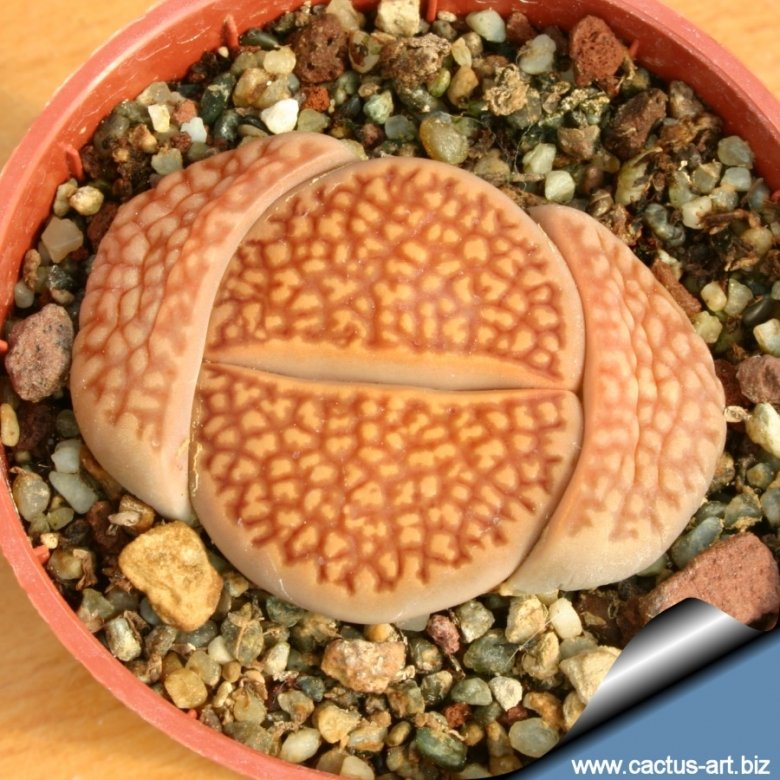
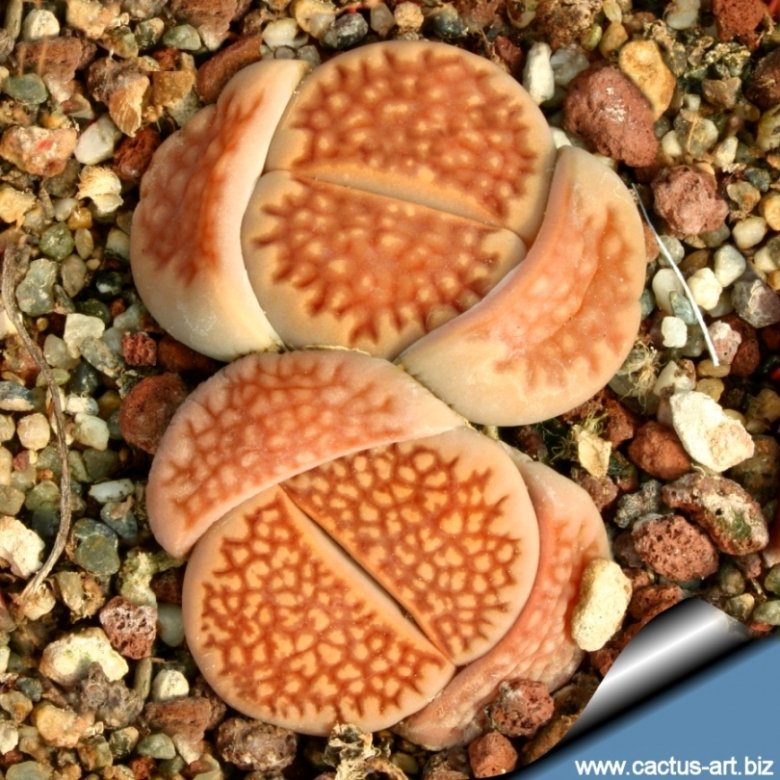
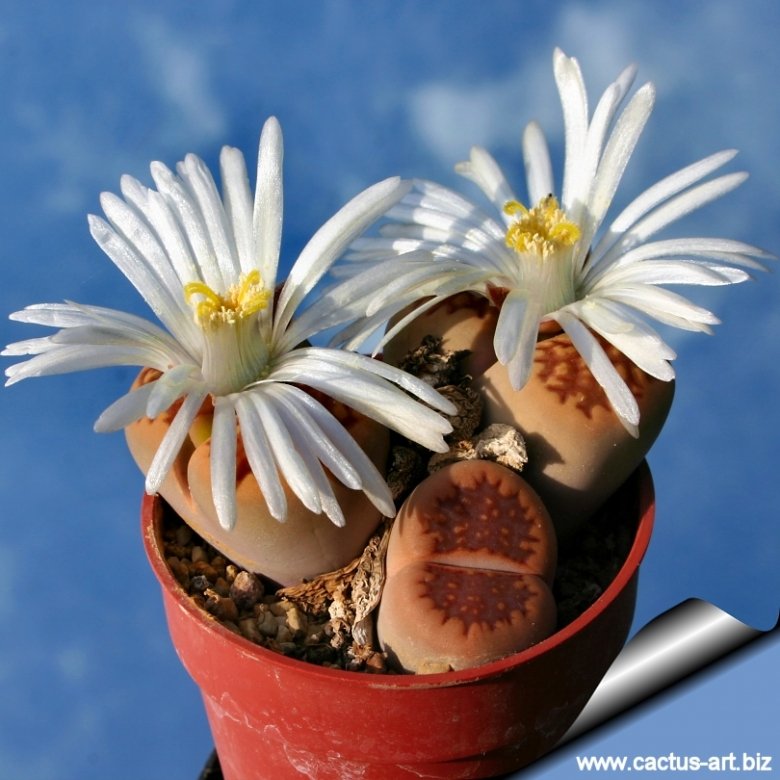
Lithops hallii var. ochracea is a very pretty distinct variety of the variable Lithops hallii and is quite variable too. The names comes from the Latin for “ochre-coloured” (reddish) for its more red-brown, opaque colouration and is distinguished from the type plant by markings on the windows.
Habit: It forms small clumps with usually 2-3 heads, but occasionally with up 6 or more heads.
Bodies (paired leaves): Medium to large, profile one-shaped, or obconic, truncate, diameter of the face about 20-30 mm. Broadly kidney shaped, top surface truncate, mostly flat, sometimes slightly convex; fissure shallow, 4-7 mm; lobes conjunct. Face flush somewhat reniform; lobes equal-unequal; opaque, slightly rugose. Margins distinct regular to somewhat dentate sometimes with a few peninsulas. This species is fairly easy to identify and shows shades of reddish-brown with regular fine to broad interlacing network of blood-red or brown channels with few or many mostly small islands with scattered dots, dashes and hooks, occasionally with some longer lines forming a broken network and fairly distinct irregularly dentate margins. Windows and channels greenish, red-brown, reddish blue, orange-brown, or brownish grey. Shoulders as for the margins, or lighter, or milky, beige, orange or brownish grey. Rubrications bright to dull blood-red or orange-red.
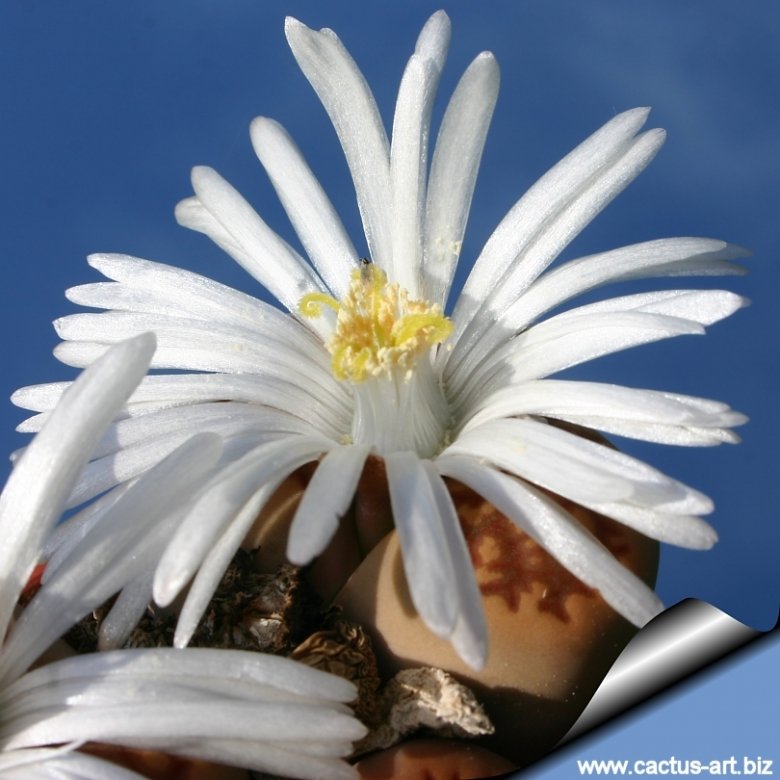
Flowers: The blooms are white, medium to very large, (20-)25-35(-45) mm in diameter.
Blooming season: Autumn.
Fruits: (5-)6(-7)-chambered capsules up to 6-10 mm long 4-6,5 mm wide, boat-shaped, top flat to slightly convex. Face narrowly elliptic about 8 x 6 mm broad.
Seeds: Light yellow-brown to yellow-brown, smooth and flecked.
Remarks: After flowering in the autumn and extending through winter season the plant doesn’t need watering, but they will still be growing, the new bodies will be increasing in size extracting water from the outer succulent leaves, allowing them to shrivel away. In fact the plant in this time extracts water and nutrient stored in the outer succulent leaves, allowing them to dehydrate relocating the water to the rest of the plant and to the new leaves that form during this period until the old leaves are reduced to nothing more than “thin papery shells”.
Origin and Habitat
Repubblic of South Africa, Cape province. Type Locality Near Upington, on a low ridge, in quartz (C059).
Habitat: L. halli v. ochracea grows on a stony soil comprising pegmatite, quartzite, calcrete, jaspillite and quartzs feldspar. Colours of the backgrounds grey-white, white, pink with some red, brown and black.
Cultivation and Propagation
They need an open mineral, fast draining mix and the maximum amount of light you are able to give them.
The basic cultivation routine is: Stop watering after flowering. Start watering after the old leaves completely dry. (Usually late March or Early April) Water freely during the growing season, soak the compost fully but allow it to dry out between waterings, no water when cold. Some growers fertilize frequently, some hardly ever. Keep them dry during the winter. Nearly all problems occur as a result of overwatering and poor ventilation especially when weather conditions are dull and cool or very humid. This plant is best for a well lit area (Bright shade to full sun). But don’t be afraid even the best growers have plants that mysteriously dry up, or leave during the night.
Notes
Improvement of lithops characteristics: Some growers (but not all!!) think it is very intriguing to reinforce any characteristic of cultivated Lithops of by crossing two similar selected plants and then back-crossing with the mother plant. This way we can eventually get some interesting results. Of course, many of the nicest Lithops we grow in cultivation have already been selected over time. However many Lithops are already nice plants which can’t really be improved, on the other hand one could try to improve the colour or the markings etc. Now if we have two particular plants we may attempt to breed between them and can maybe get a whole improved population and then select some better offspring to continue the selection.
Bibliography
Major refences and further lectures
-
Heidrun E. K. Hartmann (2002) “Aizoaceae F – Z” Springer
-
Achim Hecktheuer (2008) “Mesembs, mehr als nur Lithops” Books on Demand GmbH Norderstedt. ISBN-13 978-3-8370-1724-3
-
Desmond T. Cole & Naureen A. Cole, Uwe Beyer, Yves Delange (2008) “Les Lithops” SUCCULENTES Spécial 2008 AIAPS (now Terra seca). ISSN 0258-5359
-
Desmond T. Cole & Naureen A. Cole (2005) “LITHOPS Flowering Stones” Cactus & Co. Libri. ISBN 88-900511-7-5 ISBN-13 978-88-900511-7-3
-
Yasuhiko Shimada (2001) “The Genus Lithops” Dobun Shoin. ISBN 4-8103-4066-X
-
Rudolf Heine (1986) “Lithops - Lebende Steine” Neumann Verlag. ISBN 3-7402-0000-6; ISBN-13 978-3-7402-0000-8
-
Bernd Schlösser (2000) “Lithops – Lebende Steine” Praktische Anleitung für die Zimmerkultur. BussinessPoint MEDIA. ISBN 3-934945-01-5; ISBN-13 978-3-934945-01-2
-
Steven A. Hammer (1999) “Lithops – Treasures of the veld” British Cactus and Succulent Society. ISBN 0-902-099-64-7; ISBN-13 978-0-902099-64-7
-
Desmond T. Cole (1988) “Lithops – Flowering Stones” Acorn Books CC. ISBN 0-620-09678-0; ISBN-13 978-0-620-09678-2
-
Rudolf Heine (1986) “Lithops – lebende Steine” Neumann Verlag. ISBN 3-7402-0000-6; ISBN-13 978-3-7402-0000-8
-
David L. Sprechman (1970) “Lithops” Associated University Presses, Inc. SBN 8386-6902-6
-
Gert Cornelius Nel (1946) “Lithops” Hortors Limited, South Africa
Gallery