Description
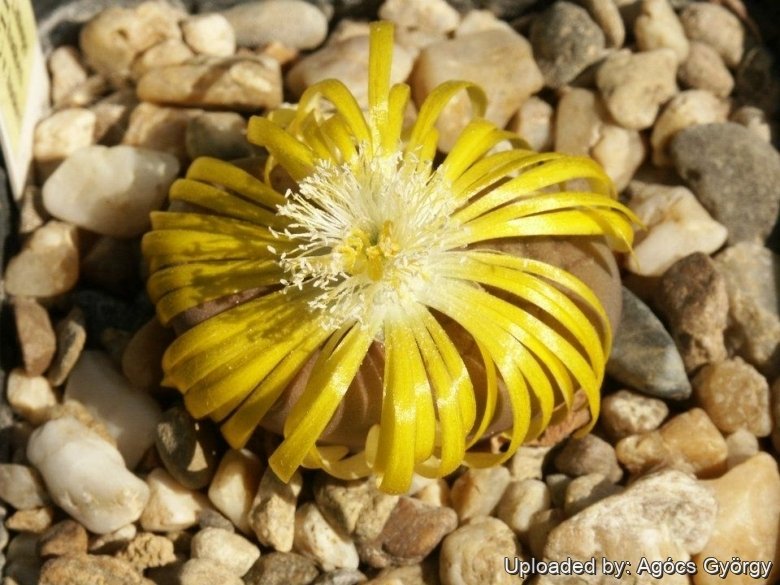
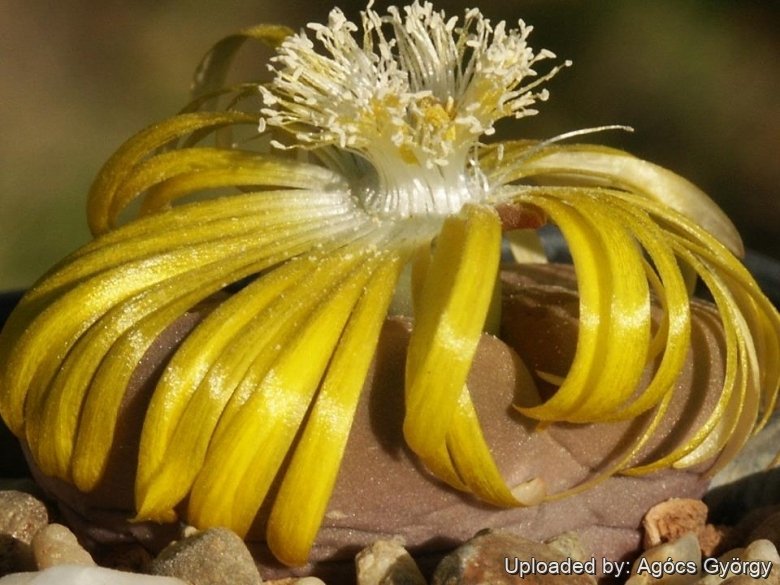
Lithops hookeri is a medium to very large species, up to 46 X 35 mm, usually about 30 X 23 mm. with up to 10 or more heads (mostly 2-4)
Bodies (paired leaves): Obconical, truncate, top surface flat to slightly convex. The face is elliptical more or less equal. The fissure is shallow 3-7 mm, the lobes are conjunct. This species is characterized by an obscure network of simple and forked groves and lines, and numerous irregular small island enclosed by groves. Margins are irregularly incise with narrow lines tapering out of the grows. This species is quite variable and the colours and face pattern varies considerably in plant from different provenance. L. hookeri comprises several more or less intergrading and distinct varieties.
Desmond Cole field number C110: This population distinguishes for having deep dark red jagged lines.
Origin and Habitat
50 km NW of Marydale, South Africa.
Habitat: Lithops hookeri grows on different kind of stony ground comprising translucent quartzite; amygdaloidal lava; amygdaloidal lava with some sandstone; sheared micaceous quartzite. Colours grey-white, brown, pink, grey, some white, red.
Cultivation and Propagation
They need an open mineral, fast draining mix and the maximum amount of light you are able to give them.
The basic cultivation routine is: Stop watering after flowering. Start watering after the old leaves completely dry. (Usually late March or Early April) Water freely during the growing season, soak the compost fully but allow it to dry out between waterings. Some growers fertilize frequently, some hardly ever. Keep them dry during the winter. Nearly all problems occur as a result of overwatering and poor ventilation especially when weather conditions are dull and cool or very humid.
Bibliography
Major refences and further lectures
-
Heidrun E. K. Hartmann “Aizoaceae F – Z” Springer 2002
-
Achim Hecktheuer “Mesembs, mehr als nur Lithops” Books on Demand GmbH Norderstedt. 2008
-
Desmond T. Cole & Naureen A. Cole, Uwe Beyer, Yves Delange “Les Lithops” SUCCULENTES Spécial 2008 AIAPS (now Terra seca). 2008
-
Desmond T. Cole & Naureen A. Cole “LITHOPS Flowering Stones” Cactus & Co. Libri. 2005
-
Yasuhiko Shimada “The Genus Lithops” Dobun Shoin. 2001
-
Rudolf Heine “Lithops - Lebende Steine” Neumann Verlag. 1986
-
Bernd Schlösser “Lithops – Lebende Steine” Praktische Anleitung für die Zimmerkultur. BussinessPoint MEDIA. 2000
-
Steven A. Hammer “Lithops – Treasures of the veld” British Cactus and Succulent Society. 1999
-
Desmond T. Cole “Lithops – Flowering Stones” Acorn Books 1988
-
Rudolf Heine “Lithops – lebende Steine” Neumann Verlag. 1986
-
David L. Sprechman “Lithops” Associated University Presses, Inc. 1970
-
Gert Cornelius Nel “Lithops” Hortors Limited, South Africa 1946
-
Edgar Lamb “The illustrated reference on cacti and other succulents” Blandford Press. 1978
-
Christopher Brickell, Royal Horticultural Society “RHS A-Z Encyclopedia of Garden Plants: K-Z., Volume 2” Kindersley, 2008
-
G. C . Nel “Lithops: Plantae succulantae, rarissimae, in terra obscuratae, e famailia Aizoaceae, ex Africa australi” Hortors Limited, Cape Town, South Africa 1946
-
Heidrun E. K. Hartmann “Illustrated Handbook of Succulent Plants: Aizoaceae F-Z” Springer, 2002
-
Steven A. Hammer “Lithops: Joyaux du veld” Editions Quae, 25/nov/2010